...
Spot Bitcoin ETFs opened Bitcoin to traditional financial infrastructure, but ETF inflows do not automatically represent outright institutional buying. Some of that flow reflects long-term portfolio allocation. A meaningful share of it reflects market-neutral arbitrage that has almost nothing to do with anyone’s view on Bitcoin’s price. I built this report to separate the two, because I think most of what gets published about ETF flows treats every dollar the same way, and that’s a mistake that leads investors to draw exactly the wrong conclusion from a headline number.Era analyzes who’s actually buying Bitcoin ETFs, not just how much flowed in. The report decomposes directional investment from institutional arbitrage. It reads ETF flows alongside CME futures positioning, the futures basis, and the kind of institutional holding behavior that separates a position that’s here for a cycle from one that’s here for a spread.
Understand who’s behind ETF flows. I separate hedge-fund arbitrage from wealth-management capital and longer-duration allocators, because they behave completely differently under stress.
Interpret inflows correctly. Billions in Bitcoin ETF inflows do not necessarily translate into billions of net bullish exposure: a real share of that flow is fully hedged.
Track structural adoption. I identify whether Bitcoin ETFs are becoming a permanent line item in traditional portfolios or remaining a tactical trading instrument that disappears the moment the trade stops paying.
Explore crypto research · Preview the key findings ↓
Executive Summary
Spot Bitcoin ETFs have materially changed how traditional investors access Bitcoin since their January 2024 launch. But total ETF inflows should never be read as one undifferentiated category of demand. I separate flows into distinct buyer types: institutional cash-and-carry arbitrage on one side, and longer-duration wealth and retirement-oriented capital on the other.
A hedge fund can buy spot ETF shares while simultaneously shorting CME Bitcoin futures against the same position, generating a large headline ETF inflow while taking on almost no net directional Bitcoin exposure at all. RIAs, family offices, and retirement-oriented accounts represent a genuinely different form of demand, because those positions tend to get built into recurring, periodically rebalanced portfolio allocations rather than closed the moment a spread compresses.
Understanding Bitcoin ETF adoption properly requires looking past the headline flow number toward futures positioning, the basis, holding persistence, and actual portfolio integration. This report treats ETF flows as a market-structure phenomenon, not as a single scoreboard of bullish conviction.
Key Takeaways
- Bitcoin ETF flows are not synonymous with directional Bitcoin demand: a real share of gross inflow is fully hedged.
- Cash-and-carry arbitrage can produce large spot ETF purchases paired with an offsetting CME futures short, netting out to close to zero directional exposure.
- Hedge funds and wealth-management investors need to be analyzed as separate buyer categories, not lumped into one “institutional” bucket.
- RIAs, family offices, and retirement accounts may represent more structurally important capital than the largest visible hedge-fund position, because they’re stickier.
- CME futures open interest and basis data are essential context for interpreting any spot ETF flow number in isolation.
- Persistent allocation over multiple quarters matters more than any single week of record inflows.
- Bitcoin ETF adoption should be measured through capital flows and portfolio integration together, not flows alone.
Bitcoin ETF Flow Dashboard
Last updated: August 20, 2026
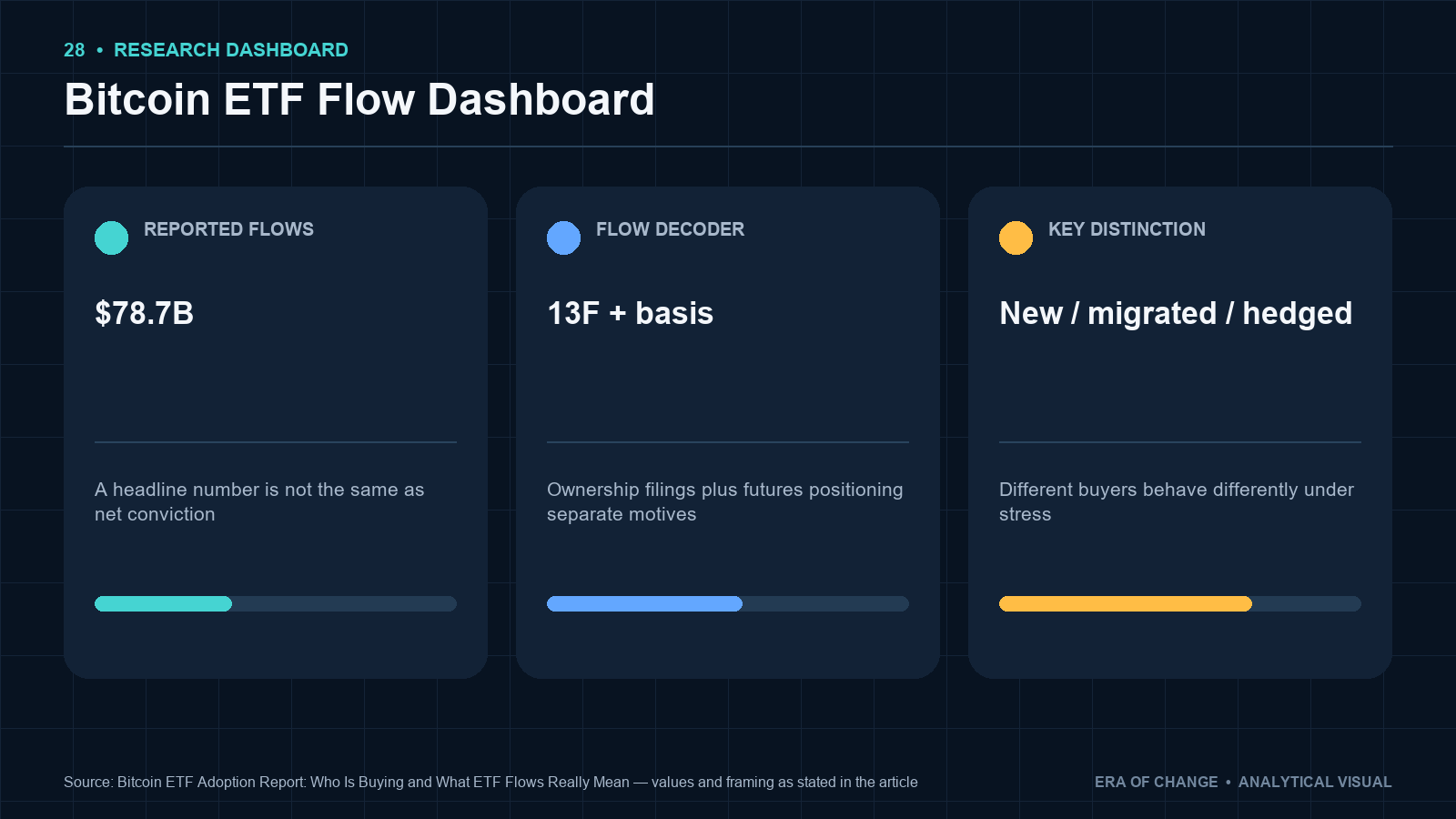
US spot Bitcoin ETFs recorded a net inflow of $517.2 million on August 19, 2026, the largest single-day figure in three and a half months and the third consecutive day of inflows, with BlackRock’s IBIT alone capturing $284.7 million of that total. That single day capped a broader streak: weekly inflows topped $750 million running from August 3 through the following Friday without a single down day. Total combined assets across US spot Bitcoin ETFs currently sit at roughly $78.7 billion, representing approximately 1,225,031 BTC held across the category, with IBIT alone holding the largest share.
The dashboard number worth sitting with, though, is the one that doesn’t make as many headlines: US spot Bitcoin ETFs recorded $5.4 billion in net outflows over the first half of 2026, the first negative half-year for the category since it launched in January 2024. August’s inflow streak is real, and it’s the strongest run since May. It followed a genuinely rough first six months.
ETF flow data alone does not indicate whether the buyer behind it is directionally long Bitcoin. Era interprets these figures alongside CME futures positioning and basis data specifically, because the headline flow number and the actual bullish exposure it represents are frequently two different numbers entirely, which is the entire subject of this report.
What Is a Spot Bitcoin ETF?
A spot Bitcoin ETF gives investors exposure to Bitcoin through a conventional exchange-traded fund structure, while the underlying Bitcoin itself is held through institutional custody arrangements on the fund’s behalf. That structure brings real practical advantages: it works through existing brokerage accounts, uses a fund structure investors and advisers already understand, relies on institutional-grade custody rather than the investor’s own wallet security, produces standard portfolio reporting, and integrates far more easily into a compliance process than direct Bitcoin ownership does. Worth being direct about one thing, though: ETF ownership is not the same as self-custody of Bitcoin. The investor holds a claim on a fund, not a private key.
Why Bitcoin ETFs Changed Institutional Adoption
Before spot ETFs existed, an institution considering Bitcoin exposure had to solve for direct custody, wallet infrastructure, internal compliance sign-off, counterparty selection among unfamiliar exchanges, exchange-specific risk, and operational security, a genuinely large lift for a first position in a new asset class.
ETF infrastructure lets that same exposure sit inside brokerage systems, wealth platforms, adviser portfolios, investment-committee frameworks, existing risk-management processes, and standard performance reporting, all without reinventing any of it. The real significance of the ETF isn’t only the incremental demand it generated; it’s the normalization of Bitcoin inside financial infrastructure that already existed and already had institutional trust behind it. For the broader adoption picture this fits into, see Era’s Institutional Crypto Adoption Trends.
Who Is Buying Bitcoin ETFs?
“Institutions are buying” isn’t a useful sentence on its own, because the motivations behind different buyer categories are frequently opposite each other.
Hedge Funds and Cash-and-Carry Arbitrage
Multi-strategy hedge funds disclose meaningful Bitcoin ETF positions through 13F filings, and some of the largest are running exactly this kind of arbitrage rather than an outright directional bet. Millennium Management disclosed roughly $1.9 billion in combined spot Bitcoin ETF holdings: $844.2 million in BlackRock’s IBIT, $806.7 million in Fidelity’s FBTC, $202 million in Grayscale’s GBTC, and smaller positions in ARKB and BITB.
Schonfeld Strategic Advisors disclosed a combined $479 million across IBIT and FBTC, a position that was later trimmed by roughly 20% to about $384 million. Point72 has also disclosed spot Bitcoin ETF holdings in the same filings. None of these disclosures on their own confirm that a given position is hedged (that requires cross-referencing CME futures positioning, which this report does), but the scale and multi-fund pattern is consistent with sophisticated relative-value activity rather than simple buy-and-hold conviction.
The mechanics: a fund buys Bitcoin ETF shares and simultaneously sells CME Bitcoin futures against that same position, substantially reducing its net directional exposure to Bitcoin’s price while capturing the spread between the futures price and the spot price instead. This is cash-and-carry arbitrage, and the key insight is uncomfortable for anyone reading 13F filings at face value: a fund can appear among the largest institutional holders of a Bitcoin ETF while remaining largely neutral on which direction Bitcoin actually moves.
Why Cash-and-Carry Changes the Meaning of ETF Inflows
The headline interpretation treats a billion dollars of ETF inflow as a billion dollars of bullish institutional demand. The more accurate interpretation is that some real portion of that billion is a long ETF position paired with a short CME futures position, a market-neutral basis trade dressed up in the flow data as directional buying.
That reframes the analytical questions that actually matter: what happened to CME open interest over the same period, did short futures positioning rise in step with the ETF inflow, what was the annualized basis available to capture, and did the resulting holdings persist or reverse quickly once the spread compressed. Gross ETF demand and net directional Bitcoin exposure are not the same thing, and treating them as interchangeable is the single most common misreading of this data in mainstream coverage.
What Is the Bitcoin Futures Basis?
The basis is, broadly, the difference between the CME Bitcoin futures price and the spot price. When futures trade meaningfully above spot, arbitrageurs have an incentive to buy spot or ETF exposure and sell futures against it, capturing that premium as the two prices converge toward expiry.
As of early August 2026, CME Bitcoin futures carry stood at roughly 5.7% to 7.9% annualized, above the roughly 4.2% yield available on Treasuries at the time, a spread wide enough to draw real arbitrage capital into the trade, since the strategy is competing directly against the risk-free rate for that capital’s attention.
Real profitability depends on more than the headline spread, though: financing costs, exchange and clearing fees, margin requirements, execution quality, how closely the ETF tracks spot Bitcoin, the specific futures contract’s time to expiry, and general operational costs all eat into the gross number before it becomes realized return.
RIAs and Wealth Management Capital
This is potentially the more structurally significant buyer category, even though it rarely produces the size of position that makes a 13F filing headline. Bitcoin held through an RIA or wealth-management relationship can become part of a formal asset-allocation framework, get rebalanced on a periodic schedule rather than reactively, get held across a full market cycle rather than exited at the first sign of stress, and get incorporated directly into client model portfolios as a standing allocation.
I’d put the type of strategic allocation showing up among wealth-oriented investors in the range of roughly 1% to 3% of a portfolio, consistent with what’s actually observable in the market: BlackRock’s own alternatives-focused model portfolios allocate 1-2% to its own IBIT product, and VanEck has publicly stated it favors a disciplined 1-3% Bitcoin allocation built through dollar-cost averaging rather than a single lump-sum purchase.
I want to be precise that this is the range showing up among the wealth managers taking a position at all, not an industry-wide standard; Edelman Financial Engines, one of the larger RIA platforms, discloses a Bitcoin ETF allocation that works out to roughly 0.01% of total AUM, and most advisers still treat digital assets as a small satellite position rather than a core sleeve of any real size.
Why a 1-3% Allocation Can Matter More Than a Large Hedge Fund Position
Worth stating directly because it cuts against how most flow coverage gets read. A $2 billion arbitrage position, however large it looks in a 13F filing, is frequently hedged, opportunistic, sensitive to the basis staying attractive, and removed entirely the moment that spread compresses. Schonfeld’s roughly 20% trim referenced above is a live example of exactly that kind of adjustment.
A much larger number of smaller 1-3% wealth allocations, by contrast, tend to be strategic rather than opportunistic, considerably stickier through a drawdown, and maintained across years rather than weeks as part of a standing policy rather than a live trading decision. The largest visible buyer in any given filing is not necessarily the most important buyer for long-term structural adoption: that’s frequently the buyer you don’t see making headlines at all.
Family Offices
Family offices allocate to Bitcoin through a different lens than either hedge funds or traditional RIAs: often through an alternative-assets mandate, a genuinely multi-generational time horizon, an explicit inflation or currency-diversification rationale, direct interest in the underlying technology, and a generally higher tolerance for a nontraditional asset than a standard advisory client base carries.
The right questions to ask about any specific family office position are whether the allocation is strategic or opportunistic, whether it’s actually maintained through a drawdown rather than only referenced in good markets, whether Bitcoin is treated distinctly from more speculative crypto exposure in the same portfolio, and whether the office uses ETF wrappers or direct custody for the position.
Public data on family-office crypto allocation specifically remains thin relative to disclosed 13F filings, and any quantification here should lean on verifiable disclosures rather than survey-based estimates.
Retirement and Long-Duration Capital
Retirement-oriented capital, inside 401(k) platforms and similar vehicles now beginning to offer Bitcoin ETF access, tends to carry a genuinely long investment horizon, recurring contribution schedules rather than one-time purchases, formal rebalancing policies, and structurally lower turnover than almost any other buyer category discussed in this report. That combination of characteristics is exactly what makes this category worth watching closely even though current participation remains limited and shouldn’t be overstated as widespread pension adoption based on current evidence. See Era’s Institutional Crypto Adoption Trends for the broader institutional picture this fits inside.
Retail Migration and Cannibalization
A genuinely important question this report doesn’t claim to fully resolve: how much ETF demand represents new capital entering Bitcoin for the first time, and how much represents investors simply moving exposure they already held somewhere else. The channels worth investigating include direct Bitcoin holdings converting into ETF shares for custody and tax-reporting convenience, capital moving out of older, higher-fee crypto trusts into lower-cost spot ETFs, offshore investment products losing assets to newly available U.S.-listed ETFs, and crypto-native trading-platform balances migrating into standard brokerage accounts.
This distinction matters because asset migration is not the same thing as new capital entering Bitcoin: a dollar that moves from a Grayscale trust into IBIT shows up as an ETF inflow without representing a single new dollar of demand for the underlying asset. This is an area Era continues researching rather than one with a settled answer, and any specific buyer-share breakdown should be treated as provisional until verified against updated fund-flow and trust-redemption data.
New Demand vs. Migrated Demand vs. Arbitrage Capital
The most useful way to think about any given flow number is across three buckets rather than one. New strategic capital is money with no prior Bitcoin exposure entering through an ETF for the first time: genuine incremental demand. Migrated capital is money that already had Bitcoin-related exposure moving into the ETF wrapper specifically: a real adoption and infrastructure signal, but limited new net demand for the underlying asset. Arbitrage capital is the cash-and-carry flow described earlier: large gross inflow, low or near-zero directional exposure. A single ETF inflow headline collapses all three into one number. This framework is the difference between reading a flow figure and actually understanding what it represents.
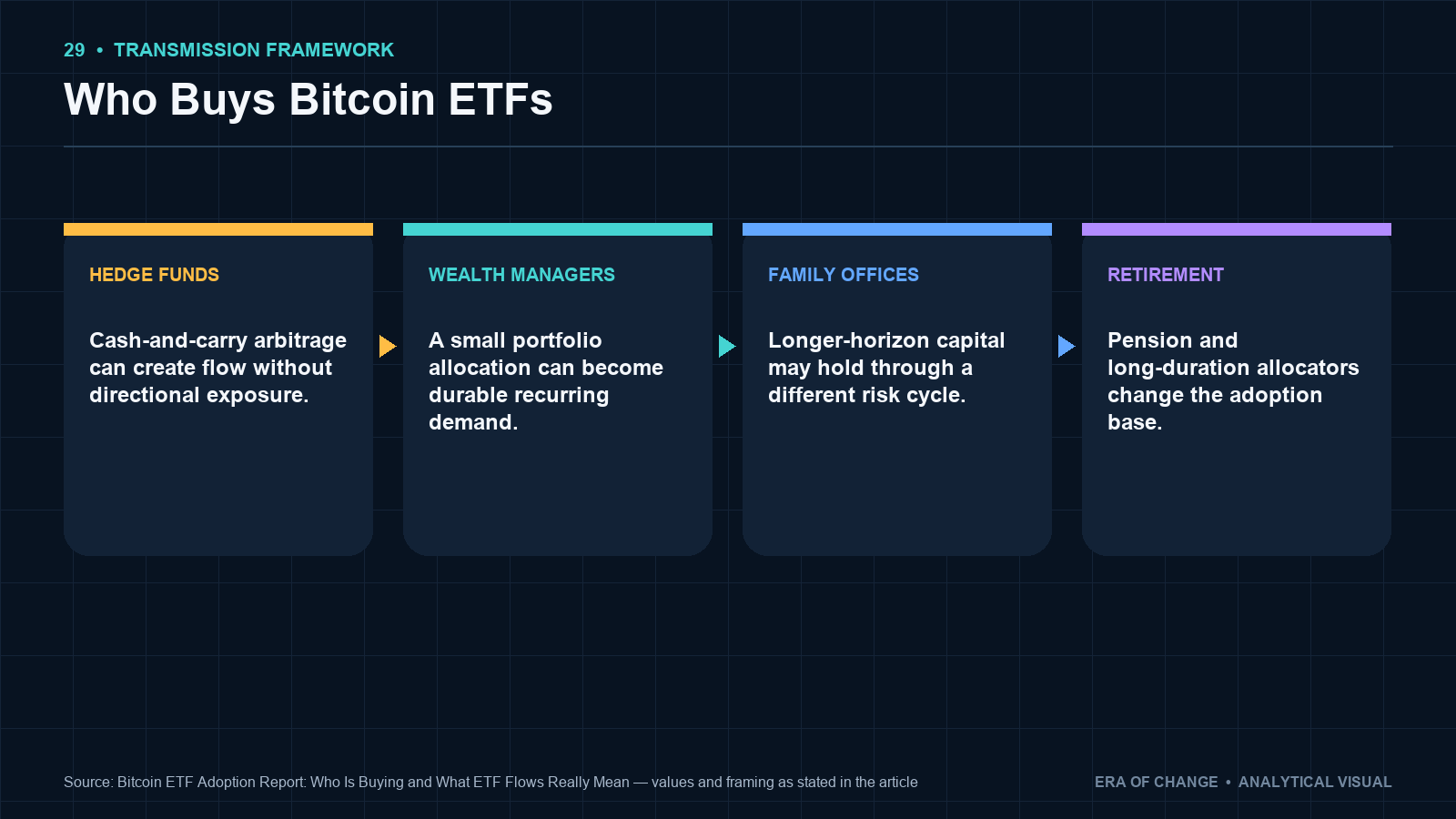
How Era Decomposes Bitcoin ETF Flows
Era reads several datasets together rather than any single one in isolation. ETF net flows show capital moving into or out of the funds themselves. CME open interest shows whether futures exposure is expanding or contracting alongside those flows. The CME futures basis indicates whether cash-and-carry economics are currently attractive enough to be pulling in arbitrage capital. Institutional 13F filings identify certain reporting managers’ holdings, with the reporting lag that comes with them.
Publicly observable custody data adds another layer where available. Bitcoin’s spot price helps separate price-led momentum from genuine allocation activity. And holding persistence (whether a disclosed position is retained across multiple filing periods or reversed quickly) is often the single most revealing variable of all.
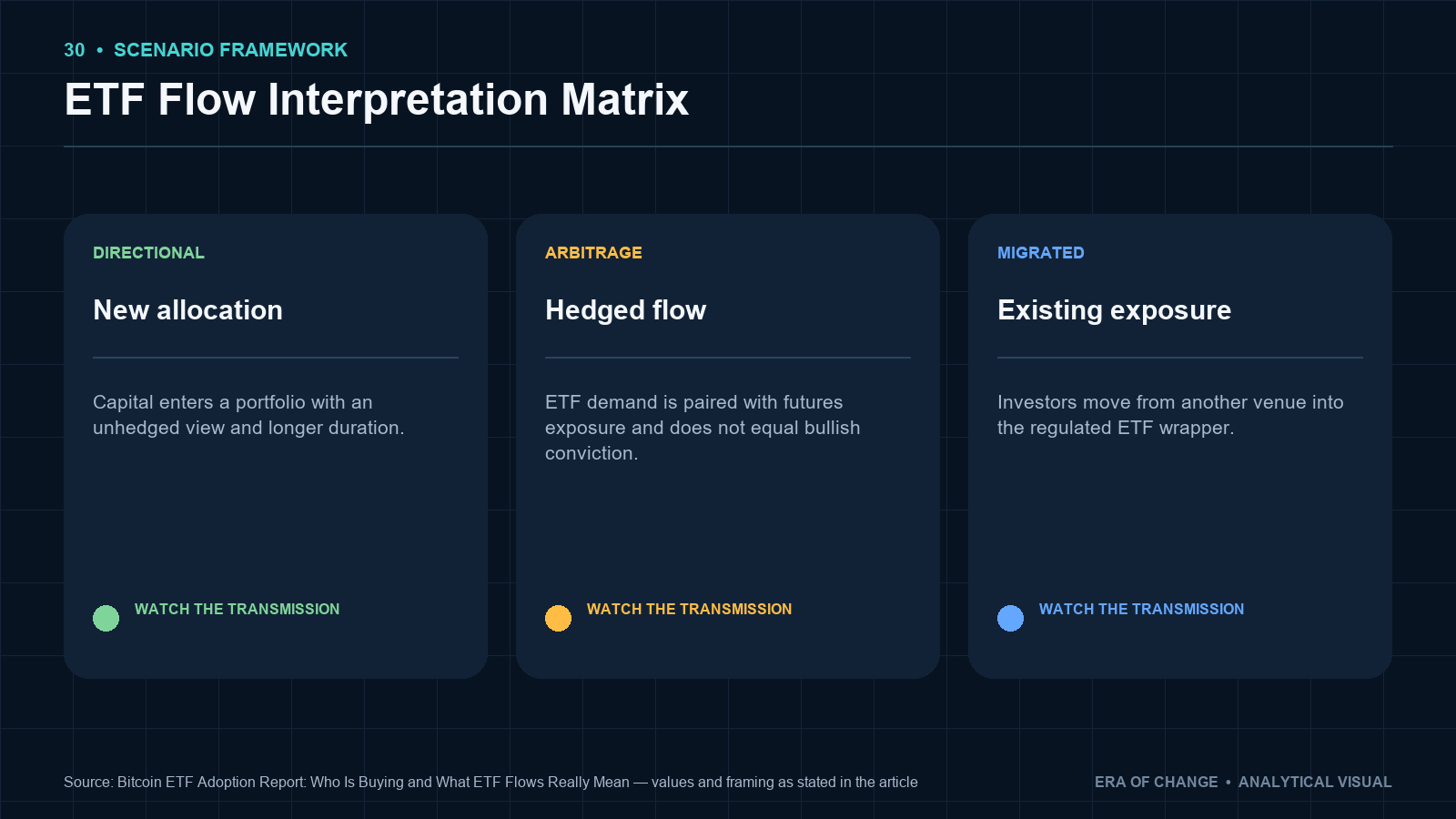
The ETF Flow Interpretation Matrix
| ETF Flows | CME Open Interest | Futures Basis | Possible Interpretation |
|---|---|---|---|
| Strong inflows | Sharp rise | Elevated | Cash-and-carry activity may be significant |
| Strong inflows | Stable | Moderate | More directional demand plausible |
| Strong inflows | Falling | Narrow | Potential outright allocation |
| Outflows | Falling | Compressing | Arbitrage unwind possible |
| Outflows | Stable | Normal | More likely directional selling |
This is an indicative framework for organizing analysis, not a mechanical trading signal: no single row should be read in isolation from the underlying data behind it.
Why 13F Filings Help, and Why They Are Not Enough
Institutional 13F filings can reveal disclosed positions held by reporting investment managers, which is genuinely useful for identifying hedge-fund, asset-manager, and adviser participation at a point in time: the Millennium and Schonfeld figures cited earlier in this report come directly from this kind of disclosure.
But the limitations are real: filings arrive with a reporting delay, they capture only a single quarter-end snapshot rather than continuous positioning, they don’t provide a complete picture of any offsetting hedge the manager may be running, futures positions are frequently reported through entirely separate regulatory channels, and the underlying position may have changed materially before the filing is even published.
The warning worth repeating plainly: seeing an institution holding a Bitcoin ETF in a 13F filing does not prove that institution has a net bullish Bitcoin position; Millennium’s and Schonfeld’s disclosed holdings are exactly the kind of data point that looks like conviction and may represent something closer to a hedged spread trade instead.
How to Distinguish Adoption From Trading Activity
Genuine structural adoption tends to show a position persisting across multiple quarters rather than one, an allocation surviving a real drawdown rather than exiting near the bottom, a growing number of wealth platforms approving Bitcoin access, rising adviser participation specifically, formal strategic-allocation policies emerging at the institutional level, expanding institutional custody infrastructure, and steady growth in long-duration investor categories over time. Primarily tactical activity, by contrast, tends to show ETF exposure tracking the basis opportunity closely, positions disappearing the moment the premium compresses, rapid turnover between filing periods, and futures shorts moving in step with ETF longs.
Bitcoin ETF Flows vs. Bitcoin Price
The relationship here isn’t simple causality in either direction, and it’s worth resisting the temptation to treat it that way. ETF inflows alongside a rising Bitcoin price could indicate genuine net demand pushing the price higher. ETF inflows alongside a flat Bitcoin price may indicate selling pressure from existing holders offsetting the inflow, arbitrage flow that isn’t directionally moving the market, or strong offsetting supply from another source entirely.
ETF outflows alongside a stable or rising Bitcoin price could indicate demand is showing up somewhere else in the market: offshore venues, direct spot purchases, or derivatives markets the ETF data doesn’t capture. ETF flows are an important component of Bitcoin demand. They are not the entire Bitcoin market, and treating them as a complete picture misses real activity happening outside the ETF wrapper. For more on how this fits the broader price cycle, see Era’s Bitcoin Cycles Explained.
Bitcoin ETF Adoption and the Four-Year Cycle
ETF and broader institutional flows may now carry more economic weight for Bitcoin’s price behavior than the daily reduction in new miner issuance ever did on its own. That reframes what actually needs watching in the modern cycle: ETF flows, global M2, interest-rate policy, institutional allocation behavior, and long-term-holder selling all matter more today than a simple halving-date-to-supply-reduction model captures by itself. The old framework isn’t wrong, exactly. It’s incomplete for a market this much more institutionally intermediated than it was during the first two halving cycles.
Does Institutional Adoption Reduce Bitcoin Volatility?
Potentially, over a long enough horizon, but this isn’t guaranteed, and it’s worth being honest about the mechanism cutting both ways. Institutional participation can bring deeper liquidity, more professional market-making, and genuine arbitrage efficiency that tightens pricing. But the same institutional participation can also produce larger synchronized reallocations when positioning shifts all at once, leveraged basis trades that unwind abruptly when the spread moves against them, forced deleveraging during a broader market stress event, and rising correlation with other risk assets that Bitcoin didn’t historically track as closely. The correct question isn’t whether institutions are “good” for volatility in the abstract; it’s empirical: does realized volatility structurally decline across complete macro cycles, not just in calm months. 2026 hasn’t yet provided a full answer either way.
What Would Prove Bitcoin ETF Adoption Is Structural?
Strong evidence would include ETF exposure persisting through a genuinely large Bitcoin drawdown rather than reversing near the bottom, adviser and wealth-platform allocations continuing to grow rather than plateauing, strategic holdings surviving a period of basis compression that removes the arbitrage incentive entirely, institutions rebalancing their positions rather than fully exiting when conditions turn, a growing number of platforms incorporating Bitcoin into standard allocation processes rather than treating it as a special-request exception, and long-duration investor categories (retirement accounts, family offices) gradually expanding their participation over multiple years.
What Would Challenge the Adoption Thesis?
Era’s falsification condition, established in our broader Institutional Crypto Adoption Trends research, applies directly here: sustained institutional ETF net outflows for more than six months while traditional risk assets like the S&P 500 and Nasdaq remain in a genuinely healthy bull market and global liquidity stays supportive. If equities are strong, liquidity is abundant, and risk appetite is healthy across the board, but institutions keep withdrawing from Bitcoin ETFs anyway, that combination would suggest crypto is behaving more like a temporary speculative product than a permanent strategic allocation.
The H1 2026 outflow period ($5.4 billion over six months) happened alongside genuine broader risk-off conditions tied to the year’s geopolitical shocks, not a standalone equity bull market, so it doesn’t yet meet this bar. August’s inflow reversal is a data point worth watching, not a settled conclusion either way.
Preview: Three Findings From the Full Report
Finding #1. ETF inflows should not automatically be read as bullish institutional buying. Cash-and-carry strategies, run by funds including Millennium and Schonfeld at real scale, can generate both spot ETF demand and an offsetting futures short in the same trade.
Finding #2. Long-duration wealth capital may matter more structurally than the largest hedge-fund position in any given 13F filing. A large arbitrage position is hedged and can unwind as the basis compresses. Smaller wealth allocations may be stickier, but E.R.A. OF CHANGES treats that as a hypothesis; the number of such holders and their holding periods are not established by the cited public data.
Finding #3. The real test of adoption happens during unfavorable conditions, not favorable ones. The question that actually matters is whether institutional allocations survive volatility and get rebalanced rather than abandoned, which is exactly what the six-month falsification window above is designed to catch.
Download the Bitcoin ETF Adoption Report
See What Bitcoin ETF Flows Are Actually Telling the Market
Headline flow numbers reveal how much money entered or left an ETF on a given day. They don’t explain who supplied that capital, whether the position was hedged, or whether it’s likely to still be there next quarter.
The full Era report combines spot ETF flows with institutional futures positioning, basis dynamics, disclosed 13F holdings data, and portfolio-adoption indicators to separate tactical trading activity from genuine structural Bitcoin adoption, including the complete buyer-type decomposition, CME open-interest and basis charts, the full Institutional Adoption Dashboard, detailed methodology, and Era’s outlook for the indicators worth watching next quarter.
Independent research · Data-driven methodology · No guaranteed-return claims · Unsubscribe anytime
Methodology
Era evaluates Bitcoin ETF adoption using official ETF flow and fund-disclosure data, CME futures data including open interest and basis, regulatory filings including 13F disclosures, publicly observable institutional holdings data, broader Bitcoin market-structure indicators, macro liquidity conditions, and publicly available custody information, read together rather than in isolation.
It’s worth disclosing the real limitations here directly rather than glossing over them, because I think that makes the report more useful, not less. Institutional filings are delayed by design and only capture a quarter-end snapshot. ETF holder identity isn’t visible in real time between filing periods. Spot holdings disclosed in a 13F don’t reveal any offsetting derivatives position held elsewhere.
Some flows genuinely can’t be reliably classified into the new-demand, migrated-demand, or arbitrage buckets with currently available public data. Custody structures can obscure true beneficial ownership. And ETF inflow data, on its own, cannot independently prove investor motive: that’s precisely why this report cross-references futures positioning and basis data rather than relying on flow figures alone.
Era Analyst’s Perspective
The number that should reframe how you read every ETF inflow headline is $1.9 billion: Millennium Management’s combined disclosed position across five different spot Bitcoin ETFs. Read at face value, that’s one of the largest institutional Bitcoin bets on record. Read against CME’s roughly 5.7% to 7.9% annualized futures basis in early August 2026, well above the risk-free rate available on Treasuries at the time, it looks a great deal more like a multi-strategy fund harvesting a spread than a directional call on Bitcoin’s price. I’m not saying Millennium’s position is fully hedged; I don’t have their futures book, and neither does anyone reading their 13F. What I’m saying is that the 13F alone cannot tell you which one it is, and most coverage treats it as settled the moment the filing hits a headline. The buyer I actually care about is smaller and less visible: the 1-3% allocation VanEck and BlackRock’s own model portfolios are building through dollar-cost averaging, because that capital doesn’t disappear the day the basis compresses. If Bitcoin ETF adoption is going to prove structural rather than cyclical, it’s going to be that quieter capital that proves it, not the next headline-grabbing hedge-fund filing.
Frequently Asked Questions
What is a Bitcoin ETF?
A Bitcoin ETF is an exchange-traded fund that gives investors price exposure to Bitcoin through a standard brokerage account, without requiring the investor to directly hold or manage the underlying asset themselves.
What is a spot Bitcoin ETF?
A spot Bitcoin ETF holds actual Bitcoin through institutional custody arrangements as its underlying asset, as distinct from a futures-based ETF, which holds Bitcoin futures contracts rather than the asset itself; spot ETFs began trading in the U.S. in January 2024.
Where can I track Bitcoin ETF flows?
Daily and cumulative flow data is published by the ETF issuers themselves and aggregated by market-data providers; Era’s dashboard above reflects figures current as of August 20, 2026 and is updated regularly alongside this report.
What do Bitcoin ETF inflows mean?
An inflow means net capital moved into the fund over a given period, but it does not by itself indicate whether that capital represents new directional demand for Bitcoin, migrated exposure from another product, or a hedged arbitrage position: distinguishing between the three requires reading the inflow alongside CME futures and basis data.
Who is buying Bitcoin ETFs?
A mix of hedge funds running cash-and-carry arbitrage strategies, RIAs and wealth managers building strategic 1-3% model-portfolio allocations, family offices with multi-generational mandates, retirement-oriented accounts, and retail investors, each with meaningfully different motivations and holding behavior.
Are hedge funds buying Bitcoin ETFs?
Yes: disclosed 13F filings show multi-strategy funds including Millennium Management and Schonfeld Strategic Advisors holding hundreds of millions to nearly $2 billion in combined spot Bitcoin ETF positions, though the filings alone don’t reveal whether those positions are hedged through offsetting CME futures shorts.
What is Bitcoin cash-and-carry arbitrage?
A strategy where an investor buys Bitcoin spot or ETF exposure and simultaneously sells Bitcoin futures against it, aiming to capture the spread between futures and spot prices as they converge toward the futures contract’s expiry, while substantially reducing directional exposure to Bitcoin’s price.
Why do hedge funds buy Bitcoin ETFs and short futures?
Because the combination can capture an attractive annualized spread (roughly 5.7% to 7.9% as of early August 2026) that’s largely independent of which direction Bitcoin’s price actually moves, making it a market-neutral yield strategy rather than a directional bet on the asset.
Do Bitcoin ETF inflows always make Bitcoin rise?
No. Inflows can coincide with a flat or even falling price if existing holders are selling into the inflow, if a meaningful share of the flow is hedged arbitrage capital, or if offsetting supply elsewhere in the market absorbs the demand.
Are Bitcoin ETFs driving institutional adoption?
They’re a major contributor by lowering the operational barrier to institutional participation, but adoption should be measured through custody expansion, adviser participation, and persistent allocation across market cycles, not through ETF inflow totals alone.
How can you tell whether ETF demand is long term?
By checking whether a disclosed position persists across multiple quarterly filings rather than reversing quickly, whether it survives a real Bitcoin drawdown rather than exiting near the bottom, and whether it’s paired with rising CME open interest and an attractive basis, which would suggest arbitrage rather than a standing strategic allocation.
What would show that institutional Bitcoin adoption is failing?
Sustained institutional ETF net outflows lasting more than six months while traditional risk assets like the S&P 500 remain in a genuinely healthy bull market and broader liquidity conditions stay supportive, a combination that would indicate institutions are treating Bitcoin as a cyclical trade rather than a durable strategic allocation.
About E.R.A. OF CHANGES
E.R.A. OF CHANGES is an independent macroeconomic, financial-market, cryptocurrency, and geopolitical research firm providing institutional-quality analysis for investors worldwide. Its research combines macroeconomic data, institutional flows, blockchain analytics, derivatives-market structure, liquidity conditions, and geopolitical risk. Era analyzes Bitcoin ETF adoption through both traditional finance and crypto-market data, distinguishing between gross investment flows, hedged institutional trades, and longer-duration strategic allocation.
The content published by E.R.A. OF CHANGES is for informational and educational purposes only and does not constitute financial, investment, legal, or tax advice. All views expressed are the personal analytical perspective of the author. Past forecast accuracy does not guarantee future results. Readers should conduct their own research and consult a qualified financial professional before making any investment decisions.
Sources
- Spot Bitcoin ETFs Report $517 Million in Net Inflows, Largest in 3.5 Months (The Block)
- BlackRock’s IBIT Captures $479M as Bitcoin ETFs Extend Streak (Bitcoin.com News)
- Bitcoin (BTC) Price News: What Next After $853 Million in Weekly ETF Inflows? (CoinDesk)
- Bitcoin ETF Inflows Analysis August 2026 (Intellectia)
- Two Major Hedge Funds Reveal $2.4 Billion Exposure to Spot Bitcoin ETFs (CryptoSlate)
- Schonfeld Advisors Sells 20% of Bitcoin ETF Holdings, Drops to $384M (CryptoBriefing)
- Millennium, Schonfeld and Point72 Among Bitcoin ETF Buyers (Hedgeweek)
- Bitcoin Futures Carry Tops Treasury Yield in Matched CME Check (CryptoSlate)
- Spot ETFs Give Rise to Crypto Basis Trading (CME Group OpenMarkets)
- Bitwise Launches Model Portfolios Focused on Crypto ETFs (WealthManagement.com)
- BlackRock Says Bitcoin’s Role Is Evolving, Calls a 1%-2% Portfolio Allocation Appropriate (Bitcoin.com News)
- Edelman Financial Engines Bitcoin ETF Tops Amazon Stake (TFTC)