Executive Summary
Political events can move financial markets. That observation, while accurate, is nearly useless without the more important question that follows: does this political decision change the structure of the financial system, or is it noise?
Most investors treat political risk as a category of headline risk, the kind of uncertainty that drives short-term volatility and then fades as attention moves elsewhere. That framing is wrong often enough to be dangerous. The political decisions that matter most to capital are not the loudest ones. They are the ones that quietly alter the architecture of global liquidity, trade, and reserve management, the financial plumbing that most market participants take for granted until it stops working.
This article explains the structural approach to political risk that E.R.A. OF CHANGES applies in the Era Global Risk Index and the Era CrisisMeter:
- why markets systematically misprice structural political consequences while overreacting to political noise;
- how the 2022 Russian reserve freeze became the decade's most mispriced structural event;
- when political risk crosses from rhetoric into market-moving economic reality;
- and how to determine, in practical terms, whether a political event has actually been absorbed into asset prices or remains an unpriced structural risk sitting beneath the surface.
Understanding this distinction is not an academic exercise. It is the difference between reacting to the news cycle and positioning ahead of it.
Key Takeaways
- Political headlines often generate short-term volatility without changing long-term market structure.
- Structural political decisions, those that alter liquidity, credit, trade flows, or physical infrastructure, can reshape inflation, capital flows, and monetary policy for years.
- Credit markets typically assess political risk more accurately than equity markets, because institutional debt participants cannot afford to be wrong.
- Markets reprice structural political risk suddenly and violently, not gradually: periods of apparent calm are followed by binary crashes, not smooth adjustments.
- The Era CrisisMeter incorporates political events only when they produce measurable signals in structural economic variables.
Most investors believe markets react to politics. That framing is imprecise enough to be dangerous.
Markets do not react to political events. They react to changes in the structure of the financial system: changes in liquidity, credit, capital flows, and the physical reality of trade. Political events are the catalyst. They are not the substance. And the distinction between a political event that is consequential for capital and one that is consequential only for the news cycle is not a subtle one, once you know what to look for.
The question I train myself to ask is not "what did the politician say?" It is "does this decision change the plumbing?" Most of the time, the honest answer is no. A declaration, a summit communiqué, a sanctions announcement that gets walked back six months later: these generate 72 hours of coverage and then disappear. The market has moved on, and nothing structural has changed.
But occasionally, and these moments are the ones that define decades, a political decision does break the plumbing. When it does, markets do not reprice it gradually, or rationally, or in advance. They ignore it for months. Then they crash into it at full speed.
What Is Political Risk?
Political risk, in its most practical definition, is the probability that a government decision (domestic or cross-border) alters the economic conditions under which capital is deployed. The definition is clean. The scope is vast.
It includes elections and the policy shifts they produce. It includes sanctions regimes, trade policy changes, tariff structures, currency controls, and nationalization decisions. It includes the choices governments make under pressure to freeze assets, to close borders to capital, to restrict commodity exports, to restructure sovereign debt. And it includes the decisions governments deliberately defer: the delays and evasions that keep structurally insolvent situations running until they physically cannot run any longer.
Geopolitical risk is a related but distinct concept. Where political risk can be entirely domestic (a government imposing price controls on energy, for instance), geopolitical risk involves the interaction between sovereign states: military conflict, trade wars, competing spheres of influence, the disintegration of international institutions that have governed global commerce for decades. In practice, the categories overlap considerably. I treat geopolitical events as a specific class of political risk that tends to carry higher structural consequences because they are harder to reverse and far more likely to produce physical disruptions to trade and capital flows.
The distinction that actually matters, day to day, is not between political and geopolitical risk. It is between political events that affect the structure of the financial system and political events that affect the news cycle. The first category is small and enormously important. The second category is large, noisy, and nearly irrelevant to long-term capital positioning.
Why Markets Misprice Political Risk
Markets are exceptionally good at pricing information that arrives in a structured, predictable format. Earnings releases, central bank policy decisions, scheduled economic data: these events have known dates, known formats, and decades of analytical infrastructure built around their interpretation. The market has gotten very good at processing them.
Political risk does not arrive in a structured format. It arrives as shock, ambiguity, and the sudden recognition that something everyone assumed was permanent has changed. And when it arrives that way, markets exhibit a consistent pattern: they overreact to the political theater and underreact to the structural signal buried inside it.
The mechanism I observe repeatedly is this. Markets price tomorrow's newspaper headline: the drama, the confrontation, the political declaration that dominates coverage for a week. What they systematically miss is the structural consequence that the political decision sets in motion over the following twelve to eighteen months. The headline is immediate and visible. The structural consequence requires connecting dots that are uncomfortable to connect, and it manifests on a timeline that is too long for most market participants to hold in their attention.
Here is a more precise way to say it. When a government imposes a major sanction on a trading partner, the market prices the political act. What it does not price is the question that every sovereign wealth manager watching the event is now asking: are the assets I hold in Western custodians safe? That second-order question is structural. It alters the architecture of global reserve management. And markets miss it almost entirely because it takes too long to confirm through conventional data sources.
Case Study: The Freezing of Russia's Foreign Reserves
The most instructive example from the last decade played out in March 2022.
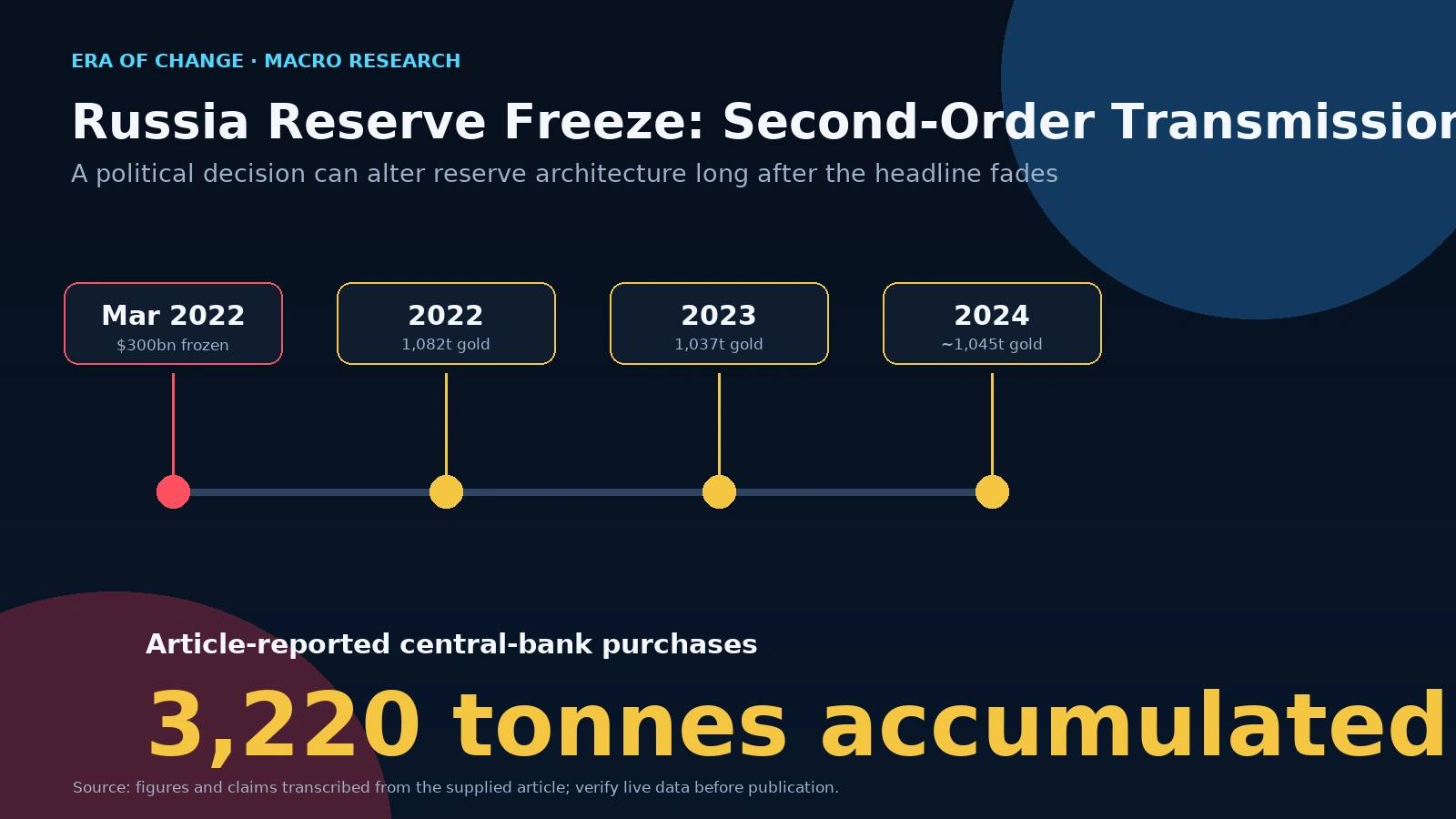
When the United States and its G7 allies froze approximately $300 billion of the Russian Central Bank's foreign currency reserves, roughly half of Russia's total foreign exchange holdings, the consensus reaction among Western financial analysts was nearly unanimous. This was maximum pressure. It would cripple Russia's ability to defend the ruble. It would demonstrate the overwhelming coercive power of the dollar-based financial system. It would isolate the
Russian economy and accelerate regime change.
The ruble did collapse immediately. Russia did face acute financing pressure. The near-term predictions about Russian economic pain were not wrong.
What the consensus completely missed was the second-order structural consequence. In a single decision, the United States demonstrated to every central bank on earth that sovereign reserve assets denominated in dollars and held in Western custodians are not risk-free in the way that a century of financial architecture had implied. They are conditionally risk-free. They are safe until the politics changes.
The response from global central banks was not announced. It was not immediate. But it was real and it was large. Central bank gold purchases reached 1,082 tonnes in 2022, the highest level since 1950, and more than double the average annual purchase rate of the prior decade. In 2023, central banks bought 1,037 tonnes, the second highest annual total in recorded history. In 2024, purchases remained elevated at approximately 1,045 tonnes. Between 2022 and 2024, the world's central banks accumulated 3,220 tonnes of physical gold, roughly double the pace of the decade before the reserve freeze.
By 2023, 68% of central banks were keeping their gold reserves on home soil, according to the Invesco Global Sovereign Asset Management Survey, compared to 50% in 2020. The 29% of central bank respondents who told the World Gold Council in 2024 that they planned to increase gold reserves further in the next twelve months, the highest proportion since that survey began in 2018, are not making a momentum trade. They are making a structural judgment about reserve asset safety.
This is what structural market mispricing looks like. The immediate political headline (Russia sanctioned, ruble falls, Western unity demonstrated) was priced in hours. The structural consequence, a multi-year realignment of sovereign reserve strategy with lasting implications for US Treasury demand, gold prices, and the depth of dollar-based global capital markets took years to fully manifest. Most market participants have still not fully incorporated it into their frameworks.
When Does Political Risk Become Market Risk?
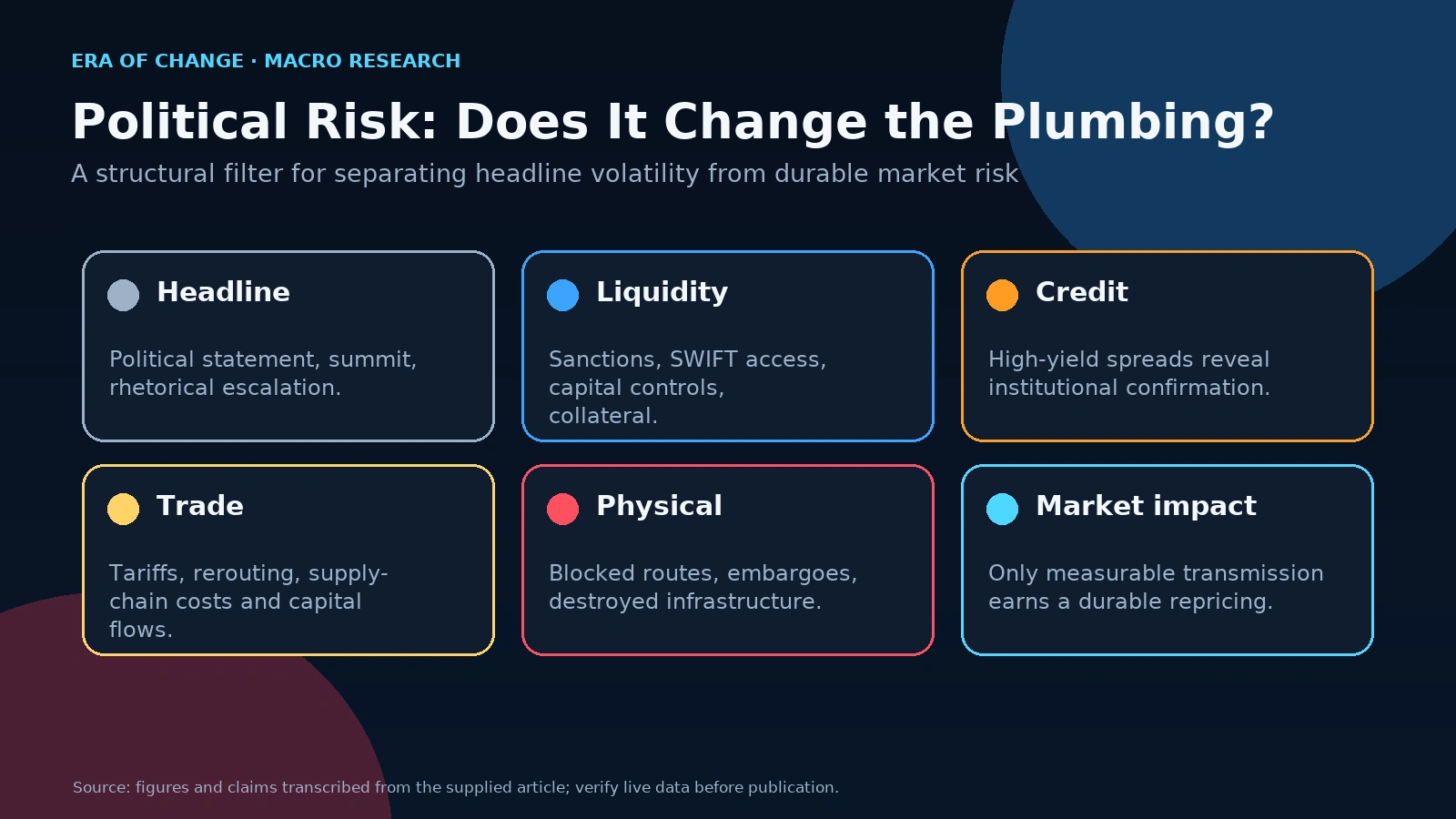
Political announcements do not move markets durably. What moves markets durably is when a political decision physically alters the conditions under which capital operates. There are four channels through which this transition happens, and understanding them is the key to separating structural risk from noise.
Liquidity
When political decisions affect the cost and availability of dollar funding through sanctions that restrict SWIFT access, through capital controls that prevent currency conversion, through reserve actions that alter the supply of high-quality collateral in repo markets, they affect the bloodstream of the economy at its most basic level.
Dollar liquidity restrictions are not theoretical risks. They are immediate, quantifiable, and visible in the SOFR-OIS spread and other funding stress indicators within hours of taking effect. A political event that tightens dollar funding conditions globally is not noise. It is a direct threat to the credit structures that underpin every leveraged position in the financial system.
Credit Markets
When political risk is genuinely structural, it shows up in the credit markets before it shows up in equities. High-yield spreads widen when institutional capital, the participants who cannot afford to be wrong, is reassessing the probability that the corporate sector can service its obligations under the new political environment. If equity markets are falling but high-yield spreads remain stable, the signal is clear: the institutional credit market does not believe the political event will have lasting economic consequences. That divergence is the most reliable short-term signal I know for separating political noise from structural risk.
Trade and Capital Flows
Tariffs, sanctions, and trade restrictions alter the cost and routing of global commerce. These effects are not abstract. They arrive as higher input costs for manufacturers, as disrupted supply chains for industrial production, as capital rerouted to jurisdictions that carry lower political risk. The inflation consequences of trade disruption are real and measurable. They are also slow to build, which is precisely why they are systematically underweighted by markets focused on the current quarter.
Physical Infrastructure
This is the most important threshold, and the most underappreciated. Political risk becomes macroeconomic fact irreversibly and immediately when it crosses into the physical world. When shipping routes are blocked. When port access is denied. When commodity exports are embargoed or energy infrastructure is destroyed.
At that moment, political theater ends and economic physics begins. You cannot model your way around a blocked strait. You cannot print additional copper when an export ban is in place. The physical constraint is the line where a political event stops being interpretable by news analysis and starts requiring a commodities, logistics, and supply chain framework.
As long as political confrontation remains in the domain of words, it is manageable. The moment it produces physical consequences, the positioning question is no longer hypothetical.
Can Political Risk Be Priced in Advance?
Not smoothly. Not reliably. And almost never as early as it should be.
Markets can ignore structural political stress for extended periods (months, sometimes years) and then reprice it in a single violent move. The reason for this is not irrationality. It is the structure of political incentives.
Politicians are not, by incentive, crisis managers. They are crisis avoiders. Their fundamental operating principle is to extend the life of an unsustainable situation for as long as mathematically possible through liquidity injections, through statistical narratives that mask underlying deterioration, through diplomatic ambiguity that allows all parties to maintain face without resolving the underlying structural problem. No elected official is rewarded for managing a crisis early. The political reward comes from being seen as the person who kept the system running, even if what kept it running was the transfer of the problem to the next administration.
What this means in practice is that structural political risk accumulates beneath the surface in debt ratios, in reserve compositions, in real versus reported economic output until the accumulation becomes impossible to conceal or defer.
At that point, what I observe consistently is that policymakers reach for what I think of as the political pedal. They initiate a controlled escalation, a trade war, an aggressive sanctions package, a dramatic foreign policy move that allows them to attribute the economic deterioration to geopolitical force majeure rather than to the accumulated consequences of their own decisions. The crisis was going to arrive regardless. The political escalation simply provides the narrative cover.
The market reprice that follows is not gradual. It is binary. The system absorbs political stress as noise for as long as liquidity allows. And then it does not. When it breaks, you get a cascade: margin calls, forced deleveraging, credit spread blowouts, and the kind of price action that makes orderly exit impossible. The investors, who waited for official confirmation that the crisis had arrived, became liquidity providers for the smart money that repositioned twelve months earlier, when the structural signals were present but the narrative had not yet arrived.
Era Analyst's Perspective
Most investors measure political risk by the intensity of the news coverage. I measure it by whether credit markets believe the headline.
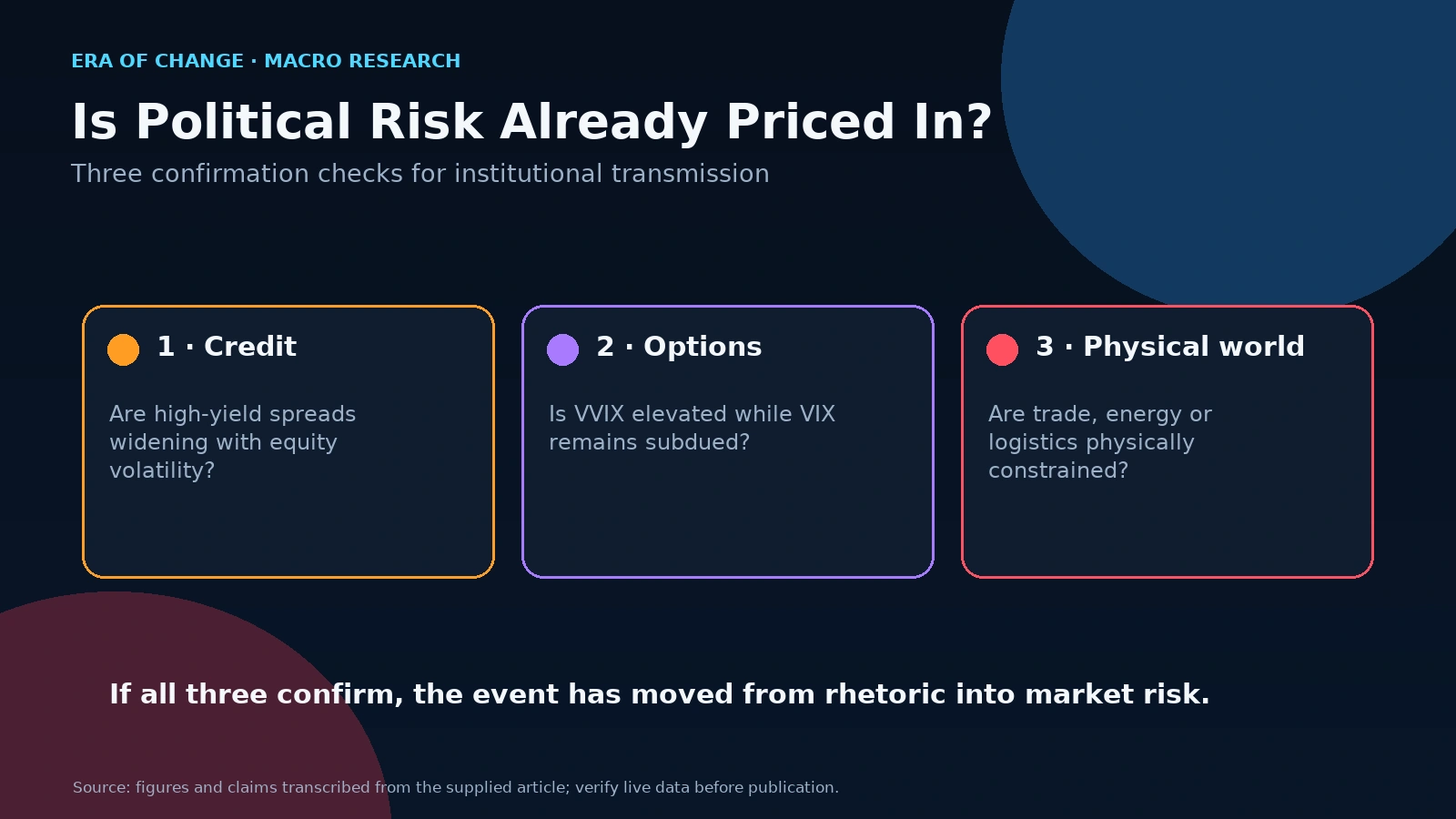
When a major geopolitical event breaks (an election result, a sanctions announcement, a military escalation), I look at three things in sequence. First, are high-yield spreads widening alongside equity volatility, or is the equity move happening in isolation? If spreads are not confirming the equity selloff, the institutional debt market is telling me this is political theater, not structural risk. Second, what is the VVIX doing relative to the VIX? When the VVIX rises sharply while the VIX itself stays below 20, it means sophisticated institutional players are buying protection for a volatility spike that has not yet materialized.
Above 110 on the VVIX is an elevated alert. That configuration (quiet spot volatility, elevated meta-volatility) is one of the most reliable early-warning signals I track for structural risk building beneath the surface. Third, and most importantly: has the political event produced any physical constraint on trade, energy, or logistics? Until it crosses into the physical world, it remains in the interpretable domain.
The Russia reserve freeze of March 2022 is the example I return to most frequently, because the immediate market reaction was almost perfectly wrong in its structural framing. Traders priced ruble weakness and Russian economic isolation.
What nobody priced and what took 18 months to fully manifest in publicly available data was that central banks globally had just concluded that reserve assets held in Western custodians carry a sovereign confiscation risk that was never built into the pricing models. Central banks bought 1,082 tonnes of gold in 2022. Then 1,037 tonnes in 2023. The structural consequence of the reserve freeze is still working its way through global capital allocation. We are not close to the end of it.
How to Determine Whether Political Risk Is Already Priced In
This is the question I receive most frequently from investors, and I will give a direct answer rather than a diplomatic one.
The credit market is the primary reference. High-yield spreads are set by institutional participants who manage large fixed-income books and who price structural risk because they have no choice but to. When geopolitical stress builds into something structural, it shows up in credit spreads before it shows up in equities, and well before it appears in mainstream financial commentary. If high-yield spreads are tight and funding markets are functioning normally, whatever the political drama on the surface the institutional credit market is telling me no structural economic disruption is currently priced. I weigh that signal heavily.
The options market provides the second reference. The VIX measures expected 30-day volatility on the S&P 500, derived from options pricing in real time. The VVIX, the volatility of the VIX itself, measures whether institutional players are paying elevated premiums for protection against a volatility spike that has not yet arrived. A VVIX above 110 signals elevated tail risk demand.
The most useful signal in the aftermath of a major political event is the volatility crush: if put option premiums collapse sharply after the event resolves, institutional hedges are being lifted and the risk has been absorbed. The political event is priced. Conversely, if the VIX has come down but the VVIX remains elevated, something in the institutional positioning is telling you the calm is provisional.
The third reference requires the most patience and the most honesty about what you are actually observing. Has the political development produced any physical constraint on trade, energy, or logistics? As long as geopolitical confrontation remains in the domain of words (diplomatic statements, threat of sanctions, escalatory rhetoric), it is manageable and interpretable.
The transition to physical disruption (blocked shipping lanes, embargoed metals, destroyed energy infrastructure, port closures) is the threshold at which political risk becomes a macroeconomic fact. Until a political event crosses that threshold, I am watching carefully. Once it crosses it, the positioning question has already been answered; the question then is about duration and magnitude.
Political Risk and Long-Term Investing
For long-term investors, the tactical question of whether this week's political news is priced matters less than the strategic question of which structural political trends are reshaping the global financial architecture over the next five to ten years.
The 2022 reserve freeze is not an isolated event. It belongs to a larger structural trend: the accelerating use of financial infrastructure as an instrument of foreign policy coercion. SWIFT exclusions, secondary sanctions, dollar clearing restrictions, asset seizures. These tools have been used with increasing frequency and escalating scale. Each deployment reinforces the strategic incentive for non-allied sovereign entities to build redundant financial systems outside the dollar's reach. This is not ideological; it is basic risk management. And it is proceeding regardless of any individual administration's stated foreign policy preferences.
The commodity dimension is equally important. Critical minerals, energy, and agricultural supply chains have become instruments of geopolitical leverage in a way that three decades of globalization made temporarily invisible. The political decisions now being made around where minerals are mined, where energy infrastructure is built, and which countries control the processing of battery metals are not short-term trade disputes. They are structural rewirings of global production that will determine inflationary dynamics and sovereign economic power for the next generation.
For the inflation consequences of this political fragmentation, What Causes Inflation? provides the structural framework. For the relationship between political risk cycles and the timing of economic downturns, How Recessions Are Measured examines when political risk tips into macroeconomic contraction.
How Era Incorporates Political Risk
At E.R.A. OF CHANGES, political events are never analyzed as standalone geopolitical commentary. They are analyzed through their effects on a specific set of structural variables: liquidity conditions in interbank and credit markets, the composition and direction of sovereign capital flows, commodity prices relative to known supply routes, and monetary policy trajectories across major central banks.
The Era CrisisMeter incorporates political risk as a variable only when a political development produces a measurable signal in one or more of these structural channels. A diplomatic statement does not move the CrisisMeter. A sanctions package that alters SWIFT clearing access for a major economy does. A trade summit communiqué does not move the needle. A port closure that reroutes 15% of global LNG shipments does.
This framework is not designed to dismiss political developments. It is designed to distinguish between political events that are consequential for capital and those that are consequential only for news coverage. The ones that matter are typically undercovered at the moment of impact and overcovered six months later, when the structural consequences have already been absorbed into asset prices. The gap between those two moments is where the analytical edge lives.
What Investors Should Watch
The indicators that provide genuine early warning of structural political risk materializing are, in order of reliability:
- high-yield and investment-grade credit spreads, which reveal whether institutional debt markets are absorbing the political signal or treating it as noise;
- the VVIX relative to the VIX, which shows whether institutional investors are already paying for tail protection before the event arrives in spot volatility;
- US Treasury yields at the long end of the curve, which can signal changing sovereign demand for US government debt;
- central bank gold purchase data, which with a six-month lag reflects how sovereign institutions are revising their structural assessment of reserve asset safety;
- physical shipping and logistics disruptions, representing the transition from rhetoric to economic fact;
- and cross-border capital flow data, which reveals the directionality of institutional repositioning in response to political developments.
What I do not use as primary inputs: political polling, summit communiqués, diplomatic statements, or media coverage intensity. These are signals about the news cycle. The structural signals are in the credit markets, the options markets, the commodity markets, and the physical logistics data.
By the time the news cycle has confirmed that a political event was consequential, the institutional repositioning is complete. Those who waited for the headline confirmation provided the exit liquidity for the capital that read the structural signals correctly and moved early.
This is the practical meaning of the rear-view mirror of macroeconomics applied to geopolitics. Official narratives confirm what already happened. Structural signals tell you what is happening now, in the bloodstream of the financial system, before the story has a name.
Frequently Asked Questions
What is political risk?
Political risk is the probability that a government decision (domestic or cross-border) alters the economic conditions under which capital is deployed. It encompasses elections and policy changes, sanctions regimes, trade restrictions, currency controls, nationalization, and the structural consequences of any government decision that affects the cost, availability, or routing of capital. It is distinct from market risk and credit risk, though political decisions are frequently the mechanism through which both are amplified.
How is political risk different from geopolitical risk?
Geopolitical risk is a specific category of political risk involving the interaction between sovereign states: military conflict, trade wars, alliance restructuring, and the erosion of international institutions governing global commerce. Political risk can also be entirely domestic: a government imposing capital controls, restructuring sovereign debt, or changing the regulatory architecture for a critical sector. Both categories matter to investors, but geopolitical risk tends to carry higher structural consequences because the decisions involved are harder to reverse and more likely to produce physical disruptions to trade and capital flows.
How do political events affect financial markets?
Political events affect financial markets in a durable way only when they alter the structural conditions under which capital operates. This occurs through four channels: changes in liquidity and funding conditions, changes in credit spreads and debt market functioning, changes in trade and capital flows, and physical disruptions to infrastructure, energy, and logistics networks. Political events that do not materially affect any of these channels generate short-term volatility without lasting market impact. Political events that do affect these channels (like the 2022 Russian reserve freeze) create structural shifts that can reshape asset prices and capital allocation for years.
Can political risk be measured?
It can be estimated, with important caveats about the inherent limits of modeling political behavior. The most reliable approach is not to quantify political intent, which is opaque by nature, but to measure the structural signals that indicate whether political risk is manifesting in economic reality. High-yield credit spreads, interbank funding rates, commodity prices, capital flow data, central bank reserve compositions, and options market positioning all provide measurable, quantifiable signals that political risk is crossing from the rhetorical domain into the structural one.
Why do markets sometimes ignore political events?
Because most political events do not change the financial plumbing. Markets have learned, correctly, that most political headlines are noise, and they have priced out the reflexive reaction to political news over decades of experience. The problem is that this same learned behavior causes markets to discount all political headlines, including the rare ones that are genuinely structural. Political risk repricing is therefore not gradual; it is a sudden, violent adjustment when structural consequences can no longer be ignored or deferred.
How do institutional investors evaluate political risk?
Sophisticated institutional investors evaluate political risk through the lens of structural economic impact rather than headline intensity. The key questions are: does this political development change funding conditions in credit markets? Does it alter the physical routing of key commodities or supply chains? Does it affect the viability of sovereign reserve strategies?
The practical tools are credit spread monitoring, options market positioning, specifically VIX, VVIX, and put premium structures, central bank reserve data, and physical commodity market signals. When these structural indicators are stable, institutional capital tends to look through political noise. When they diverge, the political event has crossed into market-relevant territory.
Which asset classes are most sensitive to political risk?
The asset classes most sensitive to structural political risk as distinct from headline noise are sovereign debt in countries whose reserve asset safety may be questioned by geopolitical realignment, currencies of countries with large dollar-denominated liabilities that could face capital flow reversals, commodity markets where physical supply routes pass through politically unstable regions, and equity sectors exposed to sanctions, tariffs, or export controls. Gold has historically functioned as a structural hedge during periods of elevated political uncertainty, which is directly reflected in the record central bank gold purchases of 2022 through 2024.
How does Era analyze political risk?
E.R.A. OF CHANGES analyzes political developments through their measurable impact on liquidity, credit, capital flows, commodity markets, and monetary policy dynamics, not through their political salience. A political event enters our analytical framework only when it produces a detectable signal in one or more of these structural variables. This approach is reflected in the Era CrisisMeter and the Era Global Risk Index, both of which are built to identify structural stress before it appears in official economic data or mainstream coverage.
About E.R.A. OF CHANGES
E.R.A. OF CHANGES is an independent macroeconomic research and geopolitical intelligence firm providing institutional-quality analysis to investors worldwide. Our research combines macroeconomics, financial markets, blockchain analytics, and geopolitical risk into proprietary forecasting frameworks designed to identify structural market trends before they become consensus.
The Era Global Risk Index, updated daily from 24 structural indicators, serves as the foundation of our analytical methodology, providing a forward-looking measure of systemic financial stress grounded in structural economic evidence rather than market sentiment. Our full methodology, live index reading, and forecast archive are available at eraperemen.info/en.
The content published by E.R.A. OF CHANGES is for informational and educational purposes only and does not constitute financial, investment, legal, or tax advice. All views expressed are the personal analytical perspective of the author. Past forecast accuracy does not guarantee future results. Readers should conduct their own research and consult a qualified financial professional before making any investment decisions.
Sources
- How to Use Russia's Frozen Assets — Council on Foreign Relations
- U.S. Treasury REPO Task Force statement on immobilised Russian assets
- Russian Bank Foreign Reserves Frozen by Sanctions — NBC News
- 2024 Central Bank Gold Reserves Survey — World Gold Council
- Central Bank Gold Demand Trends, Full Year 2024 — World Gold Council
- A Decade of Central Bank Gold Purchases — Visual Capitalist
- Gold Beyond Records 2025: Central Banks and Market Trends — Amundi Research Center
- What Is VVIX and Why Does It Matter? — Charles Schwab
- VVIX Explained: What the Volatility Index Tells Traders — SpotGamma
- Does Geopolitical Risk Raise or Lower Corporate Credit Spreads? — ScienceDirect
- Heightened Geopolitical Uncertainties Drive Risks — European Securities and Markets Authority
- 2026 Macro and Private Markets Outlook: Sustained Resilience — ICG