Executive Summary
Most investors treat geopolitical risk as a category that only matters when something explodes. A missile is fired, a border is crossed, a sanctions package is announced. Markets reprice.
Then, within weeks, the noise recedes, volatility subsides, and portfolios revert to their prior assumptions. The problem with that pattern of thinking is that it has never described how structural geopolitical change actually works. The shifts that matter most to capital do not announce themselves loudly. They accumulate quietly in trade flows, supply chains, payment infrastructure, and resource availability until a threshold is crossed and the repricing is not gradual.
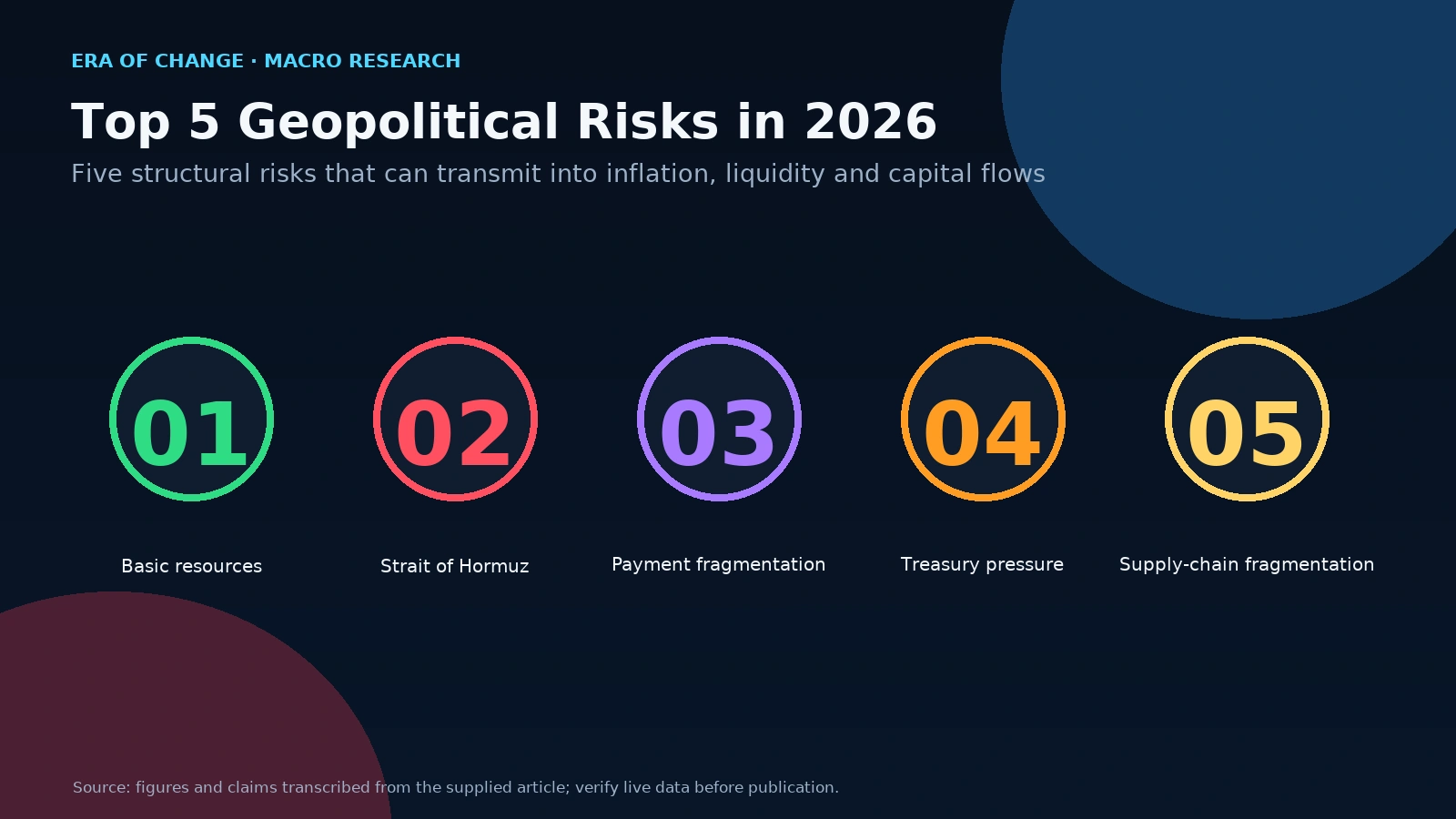
This article identifies the five structural geopolitical risks that carry the greatest potential to reshape financial markets in 2026. Several are already in motion. None is fully priced. And the full macroeconomic consequences of the most acute, a near-closure of the Strait of Hormuz, silent fragmentation of global payment infrastructure, and the deliberate weaponization of food and water supply are still ahead of us.
This is not a prediction of specific political outcomes. It is a structural assessment of where geopolitical stress is most likely to transmit into the variables that actually matter for investors: inflation, liquidity, energy costs, credit conditions, and the stability of capital flows.
Key Takeaways:
- Geopolitical risk now shapes inflation, monetary policy, and financial stability more directly than at any point since the Cold War
- Resource security (food, water, fertilizers, critical minerals) is becoming a more important geopolitical weapon than oil alone
- A broader Middle East conflict has already disrupted global energy and food supply; the full macro consequences remain ahead
- Fragmentation of global payment systems could produce a sudden, not gradual, shift in international capital flows
- Structural geopolitical change accumulates slowly before reaching tipping points investors who wait for headline confirmation are receiving the information last
Introduction
Most people think geopolitical risk begins when something visible happens. A war starts. A government falls. A port closes. Markets respond. And then, gradually, the situation is "priced in" and life resumes. I have spent enough time studying the intersection of geopolitics and financial markets to know that this is almost entirely backwards.
The geopolitical shifts that destroy capital that permanently reprice energy, restructure trade, destabilize currencies, and break the assumptions embedded in a decade of portfolio construction rarely begin with a visible event. They begin with structural changes that are measurable before they are newsworthy. Export concentration in critical agricultural inputs. The slow, bureaucratic construction of payment infrastructure designed to bypass dollar intermediation. The quiet reduction of foreign central bank holdings of U.S. Treasury securities.
These processes run for years before they reach a threshold event. By the time the threshold event makes headlines, the positioning that would have protected you needed to happen six months earlier.
In 2026, several of those structural processes have reached or are approaching threshold conditions. Some of the events I have been tracking as risks have already partially materialized.
What has not yet materialized is the full macroeconomic transmission, the inflation spiral, the central bank constraint, the capital flow reversal that makes these geopolitical events economically destructive rather than merely politically significant. That is what this article is about.
Why Geopolitical Risk Matters More Than Ever
For most of the post-Cold War era, geopolitical developments were primarily a diplomatic and humanitarian concern for investors rather than a financial one. The global economy was sufficiently integrated, trade routes sufficiently diversified, and monetary systems sufficiently stable that most geopolitical events produced temporary market dislocations rather than permanent structural repricing. That environment no longer exists.
The three-decade deflationary tailwind created by deepening globalization (falling goods prices, diversifying supply chains, expanding cross-border capital flows, a dollar-denominated trade system that provided a common language for commerce from Shanghai to São Paulo) is structurally reversing. What is replacing it is a world of competing economic blocs, strategic resource competition, deliberate financial system fragmentation, and geopolitical relationships in which trade is increasingly a tool of statecraft rather than mutual economic benefit. In that world, geopolitical events do not produce temporary market dislocations. They produce permanent shifts in the structural cost of goods, energy, capital, and credit.
The Era Global Risk Index current reading of 69 reflects, in part, the accumulation of exactly this kind of structural geopolitical stress. Each of the five risks below is a component of that reading. Understanding them individually, and understanding why their full economic consequences are still ahead rather than behind us, is the core of what I want to offer in this assessment.
How Era Evaluates Geopolitical Risk
I want to be explicit about how we think about geopolitical developments at Era, because our approach is different from what most geopolitical risk analysis produces.
Political analysis asks who will win, who will govern, and what their stated policy positions are. We do not do that. We ask what the financial system consequences are, specifically, how a geopolitical development affects interbank liquidity, trade flow costs, energy and commodity pricing, sovereign debt dynamics, and the structural availability of capital. The Era CrisisMeter includes geopolitical risk as one of its six structural categories precisely because these developments do not stay contained in the political sphere. They transmit into inflation, credit conditions, monetary policy independence, and asset prices in ways that are measurable and trackable before they become universally recognized.
What follows is that structural analysis applied to the five geopolitical risks I consider most consequential for investors in 2026.
Risk #1: The Weaponization of Basic Resources
This is the risk I believe is most dangerously underestimated by institutional capital right now. Not the one most discussed. Not the one generating the most political coverage. The one that is building structurally in ways that capital markets have not yet begun to adequately price.
Markets have spent thirty years learning to evaluate geopolitical risk through a very specific lens: oil price movements, tariff escalation, and semiconductor supply chain disruption.
These are the three variables that institutional portfolio teams have built their geopolitical scenario models around. They are not wrong to track them. But they are missing something more fundamental, a category of risk that is older than oil as a strategic asset and more basic than any semiconductor: food and water.
We are entering a period in which food security and water availability are becoming primary instruments of state power and geopolitical leverage. This is not a metaphor. It is a structural observation about what happens when a genuinely fragmented world, one in which the assumption of open trade in agricultural commodities can no longer be taken for granted, collides with the physical reality that food production is geographically concentrated, fertilizer supply chains are long and exposed, and water infrastructure is under chronic underinvestment precisely where population growth is most acute.
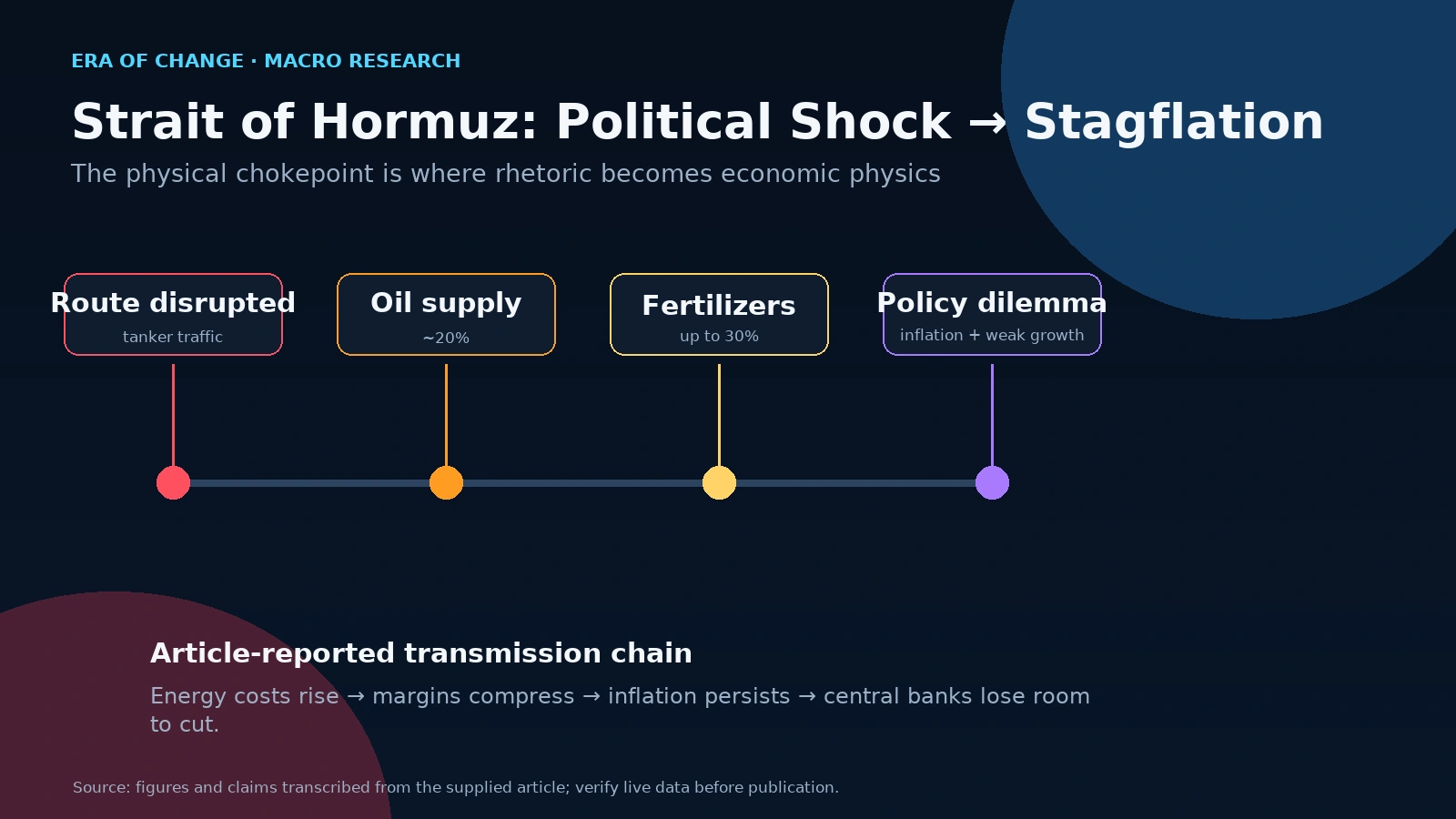
The FAO has already documented the immediate food security consequences of the 2026 Middle East conflict, specifically, that the Strait of Hormuz carries up to 30 percent of internationally traded fertilizers, and that its disruption has reduced tanker traffic by more than 95 percent through that route, interrupting millions of tons of fertilizer shipments monthly. Cereal producers globally are projected to face income losses of up to 5 percent in 2026, with cascading effects running through 2030. The Council on Foreign Relations has described this as the "fertilizer, food, and the fragility" problem, a structural vulnerability that predates the current crisis and will outlast its immediate resolution.
But the deeper risk is not the current disruption. It is the precedent and the trajectory. Countries that are net exporters of strategic agricultural inputs (grain, fertilizers, potash, water purification technology) are watching a world of hard borders and competing blocs develop in real time. The structural incentive for those countries to begin managing their agricultural exports as strategic assets to prioritize domestic food security, to use export licenses as diplomatic leverage, to restrict access to inputs that their geopolitical competitors depend on is growing with every month of continued fragmentation.
Capital is still pricing these events as temporary supply chain disruptions. The FAO itself urged governments to avoid export restrictions on agricultural inputs, which is the appropriate policy recommendation and also an acknowledgment that the risk of those restrictions is real and present enough to warrant a public call against them. When the FAO issues a public warning against a behavior, that behavior is being seriously considered by the governments most capable of implementing it.
Food and water are becoming the new currency of geopolitical leverage in a divided world. The investor who is not thinking about what that means for fertilizer producers, agricultural infrastructure, water technology, and food-producing economies is operating on a map of the world that no longer reflects the territory.
Risk #2: Middle East Escalation and the Strait of Hormuz
This is the risk I have been describing as the primary wildcard for global macro stability, the event with the maximum potential to destroy current central bank models and push the global economy into conditions that classical portfolio construction cannot navigate. As of this writing, it is no longer a hypothetical scenario. It is an active situation with consequences that are still unfolding.
Beginning on March 4, 2026, Iranian forces declared the Strait of Hormuz effectively closed, threatening and carrying out attacks on vessels attempting transit. The initial shock to oil markets was severe: Brent crude increased by approximately 65 percent, roughly $46 per barrel, by the end of March, recording its highest monthly rise on record. Analysts at leading commodity research firms have placed the risk corridor at $80 to $90 per barrel for the immediate period, with scenarios toward $100 and ultimately toward $140 per barrel if disruption extends beyond the initial acute phase.
The Strait carries approximately 20 percent of global oil supply alongside critical volumes of liquefied natural gas serving Asian and European markets.
The financial market consequences of a sustained or re-escalating disruption are not simply higher oil prices. They are the specific macro combination that produces the most dangerous policy environment for investors: a sudden, supply-driven cost inflation surge that arrives into an economy where central banks cannot credibly respond with rate cuts because core inflation is already running above target.
This is the mechanism I have described in the context of stagflation risk, the scenario where the central bank's lever that would address growth weakness actively worsens the price problem, and vice versa. A sustained closure of the Strait of Hormuz is the fastest available path to that scenario becoming fully institutionalized in the global economy.
The classic 60/40 portfolio (60 percent equities, 40 percent bonds) was designed for an environment where equity and bond returns are negatively correlated: when stocks fall, bonds rally as central banks cut rates to support growth. In a genuine energy-shock stagflation, that correlation breaks down. Bonds do not rally when central banks cannot cut. Equities do not recover quickly when input costs are rising and consumer purchasing power is being eroded simultaneously. The 40 percent that was supposed to protect the portfolio becomes part of the problem.
The acute phase of the current disruption may prove temporary. What will not be temporary is the structural repricing of geopolitical risk premium in energy markets, the acceleration of strategic reserve decisions by major importing nations, and the demonstrated vulnerability of the global supply chain to a single chokepoint that carries a fifth of the world's oil.
Risk #3: The Silent Fragmentation of Global Payment Infrastructure
This is the risk that looks, on the surface, like a slow, bureaucratic process: BRICS summits, technical working groups on digital currency interoperability, arcane discussions about cross-border clearing mechanisms. Investors have been watching it develop for years and have consistently concluded that dollar hegemony faces no credible challenge in the near to medium term. I think that conclusion underestimates one specific characteristic of infrastructure transitions: they accumulate slowly and then tip suddenly.
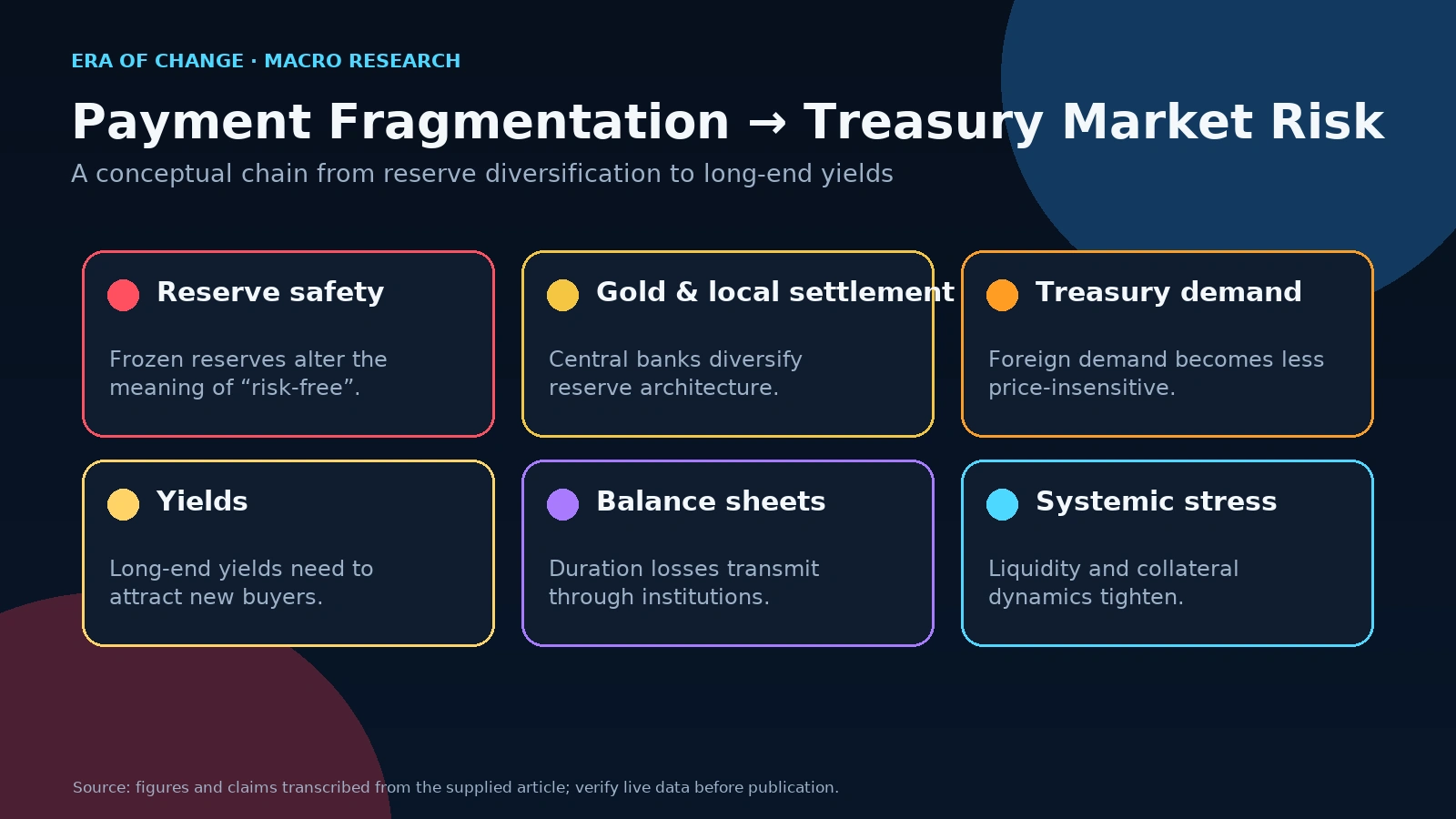
Russian officials reported that more than 90% of Russia–China mutual transactions were made in rubles or yuan in 2024; a U.S. congressional commission likewise reports that over 90% of bilateral trade was conducted in those currencies. This describes settlement currency, not proof that every trade bypassed dollar intermediation. The BRICS bloc has been systematically constructing alternative payment infrastructure through systems including mBridge and BRICS Pay, both designed to connect national digital currencies through a shared network that does not require SWIFT or dollar clearing. The IRIAS-led UNIT project says it minted an initial 100 tokens on October 31, 2025, to track a reserve basket it describes as 40% gold and 60% BRICS currencies, with one UNIT corresponding to one gram of gold. This was a project-level pilot, not an official BRICS-issued currency; the project’s description is not independent proof of reserve backing. That number is not significant. The infrastructure being tested behind it is. Source. Source 2. Source 3. Source. Source 2.
The scenario I find most underpriced is not a gradual, decades-long erosion of dollar reserve status. It is a sudden, coordinated announcement by a sufficient number of Global South economies that they are transitioning bilateral trade and reserve management to a closed clearing system, one backed by physical gold and commodity assets, denominated in instruments that do not require holding U.S. Treasury securities as the primary reserve vehicle.
If that announcement arrives, the immediate consequence is a liquidity crisis in the U.S. Treasury market. The logic is direct: the dollar's reserve status and the sustained foreign demand for U.S. government debt are not two separate phenomena. They are the same phenomenon. Foreign central banks hold Treasuries because the dollar is the reserve currency.
The reserve currency maintains its status because foreign central banks hold Treasuries. A credible, coordinated signal that this cycle is being deliberately broken would produce a rapid increase in long-bond yields as foreign demand evaporates, destroying the balance sheets of financial institutions that are carrying large Treasury positions at current prices. This structural shift, when it comes, will happen in days. Ninety-nine percent of the market will be on the wrong side of it.
Spot gold briefly exceeded $5,500/oz intraday on January 29, 2026, then fell below $4,000 in late June is not a sentiment trade. It is the early signal of exactly this structural repositioning: central banks accumulating the one asset that requires no counterparty and no clearinghouse. Source.
Risk #4: Sovereign Debt and the Treasury Market Under Pressure
The fourth risk is structurally related to the third but deserves separate treatment because its dynamics are playing out independently of any coordinated BRICS decision.
The composition of buyers in the U.S. Treasury market has shifted in ways that have not yet produced a crisis but that carry the structural preconditions for one. Foreign central banks, once the dominant and most price-insensitive holders of U.S. government debt, have retreated from direct Treasury holdings in recent years.
They have been replaced by price-sensitive private buyers: hedge funds, proprietary trading desks, and foreign asset managers who are optimizing for return rather than operating under a mandate to hold dollars as reserves. Total foreign holdings of U.S. Treasuries reached a record $9.49 trillion as of February 2026, up 6.6 percent year-over-year.
But China, once the largest foreign holder, has been reduced to third position at $693 billion, a reflection of a deliberate, multi-year diversification away from dollar-denominated reserves. Japan, the largest holder at $1.24 trillion, saw the largest monthly inflow ever into Japanese sovereign bond funds in March 2026, raising serious questions about whether Japanese institutional capital is beginning to repatriate from Treasuries toward domestic assets.
Meanwhile, U.S. interest payments on federal debt are running at approximately $1 trillion per year, with the IMF explicitly warning that the explosion of U.S. debt is eroding the "safety premium" that has historically made Treasuries the global default haven. The OECD Global Debt Report 2026 places global sovereign borrowing needs at record levels, with developed market governments simultaneously competing for the same pool of savings. The 10-year Treasury yield at 4.3 percent remains well below its long-run historical average of 5.9 percent, which means either rates have further to rise to attract adequate demand, or the Federal Reserve will be drawn toward yield control policies that compromise its inflation mandate.
The mechanism I watch most carefully is what happens when these two pressures converge: rising supply of Treasury debt and falling price-insensitivity among buyers. Auctions for two-, five-, and seven-year Treasury notes all showed weak demand in March 2026, forcing yields higher than expected. This is not a crisis. It is a structural signal. The yield curve dynamics and M2 contraction pressure that accompany a Treasury demand shortfall have historically been among the most reliable leading indicators of broader financial stress. We are watching both.
Risk #5: Deglobalization and Strategic Supply Chain Fragmentation
The fifth risk is the slowest-moving of the five, and therefore the most consistently underestimated. It has no single triggering event, no closure announcement, no overnight shock. It is the cumulative consequence of a decade of policy decisions across the United States, Europe, China, and their respective allied blocs to treat supply chain architecture as a matter of national security rather than economic efficiency.
Semiconductor export controls are the clearest current example of what this looks like in practice. In February 2026, the United States extended export controls to a broader range of semiconductor manufacturing equipment and Electronic Design Automation software, while tightening the de minimis rule on foreign-made items containing controlled U.S. technology. U.S. advanced chip manufacturing capacity, which accounted for approximately 12 percent of global capacity in 2020, now accounts for roughly 22 percent, a reflection of CHIPS Act investment reaching production scale at TSMC Arizona, Samsung Taylor, and Intel Ohio.
This reshoring represents a genuine geopolitical achievement in reducing single-point-of-failure concentration in Taiwan. It also represents a substantial permanent increase in the cost of producing those chips because domestic capacity built on security grounds rather than efficiency grounds is, by definition, more expensive than the capacity it replaces.
Multiply that logic across agriculture, pharmaceuticals, rare earth processing, battery chemistry, and water purification technology, and you have a structural, multi-decade cost inflation embedded in the global economy that no monetary policy response can directly address. This is the supply-side driver that makes the stagflation scenario more structurally embedded in the current environment than it was in the 1970s.
In 1973, you could remove the oil embargo and restore the prior cost structure. You cannot remove a decade of strategic reshoring and regulatory fragmentation. The supply chains that have been rebuilt on resilience grounds will not revert to efficiency grounds simply because political conditions improve. The cost is permanent until the next wave of structural reorganization, which will take another decade.
Why Markets Consistently Misprice Geopolitical Risk
Understanding the five risks above is only half of the analytical task. The other half is understanding why markets consistently fail to price them until they become acute because that failure pattern is predictable, and it determines when the opportunity to position ahead of the repricing exists.
Markets are extraordinarily good at pricing near-term, quantifiable, visible risks. Option markets price the probability of a specific event occurring within a specific window with remarkable efficiency. But geopolitical risk is almost never near-term, easily quantifiable, or visible in its early stages. It is structural, slow-moving, and embedded in data series that financial media does not track: fertilizer trade flows, central bank reserve composition data, bilateral currency settlement agreements, cross-border payment volumes by currency denomination. These data points do not generate breaking news alerts. They generate papers from the BIS, quarterly updates from the FAO, and working group reports from BRICS institutions.
The investors who identified the structural risk in U.S. sub-prime mortgage markets in 2006 were not reading the same sources as the investors who were surprised in 2008. The investors who identified the structural inflation risk in 2020 and 2021 were not waiting for the Fed to acknowledge it. The investors who will be correctly positioned for the next major geopolitical repricing are watching the structural indicators now, not waiting for the announcement that confirms what the indicators have been showing.
How Investors Can Think About Positioning
I want to be careful here, because I am not offering investment advice. But I can offer the structural logic that governs how I think about portfolio construction in the environment these five risks describe.
The common thread across all five risks is a structural increase in the cost of physical things relative to financial claims on future earnings. Resource weaponization raises the cost of food and agricultural inputs. Energy shock raises the cost of every production process that uses energy. Financial system fragmentation raises the cost of cross-border capital flows and reduces the pool of buyers for dollar-denominated debt. Sovereign debt stress raises the structural level of long-term interest rates. Supply chain fragmentation raises the cost of manufactured goods.
The asset categories that carry structural protection in this environment are, by extension, the ones that own or control physical productive capacity in supply-constrained categories: energy infrastructure, precious metals, agricultural producers, commodity miners, and businesses with genuine pricing power over products that consumers cannot substitute away from. The asset categories most exposed are those whose valuations depend on cheap capital, high future earnings multiples, and a monetary environment in which central banks can credibly ease at the first sign of economic weakness. In the macro environment these five risks are assembling, that monetary environment is precisely what is unavailable.
Equally important is liquidity. The forced liquidation dynamics I have described in the context of the CrisisMeter above 85 apply directly to geopolitical shock scenarios: when multiple risks materialize simultaneously, the correlation between all assets moves toward one, and the only thing that creates opportunity rather than loss is having the liquidity to act rather than the leverage that forces you to sell.
How Geopolitical Risk Fits Into the Era CrisisMeter
Geopolitical risk is one of the six structural categories in the Era CrisisMeter, but it does not operate independently from the others. What makes the current geopolitical environment structurally more dangerous than it would be in a healthier macro context is exactly this interaction.
An energy shock from a Strait of Hormuz disruption would be manageable in a world where central banks had room to absorb the growth hit. It is far more dangerous in a world where M2 contraction is already compressing credit creation and the yield curve is already signaling late-cycle stress. A fragmentation of global payment infrastructure would produce a Treasury yield spike, but that spike would be more destabilizing in a world where financial institutions are already carrying stretched leverage and where recession probability is elevated. Resource weaponization produces food inflation that is more destructive in a world where household real purchasing power is already being eroded by stagflationary dynamics.
The CrisisMeter reading of 69 reflects exactly this compounding effect. Each geopolitical development, in isolation, might produce a manageable repricing. Their simultaneous occurrence in a structural macro environment that is already under stress from multiple non-geopolitical directions is what creates the potential for non-linear outcomes.
What to Monitor Through the Rest of 2026
The signals I track most closely for evidence that any of these five risks is approaching or passing a threshold are not the political headlines. They are the financial transmission indicators, the data points that show how geopolitical stress is affecting the systems that actually matter for capital.
For resource risk: monthly export restriction announcements from major agricultural producing countries, the FAO Food Price Index, potash and phosphate spot prices, and any formal policy framework from major net exporters explicitly categorizing agricultural inputs as strategic reserves rather than commodity trade.
For Middle East/energy risk: Brent crude spot and futures curve structure, tanker insurance rates through the Strait of Hormuz, LNG spot prices in Asia, and the spread between front-month and six-month forward oil prices, which tells you whether markets are pricing the disruption as temporary or beginning to treat it as structural.
For payment system fragmentation: monthly data on foreign holdings of U.S. Treasuries, the composition shift between central bank and private buyers at Treasury auctions, the bid-to-cover ratios at 10-year and 30-year auctions, and any formal announcement from BRICS or associated institutions about expanding the "Unit" pilot to operational scale.
For sovereign debt stress: the 10-year Treasury yield, the MOVE index (bond market volatility), bid-to-cover ratios at long-dated auctions, and any indication from the Fed that it is considering yield curve control or direct Treasury purchases as a fiscal accommodation mechanism, which would represent the central bank capitulation event I have described as the most dangerous structural inflection point for inflation expectations.
For supply chain fragmentation: semiconductor equipment order volumes and lead times, the pace of CHIPS Act facility openings relative to announced timelines, and the spread in manufacturing cost between domestically produced and offshore-equivalent components across key supply chains, which reveals the real embedded cost of strategic reshoring.
None of these signals, read in isolation, tells you the complete picture. Read together, and in conjunction with the Era CrisisMeter's structural aggregate, they give you the best available map of where the next major repricing is most likely to originate.
Era Analyst's Perspective
"Of all the geopolitical risks I track, the one I believe is most dangerously underestimated right now is the weaponization of basic resources, specifically, the emerging reality that food and water are becoming the new currency of geopolitical leverage in a divided world. Markets have spent thirty years building their geopolitical risk frameworks around oil prices, tariff schedules, and semiconductor logistics. Institutions have not yet internalized what happens when food-exporting countries begin treating agricultural exports the same way oil-producing countries have always treated oil: as a strategic asset to be managed in the national interest, not simply a commodity to be sold at market price. The Strait of Hormuz already carries 30 percent of globally traded fertilizers. We have just seen what happens when that route is disrupted. The FAO is publicly calling on governments not to impose export restrictions on agricultural inputs, which tells you exactly which way those governments are thinking about it.
The payment system fragmentation risk is the second one that keeps me most focused. It looks slow. It looks bureaucratic. The IRIAS-led UNIT project says it minted 100 tokens in October 2025; this was a project-level pilot, not an official BRICS-issued currency, an almost laughably small number. But what was being tested was not the scale. It was the architecture: a proposed token described by its project as gold-and-currency-backed; the cited material does not establish operational settlement at scale or that it bypasses SWIFT or Treasury markets. If and when a sufficient number of developing economies announce they are moving their bilateral trade settlement to a system like this, the shock to the U.S. Treasury market will not be gradual. It will happen in days. Ninety-nine percent of the market will be on the wrong side. The time to understand that risk is now, not when the announcement arrives." Source. Source 2. Source 2.
Frequently Asked Questions
What is geopolitical risk?
Geopolitical risk refers to the potential for political events, conflicts, policy decisions, and international relationships to affect economic activity, financial markets, and the structural conditions that govern trade, capital flows, energy supply, and monetary systems. For investors, geopolitical risk is significant not because it produces immediate market volatility, though it often does, but because structural geopolitical shifts can permanently reprice entire asset categories by changing the underlying cost structure of production, the reliability of supply chains, and the stability of the monetary architecture that financial systems depend on.
Why is geopolitical risk important for investors?
In a highly globalized world, geopolitical risk could be somewhat contained: trade routes were diversified, monetary systems were stable, and most political conflicts produced temporary rather than structural market effects. In the increasingly fragmented world of 2026, that insulation is gone. Geopolitical developments now directly affect inflation through supply chain cost, monetary policy through energy price shocks, credit market conditions through sovereign debt dynamics, and the structural availability of capital through payment system architecture. Investors who ignore geopolitical risk in portfolio construction are ignoring one of the primary drivers of the macro environment their assets are operating in.
What are the biggest geopolitical risks in 2026?
Based on structural analysis of where geopolitical stress is most likely to transmit into macroeconomic and financial consequences, the five most significant risks in 2026 are: the weaponization of basic resources including food, water, and fertilizers; the ongoing Middle East escalation and its energy and stagflationary consequences; the silent fragmentation of global payment infrastructure and the potential for a sudden Treasury market liquidity event; the structural erosion of foreign demand for U.S. sovereign debt; and the accumulated cost inflation embedded in strategic supply chain reshoring across semiconductors, energy, and critical manufacturing.
How do geopolitical events affect financial markets?
Geopolitical events affect financial markets through several transmission mechanisms simultaneously. Energy shocks raise production costs system-wide and compress corporate margins while generating cost inflation that constrains central bank policy flexibility. Supply chain disruptions affect the availability and cost of intermediate goods, creating sustained inflation pressure in the affected categories. Financial system fragmentation affects capital flows and the depth of markets for sovereign debt. And resource restriction events, whether in energy, food, or critical minerals, directly affect the inflation dynamics that determine the real return on every financial asset.
Can geopolitical risk be measured?
Not with the same precision as financial market variables, but structural geopolitical risk can be systematically tracked through its financial transmission indicators: energy prices and futures curves, agricultural commodity spot prices and trade flow data, sovereign debt auction dynamics, foreign central bank reserve composition, bilateral currency settlement data, and the structural fragmentation of payment infrastructure. The Era CrisisMeter incorporates geopolitical risk as one of its six structural categories, translating geopolitical developments into their quantifiable financial market consequences rather than treating political events as standalone occurrences.
How does Era monitor geopolitical risk?
Era evaluates geopolitical developments exclusively through their financial transmission consequences: how a given geopolitical development affects liquidity conditions, trade costs, energy and commodity pricing, sovereign debt dynamics, and the structural stability of capital flows. We do not make political predictions or assess electoral outcomes as primary inputs. We track the financial indicators that show when geopolitical stress is beginning to transmit into the credit, funding, and capital flow markets that determine systemic financial risk because those transmission signals consistently appear before the visible market repricing.
Which sectors may be more resilient during geopolitical crises?
Sectors that own or control physical productive capacity in supply-constrained categories have historically shown greater structural resilience during geopolitical stress: energy producers and infrastructure, precious metals and commodity miners, agricultural companies with control over production inputs, water infrastructure and purification technology, and businesses with genuine pricing power over products consumers cannot easily substitute. The common thread is tangible productive capacity in categories where the geopolitical disruption itself constrains supply, which gives those businesses the ability to pass rising costs to customers even as the broader economic environment deteriorates. This is not investment advice; it is the structural logic that connects geopolitical supply disruption to asset category performance.
Why are food and water becoming geopolitical assets?
For most of the post-war era, food and water were treated as purely economic commodities traded internationally on price efficiency grounds, with access determined by market mechanisms rather than political decisions. The structural fragmentation of the world into competing economic blocs is changing that.
When food-exporting countries can no longer assume that their trading partners are geopolitical allies, the calculation around managing agricultural exports shifts from pure economic optimization toward strategic resource management. The same logic applies to water purification technology and fertilizer supply chains. The FAO's public calls in 2026 urging governments not to restrict agricultural input exports are an acknowledgment that the governments most capable of imposing those restrictions are actively considering them. That is the early signal of a structural transition whose full financial market consequences have not yet been priced.
About E.R.A. OF CHANGES
E.R.A. OF CHANGES is an independent macroeconomic research and geopolitical intelligence firm providing institutional-quality analysis to investors worldwide. Our research combines macroeconomics, financial markets, blockchain analytics, and geopolitical risk into proprietary forecasting frameworks designed to identify structural market trends before they become consensus.
The Era Global Risk Index, updated daily from 24 structural indicators, serves as the foundation of our analytical methodology, providing a forward-looking measure of systemic financial stress grounded in structural economic evidence rather than market sentiment. Our full methodology, live index reading, and forecast archive are available at eraperemen.info/en.
The content published by E.R.A. OF CHANGES is for informational and educational purposes only and does not constitute financial, investment, legal, or tax advice. All views expressed are the personal analytical perspective of the author. Past forecast accuracy does not guarantee future results. Readers should conduct their own research and consult a qualified financial professional before making any investment decisions.
Sources
- FAO: Global Agrifood Implications of the 2026 Conflict in the Middle East
- FAO: Urges Open Trade on Agricultural Inputs Amid Global Food Production Risks
- FAO: Hormuz Disruptions Could Deepen Food Crisis
- Council on Foreign Relations: Fertilizer, Food, and the Fragility of Global Agriculture
- Council on Strategic Risks: Food Trade Chokepoints and US National Security in 2040
- World Bank: Strait of Hormuz Disruption Sends Oil Prices Surging
- Kpler: US-Iran Conflict — Strait of Hormuz Crisis Reshapes Global Oil Markets
- Congressional Research Service: Iran Conflict and the Strait of Hormuz — Impacts on Oil, Gas, and Other Commodities
- Merchant Gold: BRICS Accelerates De-Dollarization as Russia and China Settle 90% of Trade in Local Currencies
- WolfStreet: The Largest Foreign Holders of US Treasury Securities — April 2026 Update
- Fortune: US Debt Explosion Wiping Out Safety Premium of Treasury Bonds — IMF Warning
- Fortune: Top Foreign Holders of US Debt May Dump Treasury Bonds
- OECD: Global Debt Report 2026 — Sovereign Borrowing Outlook
- SupplyICs: 2026 Semiconductor Supply Chain Export Controls Redrawing Global Trade Routes
- FRED: CBOE Volatility Index (VIX)
- NBER: Business Cycle Dating Committee