...
“Is cryptocurrency regulated?” is the wrong question, and it’s worth saying that plainly before going any further. A Bitcoin ETF, a centralized exchange, a stablecoin issuer, a DeFi protocol, and a company issuing tokenized securities can each sit under a completely different regulatory regime, sometimes within the same country. What’s actually changed by 2026 is that the fragmented, experimental phase of crypto regulation is giving way to more formal frameworks covering issuers, exchanges, stablecoins, custodians, and institutional investors.The EU’s MiCA framework provides harmonized rules across the bloc and was the subject of a European Commission consultation launched on May 20, 2026 to assess whether it remains fit for purpose. Dubai’s VARA runs an activity-based licensing framework and issued its 50th virtual-asset service provider license in July 2026. In the United States, the picture has genuinely moved: the GENIUS Act created a federal framework for payment stablecoins in July 2025, and in March 2026 the SEC issued an interpretation, joined by the CFTC, clarifying the application of federal securities laws to crypto assets and providing a token taxonomy, though comprehensive market-structure legislation remains stalled in Congress as of this writing. Source. Source.
Era’s central thesis is that regulatory clarity functions as financial infrastructure in its own right. It determines where custody develops, where institutional capital gets deployed, where companies incorporate, and how deep liquidity actually becomes.
Key Takeaways
- Cryptocurrency regulation differs substantially by jurisdiction and by the specific type of crypto activity being regulated; there is no single global “crypto law.”
- Regulation applies differently to token issuers, exchanges, custodians, stablecoin issuers, brokers, and DeFi protocols, often under entirely different regulators within the same country.
- Clear rules reduce legal uncertainty without necessarily implying light-touch regulation: predictability and permissiveness are two separate things.
- MiCA and Dubai’s VARA offer useful contrasting examples of a comprehensive bloc-wide framework versus an activity-based licensing model.
- The U.S. regulatory environment is genuinely clearer than it was even two years ago, but the central market-structure question remains politically unresolved as of August 2026.
- Regulation actively redirects companies, talent, and institutional capital between jurisdictions; this is measurable, not merely anecdotal.
- Crypto compliance is increasingly the gatekeeper for access to banking relationships, institutional custody, and deeper capital markets.
- The more useful investor question usually isn’t “is crypto legal here”: it’s what activities are permitted, under which regulator, and with what specific obligations attached.
Introduction
“Is cryptocurrency regulated?” gets asked constantly, and it doesn’t have a yes-or-no answer, because the question itself is malformed. A spot Bitcoin ETF trading on a U.S. exchange sits under securities law. A centralized exchange matching crypto trades might sit under commodities law, money-transmission law, or both depending on what it lists. A stablecoin issuer now sits under a dedicated federal statute. A DeFi protocol with no clear operator may not sit cleanly under any existing framework at all. These aren’t edge cases; they’re the ordinary state of the asset class, and any single-sentence answer to “is crypto regulated” is going to be wrong for at least three of the five examples above.
The more useful question is how cryptocurrency regulation actually works, and why the differences between jurisdictions matter enough to build an investment or business decision around. Era’s angle on this is that regulation isn’t purely a legal or compliance question: it’s a variable that changes the geography of capital, liquidity, custody, innovation, and institutional adoption, in ways that show up directly in where money and talent actually go.
What Is Cryptocurrency Regulation?
Cryptocurrency regulation is the body of laws, rules, licensing requirements, and supervisory standards governing digital assets and the businesses that issue, trade, custody, or transfer them.
In practice, that body of rules can determine whether a given token is treated as a security, a commodity, or some other asset category entirely; who is permitted to issue it; who is permitted to sell it to the public; who is permitted to custody it on a customer’s behalf; how reserves backing a stablecoin must be held and disclosed; whether customers must be identified before transacting; what disclosures an issuer or platform owes investors; how client assets must be segregated and protected; which specific activities require a license before they can be offered at all; and how sanctions and anti-money-laundering rules apply to the transaction flow.
There is no single global “crypto law” that answers all of this at once; every one of those questions can get a different answer depending on the jurisdiction and the specific activity involved.
Why Governments Regulate Cryptocurrency
Investor and Consumer Protection
Regulators are generally responding to concrete failure modes here: fraud, misleading disclosures, custody failures where customer assets turn out not to be segregated from a platform’s own balance sheet, platform insolvency, and outright market manipulation.
Financial Stability
This concern scales with the size and interconnection of what’s being regulated: it becomes far more pressing for stablecoins with real payment-system reach, large exchanges handling significant volume, leveraged products, and any point where crypto activity has become genuinely integrated into traditional institutional balance sheets.
Anti-Money Laundering and Sanctions
Crypto businesses increasingly operate under the same compliance architecture as traditional financial institutions: know-your-customer requirements, anti-money-laundering programs, ongoing transaction monitoring, the Travel Rule governing information that must accompany transfers, and sanctions screening against watchlists like OFAC’s.
Market Integrity
Regulators target wash trading, insider trading ahead of listings or announcements, outright price manipulation, and misuse of customer assets by the platforms meant to be safeguarding them.
Taxation
Jurisdictions also regulate how digital-asset transactions must be reported and how gains are taxed, which is a separate compliance obligation from any of the activity-specific licensing described above.
The Six Layers of Crypto Regulation
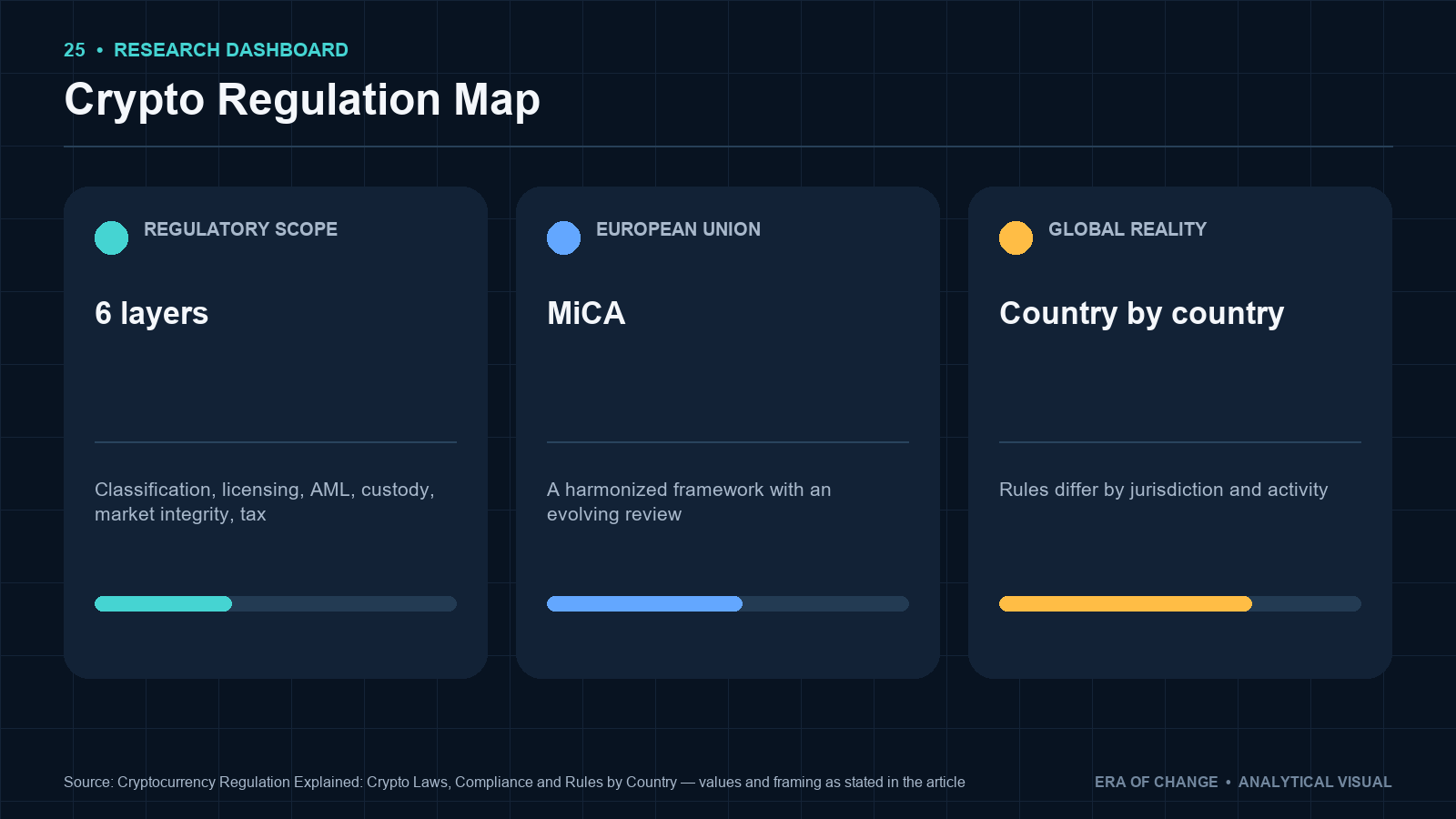
It’s useful to think of crypto regulation as six distinct layers rather than one undifferentiated mass of rules, because each layer answers a genuinely different question. Asset classification asks what a token legally is. Issuance asks who may create or sell it. Trading asks who may operate a market in it. Custody asks who may legally hold client assets. Payments and stablecoins ask who may issue a digital money-like instrument. And compliance asks what anti-money-laundering, sanctions, and reporting requirements apply across all of the above. A jurisdiction can be clear on some of these layers and genuinely unresolved on others, which is exactly the situation the U.S. is in right now, clear on stablecoins and asset classification, still unresolved on comprehensive market-structure legislation.
Crypto Asset Classification: Security, Commodity, or Something Else?
Classification matters because it determines which regulator has jurisdiction, what registration and disclosure obligations attach, which venues can legally trade the asset, and what restrictions apply to who’s allowed to buy it. Broadly, and without asserting that any specific token automatically belongs in one bucket absent an official determination, the conceptual categories in play include securities-like tokens tied closely to an issuer’s efforts and profits, commodity-like digital assets that function more like a fungible tradeable good, payment stablecoins designed to hold a stable value against a reference currency, utility or access tokens tied to a specific network’s functionality, and tokenized versions of traditional securities that carry the same legal status as the underlying instrument.
Why Token Classification Has Been So Difficult
The structural problem is that a crypto asset can change function over the course of its own life. A token might begin through a centralized fundraising round, with a founding team actively developing the network and marketing the token to early buyers, activity that looks a great deal like an investment contract in the traditional securities sense. Over time, the same token may become part of a genuinely more decentralized network, where no single party controls development or drives its value.
That evolution creates real, unresolved questions around how to treat the original issuance versus the underlying network once decentralized, how much decentralization is enough to change the analysis, how ordinary secondary-market trading should be treated separately from the original sale, and how staking and governance participation fit into a framework built originally around traditional securities concepts. This is precisely the problem U.S. securities regulation has wrestled with for years, and it’s a large part of why formal guidance took as long as it did to arrive.
Cryptocurrency Regulation in the United States
The SEC and CFTC’s 2026 Joint Guidance
On March 17, 2026, the SEC and CFTC jointly issued Interpretive Release No. 33-11412, an agency interpretation that introduced a five-category taxonomy for digital assets: digital commodities, digital collectibles, digital tools, payment stablecoins, and digital securities. The interpretation says that a digital commodity, as an asset type, is not itself a security under the described category; that does not determine the treatment of every offer or sale involving the asset, which may still involve an investment contract and securities-law questions. The guidance identified 18 major cryptocurrencies, including Bitcoin and Ethereum, as examples of digital commodities, describing the category in economic and commercial terms. This is a meaningful shift from the earlier period, and it means the present U.S. system should not be characterized as having no clarity at all, a characterization that was fair in 2022 or 2023 and is no longer fair today.
The U.S. Stablecoin Framework
The GENIUS Act, signed into law on July 18, 2025, established a federal framework for fiat-backed payment stablecoins. It provides for at least one dollar of permitted reserve assets for every dollar of covered stablecoins outstanding, with eligible reserves defined by the statute and implementing rules. These requirements are subject to the Act’s effective-date formula: the earlier of 18 months after enactment or 120 days after final implementing regulations.
The Act also sets out redemption, reserve-reporting, and technical requirements for permitted payment-stablecoin issuers. These statutory obligations are subject to the Act’s effective-date formula and implementing regulations.
Notably, the statute exempts stablecoin issuers from the same regulatory capital standards applied to traditional banks, while still requiring federal and state regulators to develop tailored capital, liquidity, and risk-management rules specific to stablecoin issuers. For the risks this framework is designed to manage, see Era’s Stablecoin Risks Explained.
What the United States Still Has Not Fully Resolved
Agency interpretation can clarify how existing law applies, but it can’t durably define jurisdiction the way an actual statute can; a future SEC or CFTC leadership could revisit an interpretive release in a way that’s considerably harder to do to an act of Congress.
The unresolved piece as of August 2026 is comprehensive market-structure legislation, currently centered on the CLARITY Act, which would divide oversight of digital assets between the SEC and CFTC more durably and establish rules for exchanges, token issuers, and certain DeFi platforms. The bill has faced repeated delays: Senate Majority Leader John Thune indicated on August 3, 2026 that the bill would get a floor vote before the August recess, the Senate instead filed a cloture motion on August 8 without a floor vote following, and the chamber is not expected to return to the question until September 14, 2026, when it will have roughly three weeks to work through this alongside other business.
The core sticking points involve unresolved disagreement between traditional banking interests and digital-asset service providers, plus broader political polarization around crypto policy that’s made a bipartisan compromise harder to land than the stablecoin bill was.
Regulation by Enforcement: Era’s Critique of the Earlier U.S. Model
It’s worth being precise about the period this critique actually describes. For much of the pre-2025 era, U.S. crypto regulation effectively operated through enforcement actions and litigation rather than through a purpose-built statute: rules were established retroactively through SEC lawsuits rather than through published rulemaking, jurisdiction between the SEC and CFTC remained genuinely disputed in practice, companies lacked a predictable path to determine how a given token would be classified before launching it, and that legal uncertainty raised operating costs meaningfully for anyone trying to build compliant crypto infrastructure in the U.S.
That’s an accurate description of the environment through roughly 2024. It is a considerably less accurate description of 2026, now that a stablecoin statute is law and a formal joint interpretive taxonomy exists, even though the deeper market-structure question the enforcement-heavy period never resolved is still sitting in front of Congress.
Cryptocurrency Regulation in the European Union: MiCA
What MiCA Regulates
MiCA creates harmonized rules across the EU covering crypto assets that fall outside existing EU financial-services law, with specific provisions addressing crypto-asset issuers generally, asset-referenced tokens, e-money tokens functioning as stablecoins, and crypto-asset service providers offering trading, custody, and related services across the bloc.
Why MiCA Matters
Before MiCA, firms operating across the EU faced fragmented national regimes, with compliance obligations that could differ meaningfully from one member state to the next. A single harmonized framework makes cross-border compliance considerably more predictable for any firm trying to operate across multiple EU markets at once.
MiCA Is Still Evolving
On May 20, 2026, the European Commission launched a targeted public consultation reviewing MiCA, open through August 31, 2026 after one deadline extension, examining whether the framework remains fit for purpose as institutional adoption accelerates. The review covers scope and definitions, stablecoin rules specifically, crypto-asset service provider obligations, DeFi, staking, NFTs, and the legal treatment of tokenized deposits. Among the issues under review: the increasingly blurred line between crypto-assets and traditional financial instruments, the absence of an equivalence framework for third-country stablecoin issuers (which currently limits EU access to global stablecoin liquidity), and whether current stablecoin rules are inadvertently hurting EU competitiveness. A report to the European Parliament and Council is due by June 30, 2027. The takeaway worth remembering: regulatory clarity does not mean regulatory rules stop changing. MiCA being comprehensive didn’t make it static.
Dubai and VARA: An Activity-Based Crypto Framework
Dubai’s Virtual Assets Regulatory Authority regulates virtual-asset activities across Dubai’s mainland and free zones, with the notable exception of the DIFC, which operates under its own separate financial-regulatory jurisdiction. VARA maintains detailed activity-specific rulebooks, a formal licensing regime, and a public register of licensed providers, which makes VARA’s growth measurable rather than anecdotal, a genuinely useful property for an article trying to move past vague “crypto-friendly” labeling.
What VARA Regulates
VARA’s licensing categories cover broker-dealer services, exchange operations, custody, lending and borrowing activity where regulated, transfer and settlement services, token issuance, and marketing of virtual-asset products and services.
VARA, established in 2022, issued its 50th VASP license on July 2, 2026, granted to Tribe Tokenisation FZE. VARA’s public register shows 12 full VASP licenses issued with 2026 dates, with at least one new full license issued in every month from January through July, alongside 14 additional In-Principle Approvals dated in 2026, the conditional pre-licensing step firms pass through before receiving full authorization. That’s a genuinely measurable growth curve, not a marketing claim.
Why Era Views MiCA and VARA as Useful Models
This is my own assessment, not an objective industry ranking, and I want to be upfront about that. What I find useful about both frameworks is clearer asset classification, defined licensing requirements a firm can actually plan around, explicit obligations for issuers and custodians spelled out in advance rather than discovered through enforcement, greater overall predictability, and considerably less uncertainty about which authority actually regulates a given activity.
The nuance that matters here: “good regulation” doesn’t necessarily mean less regulation. From an institutional allocator’s perspective, predictability is frequently worth more than permissiveness: a strict but clearly mapped licensing process is easier to build a business or an allocation decision around than an ambiguous, enforcement-driven one, even if the ambiguous regime is technically less restrictive on paper.
Crypto Regulation by Country
| Jurisdiction | Regulatory Model | Major Regulator(s) | Stablecoin Framework | Licensing | Era Assessment |
|---|---|---|---|---|---|
| United States | Multi-agency + federal statute (stablecoins) | SEC, CFTC, federal/state banking regulators | Yes (GENIUS Act, 2025) | Activity-dependent; market-structure statute pending | Improving, still unfinished |
| European Union | Harmonized MiCA, under active review | ESMA + national competent authorities | MiCA (e-money tokens / asset-referenced tokens) | CASP authorization | High clarity, evolving |
| Dubai / UAE | Activity-based licensing | VARA (+ DIFC separately under its own regime) | Jurisdiction-dependent | VASP licensing | High clarity |
| Singapore | Payment services / digital-token framework | MAS | Regulated under Payment Services Act | Standard/Major Payment Institution licensing | High clarity, Basel crypto rules delayed to 2027 |
| Switzerland | Existing financial law + DLT framework | FINMA | Addressed via existing banking/AML law | Banking license or FINMA authorization | High clarity, strong banking access |
| Hong Kong | Licensed virtual-asset regime, dealer/custodian rules pending | SFC | Under development | VATP licensing; dealer/custodian regime drafted Dec 2025 | Improving, legislation pending in 2026 |
Last updated: August 20, 2026. Confirm current status against each regulator’s own publications before republishing, as several rows describe frameworks in active motion.
Singapore, Switzerland, and Hong Kong
Singapore’s framework runs through the Payment Services Act of 2019, which brought crypto services under MAS oversight relatively early relative to global peers. Licensing tiers scale with transaction volume: a Standard Payment Institution needs SGD 100,000 in base capital, while a Major Payment Institution needs SGD 250,000 plus an additional security deposit. Singapore postponed implementation of the Basel Committee’s international crypto prudential rules from 2026 to 2027 after industry feedback, which is worth noting as a sign that even a well-regarded regulator adjusts its own timeline under pressure.
Switzerland’s approach layers a dedicated distributed-ledger-technology framework on top of existing financial law rather than building an entirely separate crypto statute, supervised by FINMA. What makes Switzerland distinctive isn’t the licensing process itself so much as genuine banking access: dedicated crypto-native banks like Sygnum and SEBA give Swiss-licensed businesses banking relationships that remain considerably harder to secure in many other jurisdictions, and Switzerland applies a 0% private capital-gains tax for individual investors, which shapes where certain investor capital chooses to sit.
Hong Kong runs a licensed virtual-asset trading platform regime under the SFC, with a VATP license requiring HKD 5 million in paid-up capital plus HKD 3 million in liquid assets. On December 24, 2025, the SFC and the Financial Services and the Treasury Bureau jointly published consultation conclusions establishing separate licensing regimes specifically for virtual-asset dealers and custodians, with draft legislation targeted for 2026, meaning Hong Kong’s framework, while further along than the U.S. on market structure specifically, is still mid-build rather than finished.
What Is Crypto Compliance?
Crypto compliance is the set of systems digital-asset businesses and financial institutions use to meet their legal and regulatory obligations in practice. That typically spans know-your-customer identity verification, anti-money-laundering programs, sanctions screening, Travel Rule compliance for transfers, ongoing transaction monitoring, customer risk assessment, recordkeeping, tax reporting, and market-abuse controls. Compliance has increasingly become the actual bridge connecting crypto-native infrastructure to institutional finance: a platform without a credible compliance program simply doesn’t get a banking relationship or an institutional counterparty, regardless of how sound its underlying technology is.
Why Crypto Compliance Matters for Investors
Weak compliance at any point in the chain can produce loss of banking access, exchange restrictions, asset freezes, direct regulatory enforcement action, withdrawal disruptions during a stress event, and reduced institutional participation generally. That means investors evaluating any crypto position should be looking past the token itself to the regulatory status of the issuer, the exchange it trades on, the custodian actually holding the asset, the stablecoin used as a settlement rail if relevant, and the jurisdiction all of the above sit inside.
How Regulation Redirects Crypto Capital
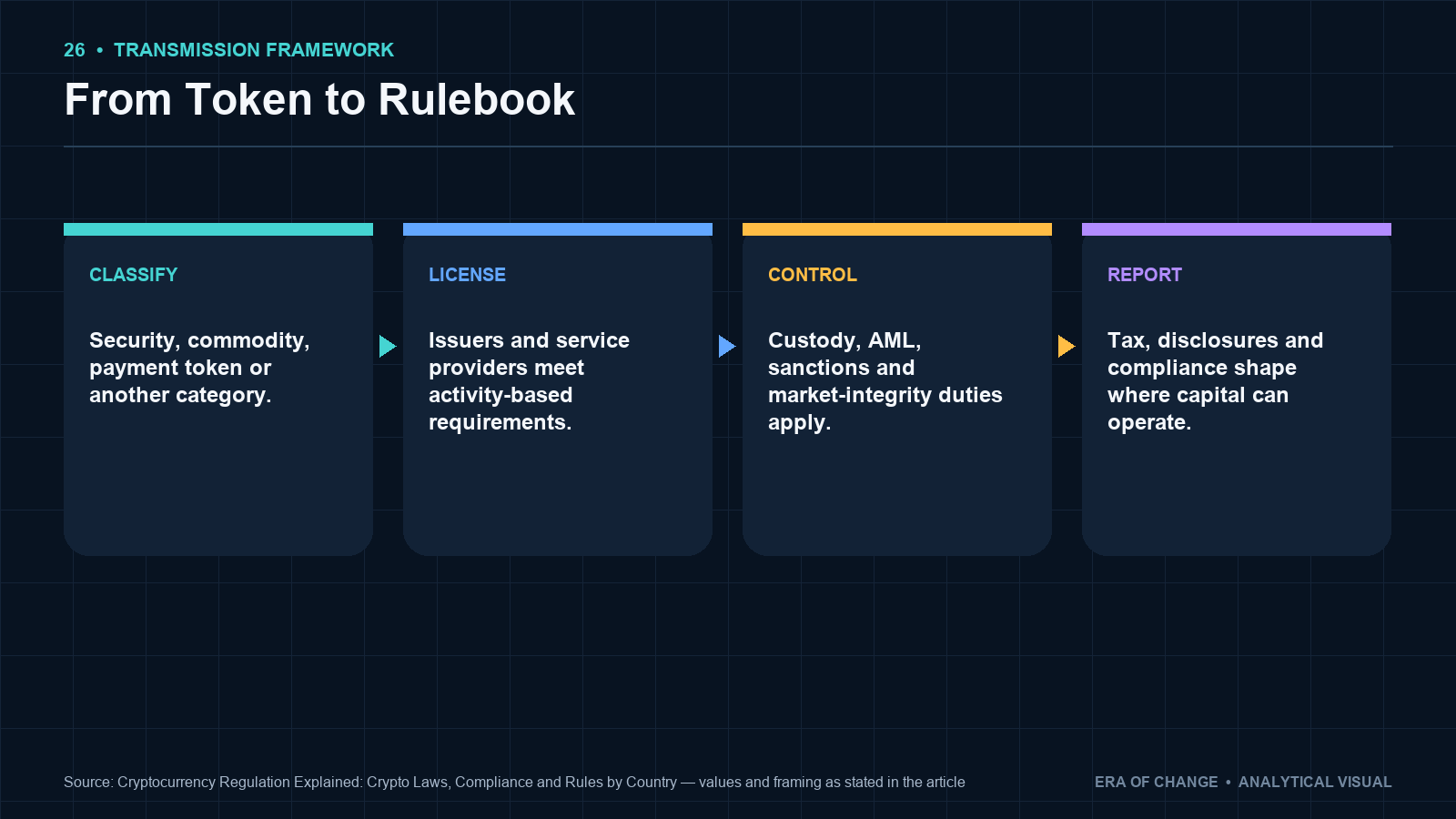
This is one of Era’s central theses in this space: capital follows regulatory certainty, not simply regulatory leniency. The transmission runs in a fairly direct line. Uncertain rules raise legal and compliance costs, which lowers institutional willingness to participate, which pushes companies toward relocation, which pulls liquidity along with them toward the new jurisdiction. Run the same chain in reverse and a clear framework produces usable licenses, which produce workable banking relationships, which produce real institutional infrastructure, which produces genuinely deeper liquidity. Neither direction happens instantly, but both are observable over a multi-year horizon, which is exactly the kind of measurable market process Era’s forecasting methodology is built to track, described in more depth in Era’s Forecasting Methodology.
The Geography of Crypto Capital Is Changing
Several distinct types of capital and infrastructure respond to this dynamic: crypto-native companies, market makers, funds, individual developers, exchanges, institutional custody providers, and venture capital all weigh regulatory clarity when deciding where to locate. The UAE, Singapore, Switzerland, and Hong Kong have each positioned themselves as destination hubs for at least some of this movement. It’s worth drawing a clear line between two things that get conflated constantly in crypto media coverage: where a company incorporates is not the same metric as where its actual trading liquidity or institutional capital sits. A firm can maintain a Dubai license while still running the bulk of its trading volume and client relationships elsewhere; incorporation location is a real signal, but it’s not a complete one on its own.
The U.S. 2023-2024 Banking-Access Debate
During 2023 and 2024, crypto-industry participants and some policymakers used the term “Operation Choke Point 2.0” to describe what they characterized as coordinated regulatory pressure on banks to limit crypto firms’ access to banking services, a claim that remains genuinely contested rather than an agreed-upon fact, and it’s worth presenting it that way rather than as settled history.
What’s better documented is that market makers Jane Street and Jump Crypto both pared back their U.S. crypto trading activity around this period; Bloomberg reported in May 2023 that both firms were retreating from U.S. crypto trading amid regulatory pressure, with Jump continuing to expand internationally (including securing a Bermuda license and pursuing UAE plans) even as it scaled back U.S. activity specifically.
I want to flag directly that verifying the precise internal reasoning behind any single firm’s relocation decision is difficult from public reporting alone, and the connection between banking-access pressure specifically and any individual firm’s strategic decision should be read as Era’s interpretation of a broader, documented trend rather than a confirmed causal chain for any one company.
Dubai as a Regulatory Competition Case Study
The Jane Street and Jump Crypto episode illustrates the underlying thesis regardless of exactly how much weight to place on any single company’s decision: clear rules can function as an economic development strategy in their own right. VARA’s measurable licensing growth through 2026 (50 total VASP licenses, a steady monthly cadence of new full licenses, and 14 additional In-Principle Approvals in progress) is the kind of concrete, publicly verifiable data point that supports the broader capital-migration thesis without relying on any single anecdote to carry the argument.
Does Strict Regulation Hurt Crypto Innovation?
Not necessarily, and the honest answer depends heavily on which kind of “strict” is actually in play. A framework that’s strict but predictable lets businesses know in advance what’s permitted, how to actually obtain a license, what compliance costs to plan for, and what capital requirements apply before they commit resources to building in that jurisdiction. A framework that’s uncertain and discretionary leaves businesses unable to confidently determine which regulator even applies, whether a product they’ve already launched might later be challenged retroactively, or what registration path (if any) actually exists for what they’re trying to build. For institutional capital specifically, predictability tends to matter more than whether a given regime is objectively strict on paper.
How Cryptocurrency Regulation Affects Investors
Market Access
Regulation determines which specific assets and products an investor is legally permitted to buy in their jurisdiction, and through which venues.
Liquidity
Where exchanges, market makers, and institutional participants are actually permitted to operate directly shapes how deep and reliable liquidity is for any given asset.
Custody
Regulation determines who is legally permitted to safeguard client assets, and under what segregation and disclosure standards.
Token Valuation
Regulatory classification can directly change exchange availability, institutional access, and compliance cost, all of which feed into how an asset actually trades, independent of its underlying fundamentals.
Stablecoins
Reserve and issuer rules directly shape whether a given stablecoin functions as reliable payment infrastructure or carries meaningful counterparty risk.
Counterparty Risk
Licensed platforms generally face more extensive custody and disclosure requirements than unlicensed ones, though it’s worth being direct that licensing reduces certain risks without eliminating counterparty risk altogether.
How Regulation Affects Institutional Crypto Adoption
Institutional investors generally require clear asset classification before committing capital, regulated custody they can point to in a compliance review, approved trading venues, functioning compliance infrastructure, defined accounting and tax treatment, and genuine legal certainty around the position they’re taking. The chain runs directly from regulatory clarity to infrastructure to institutional access to, eventually, actual allocation, which is exactly the transmission mechanism explored in more depth in Era’s Institutional Crypto Adoption Trends.
Stablecoin Regulation as the Bridge Between Crypto and Banking
Stablecoins sit at a genuinely unusual intersection: connecting blockchain settlement directly to commercial banks, Treasury markets, payments infrastructure, and corporate finance in a way most other crypto assets don’t. Regulation shapes who’s eligible to issue a stablecoin, what reserve composition is permitted, how redemption must work in practice, who can custody the reserves, what yield or payment structures are allowed, and what banking access issuers can actually secure. The enacted GENIUS Act’s reserve and disclosure framework is a clear U.S. example, with requirements phased under its statutory effective-date and rulemaking provisions. See E.R.A. OF CHANGES’ Stablecoin Risks Explained for the failure modes this framework is designed to guard against.
Crypto Regulation vs. Crypto Prohibition
Worth drawing this distinction clearly because the two produce very different outcomes for capital. Regulation licenses activity, supervises it on an ongoing basis, restricts certain practices, and requires disclosure, while still permitting the underlying activity to exist within defined boundaries. Prohibition attempts to ban an activity outright, prevent regulated financial institutions from facilitating it at all, and restrict market access entirely. A jurisdiction that regulates crypto activity tends to retain the capital and companies willing to comply with its rules. A jurisdiction that prohibits it tends to push that same activity, and the capital behind it, toward jurisdictions willing to regulate rather than ban.
Regulation and Decentralized Finance
DeFi remains one of the genuinely hardest frontiers for regulators globally, and it’s worth resisting the temptation to assert settled answers here. Real open questions include who bears responsibility for a protocol with no clear central operator, whether a website frontend interacting with smart contracts constitutes a regulated intermediary in its own right, how governance tokens that confer voting rights over a protocol should be classified, who is actually positioned to perform KYC on users interacting directly with immutable code, and whether genuinely decentralized software can even comply with rules written around the assumption of an identifiable intermediary. DeFi is, honestly, one of the areas where global regulatory frameworks remain furthest from any kind of harmonization, and that’s likely to remain true for some time.
Regulation and Self-Custody
A related and separately difficult frontier. Regulators are still working through whether private, self-custodied wallets should remain fundamentally unrestricted, at what point wallet software itself becomes a regulated service rather than a neutral tool, how anti-money-laundering rules should apply to transfers between self-custodied addresses with no intermediary involved, and what responsibilities fall on licensed intermediaries when they interact with counterparties using self-custody. This is a dimension most competing overviews of crypto regulation skip entirely, and it’s a genuine gap in how comprehensive most “crypto laws by country” content actually is.
The Biggest U.S. Regulatory Catalyst for the Next 12 Months
The single most consequential open question in U.S. crypto policy right now is whether Congress actually codifies a durable market-structure framework (defining the SEC’s and CFTC’s respective roles and establishing clear rules for digital-asset trading and issuance) rather than leaving the field to agency interpretation alone. If the CLARITY Act or comparable legislation passes, the likely effects include meaningfully greater institutional certainty, a clearer exchange-registration pathway, reduced classification ambiguity for new token launches, expanded bank participation in crypto markets, more predictable token-issuance processes, and materially lower risk that a future administration simply reverses today’s interpretive guidance by fiat.
What Happens If U.S. Market-Structure Legislation Fails Again?
The SEC/CFTC’s March 2026 joint interpretation would continue providing meaningful clarity even without a statute behind it; that guidance doesn’t disappear if Congress fails to act. But real risk remains in that scenario: a future administration could reverse or narrow that interpretation without needing congressional approval, ongoing litigation could reopen questions the guidance was meant to settle, cross-agency uncertainty could persist in edge cases the interpretation didn’t anticipate, and institutional investors who’ve been waiting specifically for legislative durability rather than agency interpretation could continue sitting on the sidelines. That’s precisely why congressional legislation still matters even in a genuinely more crypto-friendly regulatory environment than existed two years ago.
Three Crypto Regulation Scenarios
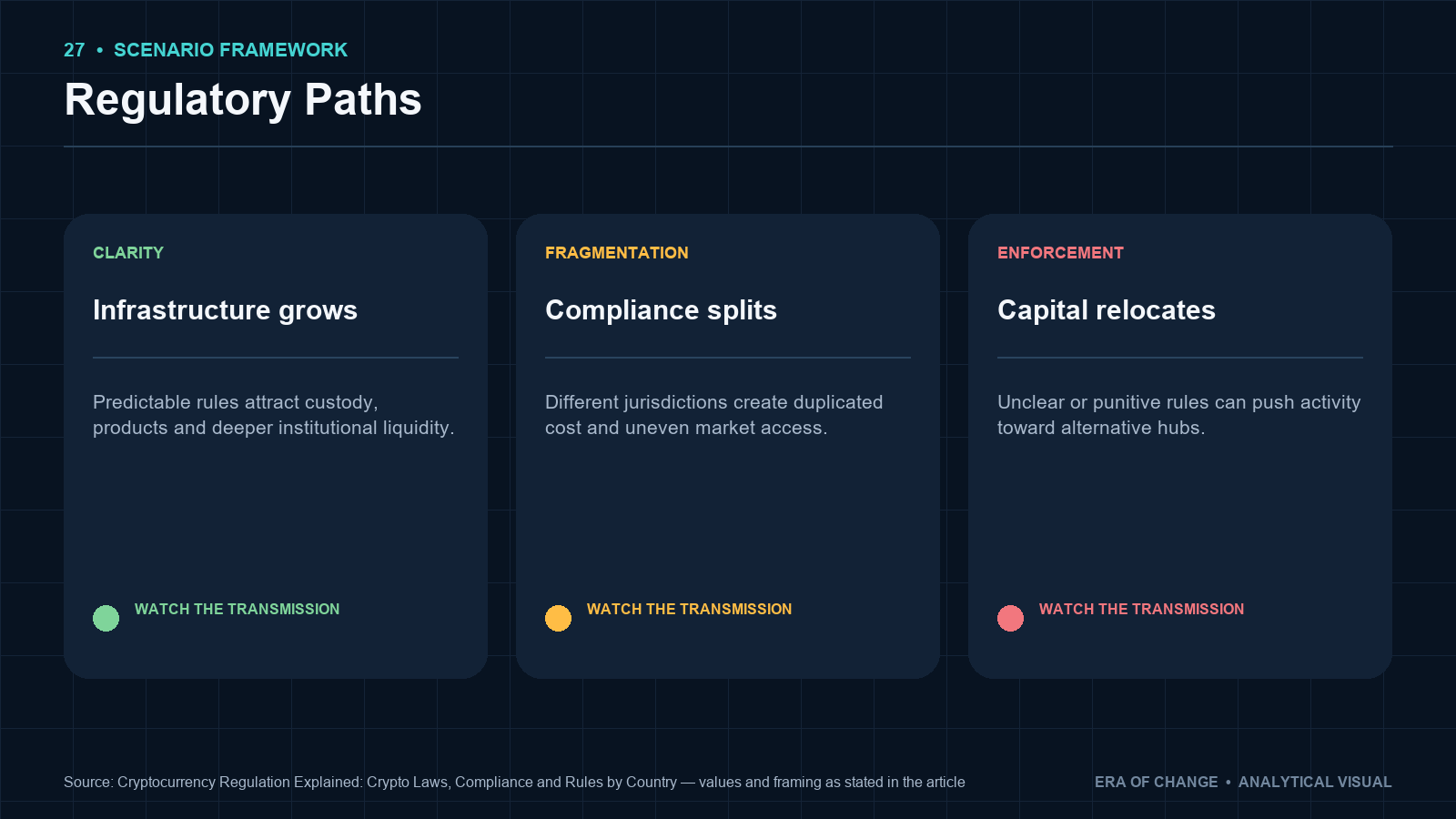
Scenario 1: Regulatory Convergence
Major jurisdictions converge on clear licensing regimes, stablecoin frameworks align more closely with each other, institutional custody expands broadly, and cross-border compliance becomes increasingly standardized. The likely result: crypto integrates more deeply into traditional financial markets rather than remaining a parallel system.
Scenario 2: Regulatory Competition
Jurisdictions continue competing through genuinely different rules, companies keep relocating toward whichever framework offers the clearest path, capital concentrates in a handful of regulatory hubs, and meaningful regional differences persist rather than converging. This looks closest to the actual state of the world as of mid-2026.
Scenario 3: Regulatory Fragmentation
Classification stays conflicting across major jurisdictions, cross-border restrictions multiply, sanctions regimes complicate compliance further, stablecoin rules remain incompatible across borders, and restrictions on DeFi and self-custody tighten unevenly. The likely result here is liquidity fragmenting across incompatible jurisdictions and infrastructure rather than consolidating anywhere.
How to Evaluate a Crypto Jurisdiction
Before committing capital or operations to any specific jurisdiction, it’s worth working through a consistent set of questions: who is the actual regulator, which specific activities require a license, how are tokens classified under that regime, are stablecoins addressed by a separate framework, can institutional-grade custodians legally operate there, what AML and KYC rules apply in practice, are client assets required to be segregated from a platform’s own balance sheet, how are DeFi and self-custody treated under the existing rules, are the rules actually published in advance of enforcement rather than discovered through litigation, and can a fully compliant firm actually secure banking access once licensed. That last question is, in practice, where several jurisdictions that look strong on paper still fall short.
Era Analyst’s Perspective
The comparison that tells you the most about how regulation actually shapes capital isn’t the U.S. versus the EU: it’s Dubai’s licensing curve against the years the U.S. spent litigating classification instead of legislating it. VARA has issued 50 VASP licenses as of July 2026, with a full license granted in every single month from January through July and 14 more In-Principle Approvals moving through the pipeline behind them.
That’s a public register anyone can check. Meanwhile the CLARITY Act, the piece of U.S. legislation that would finally settle the SEC-versus-CFTC jurisdiction question durably, missed its own August floor-vote target and won’t get another shot until the Senate returns on September 14. I don’t think the U.S. loses this permanently: the GENIUS Act and the March 2026 joint SEC-CFTC taxonomy are real, substantive progress that wouldn’t have happened three years ago. But every month market-structure legislation stays stuck in Congress is another month institutional capital that specifically wants legislative durability, not agency interpretation that a future administration could simply walk back, keeps looking at Dubai’s public VASP register instead of waiting in Washington.
Frequently Asked Questions
What is cryptocurrency regulation?
It’s the body of laws, licensing requirements, and supervisory standards governing digital assets and the businesses that issue, trade, custody, or transfer them: covering everything from how a token is classified to who’s permitted to safeguard client assets.
Is cryptocurrency regulated?
There’s no single yes-or-no answer, because regulation applies differently depending on the specific activity: a Bitcoin ETF, a centralized exchange, a stablecoin issuer, and a DeFi protocol can each fall under entirely different regulatory treatment, sometimes within the same country.
What are the main crypto laws?
Key frameworks as of 2026 include the EU’s MiCA regulation, the U.S. GENIUS Act governing payment stablecoins, the March 2026 SEC/CFTC joint interpretive taxonomy, Dubai’s VARA activity-based licensing regime, and jurisdiction-specific frameworks in Singapore, Switzerland, and Hong Kong.
Who regulates cryptocurrency in the United States?
Primarily the SEC and CFTC for asset classification and market activity, alongside federal and state banking regulators for stablecoin issuers under the GENIUS Act, FinCEN for anti-money-laundering compliance, and OFAC for sanctions screening, with jurisdiction split across categories rather than concentrated in a single agency.
Is cryptocurrency regulated by the SEC or CFTC?
Both, depending on the asset and the transaction. Under the March 2026 joint interpretive taxonomy, digital commodities such as Bitcoin and Ethereum are not classified as securities as asset types under the described category. But an offer or sale involving a non-security token may still involve an investment contract and raise securities-law questions; the taxonomy does not resolve every transaction. Payment stablecoins are addressed separately by the GENIUS Act, subject to its effective date and implementing rules.
What is MiCA crypto regulation?
MiCA is the European Union’s harmonized regulatory framework for crypto assets falling outside existing EU financial-services law, covering issuers, stablecoins, and crypto-asset service providers across all EU member states under one set of rules rather than fragmented national regimes, currently under a formal review the European Commission launched in May 2026.
How is crypto regulated in Dubai?
Through VARA, an activity-based licensing authority covering Dubai’s mainland and free zones (excluding the DIFC, which has its own separate regime), with distinct licensing categories for exchanges, custody, broker-dealer services, lending, and token issuance, backed by a public register of licensed providers.
Which countries have clear cryptocurrency regulations?
The EU under MiCA, Dubai/UAE under VARA, Singapore under the Payment Services Act, and Switzerland under FINMA’s DLT framework are generally regarded as offering relatively high regulatory clarity, though each framework continues evolving; Hong Kong is improving but still has dealer/custodian legislation pending as of 2026.
What is crypto compliance?
The systems digital-asset businesses use to meet legal obligations, including know-your-customer verification, anti-money-laundering programs, sanctions screening, Travel Rule compliance, transaction monitoring, recordkeeping, and tax reporting, increasingly the deciding factor in whether a crypto business can access banking relationships at all.
Why do crypto exchanges need KYC?
Know-your-customer requirements let exchanges verify user identity to comply with anti-money-laundering law, screen against sanctions lists, and support law-enforcement requests, obligations that are now standard for any exchange seeking a real banking relationship or institutional counterparty.
How does regulation affect Bitcoin and crypto prices?
Regulatory clarity or uncertainty shapes institutional participation, available liquidity, and market access, all of which feed into pricing indirectly: a formal classification decision, a new licensing framework, or unresolved legislative uncertainty can each move institutional willingness to allocate capital, even without directly touching the asset’s underlying fundamentals.
How does cryptocurrency regulation affect institutional adoption?
Institutional investors generally require clear asset classification, regulated custody, approved trading venues, functioning compliance infrastructure, and defined tax treatment before committing meaningful capital, meaning regulatory clarity functions as a direct precondition for institutional access rather than merely a background legal consideration.
What is stablecoin regulation?
The GENIUS Act, enacted in 2025, provides a federal framework for permitted payment-stablecoin issuers, including reserve, redemption, and reporting requirements. Those provisions take effect under the Act’s statutory effective-date formula and implementing regulations.
How does crypto regulation differ by country?
Substantially, across regulatory model, which agency has jurisdiction, whether a dedicated stablecoin framework exists, and how licensing actually works in practice: ranging from the EU’s single harmonized MiCA framework to the U.S.’s multi-agency system to Dubai’s activity-based VARA licensing regime, each producing different practical outcomes for where companies and capital choose to operate.
About E.R.A. OF CHANGES
E.R.A. OF CHANGES is an independent macroeconomic, financial-market, cryptocurrency, and geopolitical research firm providing institutional-quality analysis for investors worldwide. Its research combines macroeconomic data, blockchain analytics, market structure, institutional flows, and geopolitical risk to identify structural changes across global financial markets. Era evaluates cryptocurrency regulation not solely as a legal issue, but through its effects on capital allocation, liquidity, custody, banking access, institutional adoption, and the geographic development of digital-asset markets.
The content published by E.R.A. OF CHANGES is for informational and educational purposes only and does not constitute financial, investment, legal, or tax advice. All views expressed are the personal analytical perspective of the author. Past forecast accuracy does not guarantee future results. Readers should conduct their own research and consult a qualified financial professional before making any investment decisions.
Sources
- The GENIUS Act: Fact Sheet (The White House)
- S.1582 GENIUS Act (Congress.gov)
- SEC and CFTC Issue Landmark Joint Interpretation on Crypto Asset Classification (Jenner & Block)
- SEC-CFTC Clarify Crypto Asset Classification Rules (Weaver)
- Senate Won’t Vote on Crypto Clarity Act Before Its Summer Break (CoinDesk)
- Clarity Act: Here’s What Could Happen With the Crypto Market Structure Legislation (CoinDesk)
- Commission Seeks Feedback on the Functioning of EU Crypto-Assets Rules (European Commission)
- Fit for Purpose? European Commission Launches Review of MiCA (Skadden)
- VARA Issues 50th VASP Licence as Dubai’s Regulated Virtual Assets Market Continues to Grow (Zawya/TradingView)
- Market Makers Jane Street, Jump Retreating From U.S. Crypto Trading: Bloomberg (CoinDesk)
- Hong Kong’s SFC, FSTB Target 2026 Legislation for Virtual Asset Dealer and Custodian Rules (CoinDesk)
- Singapore: Setting the Standard for Clear Crypto Regulation (MCO)