.
Institutional crypto adoption should be measured through infrastructure and persistent capital allocation, not through price appreciation. A rising Bitcoin chart tells you retail and momentum capital showed up. It does not tell you whether a pension board, a custody bank, or a sovereign fund has decided digital assets belong in the portfolio permanently.The strongest structural evidence I see in 2026 is the integration of crypto into institutional custody, clearing, ETF, brokerage, and portfolio-management infrastructure: Fidelity, BNY Mellon, and the wealth platforms building the rails that let a compliance department say yes.
The transition that matters is the one where digital assets stop being a specialized speculative trade and become a recurring line item subject to normal rebalancing. I think sovereign wealth funds and public pension systems are an underappreciated source of long-duration demand here, particularly funds in regions thinking strategically about currency and reserve diversification. But none of this is irreversible.
My falsification test is specific: if institutional crypto ETFs see sustained net outflows for more than six months while the S&P 500 and Nasdaq remain in a healthy bull market and liquidity stays supportive, the strategic-allocation thesis needs to be reconsidered, because that combination would mean institutions abandon the asset class precisely when capital is abundant and risk appetite is strong.
Key Takeaways
- Institutional adoption is broader than institutions simply buying Bitcoin: it spans trading, custody, investment products, portfolio allocation, and settlement infrastructure.
- Custody, clearing, brokerage access, and portfolio integration are stronger structural signals than a temporary wave of ETF inflows.
- ETFs reduced the operational barriers (private-key management, unfamiliar custody, unfamiliar reporting) that previously kept traditional investors out of crypto entirely.
- Sovereign wealth funds and pension systems could matter more than hedge funds precisely because their investment horizons run in years and decades, not quarters.
- Corporate Bitcoin adoption is a distinct trend from asset-manager adoption, and the two shouldn’t be counted together as if they’re the same signal.
- Blockchain adoption and crypto-asset adoption are not identical concepts: an institution can build on blockchain rails without ever owning a token, and vice versa.
- Sustained ETF outflows during a genuinely favorable risk environment (strong equities, ample liquidity) would be the clearest evidence the institutional-adoption thesis has failed.
Introduction
“Institutions are entering crypto” has been a headline for roughly three years now, and it’s repeated so often it’s stopped meaning much. So it’s worth asking directly: what does that sentence actually claim?
Does institutional adoption mean a hedge fund trades Bitcoin futures for a quarter and closes the position? Does it mean a bank offers crypto custody as a service line without holding any crypto itself? Does it mean a wealth manager simply permits clients to buy a Bitcoin ETF if they ask? Does it mean a corporation puts Bitcoin on its balance sheet as a treasury asset? Does it mean a pension fund makes a deliberate, board-approved strategic allocation? Or does it mean a financial institution uses blockchain settlement rails without ever owning a unit of crypto at all?
These are six different things, and they represent six different depths of commitment. Collapsing them into one headline is how you end up with a market narrative that swings from “institutions are all-in” to “institutions are fleeing” based on a single ETF flow report, when the underlying reality moves far more slowly than that in either direction.
Era’s distinction is this: true institutional adoption begins when digital assets become part of financial infrastructure and recurring asset-allocation processes, rather than a temporary trading theme that gets unwound the moment the macro backdrop shifts.
What Is Institutional Crypto Adoption?
Institutional crypto adoption is the integration of cryptocurrencies and digital assets into the activities of professional financial institutions: asset managers, banks, brokerages, pension funds, sovereign wealth funds, insurance companies, hedge funds, endowments, and corporate treasuries.
That adoption can occur at several distinct levels: trading, custody, investment products, portfolio allocation, balance-sheet ownership, settlement infrastructure, and, at the deepest level, strategic reserve use. An institution can sit at any one of these levels without having reached the next. A hedge fund trading Bitcoin futures on the CME has adopted crypto at the trading level. That tells you nothing about whether a pension fund three states over has approved a strategic allocation. Treating both as the same data point is the single most common error in how this topic gets covered.
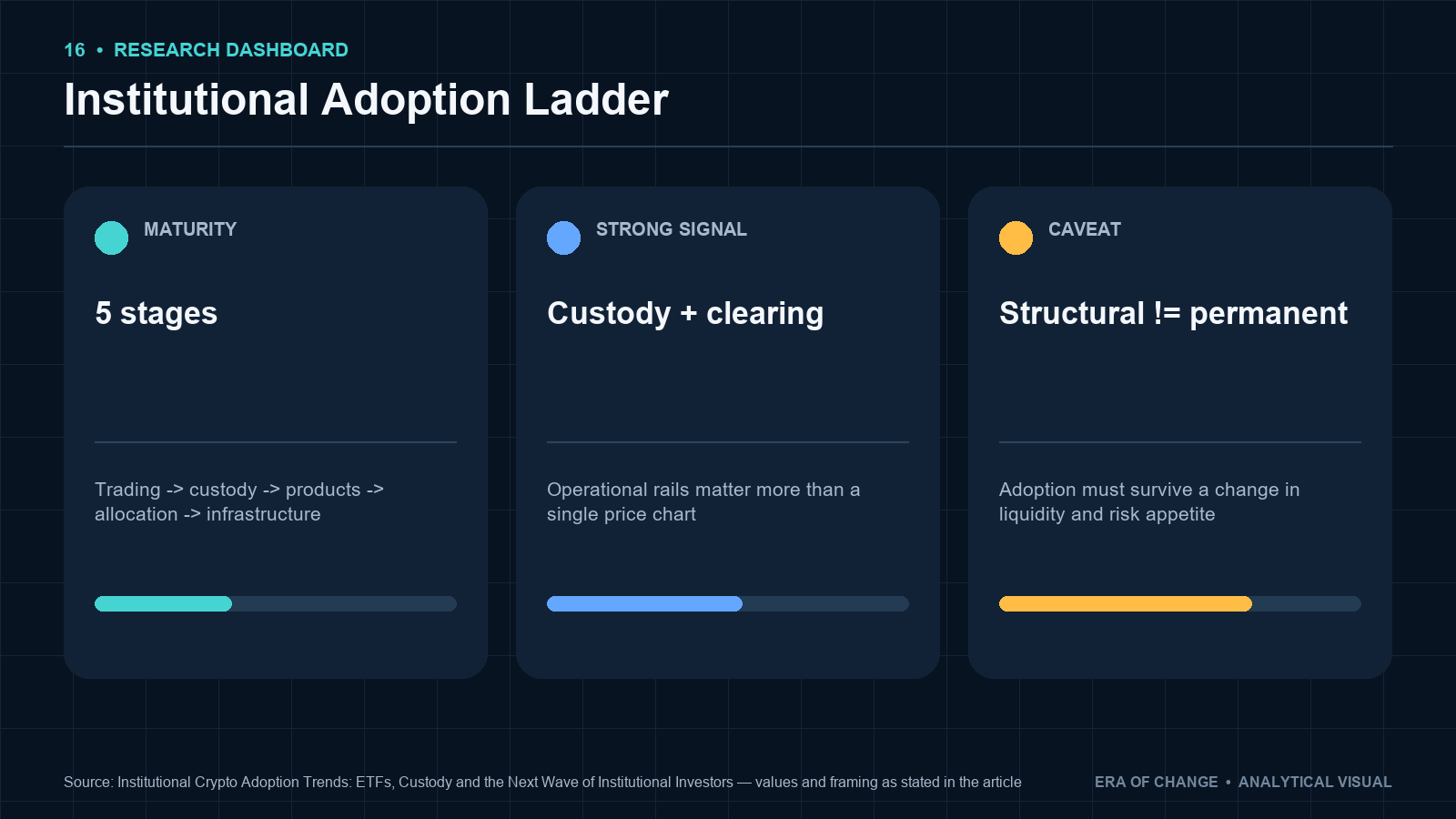
The Five Stages of Institutional Crypto Adoption
I think of institutional adoption as a maturity curve, not a binary switch. Each stage is harder to reverse than the one before it.
Stage 1: Experimental Trading
Institutions access crypto through futures, options, OTC trading, and short-term tactical positions. This is the weakest and most reversible form of adoption; capital can exit in an afternoon, and frequently does.
Stage 2: Institutional Custody
Banks and specialized custodians build infrastructure for asset safekeeping, key management, reporting, compliance, and audit trails. This matters because regulated custody removes a major operational barrier that previously kept conservative allocators out entirely; you no longer need an internal team that understands cold storage to hold the asset.
Stage 3: Regulated Investment Products
Spot ETFs, futures ETFs, structured products, and institutional funds let investors gain exposure without directly operating a crypto wallet. This is the stage most retail-facing coverage focuses on, because it’s the stage with daily, public flow data.
Stage 4: Strategic Portfolio Allocation
This is the important transition: crypto moves from an optional speculative trade to a permanent portfolio allocation subject to normal rebalancing, the same way an allocator rebalances an equity or fixed-income sleeve on a schedule rather than deciding fresh each quarter whether the asset class should exist in the portfolio at all. This is the stage closest to what I mean by structural adoption.
Stage 5: Financial Infrastructure Integration
The deepest stage. Digital assets become integrated into clearing, settlement, collateral, banking infrastructure, institutional portfolio systems, and treasury management. The further adoption moves down this stack, the harder it becomes to reverse: a bank does not build multi-year custody and clearing infrastructure and then unwind it because a quarter’s flows went negative.
The Strongest Evidence That Crypto Adoption Is Structural
When I look for evidence that this cycle is different from 2017 or 2021, I don’t start with price. I start with Stage 2 and Stage 5: custody and clearing infrastructure at the institutions that already hold trillions in traditional assets.
That’s where Tier-1 custodians and asset managers matter. Fidelity, which has run a dedicated digital-asset custody business since 2018, currently leads Strategy’s Bitcoin Banking Adoption Index (a 25-bank survey published in July 2026 that scores institutions on spot trading, custody, and digital-asset product breadth), with the highest adoption score in the survey, ahead of major banks including Goldman Sachs, JPMorgan, and Morgan Stanley.
BNY Mellon, custodian of tens of trillions of dollars in client assets, expanded its digital asset custody platform in August 2026 to add crypto staking through a partnership with Galaxy. Morgan Stanley and UBS have both moved to broaden brokerage and wealth-platform access to crypto for their client bases rather than restricting it to a narrow qualified-purchaser segment.
I want to be precise about what that does and doesn’t prove. It proves these institutions have made multi-year infrastructure commitments: the kind of capital outlay that isn’t reversed because of a bad quarter. It does not, by itself, prove that any specific institution currently treats Bitcoin as a standard line item in every model portfolio, and that distinction matters enough that I’d flag it explicitly rather than let the infrastructure story imply more than the evidence supports. Product availability and specific custody or brokerage offerings change quickly enough that anyone acting on this information should confirm current details directly with the institution in question before drawing investment conclusions from it.
Why Custody Matters More Than Headlines
Traditional institutions operate under requirements that a speculative retail trader never has to think about: segregated asset storage, auditability, regulatory compliance, risk controls, insurance arrangements, institutional-grade reporting, and unambiguous legal ownership. Before institutional-grade crypto custody existed at scale, holding the asset meant building an entirely separate operational universe (different systems, different security models, different reporting formats) just to accommodate one line item in a portfolio.
What’s changed is the direction of travel: crypto is increasingly fitting inside the same institutional processes already used for equities, bonds, and every other asset class a fund holds. That’s the insight worth sitting with. Institutional adoption becomes durable precisely when the investor no longer needs a separate operational universe to hold the asset: when it’s just another position in the same custody statement, subject to the same controls, reviewed by the same compliance team.
How ETFs Changed Institutional Crypto Adoption
Spot Bitcoin ETFs, trading since January 2024, solved a set of operational problems that had nothing to do with price and everything to do with plumbing.
Operational Complexity
Investors no longer need to manage private keys directly, run their own security infrastructure, or build internal expertise in wallet operations just to hold exposure.
Custody
Custody happens through the same institutional infrastructure (regulated, insured, audited) that already backs the rest of a fund’s holdings, rather than through a bespoke arrangement built specifically for this one asset.
Reporting
ETF positions integrate cleanly into existing portfolio and compliance systems. A position statement that already includes an ETF ticker doesn’t require a special exception process the way a direct crypto holding might.
Liquidity
ETFs trade through familiar brokerage infrastructure during normal market hours, with the same settlement mechanics as any other listed fund: no separate exchange accounts, no separate settlement rails.
Portfolio Construction
Investment committees can analyze crypto exposure using the same risk models, correlation analysis, and allocation frameworks they already apply to every other asset class, rather than needing a specialized crypto-native process. This is the mechanism worth understanding if you’re also thinking about how Bitcoin’s price cycles have historically been driven by retail speculation and halving-driven supply shocks; ETF-era demand runs on a different clock entirely.
ETF Adoption Is Not the Same as Permanent Adoption
Here’s the nuance that gets lost in most coverage: ETF inflows are not a homogeneous signal. They can come from long-term strategic allocators, tactical traders positioning around a macro view, basis-trade arbitrageurs, hedge funds running a relative-value strategy, momentum funds chasing price, and wealth-management clients making a one-time allocation decision. Gross ETF assets under management, by themselves, cannot prove that institutional investors consider Bitcoin a permanent strategic asset.
Better indicators exist, and they require more digging than a single AUM headline: holding duration, the persistence of flows across multiple quarters rather than one strong month, whether allocations survive drawdowns rather than getting sold at the first sign of stress, rebalancing behavior versus wholesale exit behavior, the number of platforms permitting allocation, growth in retirement and pension exposure specifically, and how concentrated ownership is among a small number of large holders versus broadly distributed.
Applied to 2026 specifically: total US spot Bitcoin ETF assets swung from roughly $104 billion in mid-May down to roughly $73 billion by the end of June, with June recording the worst monthly outflow total since the products launched and a record 13-consecutive-day outflow streak. That is a real, material flow signal, and it’s exactly the kind of data point that should be read as flow-layer noise unless it persists for months against a favorable macro backdrop, which is the falsification test covered later in this piece.
Who Are the Main Crypto Institutional Investors?
Asset Managers
Motivations here typically include responding to client demand, pursuing portfolio diversification, capturing new product revenue, and offering clients access to what they classify as an alternative asset.
Hedge Funds
Often the most tactical cohort. Strategies include directional exposure, basis trading between spot and futures, arbitrage across venues, options positioning, and relative-value trades. This is an important distinction to hold onto: hedge-fund participation does not necessarily equal structural adoption. A basis trade can be unwound as fast as it was put on.
Wealth Managers and Private Banks
Potentially the most consequential cohort long-term, because they control high-net-worth portfolios, model portfolios, and advisory allocations at scale. The structural signal to watch here isn’t whether a firm allows a client to request crypto exposure: it’s the movement from client-requested access toward standing approved-allocation frameworks that an advisor can recommend proactively, the way Morgan Stanley’s Global Investment Committee has issued portfolio guidance capping crypto exposure at a defined percentage of total assets depending on client risk profile, rather than leaving the decision to ad hoc requests.
Pension Funds
Longer-duration capital, but heavily constrained by fiduciary requirements, volatility tolerance, regulation, custody standards, governance processes, and (often underestimated) political scrutiny, since a public pension board’s allocation decisions are subject to public disclosure and second-guessing in a way a hedge fund’s are not.
Sovereign Wealth Funds
This is the category I think deserves its own section, because it’s the one most consistently underweighted in mainstream coverage.
The Most Underestimated Institutional Buyers: Sovereign Wealth Funds
Era’s thesis here is straightforward: sovereign wealth funds may matter more strategically than hedge funds because their investment horizons are measured in years or decades rather than quarters. A hedge fund enters a position to capture a return over a defined window. A sovereign fund enters a position to solve a balance-sheet problem: reserve diversification, currency diversification, exposure to a new asset class as part of a long-duration allocation mandate, and in some cases explicit geopolitical diversification away from reserve assets that carry counterparty or freeze risk.
The regions Nikolai flagged as most relevant here are the Middle East and Asia: sovereign funds in jurisdictions actively rethinking the composition of national reserves. It’s important to draw a hard line between two different claims: Era’s thesis about future or currently underappreciated demand from this investor class, and verified public allocations by specific named funds. On the second point, the clearest disclosed evidence comes from Abu Dhabi-linked sovereign entities.
Mubadala Investment Company’s Q1 2026 SEC 13F filing showed a Bitcoin ETF stake that had grown to roughly $566 million, an increase of 16% quarter-over-quarter, with the position built up consistently through Bitcoin’s fourth-quarter 2025 drawdown rather than in reaction to strength. Combined Abu Dhabi-linked sovereign holdings in that same ETF crossed roughly $1 billion by the end of 2025. Those are disclosed, filed numbers, not speculation about undisclosed allocations elsewhere, which is a distinction worth maintaining given how much sovereign-fund crypto commentary online treats rumor as fact.
Could Bitcoin Become a Sovereign Hedge?
This is worth engaging carefully rather than dismissively. Some sovereign investors may evaluate Bitcoin as a potential hedge against domestic currency depreciation, monetary debasement, restrictions placed on traditional reserve assets, and broader geopolitical fragmentation: the same set of pressures I’ve written about in Era’s De-Dollarization Report covering the decline in the dollar’s share of global reserves.
But the case has real limits that shouldn’t be waved away by enthusiasm. Extreme volatility, regulatory uncertainty that varies significantly by jurisdiction, liquidity that can thin out precisely during periods of systemic stress, custody risk, political controversy attached to any public disclosure, the absence of any sovereign guarantee behind the asset, and a historical record that’s short relative to gold or government debt all argue for caution. The honest framing is this: Bitcoin may be evaluated by some sovereign allocators as a diversification instrument without being remotely equivalent to traditional reserve assets like gold or government bonds in terms of stability, depth, or historical precedent.
Why Sovereign and Pension Capital Could Change the Market
It’s useful to separate capital into two categories with very different behavior patterns. Fast capital (hedge funds, leveraged traders, tactical allocators) moves in response to short-term catalysts and can reverse a position within days. Slow capital (pensions, sovereign wealth funds, endowments, insurance portfolios) tends to trade less frequently, rebalance on a periodic schedule rather than react to news, hold positions through multi-quarter drawdowns, and evaluate the asset on a multi-year horizon.
More institutional ownership concentrated in slow capital could, over time, reduce the share of Bitcoin actively circulating and available for short-term trading. I’d stop short of claiming that necessarily means lower volatility: a smaller free float can just as easily amplify price moves during periods of stress as dampen them, and there isn’t yet enough of a track record through a full cycle to say which effect dominates.
Corporate Bitcoin Adoption
Corporate Bitcoin adoption is a distinct trend from asset-manager adoption, and conflating the two muddies the analysis. It occurs when companies hold Bitcoin on their balance sheet, incorporate it into formal treasury policy, accept crypto operationally in the business, or build crypto-related financial products.
Two motivations tend to get bundled together that shouldn’t be.
Strategic Treasury Adoption
Bitcoin treated as a long-term reserve asset, an alternative to holding excess cash, or a monetary hedge against currency debasement: a genuine treasury-policy decision made with board oversight, and made materially easier by a 2023 US accounting rule change (FASB ASU 2023-08) that lets companies report Bitcoin at fair market value rather than under the old cost-less-impairment model, which had previously made any holding look worse on the balance sheet than it actually was.
Tactical or Financial Engineering
Bitcoin exposure used to change investor perception of the company, increase the equity’s sensitivity to crypto prices as a trading vehicle, or raise capital specifically against a Bitcoin-accumulation strategy. This is a financial-engineering play as much as a treasury decision, and it carries a different risk profile than the first category.
The scale of this trend by mid-2026 is real: roughly 200 public companies had adopted some form of Bitcoin acquisition strategy as of July 2026, holding a combined 1.26 million BTC worth approximately $79 billion. Strategy, the company formerly known as MicroStrategy and the model’s originator since August 2020, remains by far the largest holder: 843,775 BTC as of July 12, 2026, acquired for roughly $63.7 billion at an average cost near $75,500 per coin, including around 175,000 BTC purchased in 2026 alone. Twenty One Capital holds roughly 43,514 BTC, and Japan’s Metaplanet (often described as “the MicroStrategy of Asia”) holds roughly 35,102 BTC.
Corporate ownership, on its own, is not automatically evidence that Bitcoin is an appropriate treasury asset for every company holding it. The two motivations produce very different balance-sheet risk, and treating every corporate Bitcoin holder as equivalent evidence of “adoption” overstates the signal.
What Would Make Corporate Bitcoin Adoption Sustainable?
The right lens is balance-sheet strength, debt structure, cash-flow stability, position size relative to the overall balance sheet, the financing source used to acquire the position, liquidity requirements of the operating business, accounting treatment, and governance quality around the decision.
The single most useful question: can the company survive a 50-70% Bitcoin drawdown (a magnitude the asset has experienced multiple times in its history) without impairing its core operating business? That question is not hypothetical in 2026. Bitcoin fell from above $126,000 in September 2025 into the low $60,000s by mid-2026, and the treasury-company model has shown real stress under that decline: several smaller treasury companies have sold their entire position and exited the strategy altogether, while the larger holders with stronger balance sheets and lower average cost bases have continued adding. That divergence, not the headline count of 200 corporate holders, tells you far more about which of these positions are sustainable.
Institutional Crypto Adoption vs. Blockchain Adoption
This distinction matters for clarity as much as for search relevance. Institutional crypto adoption means institutions own, trade, custody, or allocate to digital assets directly. Blockchain adoption means institutions use blockchain infrastructure for payments, tokenization, settlement, recordkeeping, collateral management, or securities issuance, without necessarily owning any crypto asset at all.
An institution can adopt blockchain technology without ever buying Bitcoin. An institution can also buy Bitcoin without meaningfully integrating blockchain technology into its own operations. Treating the two as interchangeable (which a lot of “crypto adoption” coverage does) collapses two genuinely separate trends into one, and it obscures which one is actually moving faster.
Where Blockchain Adoption May Advance Faster Than Crypto Allocation
This is where the data actually backs up the thesis, rather than leaving it as a plausible-sounding claim. BlackRock’s tokenized Treasury fund, BUIDL, has grown roughly tenfold from its initial $200 million at launch to approximately $2.93 billion by July 2026, spread across Ethereum, Avalanche, and Solana, and commands roughly 40% share of the tokenized real-world-asset category: the single largest fund of its kind globally. The broader tokenized US Treasury market has passed $15 billion, and the total tokenized real-world-asset category is on pace to exceed $50 billion by the end of 2026. BlackRock itself is not standing still on this front: May 2026 filings show a new tokenized Treasury reserve fund in registration, and an August 2026 filing proposed onchain shares for a $7 billion traditional money-market fund: infrastructure expansion happening at the same institution simultaneously building out its spot Bitcoin ETF business, which is itself a useful illustration of how blockchain adoption and crypto-asset adoption run as parallel, not identical, tracks.
Stablecoins used for settlement rather than as an investment position tell a more mixed story worth stating honestly rather than glossing over. Visa’s stablecoin settlement pilot reached roughly a $7 billion annualized run rate across nine blockchains by April 2026, and Mastercard agreed in March 2026 to acquire stablecoin payments company BVNK for up to $1.8 billion: real institutional capital committed to the rails.
But the adoption curve here is genuinely uneven: stablecoins still represent only about 1% of global payment flows, unchanged from 2023 and 2024 despite explosive growth in absolute dollar volume, and Visa executives have rated actual institutional adoption at roughly 0.5 out of 10 even though 90% of financial institutions report they’re somewhere in the planning, piloting, or live-deployment stage.
That gap between “institutions are experimenting” and “institutions have deployed this at scale” is precisely the distinction this article has been making throughout: infrastructure and pilots are Stage 1 and 2 signals, not Stage 4 or 5 ones. Stablecoins in particular carry their own distinct risk profile worth understanding separately: see Era’s Stablecoin Risks Explained for the mechanics of how these instruments can fail even when the broader blockchain-adoption thesis is intact.
What Is Driving Institutional Crypto Adoption?
Regulated Investment Products
Spot ETFs and similar structures lower the operational barrier to entry that used to keep conservative allocators out entirely.
Institutional Custody
Purpose-built custody infrastructure makes ownership compatible with the same controls institutions apply to every other asset class.
Client Demand
Wealth managers and private banks are, in large part, responding to sustained investor interest rather than initiating exposure unprompted.
Market Liquidity
Deeper, more liquid markets allow institutions to deploy meaningfully larger amounts of capital without moving the price against themselves.
Regulatory Clarity
Clearer rules (even where they remain more restrictive than institutions would prefer) reduce the legal uncertainty that previously made compliance departments block exposure outright.
Portfolio Diversification
Some allocators evaluate crypto’s correlation profile relative to traditional assets and treat it as a genuine alternative-asset diversifier rather than a directional bet.
Monetary and Geopolitical Concerns
Potentially the most relevant driver for sovereign and other long-duration investors specifically, tying back to the reserve-diversification dynamics covered above.
What Could Slow Institutional Adoption?
This deserves the same rigor as the bullish case. Real risks include regulatory reversal in a major jurisdiction, a major custody failure that damages institutional trust in the infrastructure layer broadly, a sustained ETF outflow trend, prolonged multi-year underperformance relative to other asset classes, market-manipulation concerns that draw regulatory attention, extreme volatility events that breach institutional risk limits, cybersecurity incidents at custodians or exchanges, a systemic failure originating in stablecoins or another adjacent part of crypto market infrastructure (again, see Stablecoin Risks Explained), institutional reputational risk from association with a scandal elsewhere in the industry, and broader liquidity contraction across risk assets generally.
Era’s Falsification Test for Institutional Adoption
This is the section I think matters most, because most adoption commentary never states what would prove it wrong. Era’s test is specific: institutional adoption would be genuinely in question if crypto ETFs experience sustained institutional net outflows for more than six months while traditional risk assets such as the S&P 500 and Nasdaq remain in a healthy bull market and system liquidity remains supportive.
The specificity of the conditions is what makes this a real test rather than a vague hedge. It’s not simply “if ETF outflows happen.” It’s outflows combined with a favorable backdrop everywhere else.
Why ETF Outflows Alone Would Not Be Enough
If stocks, credit, and crypto all decline together because global liquidity is contracting broadly, institutional crypto outflows in that environment may simply reflect general deleveraging across every risk asset, not a crypto-specific loss of institutional conviction. That would not, on its own, disprove the adoption thesis. The May-June 2026 outflow streak, for instance, coincided with a period of elevated macro risk-off sentiment and widening credit spreads rather than a standalone equity bull market, which is a materially different scenario from the one the falsification test describes.
The stronger test requires all of the following at once: traditional risk assets performing well, liquidity conditions that are abundant or improving rather than tightening, no broad systemic crisis underway elsewhere in markets, and yet persistent institutional crypto outflows continuing regardless. If institutions reject crypto specifically when risk appetite and liquidity are both favorable (when there’s no macro excuse available), the argument that crypto has become a genuine strategic asset class becomes materially weaker.
A Better Way to Measure Institutional Crypto Adoption
Price is a poor proxy for adoption. A more useful framework (call it an institutional adoption dashboard) tracks five categories together rather than any single headline number.
- Capital flows: ETF net flows, institutional fund flows, and AUM trends over multiple quarters rather than any single month. Infrastructure: the number and scale of institutional custodians, brokerage availability, and clearing infrastructure actually operating.
- Portfolio integration: model-portfolio access, formal investment-policy approvals, and disclosed strategic allocations rather than ad hoc client requests.
- Corporate adoption: balance-sheet holdings, formal treasury policies, and corporate disclosures: tracked separately from asset-manager adoption, per the distinction above.
- Sovereign and pension adoption: verified fund disclosures, public filings, and government investment statements only: never media speculation about undisclosed allocations.
- And market structure: institutional derivatives activity, OTC liquidity depth, options market depth, and bid-ask spreads, which tend to tighten as genuine institutional participation deepens.
This last category is worth grounding in real numbers, because it’s the one most likely to get skipped in favor of ETF and custody headlines. CME Bitcoin futures open interest (a genuine gauge of institutional derivatives positioning) fell from roughly 175,000 BTC at the start of 2026 to around 103,000 BTC by August, a decline of more than 40% in eight months, with open interest hitting a 14-month low of $8.41 billion in April. Part of that decline reflects the unwinding of basis trades as the annualized return on that strategy compressed from the 15-20% range down to roughly 5%, pushing leveraged arbitrage capital out of the futures market, which is consistent with institutional demand rotating toward direct spot holdings via ETFs rather than leaving the asset class altogether, but it’s also a reminder that CFTC data shows CME Bitcoin futures open interest concentrated among a small number of large traders, meaning the market’s liquidity profile can look healthy in calm conditions and deteriorate quickly under stress. CME did move to close one structural gap in May 2026, launching 24/7 trading for crypto futures and options and eliminating the weekend liquidity gap that had put it at a disadvantage against crypto-native venues that never close.
Institutional Adoption Is Not the Same as Price Appreciation
This is worth stating plainly because it’s counterintuitive to how most people read the market. Bitcoin’s price can rise because of retail speculation, leverage building up in derivatives markets, short squeezes, macro liquidity conditions unrelated to crypto specifically, or pure narrative momentum. Conversely, institutional adoption can genuinely deepen during periods when price is flat, consolidating sideways, or even falling moderately, because infrastructure builds on its own multi-year timeline, independent of any given month’s price action.
The better questions to ask are structural ones: Are institutions building infrastructure? Are existing allocations surviving drawdowns rather than getting liquidated at the first sign of stress? Are products remaining available on wealth and brokerage platforms? Are investors rebalancing their positions rather than exiting permanently? Those four questions tell you more about the state of institutional adoption than any single day’s price chart.
How Institutional Adoption Could Change Bitcoin Cycles
The traditional Bitcoin cycle ran roughly: halving-driven supply shock, retail speculation, a parabolic rise, then a crash (a pattern covered in more depth in Bitcoin Cycles Explained). A more institutionalized cycle looks structurally different: global liquidity conditions drive ETF inflows, which drive institutional allocation decisions, which then produce periodic rebalancing rather than wholesale entry-and-exit behavior, extending consolidation periods rather than compressing the whole cycle into a speculative spike and crash.
The plausible effects of that shift include longer cycles overall, more persistent underlying demand, more institutional rebalancing activity replacing retail panic-selling, lower dependence on miner issuance as the dominant supply-side variable, and different distribution patterns for who actually holds the asset at any given point in the cycle. None of this is confirmed yet: 2026 is really the first full year testing whether ETF-era ownership behaves differently through a genuine drawdown, and the May-June outflow episode is one data point, not a settled conclusion.
Institutional Adoption and Global Liquidity
Even the most strategic, longest-horizon institutional investor remains sensitive to real yields, Federal Reserve policy, dollar liquidity conditions, internal risk budgets, and broader credit conditions: the same variables that drive every other asset class. Institutional adoption does not make Bitcoin independent of macroeconomic conditions; it changes who’s exposed to those conditions and how they respond to them, not whether the exposure exists. For the mechanics of how liquidity conditions move markets more broadly, see Era’s coverage of M2 money supply and how interest rate policy affects markets.
Three Institutional Adoption Scenarios
Scenario 1: Strategic Adoption Continues
ETF allocations persist and grow across multiple quarters, custody infrastructure keeps expanding, wealth-platform access broadens further, pension and sovereign participation grows gradually and is disclosed transparently, and institutional holdings survive major drawdowns without wholesale liquidation. Interpretation: crypto becomes a durable alternative asset class within institutional portfolios.
Scenario 2: Adoption Plateaus
ETFs remain large but stop growing meaningfully, existing institutional investors stay in place without new categories of investor entering, crypto exposure remains concentrated primarily in Bitcoin rather than broadening across digital assets, and blockchain infrastructure adoption outpaces direct token ownership growth. Interpretation: institutional adoption is real and durable, but it reaches a natural ceiling rather than continuing to expand indefinitely.
Scenario 3: Institutional Thesis Fails
Persistent ETF outflows continue for an extended period, traditional risk assets remain strong throughout, liquidity conditions remain available rather than tightening, institutions reduce product support and platform access rather than expand it, and portfolio allocations get removed entirely rather than merely rebalanced downward. Interpretation: crypto was treated primarily as a cyclical speculative exposure rather than a genuine strategic asset class, and the 2024-2026 infrastructure build proves to have gotten ahead of actual durable institutional conviction.
What Investors Should Monitor
Watch ETF data: net flows, assets under management, whether flows persist across multiple quarters, and specifically whether redemptions accelerate during drawdowns or stabilize. Watch institutional infrastructure: new custody launches, brokerage access expansion, clearing integration, and product approvals. Watch portfolio allocation signals: wealth-platform policy changes, pension fund disclosures, and sovereign-fund filings, relying only on verified public disclosures rather than speculation. Watch corporate adoption: treasury holding disclosures, capital raises explicitly tied to a Bitcoin-accumulation strategy, and changes in formal corporate policy. Watch macro conditions broadly: global M2, real interest rates, Fed liquidity conditions, and credit spreads. And watch Bitcoin’s own market structure: realized volatility, the share of supply held in ETF wrappers, long-term-holder behavior, and institutional derivatives positioning.
Era Analyst’s Perspective
What convinces me institutional adoption is structural isn’t a rising Bitcoin price: it’s that BNY Mellon, one of the world’s largest custodians, built staking into its digital-asset platform in the same year spot Bitcoin ETFs recorded their worst monthly outflows on record. Those two facts only look contradictory if you assume “institutions” is a single actor moving in one direction. It isn’t. A custody bank committing to multi-year infrastructure and a tactical allocator trimming ETF exposure during a risk-off month are responding to entirely different incentives on entirely different timelines.
What I actually watch is Mubadala’s quarterly 13F filings, not the weekly ETF flow tape: a sovereign fund that grew its position through a 23% drawdown in Q4 2025 and kept buying into further weakness in early 2026 is telling you something a hedge fund’s tactical rebalancing never will. My falsification test is deliberately narrow for a reason: more than six months of institutional crypto outflows while the S&P 500 sits at new highs and liquidity remains ample. We have not seen that yet. Until we do, the infrastructure being built in 2026 argues this cycle is different from 2017 or 2021, even in months when the flow data looks discouraging.
Frequently Asked Questions
What is institutional crypto adoption?
It’s the integration of cryptocurrencies and digital assets into the activities of professional financial institutions (asset managers, banks, brokerages, pension funds, sovereign wealth funds, insurance companies, hedge funds, endowments, and corporate treasuries) across multiple levels ranging from tactical trading to full financial-infrastructure integration.
Are institutional investors buying Bitcoin?
Yes, across multiple investor types, though the pace and conviction vary significantly by cohort. Custody banks and wealth platforms have built lasting infrastructure through 2026, while ETF flow data over the same period has been considerably more volatile, including a record outflow streak in May-June.
Why are institutions investing in crypto?
Drivers include lower operational barriers from regulated products, purpose-built institutional custody, sustained client demand, deepening market liquidity, improving regulatory clarity, portfolio-diversification rationale, and, for a subset of long-duration allocators, monetary and geopolitical reserve-diversification concerns.
How have Bitcoin ETFs changed institutional adoption?
Spot ETFs removed the need for institutions to manage private keys or build bespoke custody and reporting systems, letting crypto exposure flow through the same brokerage, custody, and compliance infrastructure already used for every other asset class, which materially lowered the barrier for wealth platforms and asset managers to offer access.
Which institutional investors own crypto?
Asset managers, hedge funds, wealth managers and private banks, pension funds, and sovereign wealth funds all participate, but with meaningfully different motivations, time horizons, and behavior through drawdowns: treating them as one undifferentiated group obscures more than it reveals.
Are pension funds investing in Bitcoin?
Some are, on a limited and disclosed basis. Public pension participation is constrained by fiduciary duty, volatility tolerance, governance processes, and political scrutiny, and disclosed allocations have in some cases been reduced or exited entirely after an initial position, underscoring that pension entry alone doesn’t guarantee a durable strategic allocation.
Are sovereign wealth funds investing in cryptocurrency?
Some are, based on verified public filings. Abu Dhabi-linked sovereign entities have disclosed Bitcoin ETF holdings that grew through 2025 and into 2026, including accumulation through a significant Q4 2025 drawdown: evidence of a long-duration allocation pattern rather than short-term tactical trading, though broader sovereign participation should be assessed only through verified disclosures, not speculation.
What is corporate Bitcoin adoption?
It’s when companies hold Bitcoin on their balance sheet, adopt a formal treasury policy incorporating it, accept crypto operationally, or build crypto-related financial products: a trend distinct from asset-manager adoption, driven by a mix of genuine treasury strategy and, in some cases, financial engineering aimed at equity investor perception.
What is the difference between crypto adoption and blockchain adoption?
Crypto adoption means owning, trading, or custodying digital assets directly. Blockchain adoption means using blockchain infrastructure for payments, tokenization, settlement, or collateral management; an institution can pursue either without the other, and conflating them overstates or understates the real pace of change depending on which one you’re actually measuring.
Is institutional crypto adoption permanent?
Not necessarily, and it shouldn’t be assumed to be. Infrastructure-layer adoption (custody, clearing) is harder to reverse than flow-layer adoption like ETF inflows, which can be tactical and reverse quickly. The clearest evidence the thesis is durable would be allocations surviving drawdowns and infrastructure continuing to expand; the clearest evidence it’s failing would be the falsification test described above.
How can institutional crypto adoption be measured?
Through a combined dashboard rather than any single metric: ETF capital flows over multiple quarters, custody and clearing infrastructure growth, portfolio-integration signals like model-portfolio approvals, corporate treasury disclosures, verified sovereign and pension filings, and institutional market-structure indicators like derivatives activity and bid-ask spreads.
What would prove that institutional adoption is failing?
Sustained institutional crypto ETF outflows for more than six months occurring while traditional risk assets like the S&P 500 and Nasdaq remain in a healthy bull market and system liquidity stays supportive. That specific combination (outflows despite a favorable backdrop everywhere else) would indicate institutions treat crypto as a cyclical trade rather than a strategic asset class.
About E.R.A. OF CHANGES
E.R.A. OF CHANGES is an independent macroeconomic, financial-market, cryptocurrency, and geopolitical research firm providing institutional-quality analysis for investors worldwide. Its research combines macroeconomic data, blockchain analytics, market structure, liquidity conditions, institutional flows, and proprietary risk frameworks to identify structural market changes before they become broadly recognized. Era evaluates institutional crypto adoption through infrastructure, capital flows, portfolio integration, market structure, and investor behavior, not through Bitcoin price performance alone.
The content published by E.R.A. OF CHANGES is for informational and educational purposes only and does not constitute financial, investment, legal, or tax advice. All views expressed are the personal analytical perspective of the author. Past forecast accuracy does not guarantee future results. Readers should conduct their own research and consult a qualified financial professional before making any investment decisions.
Sources
- Strategy’s Bitcoin Banking Adoption Index: Fidelity Tops Goldman Sachs, JPMorgan and Citi
- BNY to Add Crypto Staking to Digital Asset Custody Platform (CoinDesk)
- BNY Digital Asset Custody (Official Platform Page)
- Mubadala Raises Bitcoin ETF Stake 16% to $566 Million in Q1 2026 (Bitcoin.com News)
- UAE Sovereign Funds Hold $763.7 Million of BlackRock’s Bitcoin ETF (CryptoBriefing)
- Morgan Stanley Unleashes Crypto Funds for All Wealth Clients (Yahoo Finance)
- UBS to Offer Crypto Investing to Wealth Clients (Yahoo Finance)
- US Spot Bitcoin ETFs Record $4.1B in Outflows in June 2026 (KuCoin)
- Bitcoin ETF Flows 2026 Analysis (Intellectia)
- Bitcoin Spot ETFs End 13 Days of Cash Outflows (Finbold)
- BlackRock’s IBIT Accounts for 73% of Bitcoin ETF Outflows in June 2026 (KuCoin)
- State of Wisconsin Investment Board Exits Bitcoin ETF Position (iTiger)
- State of Michigan Retirement System 2024 Q3 13F information table
- Largest Bitcoin Treasury Companies in 2026 (Coinpaper)
- Companies Plan Bigger Bitcoin Treasury in 2026 (Yahoo Finance)
- BlackRock’s On-Chain Tokenized Assets Reach $2.93B as BUIDL Surges (KuCoin)
- Tokenized Treasuries Hit $15B: BlackRock’s Bold Move (Intellectia)
- BlackRock Expands Tokenized Cash with New Blockchain-Based Money Market Offerings (CoinDesk)
- Stablecoins & Cross-Border Payments Report 2026 (OpenFX)
- Stablecoin Cross-Border Payments in 2026: From Theory to Practice (Forbes)
- CME Bitcoin Futures Open Interest Reaches 14-Month Low (KuCoin)
- Bitcoin Futures Market Faces Risks from Concentrated Trader Participation (CryptoBriefing)