....
Emerging markets get sold on growth (younger populations, rising incomes, industrialization, expanding consumer demand), and all of that can be real. But growth is not the variable that determines whether you keep your returns. Era’s core thesis is that the biggest emerging-market risk is a funding mismatch: countries and companies borrow in dollars, earn in local currency, and become genuinely vulnerable the moment U.S. rates stay elevated for longer than their financing plans assumed.I treat external dollar refinancing as one of the most underestimated vulnerabilities in this asset class, and the warning combination I watch most closely is usable foreign-exchange reserves falling toward roughly three months of import coverage alongside sovereign CDS spreads rising above 500 basis points.
A second, quieter risk sits inside local-currency debt itself, when non-residents own a large share of a government’s local bonds, a global risk shock can trigger simultaneous bond and currency selling even though the debt was never denominated in dollars to begin with. Era currently sees Indonesia and Vietnam as markets where global investors may be pricing in more risk premium than the underlying fundamentals justify, though country selection has to rest on current data (trade balances, reserves, inflation, debt structure) rather than on the “emerging market” label itself.
Key Takeaways
- Emerging markets should never be evaluated as one homogeneous asset class: Brazil, Indonesia, Vietnam, Turkey, and India carry genuinely different risk profiles.
- Dollar-denominated debt is dangerous precisely because revenues and tax receipts are collected in local currency, not dollars.
- High U.S. interest rates raise refinancing costs and strengthen the dollar at the same time, which is what makes the combination so damaging.
- Headline FX reserve figures can overstate what a central bank can actually deploy in a crisis, usable reserves are the number that matters.
- Foreign ownership of local sovereign bonds can turn what looks like a domestic-currency bond-market correction into a full currency crisis.
- Current-account balances, real interest rates, and reserve adequacy tell you more than GDP growth ever will.
- Era currently views Indonesia and Vietnam as markets with potentially favorable risk-reward asymmetry, but that view comes with real, current-data caveats, including a reserve figure for Vietnam that’s worth sitting with before drawing any conclusion.
- An attractive valuation means nothing if the external financing behind it is unstable.
Introduction
Emerging markets are almost always sold the same way: younger populations, rising incomes, industrialization, a consumer class that’s still being built rather than already saturated. All real, and all genuinely attractive on paper.
What gets left out of the pitch is that higher trend growth doesn’t automatically produce better investment outcomes for the person who actually bought the asset. Investors can watch a country’s GDP print grow at 5% a year and still lose money, through currency depreciation, sovereign default, capital controls, inflation that outruns nominal returns, a sudden liquidity shock, dollar-denominated debt nobody priced correctly, or foreign capital that leaves faster than it arrived.
So the question worth asking isn’t “is this emerging market growing.” It’s how you tell the difference between a market that’s simply volatile (which is normal, even healthy) and one that’s actually approaching a genuine financing crisis. That distinction is what this piece is built around.
What Are Emerging Markets?
Emerging markets sit between lower-income or frontier economies and fully developed financial systems: a category defined more by financial-market characteristics than by a fixed income threshold. Typical traits include faster trend growth than developed peers, an expanding middle class, capital markets that are real but still developing in depth and liquidity, meaningfully greater currency volatility, higher political and institutional risk, and a much greater sensitivity to foreign capital flows than a developed market like the U.S. or Germany experiences.
It’s worth being upfront that classification isn’t universal. MSCI, FTSE Russell, the IMF, and the World Bank each apply somewhat different criteria and don’t always agree on which countries belong in the category at any given time, so “emerging market” is a useful shorthand, not a precise technical boundary.
Why Investors Allocate to Emerging Markets
Before getting into the risk side, the attraction is real and worth stating plainly. Some emerging economies genuinely grow faster than developed markets over a multi-year horizon. Younger populations can support consumption and labor-force expansion in a way aging developed-market demographics increasingly can’t. Equities in these markets often trade at a discount to developed-market peers on comparable metrics. Some countries carry real commodity exposure, energy, metals, agriculture, that developed-market portfolios lack entirely.
Manufacturing relocation is creating genuinely new investment centers as supply chains diversify. And EM assets broadly offer exposures that simply aren’t represented in a standard developed-market index.
The opportunity is real. The risk is that currency and financing losses overwhelm the growth story before it ever reaches the investor’s actual return.
What Are the Main Emerging Market Risks?
The full risk stack looks like this before drilling into any one piece: external dollar debt, currency depreciation, foreign-exchange reserve depletion, sovereign debt stress, capital flight, foreign ownership of local bonds, inflation, political and regulatory risk, commodity dependence, and liquidity or market-access risk. Most coverage of emerging markets picks one or two of these and treats the rest as background noise. Era’s view is that the interaction between them (specifically between dollar debt, reserves, and foreign capital dependence) is where the real danger sits, which is where this piece spends most of its attention.
The Most Underestimated Risk: Dollar Debt Refinancing
This is the risk I think gets the least attention relative to how much damage it can do. A refinancing crisis in sovereign and corporate dollar debt can develop specifically when U.S. rates stay high for longer than borrowers’ original financing plans assumed, and 2026 is a live test case, with the Fed holding its policy rate in the 3.50%-3.75% range since June and no clear signal of near-term cuts.
The mismatch at the center of this is straightforward to describe and genuinely hard to escape once you’re in it. A government or company borrows in U.S. dollars because dollar funding is deeper and often cheaper than local-currency alternatives. It earns revenue in local currency, because that’s where its economy actually operates. If the dollar strengthens against that local currency, which higher-for-longer U.S. rates tend to produce, the borrower needs to refinance maturing debt at a moment when both the interest cost and the local-currency cost of the principal itself have risen simultaneously. That’s two pressures compounding at once, not one.
Why U.S. Interest Rates Matter So Much for Emerging Markets
Higher Dollar Funding Costs
U.S. benchmark rates set the baseline price of international dollar borrowing for every EM issuer, not just the U.S. itself. A government or corporation issuing dollar bonds pays a spread over Treasury yields, and when the Treasury yield itself rises, the entire cost stack rises with it regardless of how the borrower’s own credit quality has changed.
A Stronger Dollar
Higher relative U.S. yields tend to pull global capital toward dollar assets, strengthening the currency broadly, which is precisely the mechanism that inflates the local-currency burden of existing dollar debt even before a single new bond is issued.
Capital Outflows
Investors chasing yield naturally rotate toward developed-market assets when those assets start offering comparable or better risk-adjusted returns, pulling portfolio capital out of EM debt and equity markets in the process.
Higher Sovereign Spreads
Riskier EM borrowers have to offer a larger premium over Treasuries to compensate investors for taking on both credit risk and currency risk simultaneously, and that spread tends to widen precisely when the base rate is already elevated, a genuinely unpleasant combination for a borrower trying to refinance.
Refinancing Pressure
Bonds issued during a cheap-money period mature directly into a much more expensive market, with no ability to renegotiate the original terms. For more on how this transmission mechanism works in developed markets first, see Era’s coverage of how interest rate hikes affect markets.
The Dollar Debt Trap Explained
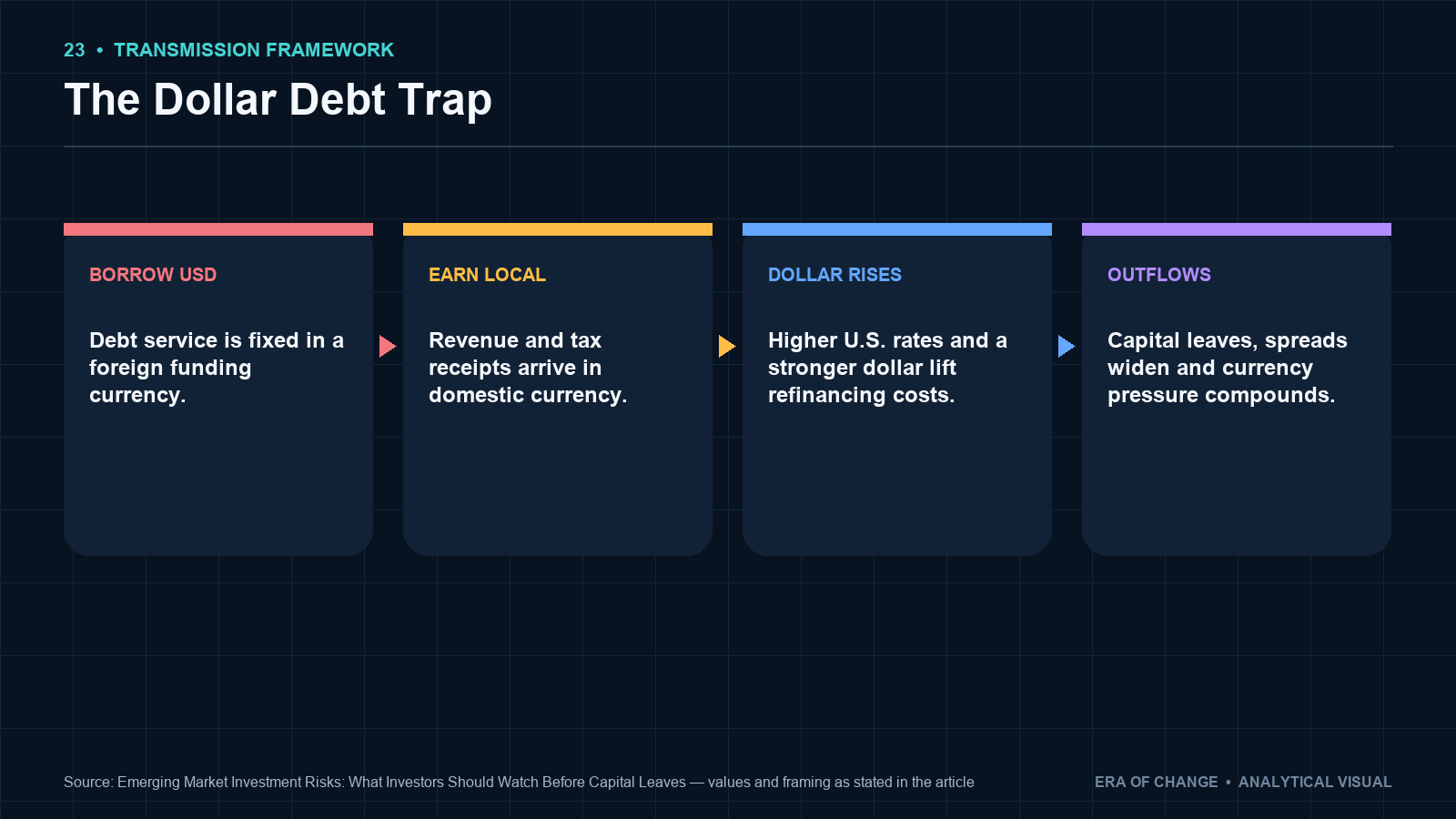
Worth walking through with a simple number rather than leaving it abstract. Say a company owes $1 billion in dollar-denominated debt. If its local currency loses 20% of its value against the dollar, the local-currency burden of servicing and eventually repaying that same $1 billion rises substantially, before you’ve even factored in any increase in the interest rate itself. Layer on higher Treasury yields, wider credit spreads specific to the borrower’s sector or country, weaker corporate earnings from a slowing domestic economy, and reduced access to international capital markets generally, and you get a company that can remain fully profitable on an operating basis and still walk into a genuine refinancing crisis, because its liabilities are denominated in a currency it has no control over.
Foreign-Exchange Reserves: The First Line of Defense
Central-bank reserves exist to pay for essential imports, meet external debt obligations as they come due, stabilize the currency during a shock, provide dollar liquidity to the domestic banking system, and restore market confidence when it starts to slip. But there’s an important distinction that gets glossed over constantly in mainstream coverage: reported reserves are not necessarily the same thing as reserves a central bank can actually deploy on short notice.
Gross Reserves vs. Usable Net Reserves
A headline reserve figure typically hasn’t been adjusted for swap obligations, forward positions already committed against the reserve pool, encumbered assets pledged elsewhere, short-term liabilities coming due, statutory reserve requirements, or other standing central-bank commitments. Era’s focus is on net usable reserves, not the gross number that makes the headlines, because the real question in a crisis isn’t “how large are the reserves,” it’s how much foreign currency remains after every claim that already has a lien on those assets is subtracted out.
The Three-Month Import Threshold
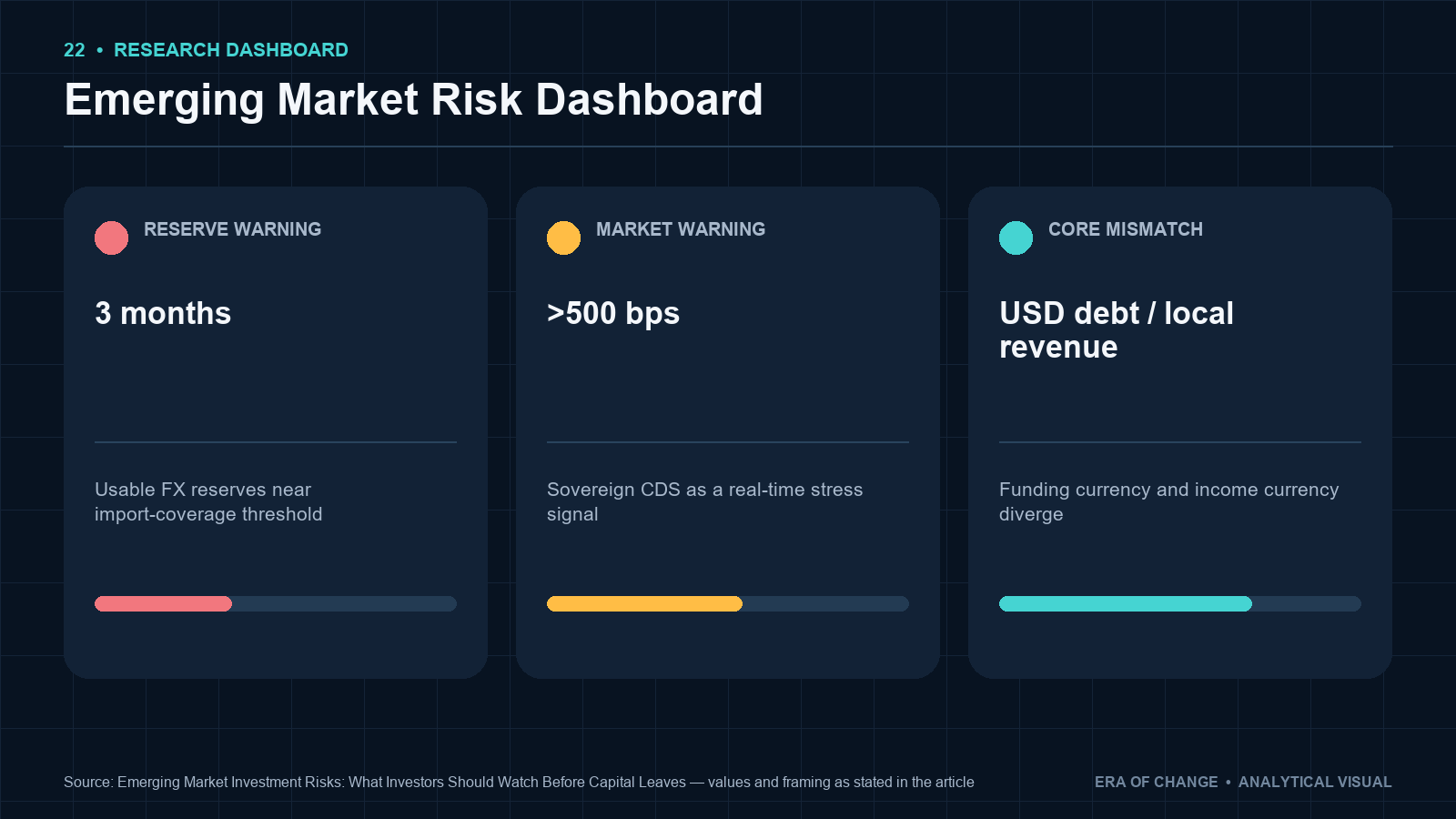
Era’s warning condition: a sharp fall in usable FX reserves toward roughly three months of import coverage can indicate serious external vulnerability. The concept is simple arithmetic, import coverage equals FX reserves divided by average monthly imports. A country holding $30 billion in usable reserves against $10 billion in average monthly imports has three months of coverage.
I want to label this precisely rather than overstate it: three months is a widely used heuristic in external-vulnerability analysis, not a universal crisis trigger that guarantees anything on its own. Context still matters enormously, the maturity profile of external debt, the current-account trajectory, access to central-bank swap lines, commodity export revenue, capital-control capacity, and the depth of the domestic financial system all shape how dangerous a given reserve level actually is.
Indonesia is a useful live example of the metric in motion rather than in the abstract. Bank Indonesia’s reserves stood at roughly $144.9 billion at the end of May 2026, the lowest level since June 2024, with reserve cover projected to decline to about 5.6 months of imports from 6.3 months the prior year, as the current-account deficit widens toward an estimated 1.1% of GDP in 2026 from just 0.1% in 2025. That’s a real erosion trend, and it’s still comfortably above Era’s warning zone, which is exactly the kind of distinction the three-month threshold is meant to help you draw.
Vietnam’s case is sharper, and worth stating plainly rather than softening it. Vietnam’s reserve position is a concern on E.R.A. OF CHANGES’ watchlist. Reserve-coverage ratios depend on the observation date and import period; the three-month warning line is E.R.A. OF CHANGES’ internal heuristic, not a universal IMF minimum. I’ll come back to what this means for E.R.A. OF CHANGES’ broader Vietnam thesis later in this piece, because it’s not a detail to bury.
Sovereign CDS: The Market’s Real-Time Warning Signal
A sovereign credit default swap spread reflects the market cost of insuring against a government default or debt restructuring: the higher the spread, the more the market is pricing in credit risk on that specific sovereign. Era treats a rise above roughly 500 basis points, particularly when it coincides with reserve depletion, as a major warning signal. I want to label that as an Era analytical threshold specifically, not a universal default boundary that applies mechanically to every sovereign.
For calibration: Turkey’s five-year CDS spread fell to roughly 225 basis points as of mid-June 2026, its lowest level since February, a reminder that even a country with a well-documented history of currency stress can trade well inside Era’s warning zone when the macro backdrop stabilizes. The point of watching CDS isn’t to memorize one number for one country; it’s to track the direction and combine it with the reserve picture.
Combining the two signals is where the real information sits. Falling reserves alongside stable CDS can mean the pressure is still manageable; the market isn’t panicking yet. High CDS alongside strong reserves can mean markets are pricing political or default risk despite the country holding adequate liquidity buffers. Falling usable reserves combined with CDS above roughly 500 basis points is the combination Era treats as a potentially serious systemic warning, because it means the market and the balance sheet are deteriorating in the same direction at the same time.
Era’s Emerging Market Crisis Trigger: The Two-Signal Warning
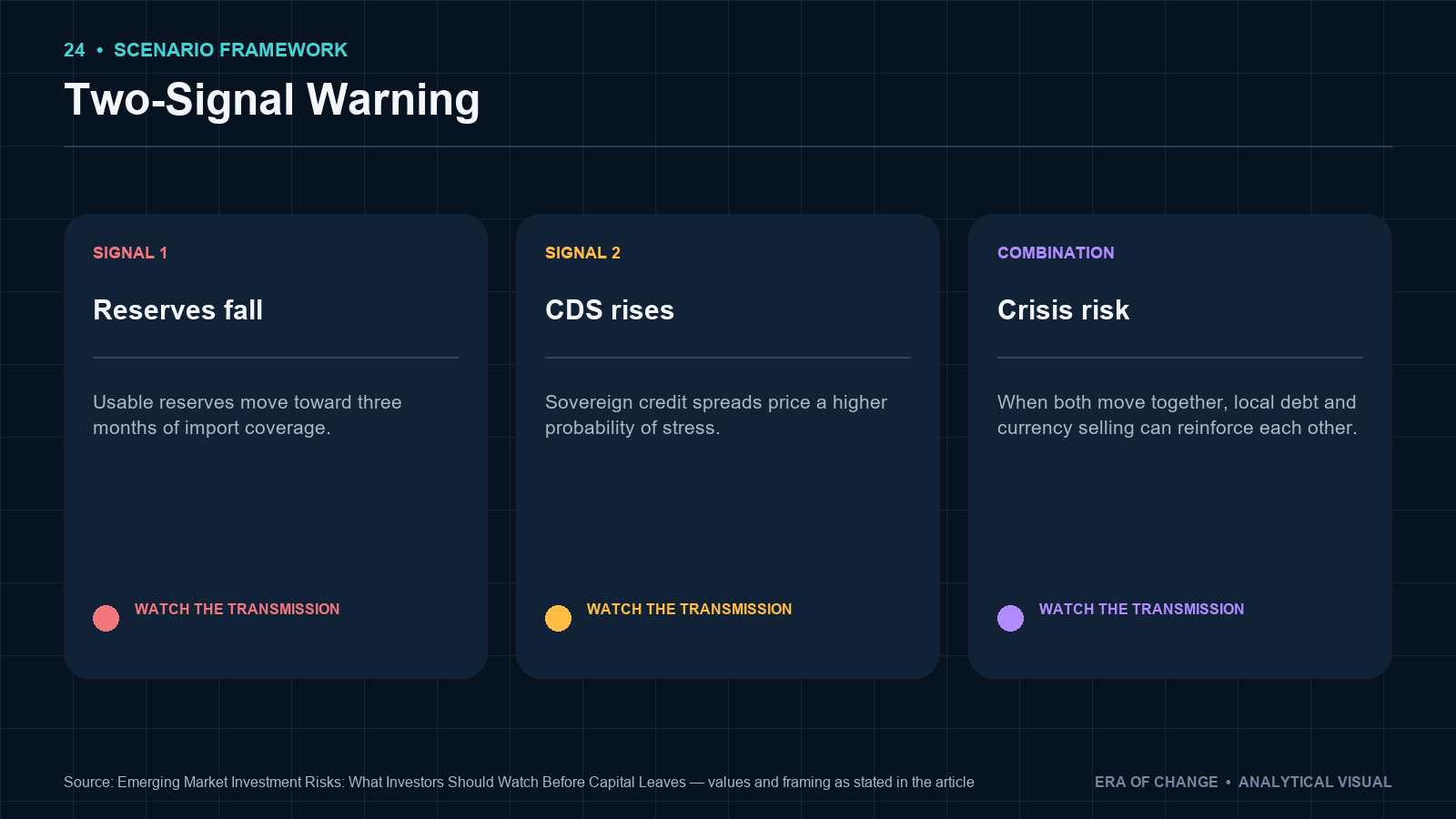
Turning this into a framework worth remembering: Signal One is usable FX reserve coverage approaching below roughly three months of imports. Signal Two is sovereign CDS rising above roughly 500 basis points. When both signals are flashing together, Era treats that as the point to evaluate secondary confirmation, currency depreciation, capital outflows, a widening current-account deficit, foreign debt maturities clustering in the near term, rising local bond yields, falling foreign bond ownership, and any sign of bank funding stress. No single signal on its own is the trigger. It’s the combination, confirmed by a second layer of evidence, that separates a genuinely dangerous setup from ordinary EM volatility.
The Indicator Most Investors Ignore: Foreign Ownership of Local Debt
This is the second major original piece of Era’s framework, and I think it gets less attention than it deserves precisely because it sounds reassuring on the surface. The indicator: the share of local-currency government debt held by non-residents, adjusted for the real interest-rate environment. A government borrowing in its own currency sounds inherently safer than a government borrowing in dollars, because there’s no direct currency mismatch on the sovereign’s own balance sheet. But if foreign investors own a large share of those local-currency bonds, a global risk-off shock can still trigger synchronized selling, and the fact that the debt was denominated locally doesn’t protect the country from the consequences of that exit.
How Foreign Bond Selling Becomes a Currency Crisis
The sequence is mechanical once it starts. A foreign investor sells a local government bond. The bond price falls and local yields rise. The investor converts the sale proceeds into dollars or another reserve currency to take the capital home. The local currency weakens as a result. Weaker currency feeds through into higher imported-goods inflation. The central bank may respond by raising rates to defend the currency, which raises financing costs across the entire domestic economy.
Domestic borrowers now face higher costs even though none of this started with them. And banks holding sovereign bonds on their own balance sheets absorb a valuation hit at the same time their funding costs are rising. Local-currency debt eliminates the direct FX mismatch for the government issuing it, but heavy foreign ownership can still import external funding risk directly into the domestic bond market, just through a different transmission channel than dollar debt uses.
Why Real Interest Rates Change the Risk
Real interest rate is approximately the nominal interest rate minus inflation. Foreign investors are generally willing to tolerate EM currency risk when real yields on local bonds are genuinely attractive: the extra compensation is worth the volatility. But if domestic inflation rises while the policy rate doesn’t keep pace, the real yield compresses, local bonds become meaningfully less attractive on a risk-adjusted basis, foreign investors start to exit, and currency pressure builds as a direct consequence. This is exactly why Era evaluates non-resident ownership and real-rate dynamics together rather than looking at foreign ownership in isolation, a country with high foreign ownership and strongly positive real rates is in a very different position than a country with the same ownership share and real rates near or below zero.
Emerging Market Currency Risk
Currency can dominate total investment performance in a way equity investors especially tend to underweight mentally. A local stock index can gain 15% in a given year, but if the local currency declines 20% against the investor’s own base currency over that same period, the foreign investor still loses money net of the conversion; the local return never actually reaches them intact. The drivers behind that currency move include the current-account balance, inflation, central-bank credibility, the scale of external debt, commodity prices, political stability, and where the broader dollar cycle sits at that moment. For a deeper look at how these dynamics compound into full-blown currency crises, see Era’s Currency Crises Explained.
Current-Account Deficits and the Need for Foreign Capital
A persistent current-account deficit means an economy depends, to some real degree, on external financing to fund the gap between what it earns and what it spends internationally. That can be entirely sustainable for years while foreign investment stays strong, growth remains credible, and markets stay liquid. The danger appears when foreign capital suddenly stops arriving: the classic “sudden stop” dynamic, where capital inflows disappear, the currency falls, reserves get drawn down to compensate, domestic rates rise in response, and growth weakens as a direct consequence of all of the above happening in sequence rather than gradually.
Emerging Market Sovereign Debt Risk
Sovereign debt risk connects directly into Era’s broader Global Debt Risks 2026 research. The relevant variables go well beyond the debt-to-GDP ratio that gets quoted most often: the interest-to-revenue ratio, the share of debt denominated in foreign currency, average maturity, the share held by foreign investors, the fiscal deficit trajectory, central-bank credibility, and (perhaps most underrated of all) a government’s actual political willingness to adjust policy under pressure rather than delay. Debt level alone is rarely sufficient to identify the next sovereign crisis; two countries with identical debt-to-GDP ratios can have completely different vulnerability profiles depending on these other factors.
Corporate Debt Can Be More Dangerous Than Sovereign Debt
An important and frequently missed differentiation. Large private companies can borrow heavily offshore even in countries where the sovereign’s own accounts look genuinely healthy. The risks concentrate around dollar-denominated liabilities against local-currency earnings, property-sector leverage specifically, short debt maturities that create frequent refinancing windows, and implicit government guarantees that markets assume exist but that governments haven’t actually committed to in writing. When corporate stress does develop at scale, governments frequently end up absorbing part of the burden anyway, through bank recapitalization, direct bailouts, loan guarantees, or simply a broader economic slowdown that follows from the corporate deleveraging.
Political and Regulatory Risk
Emerging markets carry a familiar set of political risks: capital controls, windfall taxes, foreign-ownership restrictions, nationalization risk, election uncertainty, sudden changes to mining or resource policy, direct regulatory intervention, and sanctions exposure. None of these risks are unique to emerging markets specifically, developed markets carry versions of all of them too. The real difference is usually institutional predictability and the investor’s practical ability to hedge or exit the position before the risk fully materializes.
Commodity Dependence: Opportunity and Vulnerability
Some emerging markets benefit substantially from commodity exports, oil, copper, nickel, agricultural products, and critical minerals broadly. But concentration in any of these categories creates real cycle exposure in both directions. When commodity prices rise, fiscal revenue improves, the currency tends to strengthen, and the current account improves alongside it. When prices fall, revenue deteriorates, the currency weakens, and debt ratios can rise even without any change in the government’s actual borrowing behavior.
China+1 and the New Emerging Market Opportunity
China+1 describes companies diversifying their supply chains by maintaining existing Chinese operations while actively expanding manufacturing capacity elsewhere: a hedge against concentration risk rather than a wholesale exit from China. Potential beneficiaries of this shift include Vietnam, Indonesia, India, Mexico, and a handful of other Southeast Asian markets. Era’s current interview specifically identifies Indonesia and Vietnam as the two markets showing potentially positive asymmetry within that broader trend.
Why Era Sees Potential in Indonesia
This is Nikolai’s current thesis, not an objective settled fact, and it should be read that way. The case rests on a genuinely favorable trade position, meaningful exposure to critical metals, particularly nickel, where exports reached roughly $9.73 billion in 2025 and nickel cathode exports rose nearly 80% in the first three quarters of that year, real potential benefit from supply-chain relocation out of China, inflation that’s remained relatively controlled, credible domestic growth, and active industrial-policy development around downstream nickel processing specifically.
I want the caveats to sit right next to the thesis, not several paragraphs later. Indonesia’s current-account deficit is widening (from 0.1% of GDP in 2025 to an estimated 1.1% in 2026), and usable reserves have fallen to roughly $144.9 billion with import coverage declining to about 5.6 months from 6.3 months the prior year. Neither figure is anywhere near Era’s warning thresholds today, but the direction of travel on both matters, and anyone acting on this thesis should verify current inflation, debt levels, foreign ownership of Indonesian sovereign debt, and current valuations before treating the case as settled. The real question isn’t whether Indonesia has real structural strengths, it does. It’s whether the risk premium global investors are currently assigning to those strengths is larger than the country’s actual macro vulnerability warrants.
Why Era Sees Potential in Vietnam
Same framing rules apply, this is Era’s current view, not a guarantee. The strengths are genuinely substantial: Vietnam pulled in over $15.2 billion in FDI in the first quarter of 2026 alone, a 42.9% increase year-on-year, driven directly by manufacturing relocation and China+1 positioning. The government is targeting a full-year 2026 trade surplus above $23 billion, and Vietnam’s role in global electronics and textile supply chains continues to deepen.
But the vulnerabilities here are more serious than Indonesia’s, and I’d rather be direct about that than let the positive-asymmetry framing paper over it. Vietnam ran an estimated trade deficit of $16.65 billion in the first half of 2026, a sharp reversal from a $7.6 billion surplus over the same period in 2025, meaning the full-year surplus target requires a substantial second-half swing that hasn’t happened yet. More importantly, Vietnam’s reserve position remains an external-vulnerability concern on E.R.A. OF CHANGES’ watchlist. Reserve-coverage ratios depend on the observation date and import period; E.R.A. OF CHANGES’ three-month warning line is an internal heuristic, not a universal IMF minimum. That’s not a minor footnote to an otherwise clean growth story, but a risk to weigh alongside banking and property-sector exposure, currency sensitivity to further trade-balance deterioration, dependence on external demand from the U.S. and EU specifically, export concentration in electronics, and corporate-governance standards that still lag developed-market norms. The honest read is that Vietnam’s upside case has to be weighed directly against these risks.
Positive Asymmetry Does Not Mean Low Risk
Worth stating as its own principle given the Vietnam case just laid out. An attractive emerging market can still experience currency moves of 20% or more, sharp equity corrections, genuine political shocks, and periods where liquidity simply isn’t there when you want to exit. Positive asymmetry means the potential return may exceed the risk implied by current market pricing; it does not mean the market is safe in any absolute sense. Those are two different claims, and collapsing them into one is how investors end up surprised by a drawdown they should have priced in from the start.
Indonesia and Vietnam vs. a Vulnerable EM Profile
| Indicator | More Resilient Profile | More Vulnerable Profile |
|---|---|---|
| Current account | Balanced / surplus | Persistent deficit |
| FX reserves | Strong, stable coverage | Rapidly declining |
| External dollar debt | Manageable | High |
| Inflation | Controlled | Accelerating |
| Real rates | Positive / credible | Deeply negative |
| Foreign bond ownership | Moderate | High / unstable |
| Export base | Diversified | Concentrated |
| FDI | Stable | Weak |
| Political framework | Predictable | Uncertain |
This is a framework for evaluating any market, not a scorecard with Indonesia and Vietnam’s individual boxes filled in; that requires current data at the moment of investment, not a snapshot from this article.
Emerging Market Investing: A Better Screening Framework
Before allocating to any specific emerging market, five dimensions deserve direct evaluation rather than being inferred from a headline growth number. External balance covers the current account, trade balance, and FX reserve position together. Debt structure covers the split between foreign-currency and local-currency obligations, sovereign versus corporate exposure, and the maturity profile of what’s outstanding.
Capital dependence covers foreign ownership of local bonds, portfolio flow volatility, and the stability of FDI specifically. Monetary stability covers inflation trend, real interest rates, and the market’s actual confidence in the central bank’s credibility. And structural growth covers demographics, manufacturing capacity, resource endowment, productivity trends, and how deeply the country is integrated into global supply chains.
Era Emerging Market Risk Scorecard
| Indicator | Low Risk | Moderate Risk | High Risk |
|---|---|---|---|
| Usable reserve coverage | Strong | Declining | Near or below Era’s 3-month warning threshold |
| Sovereign CDS | Low | Rising | Above roughly 500bp, Era warning area |
| Current account | Surplus | Small deficit | Large, persistent deficit |
| External dollar debt | Low | Moderate | High |
| Non-resident local debt share | Low | Meaningful | High, combined with falling real rates |
| Inflation | Stable | Rising | Unanchored |
| Real rates | Positive | Near zero | Negative |
| Currency trend | Stable | Weakening | Disorderly decline |
| Political risk | Low | Moderate | High |
This is a diagnostic tool for organizing your own research, not a mechanical buy or sell signal; no single row should ever be read in isolation from the rest of the table.
Early Warning Signs of an Emerging Market Crisis
Watch for rapid reserve depletion, CDS spreads widening meaningfully over a short period, currency weakening despite active central-bank intervention, a growing gap between the official and offshore exchange rate, the introduction of capital controls, falling foreign ownership of local bonds, real rates turning negative, bank deposit outflows accelerating, sovereign rating downgrades, declining commodity export revenue for resource-dependent economies, and short-term external debt rising relative to the reserve base available to cover it.
A Typical Emerging Market Crisis Sequence
The pattern, when it does play out, tends to follow a recognizable chain: an external shock hits, foreign capital exits, the currency weakens, the central bank draws down reserves defending it, inflation rises as imported goods get more expensive, interest rates increase in response, debt service becomes harder for both government and corporate borrowers, banks and corporates weaken under the combined pressure, and the endpoint risk becomes recession, IMF involvement, or outright debt restructuring. Not every crisis follows this exact sequence end to end, and plenty of EM stress episodes stop well short of the final stages, but the chain is worth knowing because each link is a place where the crisis could still be arrested before it reaches the next one.
How Emerging Market Crises Affect Asset Classes
Local equities tend to fall through some combination of lower corporate earnings, foreign investor selling, and currency weakness compounding all of it together. Local government bond yields can rise sharply as both domestic and foreign holders demand more compensation for the deteriorating outlook. Dollar-denominated sovereign bonds see their credit spreads widen directly. The currency itself is very often the first major adjustment mechanism to move, ahead of any of the other asset classes. Banks can face sovereign-bond losses on their own balance sheets, deposit outflows, direct FX mismatches in their own funding, and rising corporate defaults among their borrowers simultaneously. And commodity exporters and importers within the same crisis can move in genuinely opposite directions depending on which side of the relevant commodity cycle they sit on.
Hedged vs. Unhedged Emerging Market Exposure
An investor can be entirely right about a country’s growth trajectory, its equity market, and even its local bond yields, and still lose money because of the currency. Unhedged exposure means taking on both the underlying asset risk and the currency risk together, as a single combined bet. Currency-hedged exposure attempts to isolate the asset risk by reducing FX impact, but that protection isn’t free: it introduces hedging costs, basis risk between the hedge and the actual exposure, and rollover costs that compound over a longer holding period. Neither approach is universally correct; the right choice depends on the specific market, the investor’s own base currency, and how long the position is meant to be held.
Common Emerging Market Investing Mistakes
Chasing headline GDP growth is a frequent one: high national growth does not guarantee shareholder returns, particularly when that growth is capital-intensive and dilutive to existing equity holders. Ignoring currency entirely is another: local-market returns can evaporate completely after conversion back to the investor’s base currency. Looking only at debt-to-GDP misses that the currency denomination and maturity profile of that debt often matter more than its headline size.
Using gross reserves instead of usable reserves can make a country look far more resilient than it actually is. Ignoring foreign bond ownership specifically misses that local-currency debt can still be vulnerable to external capital flight through the mechanism described earlier in this piece.
Treating all emerging markets as a single trade ignores that Brazil, Indonesia, Vietnam, Turkey, and India have almost nothing in common structurally beyond the label. And buying purely on a “cheap” valuation without a clear catalyst forgets that assets can stay cheap indefinitely because the risk premium priced into them is actually justified.
Three Emerging Market Scenarios
Scenario 1: Soft Landing / Dollar Weakens
U.S. rates decline gradually, the dollar softens, global growth stays stable, and commodity demand holds up. Under these conditions, EM currencies tend to strengthen, capital inflows improve, local bonds perform better, and selected equities rerate higher as the risk premium compresses.
Scenario 2: Higher-for-Longer U.S. Rates
The Fed stays restrictive, the dollar remains strong, refinancing costs stay elevated, and global capital continues favoring developed markets over EM broadly. Under this scenario (the one most relevant to Era’s current thesis given where policy sits through mid-2026), dispersion widens meaningfully: the weakest external borrowers deteriorate further while countries with genuinely strong trade balances and reserve positions continue to outperform their peers.
Scenario 3: EM Refinancing Crisis
Usable reserves fall rapidly, CDS spreads surge across multiple issuers, the dollar strengthens sharply, foreign investors exit local-currency debt en masse, and corporate refinancing effectively freezes for the weakest borrowers. This is the scenario where currency crises, local bond selloffs, bank stress, capital controls, and sovereign restructuring risk all become live possibilities simultaneously rather than isolated events.
How Era Analyzes Emerging Markets
Era combines external liquidity, FX reserves, current account, external debt, with sovereign credit signals like CDS spreads, bond spreads, and the near-term refinancing schedule. Domestic monetary conditions add inflation, real rates, and currency policy credibility. Capital-flow analysis covers foreign bond ownership, portfolio flow direction, and FDI stability. Structural fundamentals bring in trade composition, critical-resource endowment, manufacturing capacity, and China+1 exposure specifically.
And global conditions (U.S. rates, dollar liquidity, global M2, commodity prices, and geopolitical risk broadly) sit on top of all of it, because emerging-market risk is rarely purely local. Global liquidity conditions are usually what determines the exact moment domestic weaknesses that have existed for years suddenly become a market event.
What Investors Should Monitor
On the external position: net usable FX reserves, import coverage specifically, the current-account trend, and short-term external debt coming due. On market risk: sovereign CDS, dollar bond spreads, the currency itself, and local bond yields. On capital flows: foreign ownership of local bonds, portfolio flow direction, and FDI trends. On monetary conditions: inflation, real rates, and central-bank policy credibility.
And on global conditions broadly: U.S. Treasury yields, the dollar index, dollar funding costs, commodity prices, and Fed policy direction, all of which shape the environment every individual emerging market has to operate inside, regardless of how sound its own domestic policy happens to be.
Era Analyst’s Perspective
Vietnam’s reserve position is one risk investors should weigh. Reserve-coverage ratios depend on the observation date and import period; E.R.A. OF CHANGES’ three-month warning level is an internal heuristic, not a universal IMF minimum. I still think Vietnam’s FDI story is real: $15.2 billion in the first quarter alone, a 42.9% jump year-on-year, driven by genuine manufacturing relocation rather than speculative capital. But those two considerations sitting next to each other are exactly the tension this entire framework is built to surface.
A country can have a legitimate structural growth story and a genuinely uncomfortable external liquidity position at the same time; the market doesn’t have to pick one narrative and stick with it, and neither should you. What I watch isn’t whether a country’s growth story is compelling. Almost every emerging market has a compelling growth story if you frame it right.
What I watch is whether usable reserves are approaching three months of import coverage while sovereign CDS is climbing past 500 basis points at the same time, because that combination, confirmed by falling foreign bond ownership or accelerating capital outflows, is what actually separates an emerging market having a rough quarter from one heading into a genuine external financing crisis.
Frequently Asked Questions
What are emerging markets?
Emerging markets are economies positioned between lower-income or frontier markets and fully developed financial systems, generally characterized by faster trend growth, developing capital markets, greater currency volatility, and higher sensitivity to foreign capital flows than developed markets exhibit, though classification standards vary somewhat between index providers like MSCI, FTSE Russell, and institutions like the IMF and World Bank.
What are the biggest emerging market risks?
The core risk stack includes external dollar debt, currency depreciation, foreign-exchange reserve depletion, sovereign debt stress, capital flight, foreign ownership of local-currency bonds, inflation, political and regulatory risk, commodity dependence, and liquidity risk, with the dollar-debt refinancing mismatch and foreign ownership of local debt standing out as the two most consistently underestimated by investors.
Is emerging market investing risky?
Yes, meaningfully more than developed-market investing on average, though risk varies enormously by country. The risk isn’t simply volatility, it’s the possibility of a funding-driven crisis where currency depreciation and financing stress overwhelm whatever underlying growth story originally attracted the investment.
Why do U.S. interest rates affect emerging markets?
Higher U.S. rates raise the cost of dollar-denominated borrowing globally, strengthen the dollar against most EM currencies, pull portfolio capital toward developed-market yields, and widen the credit spreads riskier EM borrowers have to pay, all of which compound refinancing pressure on any country or company holding significant dollar debt.
Why is dollar debt dangerous for emerging economies?
Because the borrower earns revenue in local currency but owes principal and interest in dollars. When the local currency weakens against the dollar, the local-currency cost of servicing that same debt rises even if nothing about the borrower’s underlying business has changed.
How much foreign-exchange reserves should a country have?
There’s no single universal number, but Era treats usable reserve coverage approaching roughly three months of imports as a meaningful warning threshold, consistent with widely used external-vulnerability heuristics, while emphasizing that the maturity of external debt, the current-account trend, and access to swap lines all shape how dangerous any specific reserve level actually is.
What is sovereign CDS?
A sovereign credit default swap spread reflects the market cost of insuring against a government default or debt restructuring. A rising spread signals the market is pricing in higher credit risk, and Era treats a move above roughly 500 basis points (particularly alongside reserve depletion) as a significant warning signal specific to Era’s own analytical framework.
What causes an emerging market currency crisis?
Typically a combination of a current-account deficit requiring external financing, a “sudden stop” in foreign capital inflows, declining usable reserves, and rising external debt service costs, often triggered or accelerated by a global shock like a sharp move in U.S. rates or the dollar.
Why does foreign ownership of government bonds matter?
Because heavy non-resident ownership of local-currency debt means a global risk-off shock can trigger synchronized selling by foreign holders, pushing local yields up and the currency down together, importing external funding risk into a bond market that, on paper, carries no direct foreign-currency mismatch.
Which emerging markets have the strongest fundamentals?
This changes constantly and depends on the specific dimension being evaluated, external balance, debt structure, capital dependence, monetary stability, and structural growth all matter, and a country can score well on some while remaining vulnerable on others, which is exactly why Era evaluates these dimensions separately rather than relying on a single country ranking.
Why does Era currently favor Indonesia and Vietnam?
Both benefit from China+1 supply-chain relocation and carry real structural strengths, Indonesia’s critical-metals position and trade profile, Vietnam’s manufacturing and FDI momentum, that E.R.A. OF CHANGES believes may be priced with more risk premium than the underlying fundamentals justify. That view comes with real caveats specific to each country, including Vietnam’s reserve position, which E.R.A. OF CHANGES considers a vulnerability; its three-month warning threshold is an internal heuristic rather than a universal IMF minimum.
How should investors evaluate emerging market investments?
Across five dimensions together rather than any single metric: external balance, debt structure, capital dependence, monetary stability, and structural growth, with particular attention to usable FX reserves, sovereign CDS trends, and the share of local debt held by foreign investors, since these three tend to move together ahead of an actual crisis rather than in isolation.
About E.R.A. OF CHANGES
E.R.A. OF CHANGES is an independent macroeconomic, financial-market, cryptocurrency, and geopolitical research firm providing institutional-quality analysis for investors worldwide. Its research combines macroeconomics, credit markets, liquidity, capital flows, market structure, and geopolitical risk within proprietary forecasting frameworks designed to identify vulnerabilities before they become broadly recognized. Era evaluates emerging markets through external financing conditions, usable foreign-exchange reserves, sovereign credit signals, real interest rates, foreign capital dependence, and structural trade fundamentals, rather than relying primarily on GDP growth or headline equity valuations.
The content published by E.R.A. OF CHANGES is for informational and educational purposes only and does not constitute financial, investment, legal, or tax advice. All views expressed are the personal analytical perspective of the author. Past forecast accuracy does not guarantee future results. Readers should conduct their own research and consult a qualified financial professional before making any investment decisions.
Sources
- Indonesia’s CAD Widens, Foreign Exchange Reserves Decline (IDN Financials)
- Indonesia Foreign Exchange Reserves (CEIC Data)
- Indonesia Exports of Nickel (Trading Economics)
- Vietnam FDI Update: Q1 2026 Performance and Key Trends (Vietnam Briefing)
- Vietnam’s $20.5 Billion Trade Deficit Not Yet a Concern in Short Term (The Investor)
- How Trade Deficit Is Affecting Vietnam’s Foreign Exchange Flows, Currency (The Investor)
- Vietnam Targets 23 Billion USD Trade Surplus in 2026 (VietnamPlus)
- Turkey’s Five-Year Credit Risk Premium Falls to Lowest Level Since February (Bazaar Times)
- CFR Sovereign Risk Tracker (Council on Foreign Relations)
- Emerging Market Debt 2026 Investment Outlook (Invesco)
- Emerging Markets Debt Monitor Q1 2026 (Morgan Stanley Investment Management)
- EM Local Currency Bond Monitor (IMF)