Executive Summary
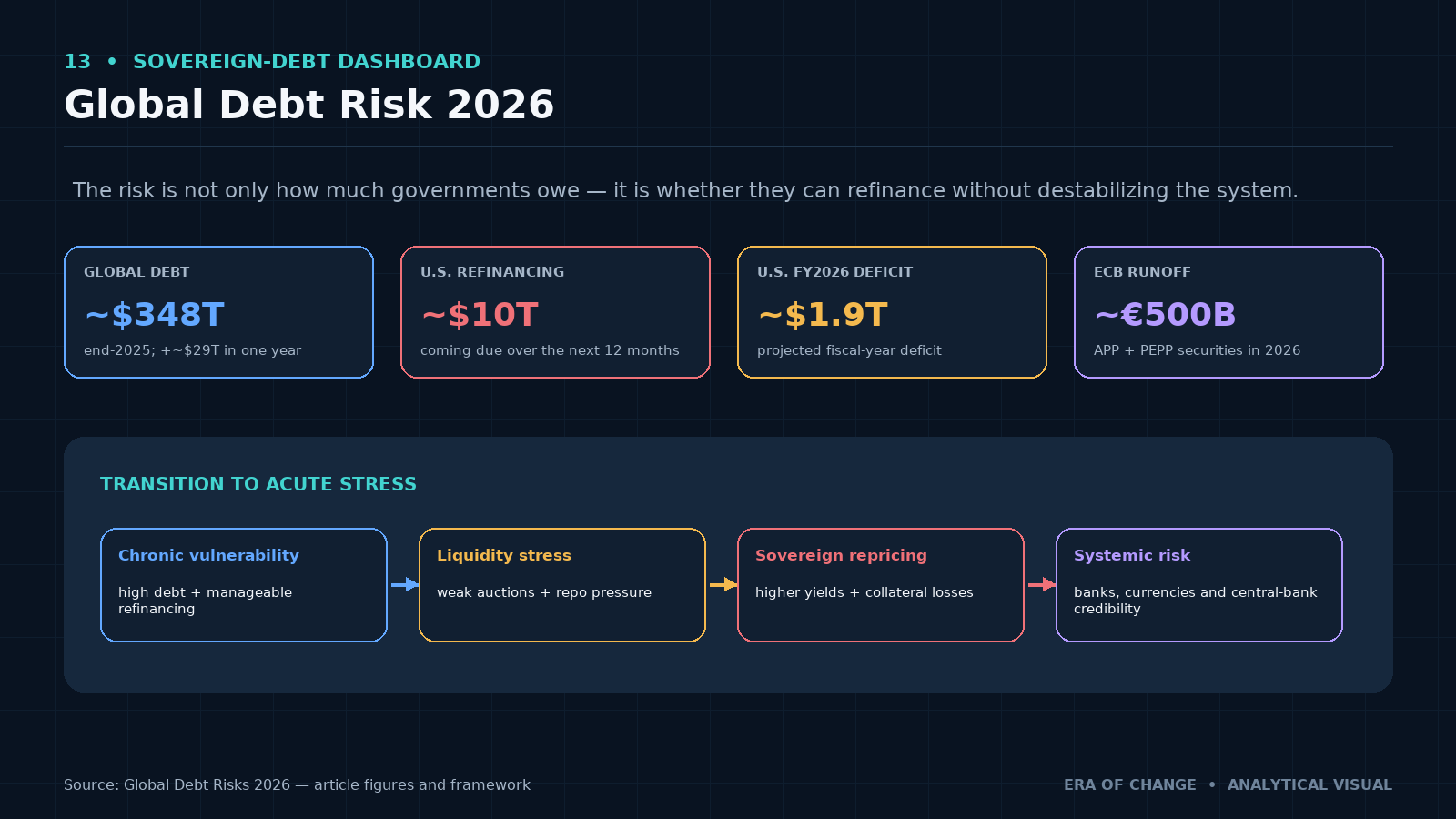
Global debt risk in 2026 is no longer mainly a question of how much governments owe. It’s a question of whether they can actually refinance the volumes coming due without destabilizing bond markets, banks, currencies, or central-bank policy in the process. Total global debt crossed $348 trillion at the end of 2025, up nearly $29 trillion in a single year, the fastest annual buildup since the pandemic surge of 2020. That number alone tells you almost nothing about who’s actually at risk.
Era tracks two specific signals for the transition from chronic vulnerability into acute stress: repeated weak U.S. Treasury auctions and a sharp rise in repo-market funding rates. Emerging markets carrying heavy dollar-denominated liabilities and persistent current-account deficits remain structurally exposed. But the systemic trigger I watch most closely sits in the eurozone periphery, specifically Italy, as the European Central Bank continues withdrawing the balance-sheet support that’s quietly held peripheral spreads in check for years.
This piece walks through where debt vulnerabilities are actually concentrated, how sovereign stress spreads once it starts, and which indicators deserve your attention through the rest of 2026. I want to be clear up front: high debt does not automatically mean imminent default. The mechanism is more specific than that, and more useful to understand.
Key Takeaways
- Debt crises typically begin as refinancing and liquidity problems, well before they become genuine solvency crises.
- Weak government-bond auctions can reveal declining investor capacity or willingness to absorb new debt, not just noise in a single sale.
- Repo-market stress can show that primary dealers are struggling to finance their own bond inventories, a distinct problem from the government’s fiscal position.
- Emerging markets with large dollar-denominated debt are especially exposed to currency weakness combined with elevated U.S. rates.
- Eurozone peripheral debt remains a genuine systemic trigger, precisely because sovereign risk there is directly wired into the banking system.
- Long-duration sovereign bonds can carry real inflation, currency, and duration risk even in scenarios where outright default looks unlikely.
Introduction
Countries do not fall into debt crises simply because a debt-to-GDP ratio crosses some specific threshold. That’s a genuinely common misconception, and it leads people to watch the wrong number.
Highly indebted governments can stay stable for years, even decades, as long as refinancing markets keep functioning, investors retain confidence, interest costs stay manageable relative to revenue, the currency remains credible, and domestic institutions can absorb the new issuance without strain. Japan is the clearest living proof of this, debt above 200% of GDP with no crisis in sight, a case I’ll come back to below.
So the real question isn’t the debt level itself. It’s what causes a heavily indebted system to move from chronic, tolerable vulnerability into acute, market-moving crisis. That transition is what this piece is actually built to explain.
What Is a Sovereign Debt Crisis?
A sovereign debt crisis is a situation in which a government becomes unable to refinance maturing debt on sustainable terms, typically involving rapidly rising bond yields, potential restructuring or outright default, currency depreciation, emergency central-bank intervention, capital controls, banking-system stress, and forced fiscal austerity, often all at once, each reinforcing the others.
It’s worth distinguishing several related but genuinely different things. High public debt is simply a large stock of obligations. Debt-sustainability concerns are a judgment about whether that stock is manageable given growth and revenue trends. Bond-market stress is a specific, observable deterioration in how debt actually trades. A liquidity crisis is an inability to refinance smoothly despite fundamental solvency. And sovereign default is the terminal outcome where none of the above got resolved in time. The key distinction underlying all of it: a government can be highly indebted without being in crisis. Crisis begins specifically when markets start questioning its ability or willingness to refinance on sustainable terms, a question about market confidence, not just arithmetic.
Why Global Debt Risk Is Rising
Higher Interest Costs
Governments that issued debt cheaply during the low-rate years are now refinancing that same debt at materially higher rates as it matures, which shortens the effective maturity of the overall obligation in economic terms, raises debt-service costs, reduces fiscal flexibility, and crowds out other public spending that would otherwise be available.
Large Refinancing Needs
The total stock of debt matters less than the volume that has to be rolled over within any given short window. The U.S. alone faces roughly $10 trillion in debt coming due for refinancing over the next 12 months, a number that has to find buyers regardless of how favorable or unfavorable conditions happen to be at the moment it comes due.
Persistent Fiscal Deficits
Governments keep issuing new debt on top of what’s already being refinanced, rather than pausing new issuance until the existing stock is rolled over. The U.S. federal deficit is projected at roughly $1.9 trillion for fiscal year 2026, averaging around $2.4 trillion annually from FY2027 through FY2036, a trajectory that keeps issuance elevated indefinitely rather than as a temporary bulge.
Reduced Central-Bank Support
Quantitative tightening and smaller central-bank purchase programs remove a major, price-insensitive source of demand from the market. The ECB alone is set to let roughly €500 billion in previously reinvested securities run off in 2026, €330 billion from its Asset Purchase Programme and €173 billion from the Pandemic Emergency Purchase Programme, precisely the kind of demand withdrawal that leaves private investors needing to absorb far more than they’ve had to in years.
Inflation and Currency Risk
Investors demand higher yields when they suspect a government might prefer to reduce its real debt burden through inflation or currency depreciation rather than genuine fiscal discipline, a rational pricing response to a genuine incentive problem.
Political Fragmentation
Weak governing coalitions, elections, populist pressure, and open fiscal disagreement within a government all erode the market’s confidence in that government’s ability to actually follow through on stated fiscal plans, which raises the risk premium demanded on its debt independent of the underlying numbers.
Liquidity Risk vs. Solvency Risk
This distinction sits at the center of everything else in this piece.
Liquidity risk describes a government that may be fundamentally solvent but temporarily unable to refinance at acceptable rates, showing up as weak auctions, dealer balance-sheet stress, repo pressure, sudden yield spikes, and general market dysfunction that isn’t really about the underlying fiscal math.
Solvency risk describes a government whose future revenue genuinely cannot support its debt burden without restructuring, inflation, or default, characterized by persistent primary deficits, a rising interest-to-revenue ratio, weak underlying growth, meaningful foreign-currency liabilities, and eventual loss of normal market access.
The message worth holding onto: liquidity problems can become solvency problems if they persist long enough without resolution. A government that can’t refinance smoothly today because of a temporary market dislocation can find itself facing genuinely higher permanent borrowing costs once that dislocation forces a repricing that sticks.
The Two Warning Signals That Could Move the Crisis Into an Acute Phase
1. Repeatedly Weak U.S. Treasury Auctions
Treasury auctions sell new government debt to a mix of primary dealers, direct bidders, and indirect bidders, largely foreign official and institutional buyers, and several metrics reveal how genuinely well-absorbed a given auction actually was: the bid-to-cover ratio, indirect bidder demand, direct bidder demand, how much dealers were left holding, and the auction tail.
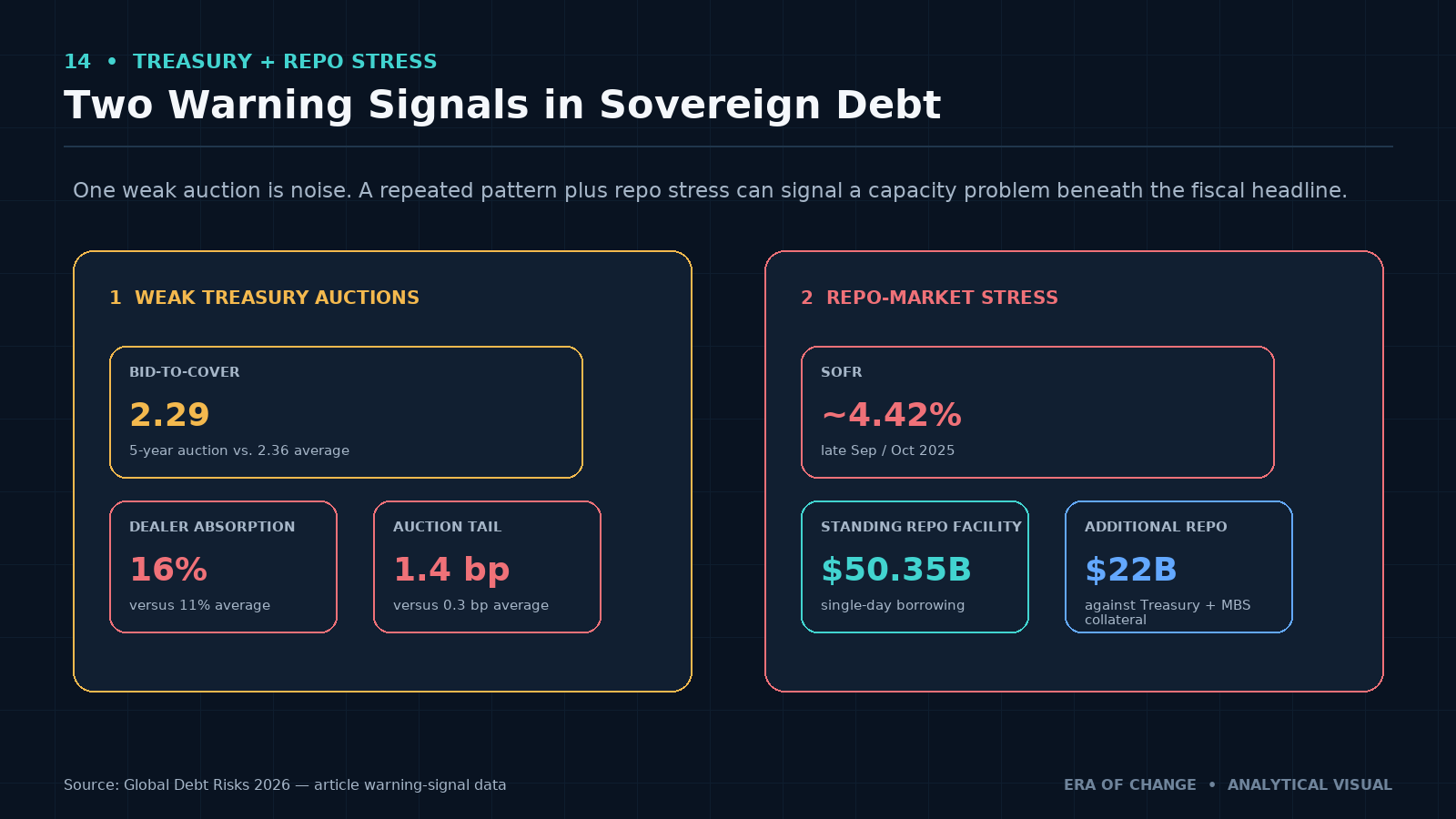
An auction “tails” when the final accepted yield comes in meaningfully higher than the market yield trading immediately beforehand, a direct signal that the Treasury had to pay up beyond what the market was already pricing in order to clear the sale. This already happened in a visible way in March 2026, when 2-, 5-, and 7-year Treasury note auctions all drew weak demand: the 5-year auction posted a bid-to-cover ratio of 2.29 against a 2.36 average, primary dealer absorption ran to 16% against an 11% average, meaning dealers were left holding materially more inventory than usual, and the tail came in at 1.4 basis points against an average of just 0.3.
Why repeated tails matter beyond the single auction: investors are demanding higher compensation to show up at all, primary dealers are absorbing more inventory than their own risk appetite would normally tolerate, market depth may be genuinely weakening, future issuance becomes structurally more expensive, and confidence in the Treasury market’s ability to absorb ongoing supply can decline in a way that feeds on itself. I want to be precise here, because overstating a single data point would undermine the whole framework: one weak auction is not a crisis signal. The concern is a repeated pattern building across maturities over successive auction cycles, which is exactly the pattern the March 2026 auctions began to show.
2. A Sharp Rise in Repo-Market Rates
The repo market is where institutions borrow cash overnight against government securities as collateral, the mechanism that lets primary dealers actually finance the enormous bond inventories they’re required to hold, and a core piece of plumbing for the entire Treasury market’s liquidity.
Why repo stress matters: dealers can struggle to finance growing bond inventories, demand for eligible collateral can spike sharply, market-making capacity can deteriorate as a direct result, forced selling into a thin market can push yields higher than fundamentals alone would justify, and funding stress originating here can spread into banks and other asset classes that rely on the same collateral and the same dealers. We already saw a real preview of this dynamic: SOFR climbed to roughly 4.42% in late September and October 2025 and stayed elevated near 4.3% through mid-October, while banks borrowed a record $50.35 billion in a single day from the Fed’s Standing Repo Facility, followed by a separate $22 billion repo operation against Treasury and mortgage-backed collateral. The structural drivers behind that episode, large Treasury settlements and tax flows draining cash from dealer accounts at the same time bill issuance was surging, a rebuilding Treasury General Account after a prolonged shutdown, and a drawdown of the Fed’s reverse-repo facility, are exactly the kind of mechanical pressures that recur whenever issuance runs ahead of the system’s genuine capacity to absorb it.
My own read on this: a sudden repo-rate spike is one of the clearest signals available that primary dealers can no longer comfortably absorb or finance the volume of new government debt actually entering the market, a funding-capacity problem sitting one layer beneath the headline fiscal numbers, and one that tends to move before the fiscal story becomes obvious to anyone not already watching the plumbing directly.
How a Sovereign Debt Shock Spreads Through the Financial System
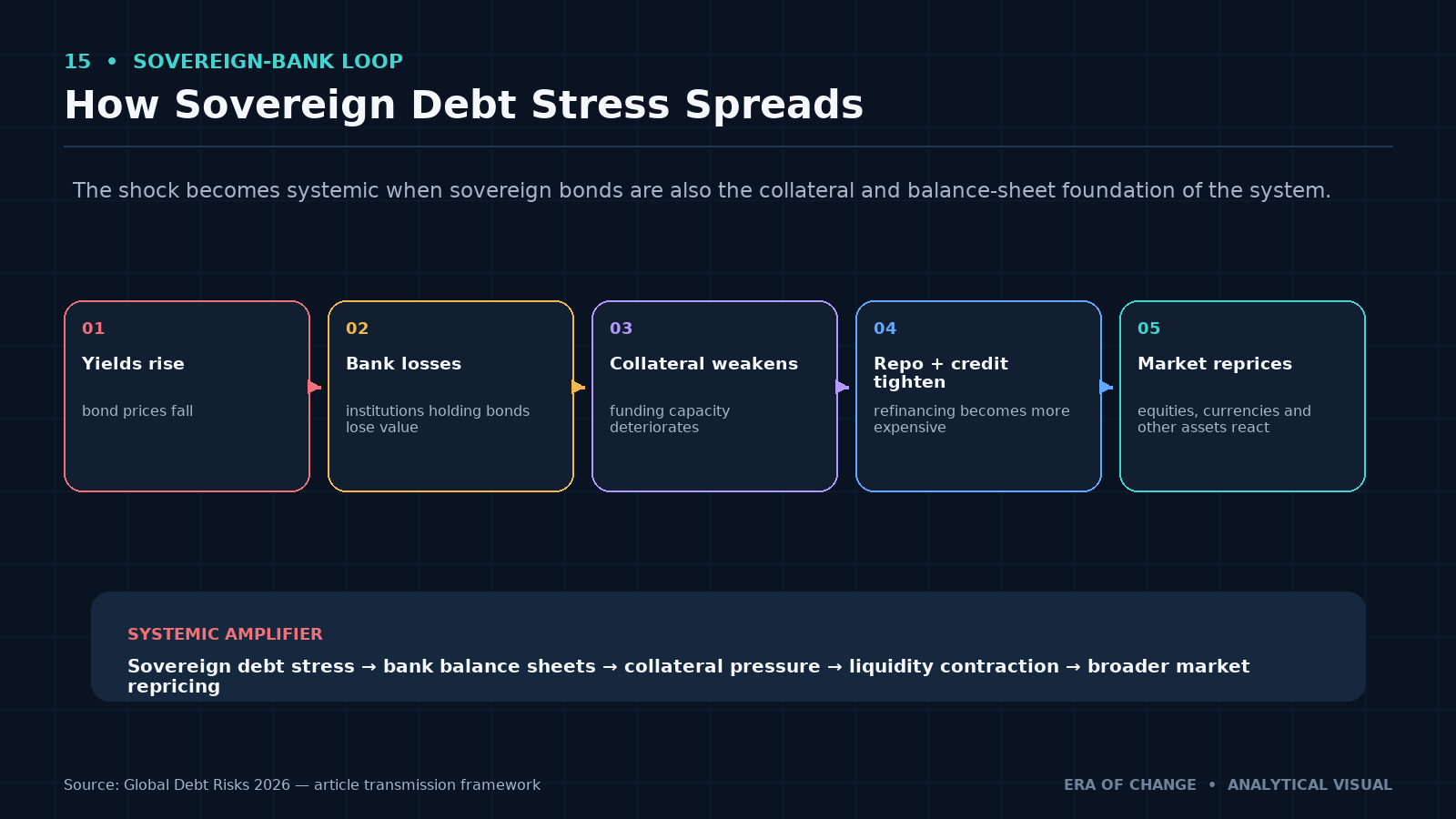
The transmission runs in a fairly consistent sequence once it actually starts. Government bond yields rise, which mechanically pushes bond prices down. Banks and funds holding those bonds record losses. Collateral values weaken as a direct consequence, since much of the financial system uses government bonds as collateral for other borrowing. Repo and funding costs increase in response. Credit conditions tighten across the board. Corporate refinancing becomes more expensive as government yields set the floor most corporate borrowing is priced against. Equity valuations compress under the weight of higher discount rates and tighter credit. Currency confidence can weaken if the stress is severe enough. And central banks come under real pressure to intervene, even when intervention carries its own costs.
The chain, in sequence: sovereign debt stress moves into bank balance sheets, then into collateral pressure, then into liquidity contraction, and finally into broader market repricing across asset classes that had nothing directly to do with the original sovereign issue.
The U.S. Treasury Market, Why It Matters Globally
U.S. Treasuries function as the benchmark for global interest rates, the core collateral asset throughout the financial system, the world’s dominant reserve asset, the pricing reference nearly all corporate debt is set against, and the foundation underlying both the repo market and a huge share of global derivatives markets. This is exactly why stress here would be systemic even without anything resembling an actual default, the Treasury market doesn’t need to fail outright to cause real damage. It just needs to function noticeably worse than the rest of the system has been built to assume.
The Supply Problem
Large fiscal deficits, rising issuance to fund them, substantial refinancing needs layered on top, and direct competition with corporate and other sovereign issuers for the same pool of investor capital all combine to push more paper into the market than in prior cycles.
The Demand Question
The buyer base matters as much as the supply: foreign official demand, domestic banks, pension funds, asset managers, money-market funds, and primary dealers themselves each bring a different appetite, and each can shift independently of the others.
The Dealer Balance-Sheet Constraint
Primary dealers are effectively required to absorb bonds when end-investor demand falls short at a given auction, but their own balance sheets are not unlimited, regulatory capital requirements and internal risk limits both cap how much inventory they can realistically carry before their own cost of funding starts rising, exactly what the March 2026 data showed happening in real time.
Why Rising Yields Are Not Always Healthy
Higher yields can reflect strong growth, rising inflation expectations, a larger term premium demanded for holding longer-duration risk, genuine supply concerns, deteriorating market liquidity, or fiscal credibility risk specifically. The cause matters far more than the direction alone, a yield rise driven by strong growth is a fundamentally different signal than one driven by investors losing confidence in a government’s fiscal trajectory, even though both produce the identical chart.
Emerging Markets, The First Weak Link
Emerging markets carrying large dollar-denominated debt, persistent current-account deficits, thin foreign-exchange reserves, structurally weak currencies, heavy import dependence, political instability, and short average debt maturities are the most immediately vulnerable link in the global debt system.
The Dollar-Debt Trap
The mechanism is self-reinforcing once it starts: the local currency weakens, which makes dollar-denominated debt more expensive to service in domestic-currency terms, which raises actual debt-service costs, which pressures reserves as the government defends the currency or meets dollar obligations, which weakens credit ratings, which accelerates capital outflows, and those outflows weaken the currency further, closing the loop. We cover this precise dynamic, including the specific early-warning indicators, in Currency Crises Explained.
Current-Account Deficit Risk
Countries that depend on continuous foreign financing to cover a persistent current-account deficit are structurally exposed to a sudden stop, a point where foreign capital simply declines to keep showing up, regardless of the price offered.
Why High U.S. Rates Matter
Elevated U.S. yields pull global capital away from emerging markets toward safer, higher-yielding developed-market assets, strengthen the dollar as a direct consequence, raise the real cost of emerging-market refinancing, and increase currency pressure on precisely the countries least equipped to absorb it.
Eurozone Periphery, A Potential Systemic Trigger
This is the risk I watch most closely of everything in this piece, and I want to explain exactly why.
Why Italy Matters
Italy carries one of the largest sovereign debt stocks in the developed world, combined with persistently low trend growth, heavy domestic bank exposure to its own government’s bonds, real political sensitivity to any fiscal tightening, and meaningful dependence on the credibility of euro-area support mechanisms remaining intact and available if needed.
The Sovereign-Bank Loop
The mechanism here is genuinely dangerous precisely because it’s circular: government bond prices fall, domestic banks, which hold large quantities of that same government’s debt, record losses, bank credit availability weakens as a result, the domestic economy slows, government fiscal pressure increases as tax revenue softens and spending needs rise, and sovereign spreads widen further in response, feeding directly back into the first step. This loop is why a purely fiscal problem in one country can become a genuine banking-system problem almost immediately, without any separate banking-specific shock required.
The Role of the European Central Bank
The ECB’s asset-purchase programs, reinvestment policy, Transmission Protection Instrument, general liquidity support, and, perhaps most importantly, the sheer credibility of its willingness to intervene have collectively kept peripheral spreads contained for years, arguably longer than the underlying fiscal fundamentals alone would justify.
My concern specifically: a genuine reduction in ECB support, and the roughly €500 billion in APP and PEPP runoff scheduled for 2026 is exactly that kind of reduction, could expose just how dependent peripheral debt markets have quietly become on central-bank backstops that were always meant to be temporary. Italian BTP yields have already climbed to a more than two-month high as this runoff has progressed through 2026. I want to be careful not to overstate this: I am not claiming an Italian crisis is inevitable, or even the most probable near-term outcome. I am saying this is the single mechanism, among everything covered in this piece, most capable of turning a contained, manageable stress into something genuinely systemic.
Could Japan Become a Sovereign Debt Risk?
I covered Japan’s specific vulnerabilities in more depth in Currency Crises Explained, but the debt angle deserves its own treatment here. Japan carries extraordinarily high public debt, roughly 200.8% of GDP as of March 2026, alongside a large domestic investor base, a Bank of Japan balance sheet that now holds roughly 46.3% of outstanding government bonds, a long history of active yield suppression, and a currency trading near 40-year lows.
Japan differs from a classic emerging-market debt story in three important ways: its debt is denominated almost entirely in its own currency, domestic institutions hold the overwhelming majority of it rather than foreign creditors, and the country retains substantial institutional and financial capacity relative to almost any emerging market. That combination is exactly why Japan hasn’t experienced a debt crisis despite carrying the highest debt load of any major economy.
But real stress can still emerge through other channels: currency depreciation that erodes real purchasing power domestically, inflation forcing the BOJ into tighter policy faster than the JGB market can comfortably absorb, rising yields that stress a central bank holding an enormous quantity of low-coupon legacy debt on its own balance sheet, and market-functioning problems in a government-bond market where the central bank itself is now the single largest holder. This is a structurally different risk than Italy’s or an emerging market’s, but it’s not a risk that can simply be dismissed because the debt happens to be denominated in yen.
National Debt Crisis vs. Global Debt Crisis
| National Debt Crisis | Global Debt Crisis |
| Concentrated in one country | Spreads across major markets simultaneously |
| May involve local default or devaluation | Affects global collateral and liquidity broadly |
| Capital can generally move elsewhere | Few genuinely safe markets remain to move into |
| A single central bank may stabilize it locally | Multiple central banks may need to coordinate |
| Limited asset correlation | Correlations can move sharply higher across the board |
A crisis becomes genuinely global specifically when it touches reserve assets, major banks, cross-border funding markets, core collateral markets, major currencies, or central-bank credibility itself — the difference between a contained, local event and something that moves through the entire system.
The Role of Inflation in Sovereign Debt Risk
Inflation can temporarily reduce the real value of existing fixed-rate debt, a genuine, if politically unstated, benefit to a heavily indebted government, but it introduces its own set of problems in exchange: higher nominal yields going forward, real losses for existing bondholders, currency depreciation, reduced investor confidence generally, higher refinancing costs on all future issuance, and direct pressure on the central bank to either accommodate or fight the inflation, depending on its mandate.
The key distinction worth holding onto: inflation can reduce the real burden of debt already on the books, while simultaneously making all future debt significantly more expensive to issue, a trade that looks appealing only if you ignore the second half of it. We cover the broader mechanics of this dynamic in What Causes Inflation?.
The Role of Central Banks
Central banks can buy government bonds directly, provide repo liquidity when funding markets seize up, expand the range of eligible collateral, cut policy rates, coordinate currency swap lines with other central banks, and generally work to stabilize market functioning during acute stress.
But every one of those interventions carries a cost: it can reignite inflation, weaken the currency, encourage exactly the fiscal dependence on central-bank support that makes the underlying problem worse over time, damage institutional credibility if used too readily or too often, and effectively transfer risk from private markets onto the central bank’s own balance sheet rather than genuinely resolving it. The message worth taking from this: central-bank intervention can address a liquidity crisis. It cannot permanently solve an unsustainable underlying fiscal structure, a distinction we explore in operational detail in How Central Banks Respond to Recessions.
Which Indicators Should Investors Monitor?
For the U.S. Treasury market: auction tails, bid-to-cover ratios, dealer take-down, term premium, market depth, Treasury market volatility, and repo rates.
For broader sovereign risk: credit-default-swap spreads, government bond spreads against benchmark issuers, the interest-to-revenue ratio, the debt maturity profile, the share of foreign ownership, and the underlying fiscal deficit trajectory.
For emerging markets specifically: foreign-exchange reserves, the current-account balance, the scale of dollar-denominated debt, real interest rates, currency depreciation, and cross-border capital flows.
For the eurozone: the Italy-Germany bond spread, broader peripheral sovereign spreads, ECB reinvestment policy specifically, domestic bank holdings of their own sovereign's debt, and any targeted intervention announcements from the ECB.
And for systemic liquidity generally: SOFR and repo conditions, the cross-currency basis, bank funding spreads, high-yield credit spreads, and the Era CrisisMeter reading itself, which synthesizes all of the above into a single structural score.
Era's Global Debt Risk Framework
We combine debt metrics with the broader systemic indicators covered throughout this piece: the debt stock itself, the refinancing schedule, the interest burden relative to revenue, currency denomination, the composition of the investor base, reserve adequacy, auction quality, repo-market conditions, the likely central-bank reaction, banking-system exposure, political credibility, and geopolitical pressure layered on top of all of it.
The underlying principle: debt risk depends not only on how much is owed, but on who owns it, how it's financed, what currency it's denominated in, and whether the markets it depends on remain genuinely liquid. Debt-to-GDP alone answers none of those questions. The full architecture behind how we weight and combine these inputs is covered in Era Forecasting Methodology.
Three Global Debt Scenarios for 2026
Base Case: Contained Refinancing Stress. Auctions remain broadly functional even if not always strong. Yields stay elevated rather than spiking. Central banks provide limited, targeted liquidity support rather than broad intervention. No major sovereign loses market access outright. Growth weakens, but systemic contagion is avoided. Likely implications: higher volatility, continued pressure on long-duration bonds, more selective credit conditions generally, and ongoing fiscal strain without acute crisis.
Stress Case: Eurozone or Emerging-Market Sovereign Event. Peripheral spreads widen sharply. Emerging-market currency stress accelerates meaningfully. Banks holding exposed sovereign debt face real losses. Central banks intervene in response. Likely implications: stronger safe-haven demand, equity drawdowns, wider credit spreads across the board, elevated currency volatility, and gold strength.
Systemic Case: Treasury and Repo Market Dysfunction. Repeated weak U.S. Treasury auctions continue. Dealer absorption capacity reaches its practical limit. Repo rates spike sharply. Market depth collapses. Forced deleveraging begins across multiple asset classes simultaneously. Likely implications: a genuine global liquidity crisis, rapid convergence of cross-asset correlations, emergency central-bank intervention, sharp equity and credit losses, and extreme volatility in government bonds themselves, the asset class the rest of the system is built to treat as the stable foundation.
Portfolio-Risk Considerations
This is general risk-management analysis based on Era's structural framework, not individualized investment advice.
Physical Precious Metals
Physical gold and other precious metals carry no direct sovereign liability, offer genuine currency diversification, and provide some protection specifically against policy-credibility risk, the risk that a government resolves its debt burden through inflation or currency debasement rather than genuine fiscal discipline. They also carry real price volatility, meaningful storage and custody considerations at scale, and produce no cash flow of their own.
Volatility Hedges
VIX options can offer protection during sudden systemic stress events specifically, but they carry real timing sensitivity, meaningful premium decay if the stress doesn't materialize on the expected timeline, and genuine complexity and risk that make them unsuitable as a default holding rather than a targeted, sized position.
Short Exposure to Lower-Quality Credit
The underlying logic is straightforward: weak issuers become disproportionately vulnerable when sovereign yields and broader refinancing costs rise, since their own borrowing costs rise faster and their margin for error is thinner to begin with. The risks are equally real, ongoing carry cost while waiting for the thesis to play out, timing risk, the possibility of a short squeeze, and the risk that central-bank intervention arrives and compresses spreads before the thesis has time to resolve, alongside the potential for significant loss depending on the specific instrument used.
Unhedged Long-Duration Emerging-Market Sovereign Bonds
My own concern here is direct: these instruments combine currency depreciation risk, duration risk, default risk, liquidity risk, and the risk of direct political intervention, all stacked on top of each other in a single position. I’m not issuing categorical investment instructions, this is a risk category that genuinely requires careful, individualized evaluation, not a blanket recommendation to avoid it entirely. But it’s worth naming plainly as the category I’m personally most cautious about within this entire framework.
Era Analyst's Perspective
From Nikolai Fainizkii, CEO & Senior Analyst, Era of Change
“Everyone wants to talk about total global debt, $348 trillion is a genuinely staggering number, and it makes for an easy headline. But that number tells you almost nothing about timing. What tells you about timing is whether primary dealers can still absorb the debt actually coming to market this quarter, and that March 2026 auction data, a 5-year note tailing by 1.4 basis points against a normal average of 0.3, with dealers left holding 16% of the issue against an 11% norm, was the clearest signal I’ve seen in years that the absorption capacity is genuinely being tested.
The systemic trigger I watch most closely isn’t an emerging market. It’s Italy, specifically because of the sovereign-bank loop. When Italian bond prices fall, Italian banks holding that debt take losses directly, credit tightens, growth slows, and Italy’s own fiscal position gets worse at exactly the moment it needs to look better, a loop with no natural circuit breaker except sustained ECB support. And the ECB is now letting roughly half a trillion euros in previously reinvested securities run off in 2026 alone. I don’t think an Italian crisis is inevitable this year. But I think markets have spent years pricing ECB backstop support as though it’s permanent, and 2026 is the year that assumption actually gets tested against real numbers.
That’s exactly why I hold physical precious metals, VIX options, and short positions in lower-quality credit right now, and why I categorically avoid unhedged long-duration emerging-market sovereign bonds. If this is a liquidity story rather than a solvency story, and I believe it is, for now, the instruments that protect you look completely different from the ones that would protect you against outright default.”
— Nikolai Fainizkii, CEO & Senior Analyst, Era of Change
Common Misconceptions About Global Debt
“Governments that print their own currency cannot default.” They may avoid a formal nominal default, but they can still impose real losses on creditors and citizens alike through inflation, currency depreciation, financial repression, or outright restructuring dressed up in softer language.
“High debt automatically means crisis.” Institutional quality, average debt maturity, currency denomination, and the composition of the investor base all matter enormously, which is exactly why Japan carries far higher debt than Italy without carrying anywhere near the same market stress.
“Government bonds are always safe.” They can carry real duration risk, inflation risk, currency risk, liquidity risk, and political risk, even in scenarios where the probability of outright default is genuinely close to zero.
“Central banks can always stabilize the market.” Intervention capacity is constrained by inflation dynamics and by the central bank’s own credibility, tools that look unlimited on paper are considerably more limited in a world where inflation is already running above target.
“A debt crisis begins with default.” In practice, market dysfunction, auction weakness, and funding stress almost always appear well before anything resembling an actual default, which is precisely why the two acute-phase signals covered in this piece matter more than watching for a default announcement that, in most cases, never actually arrives.
Indicators That Would Change the Outlook
Signals of improvement: strong and consistent Treasury auction demand, stable or falling repo rates, narrowing peripheral eurozone spreads, lower government interest expense as a share of revenue, reduced fiscal deficits, stronger emerging-market reserve coverage, and lower dollar funding stress generally.
Signals of deterioration: repeated auction tails across multiple maturities, rising dealer inventories, further repo-market spikes, a widening Italy-Germany spread, emerging-market reserve depletion, sovereign credit downgrades, the appearance of capital controls anywhere in the system, a sharp increase in cross-currency funding stress, and the Era CrisisMeter moving above 80.
Frequently Asked Questions
What is a global debt crisis?
A global debt crisis is a period in which sovereign debt stress in one or more major markets spreads across the broader financial system, affecting reserve assets, major banks, cross-border funding, and global collateral markets simultaneously, distinct from a contained crisis affecting a single country whose effects largely stay local.
What causes a sovereign debt crisis?
Sovereign debt crises typically result from the interaction of large refinancing needs, persistent fiscal deficits, reduced central-bank support for the bond market, rising interest costs, currency or inflation risk that pushes investors to demand higher compensation, and political fragmentation that undermines confidence in a government’s fiscal credibility.
Is global debt too high in 2026?
Total global debt reached $348 trillion at the end of 2025, an increase of nearly $29 trillion in a single year. Whether this level is genuinely “too high” depends far more on refinancing capacity, investor confidence, and market liquidity in specific countries than on the aggregate figure alone, which is exactly why this piece focuses on the mechanisms that turn debt into crisis rather than the total debt figure itself.
How do Treasury auctions signal debt stress?
Weak Treasury auctions, reflected in low bid-to-cover ratios, reduced indirect bidder demand, and larger-than-average dealer take-down, signal that investor demand for new government debt may be softening. A repeated pattern of weak auctions across multiple maturities, rather than a single isolated sale, is the signal genuinely worth monitoring.
What does a Treasury auction tail mean?
An auction tails when the final yield accepted is meaningfully higher than the market yield trading immediately before the auction, indicating the Treasury had to pay investors more than the market had already priced in to fully clear the sale. Repeated tails across successive auctions can signal declining market absorption capacity.
Why is the repo market important?
The repo market allows institutions to borrow cash overnight against government securities as collateral, and it underpins how primary dealers finance the substantial Treasury inventories they’re required to hold. A sharp, sustained rise in repo rates can signal that dealers are struggling to finance those inventories, a stress that can spread quickly into broader market liquidity.
Which countries are most vulnerable to sovereign debt risk?
Emerging markets carrying large dollar-denominated debt, persistent current-account deficits, thin foreign-exchange reserves, and short average debt maturities face the most immediate vulnerability. Among developed markets, the eurozone periphery, particularly Italy, carries a distinct systemic risk due to the close linkage between sovereign debt and domestic bank balance sheets.
Why is dollar-denominated debt dangerous?
When a country’s currency weakens, dollar-denominated debt becomes proportionally more expensive to service in local-currency terms, raising debt-service costs at precisely the moment reserves and credit ratings are also coming under pressure, a mutually reinforcing dynamic that can accelerate capital outflows and currency weakness together.
Could Italy trigger a eurozone debt crisis?
Italy carries a large sovereign debt stock, low trend growth, and heavy domestic bank exposure to its own government bonds, making it a genuine candidate for systemic stress, particularly as the ECB reduces balance-sheet support through 2026. This is a risk to monitor closely rather than a predicted or inevitable outcome.
Can central banks prevent a debt crisis?
Central banks can address liquidity stress directly through bond purchases, repo support, and expanded collateral frameworks, but they cannot permanently resolve an underlying fiscal structure that is genuinely unsustainable. Intervention also carries real costs, including inflation risk, currency weakness, and the gradual transfer of risk onto the central bank’s own balance sheet.
Are government bonds still safe?
Government bonds remain generally safe from outright default risk in most developed markets, but they can still carry meaningful duration risk, inflation risk, currency risk, and liquidity risk, all of which can produce real losses for bondholders even in scenarios where default itself never becomes a serious possibility.
How does sovereign debt affect currencies and banks?
Rising sovereign yields lower bond prices, which can generate direct losses for domestic banks holding that debt, tightening credit conditions and weakening growth. That weaker growth and reduced fiscal position can, in turn, pressure the currency, particularly where sovereign and banking risk are as closely intertwined as they are in the eurozone periphery.
About Era of Change
Era of Change is an independent macroeconomic research and geopolitical intelligence firm providing institutional-quality analysis for investors worldwide. Its research combines macroeconomics, financial markets, blockchain analytics, artificial intelligence, and geopolitical risk within proprietary forecasting frameworks designed to identify structural market changes before they become broadly recognized.
Era evaluates sovereign debt through refinancing capacity, auction demand, repo-market liquidity, currency exposure, banking-system links, central-bank policy, and political credibility rather than relying on debt-to-GDP ratios alone. Our full methodology, live index reading, and forecast archive are available at eraperemen.info/en.
The content published by Era of Change is for informational and educational purposes only and does not constitute financial, investment, legal, or tax advice. All views expressed are the personal analytical perspective of the author. Past forecast accuracy does not guarantee future results. Readers should conduct their own research and consult a qualified financial professional before making any investment decisions.
Sources
United States
- U.S. Treasury: Fiscal Data — Understanding the National Debt
- FRED: Federal Debt as Percent of GDP (GFDEGDQ188S)
- FRED: Secured Overnight Financing Rate (SOFR)
- GAO-26-107529: Federal Debt Management — Treasury Is Meeting Borrowing Needs but the Deteriorating Fiscal Outlook Poses Risks
- Fortune: US Debt Draws Weaker Demand as $10 Trillion Must Be Rolled Over Amid Iran War
- The Daily Economy: Repo Market's Warning Light Is Flickering
Eurozone
- CPR AM: The ECB — The End of Quantitative Tightening Is Not on the Agenda
- Trading Economics: Italy's BTP Yields Rise to Over Two-Month High
International Institutions
Internal Research
- Era CrisisMeter Explained
- What Causes Inflation?
- 2026 Mid-Year Global Outlook
- Currency Crises Explained
- How Central Banks Respond to Recessions
- Era Forecasting Methodology
- Scenario Planning for Investors
— Nikolai Fainizkii, CEO & Senior Analyst, Era of Change