Executive Summary
A currency crisis is a rapid loss of confidence in a national currency, usually accompanied by capital flight, reserve depletion, accelerating inflation, and sharply higher interest rates forced on the central bank rather than chosen by it. Currency collapses rarely come from a single cause. They emerge from several forces acting together: unsustainable debt, negative real interest rates, declining foreign-exchange reserves, political interference in monetary policy, and a genuine loss of policy credibility.
Era monitors three indicators before almost anything else: the three-month rate of foreign-exchange reserve depletion, the gap between the official exchange rate and whatever parallel rate the market is actually using, and deeply negative real interest rates. Turkey is the clearest illustration of how a delayed and politically constrained policy response turns temporary currency weakness into a structural crisis. Japan represents a genuinely different kind of risk, not policy recklessness, but a combination of extraordinary public debt, a central bank that now holds nearly half its own government’s bonds, and a currency the entire world has been using as a funding source for a decade.
I want to be clear about the framing before we go further: a currency crisis is a process, not a single-day event. By the time the exchange rate itself makes headlines, the crisis has usually been building for months.
Key Takeaways
- Currency crises usually begin well before the exchange rate visibly collapses.
- Falling foreign-exchange reserves can reveal that authorities are defending a currency level that isn’t actually sustainable.
- A widening gap between the official and market exchange rate signals declining trust in the official number.
- Negative real interest rates push savers toward foreign currency, gold, or crypto, quietly, before the headline crisis arrives.
- Political delays make eventual stabilization more expensive, not less.
- Currency weakness becomes systemic once it spreads into inflation, debt servicing, banking stability, and capital controls simultaneously.
Introduction
A currency does not collapse simply because traders wake up one morning and decide to sell it. That’s the misconception I want to dismantle immediately, because it leads people to treat currency crises as sudden, unpredictable events rather than what they actually are: the visible final stage of a process that’s usually been running for months.
The exchange-rate move that makes the news is the release, not the cause. What causes a currency crisis, how does it actually spread once it starts, and which warning signals show up first, well before anyone outside the central bank is paying attention? That’s what this piece is built to answer.
What Is a Currency Crisis?
A currency crisis is a period of rapid, disorderly currency depreciation combined with a genuine loss of public and investor confidence, capital flight, reserve depletion, rising import prices, emergency interest-rate increases, and often capital controls or foreign-exchange restrictions imposed as a last resort.
It’s worth distinguishing this from three related but different things. Normal currency volatility is just markets pricing in day-to-day information, not a crisis. A managed devaluation is a deliberate, controlled policy choice, often aimed at improving competitiveness, and it can be executed without triggering a loss of confidence. A currency crisis is what happens when that control is lost. And a full currency collapse is the most severe endpoint, where the currency effectively stops functioning as a reliable store of value domestically. A currency can weaken substantially, 15%, 20%, even more, without ever crossing into systemic crisis. The distinction is whether confidence, reserves, credit conditions, and payment stability are breaking down simultaneously, or whether the currency is just adjusting to new information in an orderly way.
What Causes a Currency Crisis?
Excessive Money and Credit Expansion
When money supply growth substantially outpaces the real economy, often because fiscal deficits are being financed indirectly through monetary expansion, or because a credit boom is running well ahead of productive capacity, the currency’s purchasing power erodes from the inside before it ever shows up as an exchange-rate move. We cover this mechanism in detail in M2 Money Supply Explained.
Persistent Inflation
Domestic inflation reduces a currency's purchasing power and steadily erodes competitiveness relative to trading partners. Once this starts, it tends to feed itself: the currency depreciates, import prices rise as a direct consequence, that pushes inflation higher still, and higher inflation pushes the currency lower again. Breaking that loop from the inside, once it's running, is genuinely difficult.
Unsustainable Public or External Debt
Debt denominated in foreign currency, heavy dependence on refinancing that debt on acceptable terms, rising interest costs, and a sovereign's overall credibility with international lenders all compound each other. A government that cannot credibly service its foreign-currency obligations puts direct pressure on the currency needed to service them, a dynamic we cover from the debt side in Global Debt Risks 2026.
Negative Real Interest Rates
The real interest rate is simply the nominal rate minus inflation, and when it's meaningfully negative, domestic savers are effectively being paid to lose purchasing power by holding their own currency. That pushes capital toward flight, dollarization, gold, or conversion into foreign currency, and it reduces domestic savings at exactly the moment the country needs capital to stay put.
Loss of Central-Bank Credibility
Political interference, delayed tightening when tightening is clearly warranted, unclear or contradictory communication, frequent policy reversals, and artificial exchange-rate targets all erode the market's belief that the central bank will actually do what price stability requires. Credibility, once damaged, is far harder to rebuild than it was to earn.
External Shocks
Commodity-price shocks, war or sanctions, a sudden stop in foreign capital inflows, a sharp rise in global interest rates, or a collapse in export revenue can all trigger a crisis in a currency that was otherwise structurally sound — though the currencies most vulnerable to an external shock are almost always the ones already carrying some of the internal weaknesses described above.
How a Currency Crisis Develops
The process moves through a fairly consistent sequence, even though the specific trigger differs case to case.
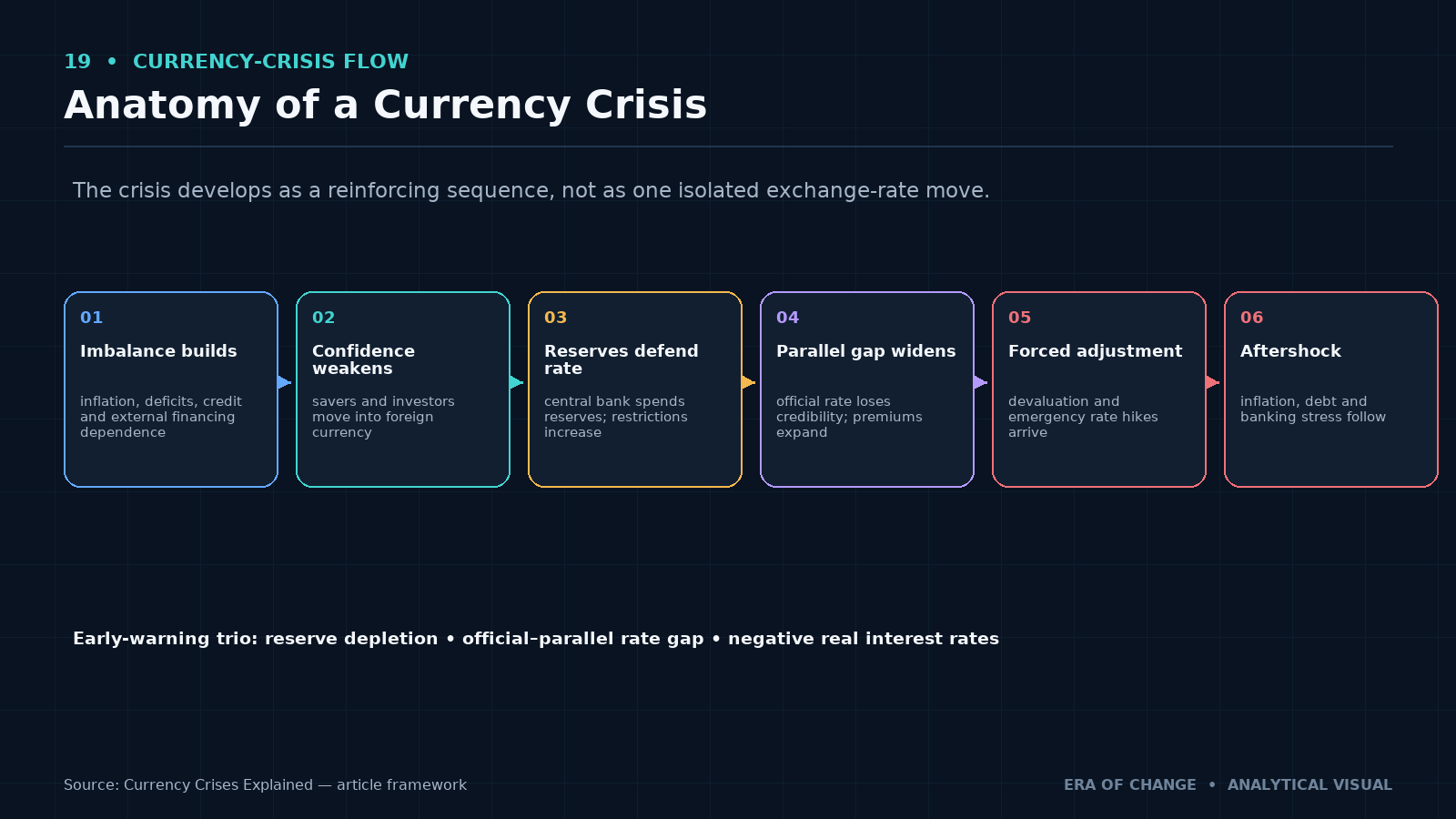
Structural imbalances build first, often quietly: inflation drifts higher, fiscal deficits widen, credit growth accelerates, and the economy becomes progressively more dependent on external financing to keep functioning normally. Confidence weakens next — domestic savers start moving into foreign currency, foreign investors quietly reduce their exposure, and local businesses begin accelerating imports or paying down foreign debt faster than they otherwise would, all of which puts additional pressure on the currency. Authorities move to defend the currency, the central bank sells reserves to support the exchange rate, policy restrictions increase, state banks intervene directly, and the official exchange rate becomes progressively less credible even as it's being defended. Parallel markets expand as the gap widens, black-market exchange rates diverge from the official rate, crypto premiums in the local currency increase, and importers increasingly struggle to access foreign currency through official channels. And finally, forced adjustment arrives: a sharp devaluation, emergency rate hikes far larger than would have been needed earlier, capital controls, an inflation shock, and often banking or sovereign stress layered on top.
The flow, in sequence: imbalance builds, confidence weakens, reserves get spent defending the rate, the parallel-market gap widens, devaluation arrives, and inflation and debt stress follow.
The Three Early Warning Indicators Era Watches
1. Speed of Foreign-Exchange Reserve Depletion
The direction and rate of change in reserves matters far more than the headline reserve figure on its own. Our preferred approach tracks reserves on a rolling three-month basis, adjusts where possible for scheduled debt repayments, gold-price movements, and known interventions, and compares the pace of decline against a country's import needs and short-term external debt obligations. The IMF's International Financial Statistics publish the underlying reserve data most central banks report against.
The warning signal is specific: a central bank burning through reserves rapidly to defend its currency may be postponing an overdue adjustment rather than genuinely restoring confidence. Turkey's own central bank was still intervening directly in FX markets in mid-2026 to contain pressure on the lira, even after years of nominal stabilization, a reminder that reserve defense doesn't automatically signal genuine strength.
2. Gap Between the Official and Parallel Exchange Rate
This gap can appear as a black-market rate, an offshore rate, or increasingly, a premium visible in crypto-exchange pricing for the local currency. A widening gap tells you the official price no longer reflects the market's actual demand for foreign currency, and it tends to produce arbitrage, corruption, import shortages, capital controls, and, eventually, reduced confidence in official statistics generally, since a government defending an unrealistic official rate has an obvious incentive to also manage the inflation numbers that would otherwise expose the gap. The parallel-market premium is calculated simply: (parallel rate ÷ official rate − 1) × 100.
3. Negative Real Interest Rates
Nominal rates can look aggressively high while still being far too low relative to inflation. Turkey's own history is the cleanest illustration: in 2022, the central bank cut its policy rate to 12% even as inflation soared above 83%, a real rate of roughly negative 70 percentage points, a level that makes holding the domestic currency almost punitive by design. Negative real rates cause domestic deposits to lose purchasing power in real time, reward borrowers while penalizing savers, push demand toward foreign currency, and steadily erode central-bank credibility the longer they persist. It's worth being precise here: very high positive rates can also damage growth and debt sustainability on their own. The real question is whether policy is both credible and sufficient relative to actual inflation, not simply whether the headline number looks large.
Additional Currency-Crisis Indicators
A framework built on three indicators alone would be too narrow, so we also track a current-account deficit, since a large deficit increases dependence on external financing that can dry up quickly. We watch short-term external debt against liquid foreign-exchange reserves directly, since that comparison tells you how much genuine cushion actually exists. Sovereign credit-default-swap spreads and bond spreads often reveal deteriorating confidence before the currency itself breaks, because credit markets frequently move first.
Rising bank deposit dollarization, a growing share of domestic deposits held in foreign currency, signals a local loss of confidence building from within the banking system. Capital controls and administrative restrictions can slow outflows temporarily, but their appearance also confirms that authorities are already under real pressure. And import coverage, how many months of imports the current reserve stock could actually finance, is a simple, durable stress test that cuts through a lot of noise.
Why Governments Respond Too Late
This is where the political economy matters as much as the financial mechanics. Policymakers delay action for reasons that are entirely rational from their own short-term perspective: elections, populist commitments to cheap credit, fear of triggering a recession, pressure to keep government debt-servicing costs manageable, and a genuine reluctance to publicly admit that prior policy was a mistake.
The insight worth holding onto is this: the measures required to stabilize a currency are almost always politically painful well before they become economically unavoidable, and every month of delay compounds the eventual cost, larger rate hikes than would otherwise have been necessary, a deeper recession, greater reserve losses, more severe inflation, and lasting damage to public trust in the institutions responsible for managing all of it.
Case Study: Turkey
The Starting Conditions
Turkey entered its crisis period carrying persistent inflation, sustained political pressure for low interest rates, heavy reliance on foreign capital inflows, significant foreign-currency exposure in its private sector, and declining confidence in the independence of its policy institutions.
The Policy Error
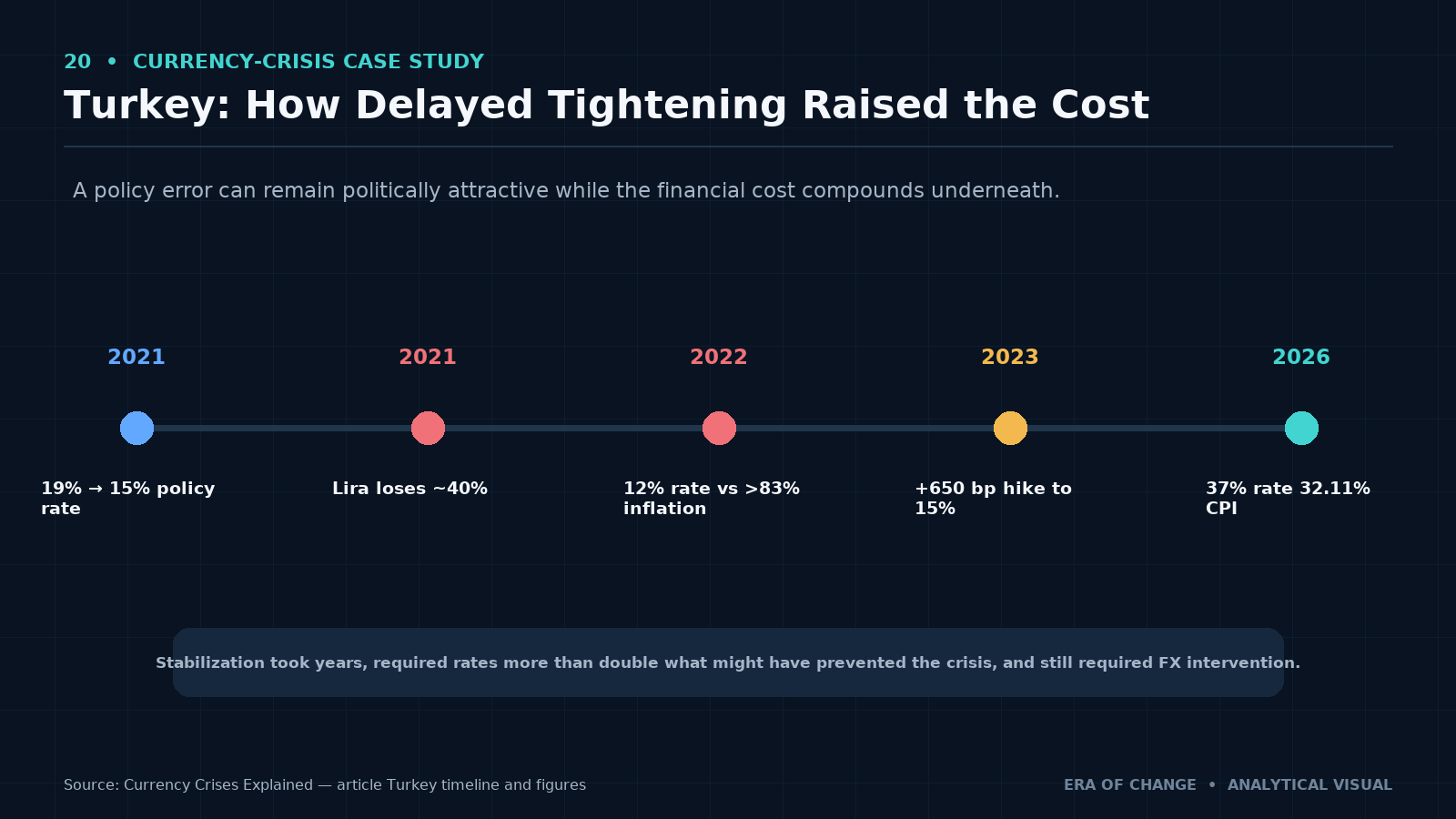
Beginning in September 2021, under direct pressure from President Erdoğan, who held the unconventional conviction that higher interest rates cause more inflation rather than less, the Central Bank of the Republic of Türkiye cut its policy rate from 19% to 15%, the start of a cumulative easing cycle that continued even as inflation accelerated. The lira lost roughly 40% of its value in 2021 alone.
The Currency-Inflation Feedback Loop
The mechanism ran exactly as the general framework above predicts: the currency weakened, import costs rose as a direct result, inflation accelerated, real interest rates became even more deeply negative as nominal rates stayed low against rising prices, savers responded rationally by seeking foreign currency, and that additional pressure weakened the currency further still. By 2022, the central bank cut rates to 12% even as inflation exceeded 83%, the loop running in full, with policy actively reinforcing it rather than resisting it.
Why Stabilization Became Expensive
Restoring confidence eventually required exactly the double-digit policy rates the government had spent two years avoiding. Following Erdoğan's re-election in May 2023, Turkey's central bank raised its key rate by 650 basis points to 15%, the first hike since early 2021, and continued tightening from there. As of mid-2026, the policy rate sits at 37%, with annual inflation at 32.11% in June, meaning the real rate has finally turned modestly positive after years deep in negative territory.
That stabilization took years, required rates more than double what would likely have prevented the crisis if applied in 2021, and the central bank was still directly intervening in FX markets in mid-2026 to manage residual pressure on the lira, with energy costs from the ongoing Middle East conflict now adding a fresh complication on top of the underlying stabilization effort.
Lessons for Other Countries
Delayed tightening reliably increases the eventual cost of stabilization rather than reducing it. Artificial stability, an exchange rate held steady through intervention or restriction, can conceal imbalances that are actively growing underneath. Credibility can be lost in months and takes years to rebuild. And currency defense without genuine policy reform underneath it is rarely sustainable on its own, no matter how large the reserves being spent to maintain it.
Case Study: The Japanese Yen as an Underestimated Risk
I want to frame this correctly from the start: this is a different type of vulnerability than Turkey's, not a claim that a yen collapse is inevitable or even likely on any specific timeline.
Why the Yen Is Different
The yen carries genuine reserve-currency characteristics, Japan has an enormous domestic savings base to draw on, its government-bond market is among the deepest in the world, the yen has functioned as the world’s dominant funding currency for over a decade, and Japan’s institutional capacity, the Ministry of Finance, the Bank of Japan, the broader bureaucracy, is about as strong as any in the world. None of this is Turkey.
Structural Sources of Risk
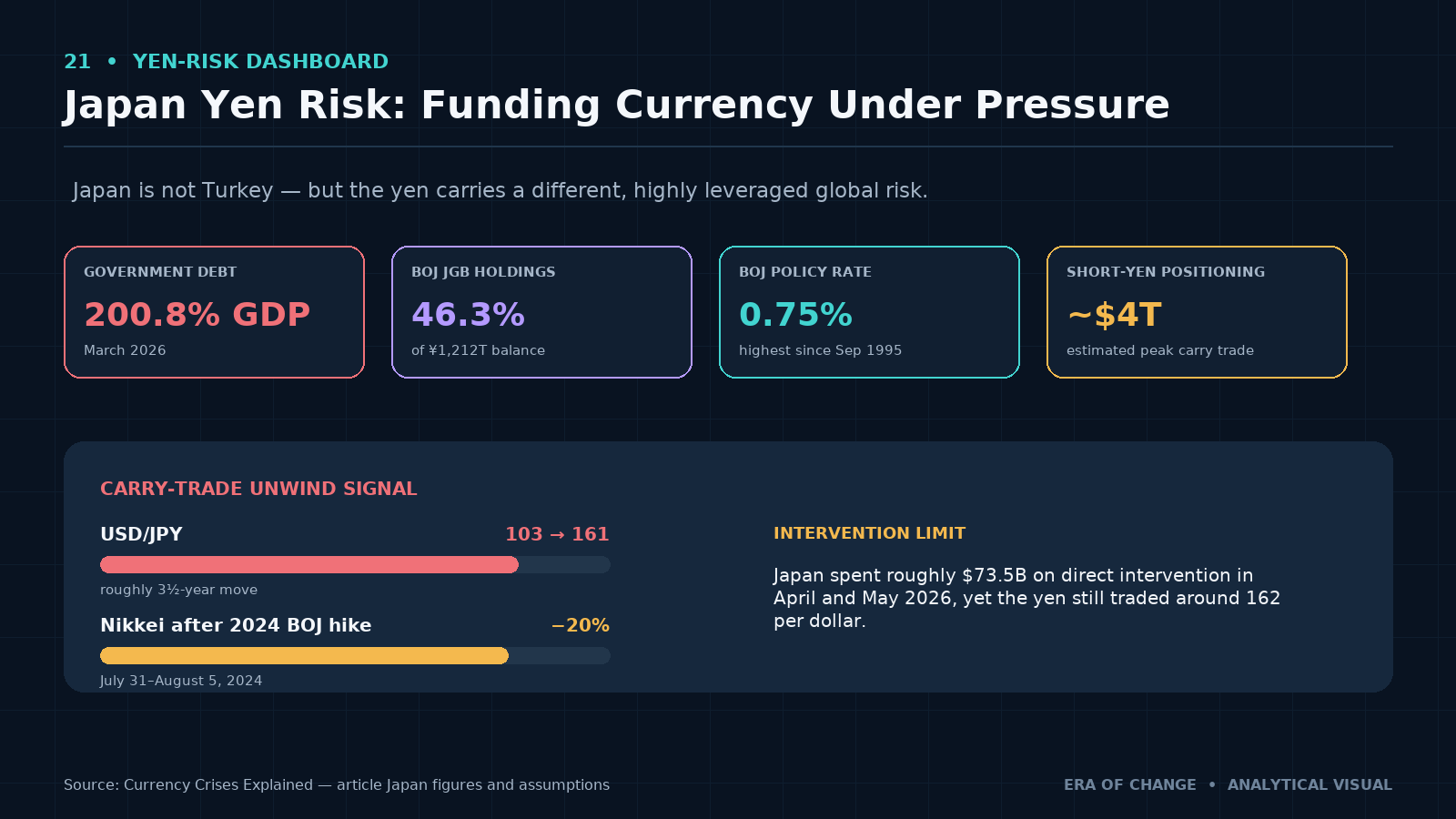
But underneath that strength sit some genuinely uncomfortable numbers. Japan's government debt stands at roughly 200.8% of GDP as of March 2026, among the highest of any developed economy by a wide margin. The Bank of Japan has become the dominant buyer of that debt, holding 46.3% of the total ¥1,212 trillion Japanese government bond balance as of late 2024, a central bank that is, in effect, its own government's largest single creditor.
Japan spent decades suppressing yields through explicit yield-curve control, and the BOJ’s policy rate now sits at 0.75%, the highest level since September 1995, reflecting a genuine, if gradual, shift after that long period of near-zero rates. That combination leaves Japan structurally sensitive to any global bond-yield shock, and creates a real tension between what currency stability would require and what the government-bond market can actually absorb without disruption.
The Funding-Currency Problem
For over a decade, the standard version of the yen carry trade has worked the same way: borrow cheaply in yen, invest the proceeds in higher-yielding assets elsewhere, and profit as long as the yen stays weak and volatility stays low. The USD/JPY rate ran from roughly 103 to 161 over about three and a half years as the BOJ held rates near zero while the Fed pushed its own rate to 5.5%, producing the widest rate differential in the G10 and an estimated $4 trillion in short-yen positioning globally at the trade's peak.
We already got a preview of what unwinding that looks like. When the BOJ raised its rate from roughly 0–0.1% to 0.25% on July 31, 2024, the Nikkei fell 20% between July 31 and August 5. On August 5 alone, the Nikkei and Topix both fell more than 12%, the steepest single-day drop since 1987, and the S&P 500 fell 3% on the same day, purely from carry-trade positions unwinding on the other side of the world. That's what happens to global markets when a modest, well-telegraphed 25-basis-point move forces a multi-trillion-dollar trade to unwind. It's worth sitting with that.
What Could Trigger Stress
A global bond-yield shock, a genuine loss of confidence in Japanese government bonds specifically, a disorderly currency intervention that spooks rather than calms markets, a rapid and forced carry-trade unwind, domestic inflation forcing the BOJ into tighter policy faster than the bond market can absorb, or simply weak demand at a JGB auction could each independently trigger real stress.
By mid-2026, the yen was trading around 162 per dollar, near its weakest level since 1996, despite Japan having spent roughly $73.5 billion on direct intervention in April and May 2026 alone. That's a striking amount of firepower to spend without reversing the underlying trend, and it tells you something important about how limited intervention alone actually is against a rate differential this wide.
What Investors May Be Underestimating
My own view is that the market currently places too much confidence in the yen's funding-currency status and not enough weight on the fiscal and central-bank balance-sheet risk sitting underneath it. This is a scenario to monitor closely, not a deterministic forecast, but the 2024 episode already showed how fast a modest policy surprise can cascade through global markets once a trade this large is positioned on one side.
Currency Crisis vs. Currency Devaluation
| Currency Devaluation | Currency Crisis |
| May be planned or gradual | Usually disorderly |
| Can improve competitiveness | Often destroys confidence |
| Reserves may remain adequate | Reserves often fall rapidly |
| Inflation impact may be manageable | Inflation can accelerate sharply |
| Capital markets may remain functional | Funding and banking stress may develop |
| Policy credibility may survive | Credibility is often severely damaged |
Currency Crisis vs. Sovereign Debt Crisis
The two are deeply intertwined rather than separate problems. A currency crisis can raise the domestic-currency cost of servicing foreign-currency debt, increase overall government financing costs, reduce access to international capital markets, and eventually force a government toward monetary financing of its deficit, the exact dynamic that reinforces the original currency weakness.
A sovereign debt crisis, moving in the opposite direction, can trigger capital flight, undermine the domestic banking system, force currency depreciation, and deplete reserves just as effectively as a currency-specific shock would. Currency, sovereign-debt, and banking crises reliably reinforce one another once any one of them gets underway, which is precisely why Global Debt Risks 2026 and this piece should be read as two views of the same underlying structural risk, not separate topics.
How Currency Crises Affect Financial Markets
Domestic equities can post rising nominal prices even while losing real value in local-currency terms, or losing value entirely once measured in a stable foreign currency, a distinction that trips up a lot of retail investors watching only the headline index level. Government bonds split by currency: local-currency bonds suffer from the inflation the crisis itself generates, while foreign-currency-denominated bonds face rising default risk directly. Banks typically experience deposit flight, foreign-currency mismatches on their own balance sheets, rising loan defaults, and genuine liquidity shortages, often the first visible sign of contagion beyond the currency market itself.
Exporters can benefit from lower local costs measured in foreign currency, but financing constraints and import-input costs frequently offset much of that advantage in practice. Gold and foreign currency demand typically rises sharply as domestic confidence erodes, exactly the dynamic Era covers in our broader Era Global Risk Index framework. And real estate can function as a partial inflation hedge, but affordability, property taxes, financing availability, and liquidity can all deteriorate simultaneously during a genuine crisis.
How Investors Commonly Misread Currency Risk
Looking only at the exchange rate misses that the rate can appear artificially stable simply because the central bank is actively spending reserves to hold it there. Trusting the official rate ignores that a controlled rate can diverge sharply from the true market-clearing price, sometimes by a wide margin. Assuming high nominal rates are automatically protective overlooks that rates can still be deeply negative in real terms, exactly as Turkey demonstrated at a policy rate of 12% against 83% inflation. Ignoring foreign-currency debt exposure misses that a weaker currency can make debt repayment exponentially harder for both governments and companies carrying it. Treating capital controls as evidence of stability confuses a symptom for a cure. Controls may delay adjustment without resolving anything underneath. And assuming reserve size alone is sufficient overstates the real cushion available whenever a meaningful share of gross reserves is borrowed, encumbered, or already offset by near-term obligations that reduce genuinely usable liquidity.
A Practical Currency-Risk Analysis Framework
| Indicator | Stable | Warning | Crisis Risk |
| Three-month reserve trend | Stable/rising | Moderate decline | Rapid depletion |
| Official–parallel rate gap | Minimal | Expanding | Severe divergence |
| Real policy rate | Positive/credible | Slightly negative | Deeply negative |
| Short-term external debt | Covered by reserves | Rising pressure | Exceeds liquid reserves |
| Inflation expectations | Anchored | Deteriorating | Unanchored |
| Capital controls | Limited | Increasing | Broad restrictions |
| Sovereign spreads | Stable | Widening | Disorderly |
| Deposit dollarization | Stable | Rising | Accelerating |
Country structures differ substantially, so treat this as a diagnostic framework rather than a set of rigid universal thresholds: what counts as "warning" for one economy's reserve structure can be entirely normal for another's.
Era Analyst's Perspective
From Nikolai Fainizkii, CEO & Senior Analyst, Era of Change
"Everyone wants to talk about Turkey when the subject is currency crises, and I understand why. It's the cleanest, most textbook example of the last decade. Rates cut to 12% against 83% inflation is about as unambiguous as monetary policy gets. But I think the more important conversation right now is about the yen, precisely because almost nobody is having it with any urgency.
Japan's central bank holds 46% of its own government's bonds. Its debt sits above 200% of GDP. And the world has spent over a decade building an estimated $4 trillion in positions that are essentially short the yen, funded by borrowing at rates near zero. We already got a preview of what unwinding that looks like in August 2024, when a 25-basis-point BOJ hike, a genuinely modest move by any normal standard, produced a 12% single-day crash in the Nikkei and knocked 3% off the S&P 500 on the same day, purely through carry-trade contagion.
The market keeps pricing the yen as a stable funding currency because that's what it has been for so long. I think that's exactly the kind of assumption that breaks hardest when it finally breaks, because the entire trade depends on volatility staying low and the rate differential staying wide. Neither of those conditions is guaranteed to hold indefinitely, and Japan just spent $73.5 billion in two months defending a currency that kept weakening anyway. That's not the sign of a market in equilibrium."
— Nikolai Fainizkii, CEO & Senior Analyst, Era of Change
How Era of Change Evaluates Currency-Crisis Risk
We don't treat currencies as isolated price charts to be read in a vacuum. Our framework incorporates foreign-exchange reserves, real interest rates, inflation, M2 growth, capital flows, sovereign debt dynamics, credit spreads, banking-system stability, political intervention in monetary policy, commodity dependence, and broader geopolitical risk, synthesized continuously through the Era CrisisMeter.
The underlying principle is simple to state and hard to apply in practice: a currency becomes genuinely vulnerable when monetary, fiscal, external, and political stress converge at the same time, rather than any single factor deteriorating in isolation. Political developments, specifically elections, leadership changes at the central bank, shifts in fiscal policy matter enormously here, which is why this framework connects directly to our broader work in How Political Events Affect Financial Markets.
What to Watch Before a Currency Crisis
- Monthly foreign-exchange reserve data from the relevant central bank
- The three-month reserve depletion rate specifically, not just the headline level
- The gap between official and offshore or parallel exchange rates
- Crypto-exchange premiums priced in the local currency
- Real policy rates, calculated against actual inflation rather than forecasts
- Inflation expectations, and whether they remain anchored or are drifting
- Short-term external debt relative to liquid reserves
- The current-account balance
- Sovereign bond and CDS spreads
- Bank deposit dollarization trends
- Any capital-control announcements, even modest or "temporary" ones
- Central-bank leadership changes, particularly under political pressure
- Direct government pressure on monetary policy, stated or implied
Frequently Asked Questions
What is a currency crisis?
A currency crisis is a period of rapid, disorderly currency depreciation combined with a genuine loss of investor and public confidence, capital flight, foreign-exchange reserve depletion, and emergency policy responses including sharp interest-rate increases and, often, capital controls.
What causes a currency collapse?
Currency collapses typically result from several forces acting together rather than a single cause: excessive money and credit expansion, persistent inflation, unsustainable public or external debt, deeply negative real interest rates, loss of central-bank credibility due to political interference, and external shocks such as commodity-price swings, war, or a sudden stop in foreign capital.
What are the warning signs of a currency crisis?
The earliest and most reliable signals include an accelerating three-month rate of foreign-exchange reserve depletion, a widening gap between the official and parallel exchange rate, and deeply negative real interest rates. Supporting indicators include a large current-account deficit, rising short-term external debt relative to reserves, widening sovereign credit spreads, and increasing bank deposit dollarization.
Why do foreign-exchange reserves matter?
Reserves function as a central bank's capacity to defend its currency and meet foreign-currency obligations. The rate at which reserves are being spent matters more than the absolute level, rapid depletion signals that authorities may be postponing an overdue currency adjustment rather than genuinely restoring market confidence.
What is a parallel exchange rate?
A parallel exchange rate is an unofficial rate (black-market, offshore, or a premium visible on crypto exchanges), at which a currency actually trades when the official rate no longer reflects genuine market demand for foreign currency. A widening gap between the two rates is one of the clearest early indicators of declining confidence in the official currency regime.
How do negative real interest rates weaken a currency?
When a country's nominal interest rate sits below its inflation rate, domestic savers lose purchasing power simply by holding the local currency, which creates a rational incentive to move savings into foreign currency, gold, or other stores of value. That outflow pressures the currency further and tends to reinforce the same inflation dynamic that caused the negative real rate in the first place.
What happens to savings during a currency crisis?
Savings held in the local currency typically lose substantial real value as inflation accelerates and the currency depreciates. This is precisely why negative real rates accelerate capital flight during a crisis — rational savers move toward foreign currency, gold, or other assets that can preserve purchasing power once the domestic currency clearly cannot.
Can central banks stop a currency collapse?
Central banks can slow a currency collapse temporarily through reserve intervention and interest-rate increases, but sustainable stabilization generally requires the underlying imbalances (fiscal, inflationary, or political) to actually be addressed. Turkey's experience shows that a policy reversal alone, even a sharp one, can take years to fully rebuild confidence once it has been lost.
What caused Turkey's currency crisis?
Turkey's crisis stemmed from a sustained unorthodox monetary policy, beginning in September 2021, in which the central bank cut interest rates under political pressure even as inflation accelerated, reaching over 83% by 2022 while the policy rate sat at just 12%. That deeply negative real rate drove sustained capital flight and lira depreciation, and stabilization ultimately required raising rates to 37% by mid-2026, alongside years of rebuilding policy credibility.
Is the Japanese yen at risk?
The yen carries a different risk profile than a classic emerging-market currency crisis, given Japan's institutional strength and deep domestic savings base. But structural vulnerabilities are real: government debt above 200% of GDP, a central bank holding roughly 46% of outstanding government bonds, and the yen's decade-long role as the world's dominant carry-trade funding currency, with an estimated $4 trillion in related global positioning. The August 2024 carry-trade unwind, triggered by a modest 25-basis-point BOJ rate hike, demonstrated how quickly that structure can generate global market stress. This should be treated as a risk to monitor closely rather than a prediction of imminent crisis.
About Era of Change
Era of Change is an independent macroeconomic research and geopolitical intelligence firm providing institutional-quality analysis for investors worldwide. Its research combines macroeconomics, financial markets, blockchain analytics, artificial intelligence, and geopolitical risk within proprietary forecasting frameworks designed to identify structural market changes before they become broadly recognized.
Era evaluates currency risk through the interaction of reserves, real interest rates, inflation, capital flows, sovereign debt, banking stability, and political policy rather than relying on exchange-rate movements alone. Our full methodology, live index reading, and forecast archive are available at eraperemen.info/en.
The content published by Era of Change is for informational and educational purposes only and does not constitute financial, investment, legal, or tax advice. All views expressed are the personal analytical perspective of the author. Past forecast accuracy does not guarantee future results. Readers should conduct their own research and consult a qualified financial professional before making any investment decisions.
Sources
Central Banks and Official Data
- Central Bank of the Republic of Türkiye: Inflation Report
- Central Bank of the Republic of Türkiye: Consumer Prices
- Bank of Japan: Foreign Exchange Rates
- Federal Reserve: H.10 Foreign Exchange Rates
- Ministry of Finance Japan: Foreign Exchange Intervention Operations
International Institutions and Data
- IMF: International Financial Statistics
- Trading Economics: Turkey Interest Rate
- CEIC Data: Japan Government Debt (% of Nominal GDP)
News and Market Analysis
- ING Think: Turkish Central Bank Puts All Policy Options on the Table
- The Conversation: Turkey's Economy Is Paying the Price for Years of Policy Mistakes
- Al Jazeera: Erdogan Fiercely Defends Low Interest Rates as Lira Crashes
- Wikipedia: National Debt of Japan
- Statistics of the World: Japan Economy 2026
- CNBC: Japan Spent $74 Billion Propping Up the Yen
- Lambda Finance: Yen Carry Trade Unwind — 2024 Episode and What Comes Next
- Financial Study Association Groningen: The Collapse of the Yen Carry Trade
- Forbes: Global Markets React to the Japanese Yen Carry Trade Unwind
Internal Research
- Era Global Risk Index
- Era CrisisMeter Explained
- M2 Money Supply Explained
- What Causes Inflation?
- What Is Stagflation?
- How Political Events Affect Financial Markets
- Monthly Forecast Review: June Review (Forecast Scoreboard)
- Global Debt Risks 2026
- How Central Banks Respond to Recessions
- Scenario Planning for Investors
— Nikolai Fainizkii, CEO & Senior Analyst, Era of Change