Prepared by: E.R.A. OF CHANGES Editorial Team
Reviewed by: Nikolai Fainizky, CEO & Senior Analyst, E.R.A. OF CHANGES
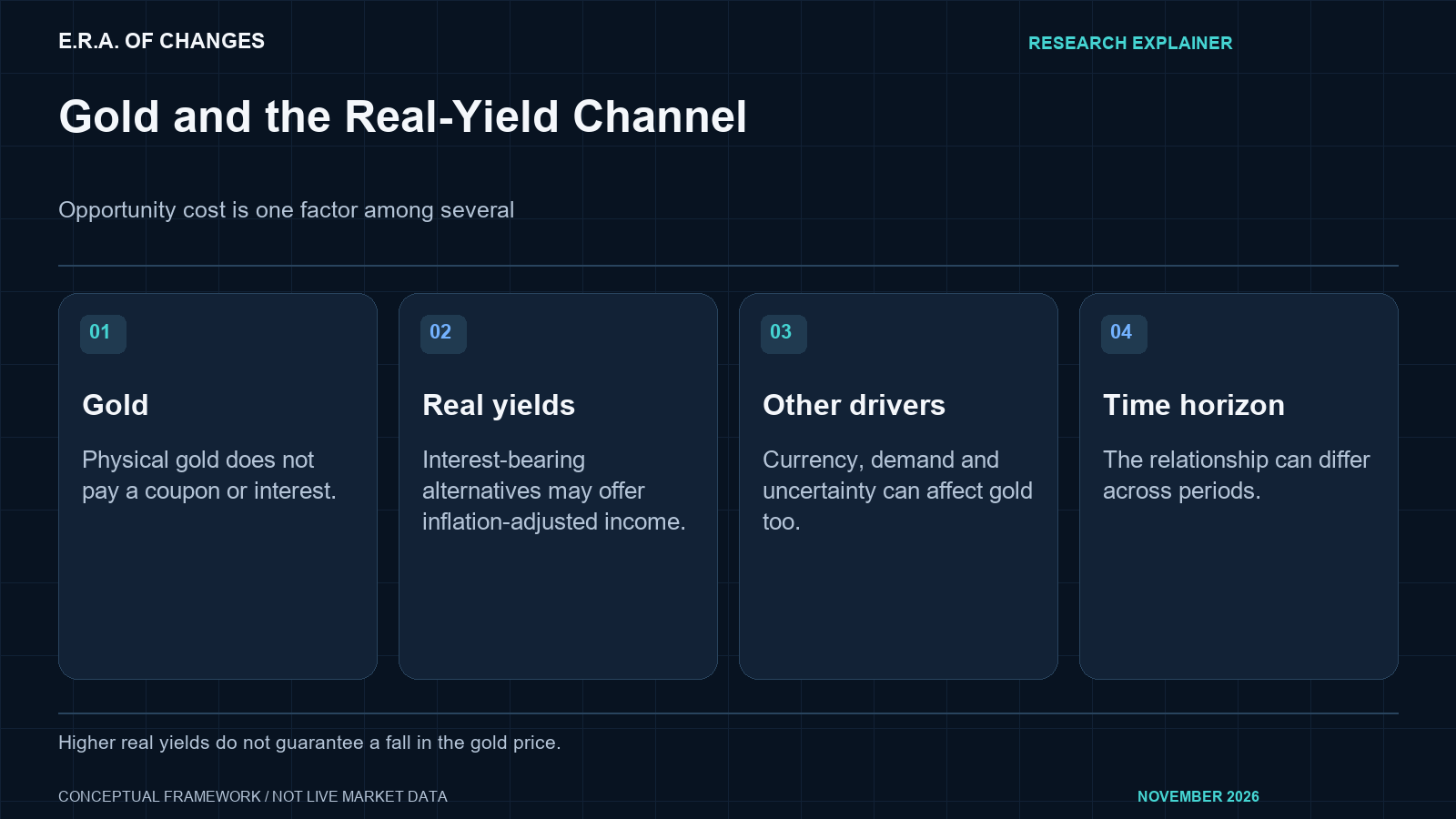
Gold pays no coupon or interest. When investors can earn a higher inflation-adjusted return on comparatively low-risk interest-bearing assets, holding gold may become less attractive on that dimension. When real yields fall, the opportunity cost of holding gold may decline. This is the intuition behind one of the most widely watched relationships in commodity markets.
The relationship is useful, but it is not a rule that gold must fall whenever real yields rise. The dollar, central-bank demand, market stress and expectations can influence the price at the same time. A sound analysis treats real yields as an important factor, not a complete gold-pricing model.
What is a real interest rate?
The real interest rate describes an interest rate adjusted for inflation. For a simple illustration, a nominal rate of 5% and inflation of 2% imply an approximate real rate of 3%. The exact result depends on compounding and on whether the comparison uses observed inflation or expected inflation over a matching period.
Investors often watch yields on US Treasury Inflation-Protected Securities, or TIPS, as one market-based reference for real yields. TreasuryDirect explains how TIPS principal and interest payments are adjusted. Their yields should not be treated as a perfect, universal measure of every investor's real return: liquidity, taxes, market pricing and investment horizon matter. A TIPS yield and a short-term policy rate are also different measures.
Our guide to inflation and interest rates separates inflation itself from the policy and market rates used to respond to it.
Why can real yields matter for gold?
In an earlier gold-market assessment, Nikolai Fainizky identified real interest rates and potential monetization of the US fiscal deficit as two variables in his framework. His point was broader than a simple comparison of gold with a Treasury yield: fiscal and monetary conditions can also shape investors' expectations and demand for alternatives.
That prior assessment does not establish that a particular fiscal policy will be adopted or that gold must rise. To evaluate the idea, distinguish realized policy actions from expectations and compare them with real yields, the dollar and available demand data over the same period.
An investor choosing among assets compares expected benefits and risks. Gold does not produce interest income, whereas an interest-bearing security may offer a real yield. All else equal, a higher real yield raises the income forgone by holding non-yielding gold instead.
Research from the Federal Reserve Bank of Chicago examines the role of expected real interest rates alongside other drivers of gold prices. “All else equal” is the crucial qualification. In real markets, the other factors rarely stay unchanged.
For example, investors might expect rates to rise because inflation risks or public-debt concerns are changing. Those same concerns could influence demand for gold through channels not captured by the real-yield comparison alone. Gold has price volatility and no guaranteed protective return.
Why does the relationship sometimes weaken?
Currency movements
Gold is commonly quoted in US dollars. A change in the dollar affects the price faced by buyers using other currencies, although the resulting market response is not fixed. Currency movements and real rates may also reflect some of the same underlying expectations, which makes simple cause-and-effect claims difficult.
Central-bank and investment demand
Purchases or sales by central banks, funds and individual investors can affect demand at the margin. Their motives and horizons differ. It would be misleading to assume that every official-sector purchase reflects the same view, or that any source of demand can never reverse.
Uncertainty and market structure
During periods of financial or geopolitical stress, demand for liquidity can initially push investors to sell assets, including gold, even if longer-term concerns support demand later. Positioning, margin requirements and the availability of funding can affect the path.
Which real yield is being measured?
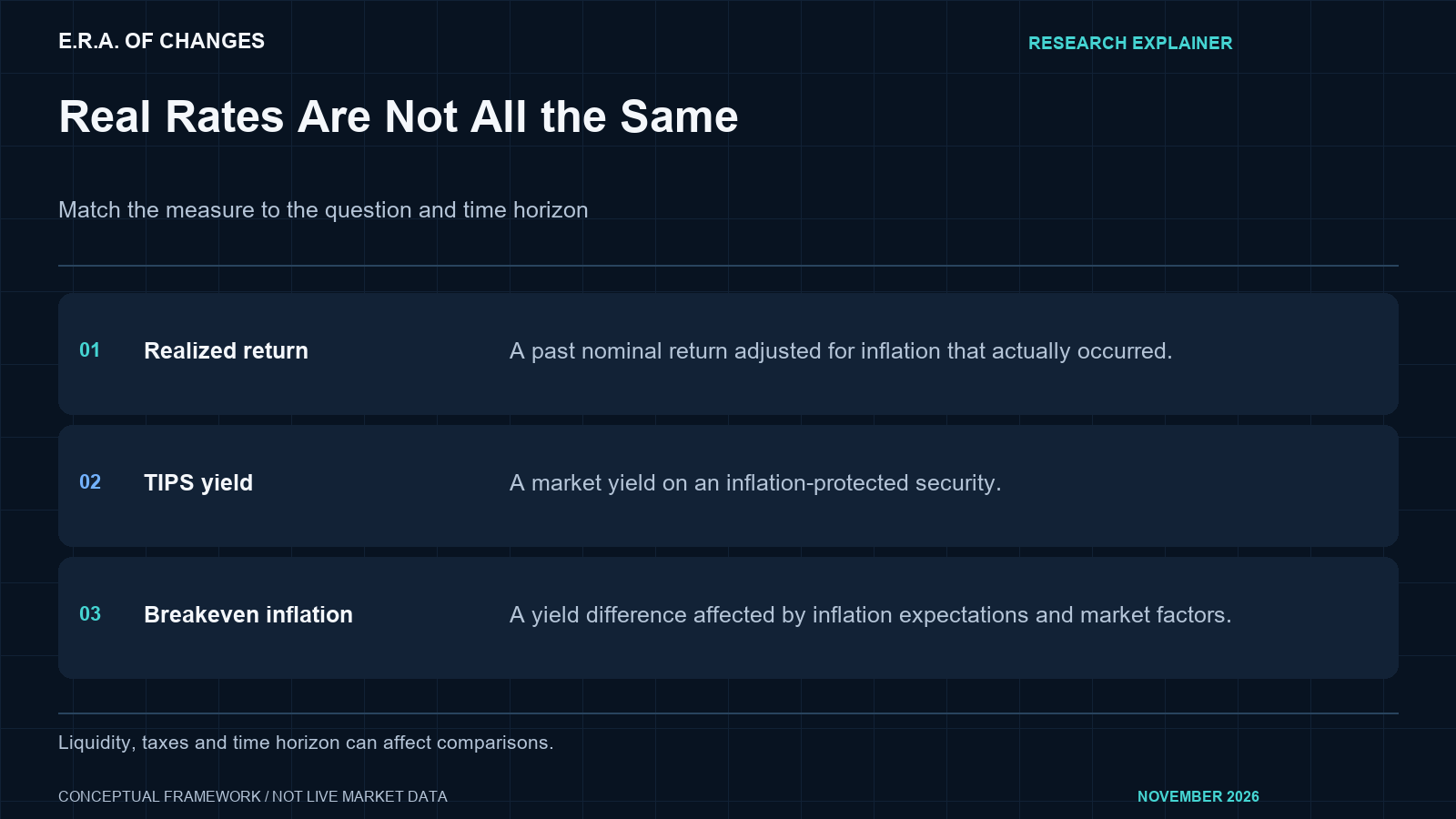
A ten-year market-implied real yield is not the same as a realized real return, a policy rate adjusted by the latest inflation print, or an individual investor's after-tax return. Different time horizons and calculation methods can produce different comparisons.
Expected inflation, realized inflation and TIPS yields
A rate can be adjusted using past inflation or expected inflation. These are different questions. If an investor looks back at a one-year nominal return and the inflation that actually occurred over that year, the calculation describes a realized outcome. If the investor compares a nominal yield with market expectations of future inflation, the result concerns expectations and market pricing. The two can diverge substantially.
A commonly watched approximation is the difference between a nominal Treasury yield and the yield on a similar-maturity TIPS, often called breakeven inflation. It should not be treated as a pure forecast of future CPI: the relative pricing of the securities can also reflect liquidity, inflation-risk compensation and other factors. The St. Louis Fed's ten-year breakeven series describes its calculation, while a New York Fed study discusses the effect of risk and liquidity components.
For gold analysis, matching horizons matters. Comparing a ten-year real yield with a one-day gold-price change can reveal a market response, but it does not prove what will happen over the next decade. Likewise, subtracting last month's annual inflation reading from a policy rate is not interchangeable with an observed TIPS yield. Label the measure rather than calling every calculation simply “the real rate.”
A historical example: when the simple model was incomplete
During 2022, the World Gold Council observed that gold was more resilient than a simple historical relationship with rising real yields might have suggested, while identifying strong central-bank and retail demand among the factors it considered. Its 2022 market commentary is an industry organization's interpretation of that historical period, not a controlled experiment proving the effect of each buyer.
For a concrete comparison, the US Treasury's daily real yield table records the ten-year par real yield at 1.17% on December 1, 2022. The Council's year-end commentary reported that ten-year TIPS yields rose roughly 250 basis points during 2022 while gold posted a small annual gain. Those are different observations: a yield level on one date and an industry report's full-year change. Neither means gold rose every day as yields rose.
In its January 31, 2023 demand report, the Council estimated 2022 central-bank demand at 1,136 tonnes and ETF holdings down 110 tonnes. Much official buying in the estimate was unreported, and the series was subsequently revised; its 2023 report put the 2022 comparison at 1,081.9 tonnes. The contrasting flows support investigating multiple sources of demand, but cannot quantify how much each caused the gold price to change.
The lesson is not that real rates stopped mattering. It is that more than one variable can matter at the same time. A statistical relationship estimated over a long sample can weaken in a particular interval, and a market price can reflect several changing expectations. A convincing explanation should show the period, the data and plausible alternatives rather than selecting one driver after the fact.
Physical gold, a fund and a mining share are not identical
The gold price discussed in macro analysis is different from an investor's realized return after product expenses, transaction costs, custody charges and currency conversion. A gold-backed fund has its own structure and expenses. A mining company's shares add business risks including operating costs, production, management, debt and equity-market valuations. A rise in the metal does not guarantee a comparable rise in a mining share.
The horizon matters as well. An investor who must meet a short-term liability may face a loss if gold falls at the wrong time, even if the longer-term thesis eventually plays out. Describing gold as a potential diversifier is not the same as saying it protects every portfolio or every inflation episode.
A hypothetical investor comparison
Assume an investor compares a one-year instrument with a 5% nominal return against a gold holding. If inflation over the year is 2%, the nominal instrument's approximate real return is 3%; the exact compound-adjusted return is about 2.94%, before taxes and fees. Gold's return depends on its change in price and costs of ownership. If its dollar price is unchanged, its nominal return before costs is zero and its purchasing power has fallen in this illustration.
That arithmetic does not establish which asset will perform better. The 5% instrument may have credit, liquidity, tax or reinvestment risks; gold can rise or fall; and inflation can differ from the assumed 2%. The purpose is to make the opportunity-cost comparison explicit without turning it into a recommendation.
The currency of the investor's liability is another variable. A person spending in a non-dollar currency can experience a different local-currency gold return even when the dollar price is unchanged. Any comparison should use a consistent currency and time period and include the costs of the actual instrument.
From an observation to an analytical test
Suppose ten-year real yields rise while gold is stable. First confirm that the yield and gold prices use comparable dates and that currency conversion is understood. Next examine the dollar, changes in investor positioning and available demand data. Finally ask what evidence would challenge the preferred explanation. For example, a proposed “central-bank demand” explanation requires data about official-sector purchases and cannot be established merely because gold did not fall.
Compare the current reading with more than one historical window and avoid relying on a single day. Correlation is sensitive to the starting and ending dates, and models can miss political, liquidity or structural changes. This discipline is particularly important when discussing past forecasts: our gold outlook contains a dated target that should remain clearly attributed to its original period, not promoted as today's price objective.
A framework rather than a price target
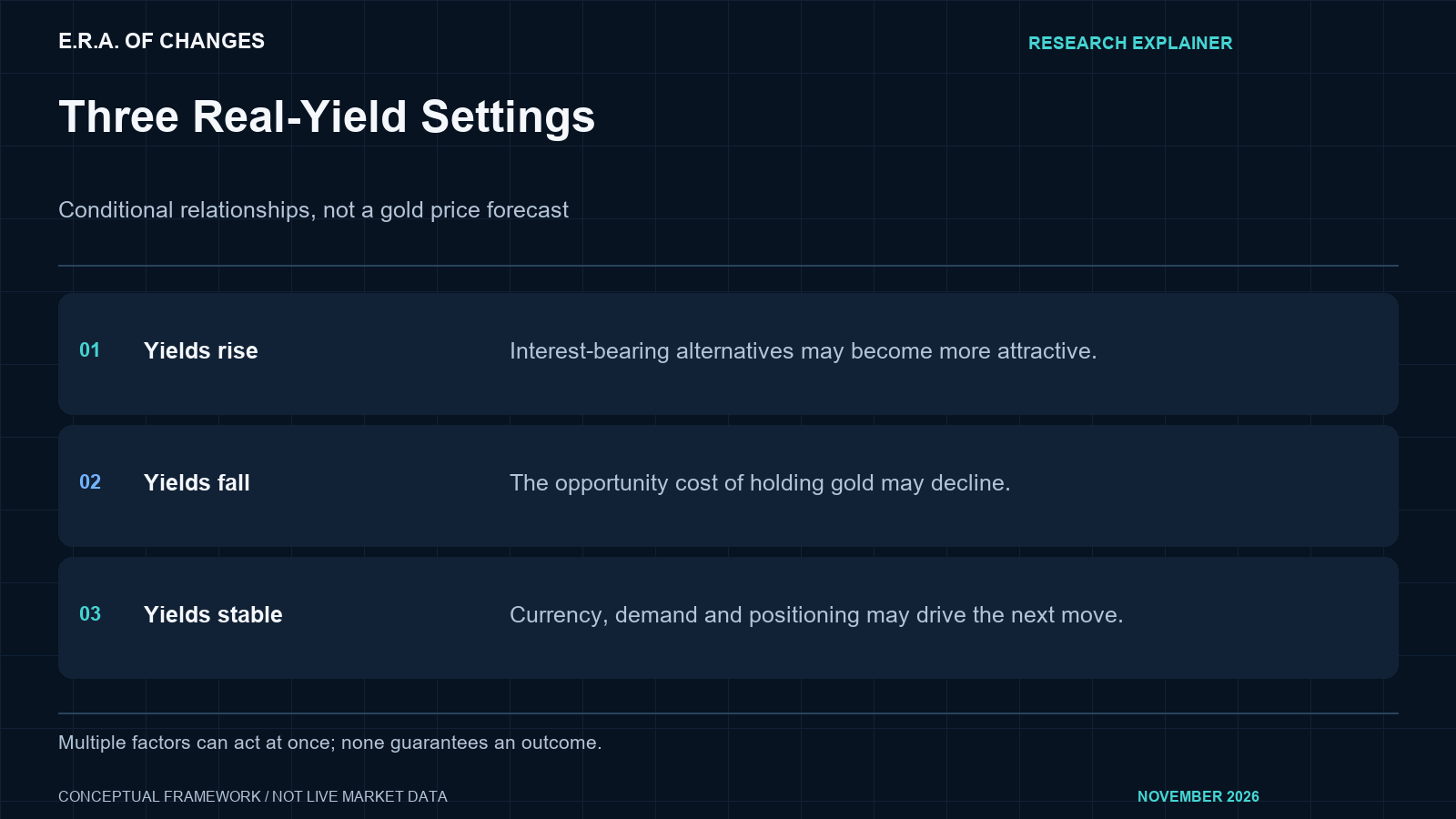
| Scenario | Why real yields could matter | What could change the result |
|---|---|---|
| Real yields rise | Interest-bearing alternatives may become more attractive relative to a non-yielding asset. | Currency changes, shifts in demand and uncertainty. |
| Real yields fall | The opportunity cost of holding gold may decline. | A stronger dollar, selling pressure or other changes in expectations. |
| Real yields are stable | The rate channel may contribute less to the next move. | Official-sector demand, liquidity, positioning or geopolitical developments. |
These are conditional scenarios, not predictions. A past price target belongs to the period in which it was published; it should not be presented as a current target without a fresh assessment.
How to follow the relationship
First choose a consistent real-yield series and time horizon. Then compare its movement with the dollar and the gold price over the same dates. Ask whether an apparent divergence is temporary, whether other drivers have changed and whether the comparison survives a longer sample. A historical correlation does not guarantee a future one.
For context, the project's earlier gold market outlook records its stated historical analysis and forecast. The global inflation trends article looks at regional differences that can also matter for real returns. Neither should be read as a live market update.
Our guide to copper and China examines a different metal market, where industrial demand and mine supply are central to the analysis.
Frequently asked questions
Does gold always fall when real yields rise?
No. Higher real yields can increase the opportunity cost of holding gold, but other drivers can offset that effect. The relationship is conditional, not a mechanical rule.
Are real rates and nominal rates the same?
No. A nominal rate is quoted before the relevant inflation adjustment; a real rate accounts for inflation over a defined period. Expected and realized inflation can differ.
Is gold guaranteed to protect purchasing power during inflation?
No. Gold prices can rise or fall over an investor's actual holding period. Currency, purchase price, storage and other costs also affect the result.
Is a TIPS yield an investor's guaranteed after-tax return?
No. Realized returns depend on purchase price, holding period, taxes, transaction costs and any sale before maturity. Fund investors also face fund-level expenses and pricing.
Real yields are one part of the picture
Real yields help explain the opportunity cost of holding gold, but they do not determine its price on their own. Currency movements, investor demand and the wider risk environment matter too, and their influence can change over time.
Sources
- Chicago Fed: What Drives Gold Prices?.
- TreasuryDirect: Treasury Inflation-Protected Securities.
- FRED: Ten-Year Breakeven Inflation.
- World Gold Council: December 2022 Market Commentary.
Explore financial-market research for related analysis of rates and real assets.
This material is for informational and educational purposes only and is not investment advice.