Executive Summary
Scenario analysis is a structured method for evaluating several plausible future outcomes rather than betting a portfolio on one forecast. I use it because I’ve watched too many smart people build a portfolio around a single expected future and then get genuinely blindsided when that future didn’t arrive on schedule, or didn’t arrive at all.
At Era, we combine macroeconomic data, geopolitical developments, liquidity indicators, and options-market pricing to build our scenarios. The goal isn’t predicting one outcome with certainty. It’s finding positions with favorable asymmetric risk-reward across multiple outcomes: exposures that don’t require you to be right about the future in order to survive it.
This piece explains the actual process, not a simplified version of it, and applies it to Era’s current three 12-month market scenarios: a base case built around stagflation, a stress case built around an inflationary recession, and an optimistic case built around a soft landing. I’ll also walk through a risk that sits entirely outside those three scenarios and that I think deserves far more attention than it gets, a coordinated cyberattack on financial infrastructure, along with a reusable framework you can apply to your own portfolio regardless of which scenario you find most persuasive.
Key Takeaways
- Scenario analysis prepares investors for uncertainty instead of pretending uncertainty can be eliminated.
- A useful scenario needs defined assumptions, trigger events, an assigned probability, and clear portfolio implications, not just a narrative.
- The base case is not necessarily the most profitable outcome. It’s simply the most probable one under current evidence.
- Options pricing and volatility skew help estimate how markets are actually pricing tail risks, which is often different from how investors talk about them.
- Strong portfolios seek asymmetric outcomes, limited downside with meaningful upside, rather than outcomes that depend on one specific forecast being correct.
- Rare operational risks, including cyberattacks on financial infrastructure, deserve real consideration even when they resist clean modeling.
Introduction
Most investors build their portfolio around one expected future. They form a view, rates fall, inflation cools, the AI cycle keeps running, and then position almost everything around that single narrative being correct.
That approach is fragile, and it’s fragile in a specific, structural way. A single forecast can fail because of a policy mistake, a geopolitical shock nobody priced, a liquidity event that has nothing to do with the fundamentals you were tracking, market reflexivity that turns a small move into a large one, or an operational disruption that has no economic cause at all. Any one of these can invalidate a single-narrative portfolio overnight, and I’ve watched it happen to genuinely sophisticated investors who simply hadn’t built in room to be wrong.
The core principle I want to establish here is this: professional investing is less about knowing exactly what will happen and more about knowing what you will actually do under several different outcomes. That distinction, preparation over prediction, is the entire foundation of what follows.
What Is Scenario Analysis?
Scenario analysis is the process of identifying several plausible future environments, defining the variables that distinguish one from another, estimating their relative probabilities, measuring how each would affect specific assets or an entire portfolio, and preparing decisions in advance rather than improvising once the environment has already shifted.
It is not a single-point forecast dressed up in extra language. It is not a prediction contest where the goal is guessing the one right answer. It is not a vague list of things that could theoretically happen. And it is not a guarantee of protection, nothing about building three scenarios instead of one insulates you from being wrong about all three. What it does is force explicit assumptions into the open, where they can actually be tested against evidence as that evidence arrives.
Scenario Analysis vs. Forecasting
| Forecasting | Scenario Analysis |
| Seeks the single most likely outcome | Evaluates several plausible outcomes |
| Often produces one point estimate | Produces a range of environments |
| Can create false precision | Makes uncertainty explicit |
| Focuses on what may happen | Focuses on what to do if it happens |
| Often judged by prediction accuracy | Judged by preparedness and robustness |
Forecasts remain genuinely useful. Era publishes them regularly, including our 2026 Mid-Year Global Outlook and Inflation Forecast H2 2026. But a forecast becomes more valuable, not less, when it's embedded inside a scenario framework rather than presented as the only path forward. The forecast tells you what we think is most likely. The scenario framework tells you what we'd do if we're wrong.
Why Scenario Planning Matters for Investors
It Reduces Dependence on One Narrative
An investor who has genuinely thought through three or four plausible environments is less vulnerable to consensus errors than one who has only ever considered the environment everyone around them is currently discussing. Consensus narratives feel safest precisely at the moments they're most likely to be wrong.
It Reveals Hidden Portfolio Concentration
Holdings that look diversified on the surface frequently depend on the exact same underlying macro assumption. A portfolio holding technology stocks, long-duration bonds, and growth funds can look spread across three asset classes while every single position actually depends on the same thing happening: rates falling and inflation staying low. Scenario analysis exposes that hidden concentration before the market does it for you.
It Improves Risk Management
Working through scenarios in advance lets an investor define loss limits, hedging conditions, rebalancing triggers, and liquidity requirements while thinking clearly, rather than making those decisions under stress, in real time, while a position is actively losing money.
It Helps Separate Probability From Payoff
A low-probability scenario can still deserve serious attention if the potential loss under that scenario is severe enough. This is the distinction most retail portfolio construction misses entirely, treating "unlikely" and "ignorable" as the same thing, when they frequently aren't.
The Core Components of a Strong Investment Scenario
Every scenario worth building shares the same underlying structure, regardless of the specific macro environment it describes.
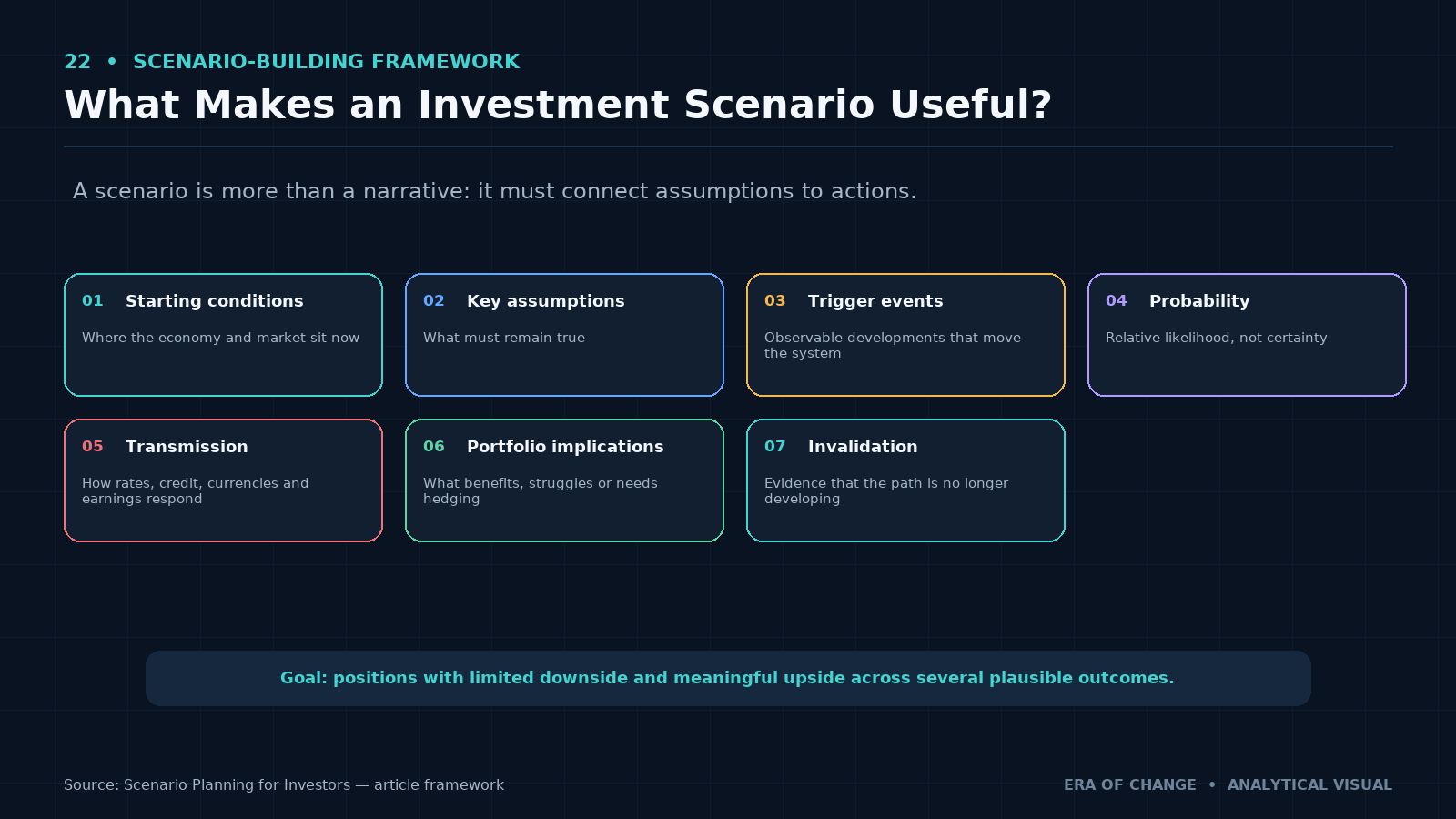
Starting conditions establish where the economy actually sits right now, current inflation, growth, liquidity, valuation levels, and the geopolitical backdrop, because every scenario is a path forward from a specific starting point, not from a blank slate.
Key assumptions define what has to remain true for the scenario to actually develop as described. If those assumptions stop holding, the scenario stops being relevant, which is exactly why they need to be stated explicitly rather than left implicit.
Trigger events are the observable developments that would move the system toward this particular outcome, a data release, a policy decision, a geopolitical escalation, something concrete you could point to and say, “that’s the scenario starting to play out.”
Probability is an estimate of how likely the scenario is relative to the alternatives, not a claim of certainty. I’ll walk through how we actually build these estimates below.
Market transmission traces how the scenario would move through rates, credit, currencies, commodities, and corporate earnings, the actual mechanism connecting a macro story to asset prices, not just the macro story itself.
Portfolio implications identify which exposures benefit, which struggle, and which require active hedging under this specific scenario.
Invalidation conditions define the evidence that would tell you the scenario is no longer developing, arguably the single most important component, and the one investors skip most often.
How Era of Change Builds Investment Scenarios
Step 1. Analyze Macroeconomic Data
We start with inflation, growth, labor-market conditions, credit conditions, M2 and credit growth, yield-curve shape, sovereign-debt dynamics, and corporate refinancing activity. This is the foundation every scenario is built on top of.
Step 2. Add Geopolitical Variables
Military escalation risk, sanctions regimes, trade fragmentation, energy-route security, resource restrictions, and shifting political policy all get layered onto the macro picture, because macro data alone consistently misses the developments that end up mattering most in any given year.
Step 3. Evaluate Liquidity
Credit spreads, interbank funding conditions, central-bank balance-sheet trajectories, dollar liquidity, cross-border capital flows, and margin and collateral stress all get assessed together, because liquidity conditions determine how much stress the financial system can actually absorb before a slowdown becomes a dislocation.
Step 4. Examine Options-Market Pricing
Implied volatility, volatility skew, put demand, and tail-risk pricing all reveal something macro data alone cannot: which outcomes investors are actually hedging against, where downside protection has gotten expensive, and which risks the market may currently be underpricing. The CBOE SKEW Index is a useful illustration of this. It's derived from the pricing of out-of-the-money S&P 500 options, and a reading above roughly 135 to 140 has historically signaled the market is pricing meaningfully elevated odds of a genuine black-swan move.
I want to be clear that options markets provide inputs to our process, not definitive probabilities on their own. They tell you what the market is willing to pay for protection, which is valuable information, but it's one input among several, not an oracle.
Step 5. Search for Asymmetric Risk-Reward
A position is asymmetric when the potential gain is meaningfully larger than the capital genuinely at risk, or when it performs reasonably across several different scenarios while the downside stays controlled in each of them. We don't build portfolios around being perfectly correct about which scenario plays out. We look for exposures where the payoff distribution itself is favorable, regardless of which specific path the economy actually takes.
How Probabilities Should Be Assigned
Probabilities in this framework are disciplined estimates, not objective facts pulled from a formula. The inputs include historical frequencies of comparable environments, current macroeconomic conditions, market-implied probabilities embedded in derivatives pricing, options skew, credit pricing, geopolitical indicators, Era CrisisMeter readings, and analyst judgment applied on top of all of it.
Here's the distinction I want to be precise about: when we assign a scenario 60% probability, that does not mean it will happen. It means that, given the stated assumptions and the evidence currently available, it appears more plausible than the alternatives right now. Probabilities should be updated as new information arrives, treating an assigned probability as fixed once it's published is exactly the kind of false precision that undermines the entire exercise.
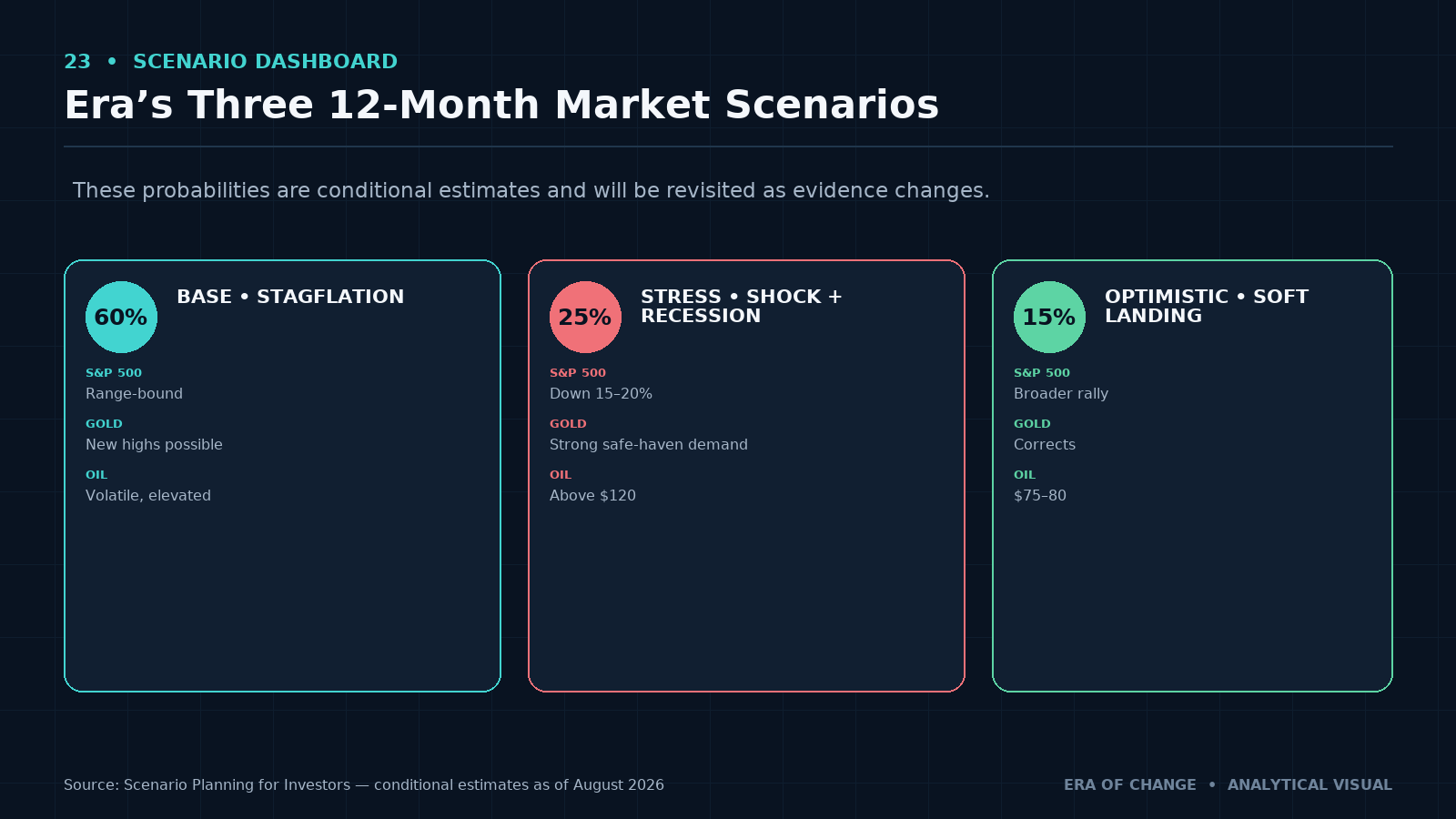
Era's Three 12-Month Market Scenarios
| Scenario | Probability | Macro Environment | S&P 500 | Gold | Oil |
| Base case | 60% | Stagflation | Range-bound | New highs possible | Volatile, elevated |
| Stress case | 25% | Inflation shock + recession | Down 15–20% | Strong safe-haven demand | Above $120 |
| Optimistic case | 15% | Soft landing | Broader rally | Corrects | $75–80 |
These figures are conditional estimates as of August 2026 and will be dated and revisited as conditions evolve. Treat them as a snapshot of our current thinking, not a permanent forecast.
Base Scenario: Stagflation
Assigned probability: 60%
This scenario assumes inflation remains above target, economic growth weakens without collapsing outright, central banks lack room to ease aggressively, commodity and geopolitical risks stay elevated, and liquidity remains sufficient to prevent an immediate systemic crisis even as conditions stay uncomfortable.
Under this path, the S&P 500 stays broadly range-bound, with market leadership remaining uneven rather than broadening out. Gold tests or reaches new highs, consistent with where it's already trading, near $4,000 an ounce after touching an all-time high above $5,500 in January. Oil stays volatile but structurally elevated, a dynamic already visible in Brent's current swings through the high $80s and above $90 amid the ongoing Strait of Hormuz situation. Long-duration assets remain sensitive to both inflation surprises and rate expectations throughout.
The questions worth asking your own portfolio under this scenario: does it depend too heavily on falling rates to perform? Which holdings actually have pricing power rather than just revenue growth? Is your inflation protection sufficient, or largely theoretical? Do you hold enough liquidity to respond when volatility actually arrives rather than after it's already priced?
This case would be invalidated by a rapid fall in core services inflation, strong productivity-led growth that lets the economy outrun its cost pressures, broad improvement in market breadth beyond the current handful of leaders, or a sustained decline in commodity and energy pressure that removes the structural floor under prices.
Stress Scenario: Inflationary Shock and Recession
Assigned probability: 25%
This path assumes a geopolitical or supply shock drives energy meaningfully higher, inflation accelerates rather than continuing to cool, central banks remain restrictive by necessity rather than choice, credit conditions deteriorate, and recession and inflation arrive simultaneously, the genuinely difficult combination that gives central banks no clean policy option.
Under this scenario, the S&P 500 falls approximately 15% to 20%. Gold functions as a primary safe-haven asset rather than merely a hedge. Oil rises above $120, a level that would represent a further escalation beyond the volatility already visible in current Brent pricing. Credit spreads widen materially, and long-duration, low-profitability equities come under the heaviest pressure as financing costs rise into weakening demand. Consumer-sensitive sectors weaken as real incomes get squeezed from both directions at once.
The transmission mechanism runs in a specific sequence: an energy shock drives inflation higher, which forces restrictive policy, which weakens demand, which raises defaults, which produces an equity drawdown. It's the same chain we've mapped in detail in our Inflation Forecast H2 2026, just carried further than our current base case assumes.
The questions worth asking here: how much drawdown can the portfolio actually tolerate before it forces a bad decision? Are hedges already in place, or would you be trying to buy protection after volatility has already repriced it higher? Is there exposure to leveraged or refinancing-dependent companies that would struggle badly in this environment? Are assets you're treating as "safe" actually vulnerable to inflation specifically, rather than just to a generic downturn?
This case would be invalidated by the energy disruption resolving quickly, inflation expectations remaining anchored despite the shock, credit markets staying stable through the stress, or central banks finding genuine room to ease without damaging the currency or reigniting inflation expectations.
Optimistic Scenario: Soft Landing
Assigned probability: 15%
This scenario assumes inflation declines without a severe recession, labor markets cool gradually rather than abruptly, central banks ease cautiously as conditions genuinely improve, credit markets remain functional throughout, and market participation broadens meaningfully beyond mega-cap technology.
Under this path, the S&P 500 rises with genuinely broader sector participation rather than concentration in a handful of names. Equal-weighted indices and cyclical sectors outperform their recent trend. Gold experiences a real correction as safe-haven demand fades. Oil stabilizes in a $75–80 range as geopolitical risk premium unwinds. Credit conditions improve across the board as default risk recedes.
The questions worth asking under this case: is the portfolio currently positioned too defensively to participate if this is actually the path we're on? Would the cost of maintaining hedges materially reduce upside participation if the soft landing genuinely arrives? Is there exposure to the sectors that specifically benefit from improving market breadth? And what evidence, concretely, would justify increasing risk exposure if this scenario starts to look more probable?
This case would be invalidated by renewed inflation acceleration, a fresh energy shock, sharp credit-spread widening, rising unemployment, or a deterioration in liquidity conditions that undermines the "credit markets remain functional" assumption at its core.
The Risk Outside the Main Scenarios
This is the section I think deserves the most attention, precisely because it doesn't fit cleanly into any of the three paths above.
A coordinated cyberattack on critical financial infrastructure — payment networks, clearing systems, settlement infrastructure, exchanges or custodians, cross-border banking systems — represents a risk of paralysis that central-bank liquidity does not solve. This isn't a hypothetical exercise. We already have a real, recent precedent. In November 2023, a ransomware attack on the U.S. broker-dealer unit of ICBC, the world's largest commercial bank, disrupted trading in the $26 trillion U.S. Treasury market. The bank lost connectivity to DTCC and NSCC, the core U.S. clearing infrastructure, and more than $62 billion of Treasuries failed to deliver in a single day. Employees reportedly resorted to USB drives to process trades manually while core systems were down.
That was one institution, contained relatively quickly, and it still moved the world's most important bond market. The scenario I'm describing here is broader: a coordinated attack across multiple points in the payment and clearing infrastructure simultaneously.
Why it matters structurally: transactions could stop even while every institution involved remains fully solvent. Asset ownership could become temporarily difficult to verify or settle, not because the assets ceased to exist but because the systems that confirm who owns what have stopped functioning correctly. Central-bank liquidity, the standard tool for every crisis we've discussed above, does not solve operational paralysis, because the problem isn't a shortage of money. It's a breakdown in the plumbing that moves money and confirms ownership. And market pricing itself could become genuinely disorderly, not because fundamentals changed, but because participants simply cannot transact normally.
I want to be clear about what this is and isn't: a low-frequency, high-impact operational risk worth serious contingency planning, not a prediction that it's imminent. The BIS has published specific research on cyber risk in central banking, and financial-sector cyber incidents are accelerating in both frequency and speed early 2026 data shows a sharp year-over-year increase in finance-sector incidents, and the median time between an attacker gaining initial access and escalating to a more damaging follow-on action has compressed from more than eight hours in 2022 to roughly 22 seconds by 2025. That compression matters enormously for how much warning anyone actually gets once an intrusion is detected.
Indicators worth watching: escalating state-sponsored cyber activity generally, formal warnings from financial regulators, repeated payment-system interruptions even at a smaller scale, direct attacks on critical infrastructure beyond the financial sector, and any sudden increase in operational-risk hedging or contingency planning among major institutions, the kind of thing that tells you people closer to the plumbing than we are have started genuinely worried.
Why Rare Risks Should Not Be Ignored
This comes down to expected-value thinking, and it's worth stating plainly. A scenario can carry low probability, extreme consequences, and a limited ability to respond once it actually begins and that combination can justify real preparation even when the probability alone looks small enough to dismiss.
For an operational risk like the one above, that preparation might reasonably include additional liquidity buffers, genuine operational diversification rather than concentration in a single custodian or clearing relationship, multiple custodians where practical, backup access to payment rails, reduced leverage generally, and clearly defined contingency procedures decided in advance rather than improvised during the event itself. I'm not going to present any specific custody or portfolio arrangement as universally appropriate. That depends entirely on your own scale, mandate, and existing infrastructure. But the underlying discipline, thinking through what you'd actually do if the plumbing itself froze, applies regardless of portfolio size.
How to Stress-Test a Portfolio
Map Each Holding to Its Macro Dependencies
For every position, ask directly: does it need low rates to perform? Does it depend on cheap energy? Does it rely on resilient consumer spending? Is it sensitive to dollar strength or weakness specifically? Does it require continuous, uninterrupted refinancing to function?
Estimate Scenario-Level Returns
For each asset, estimate a best case, a base case, and a stress case, along with how it would behave for liquidity purposes and whether its correlation to other holdings would hold or break down under stress.
Test Correlation Breakdown
Assets that reliably diversify each other in normal conditions frequently move together in a genuine liquidity crisis, when everything correlated gets sold simultaneously to raise cash. A portfolio that looks diversified on a normal Tuesday can behave like a single concentrated position on the day it actually matters.
Measure Drawdown and Liquidity Needs
Assess maximum expected loss under each scenario, the potential for margin calls, actual cash requirements through a period of stress, and realistically how much time it would take to exit positions if you needed to, not the time it takes in a liquid market, but the time it takes when everyone is trying to sell at once.
Define Pre-Commitment Rules
Decide, in advance and while thinking clearly, when you would reduce leverage, when you would rebalance, when you would add hedges, when you would take profits, and what specific evidence would change your scenario weights. Rules set during a crisis are worth far less than rules set before one.
How to Build a Scenario Matrix
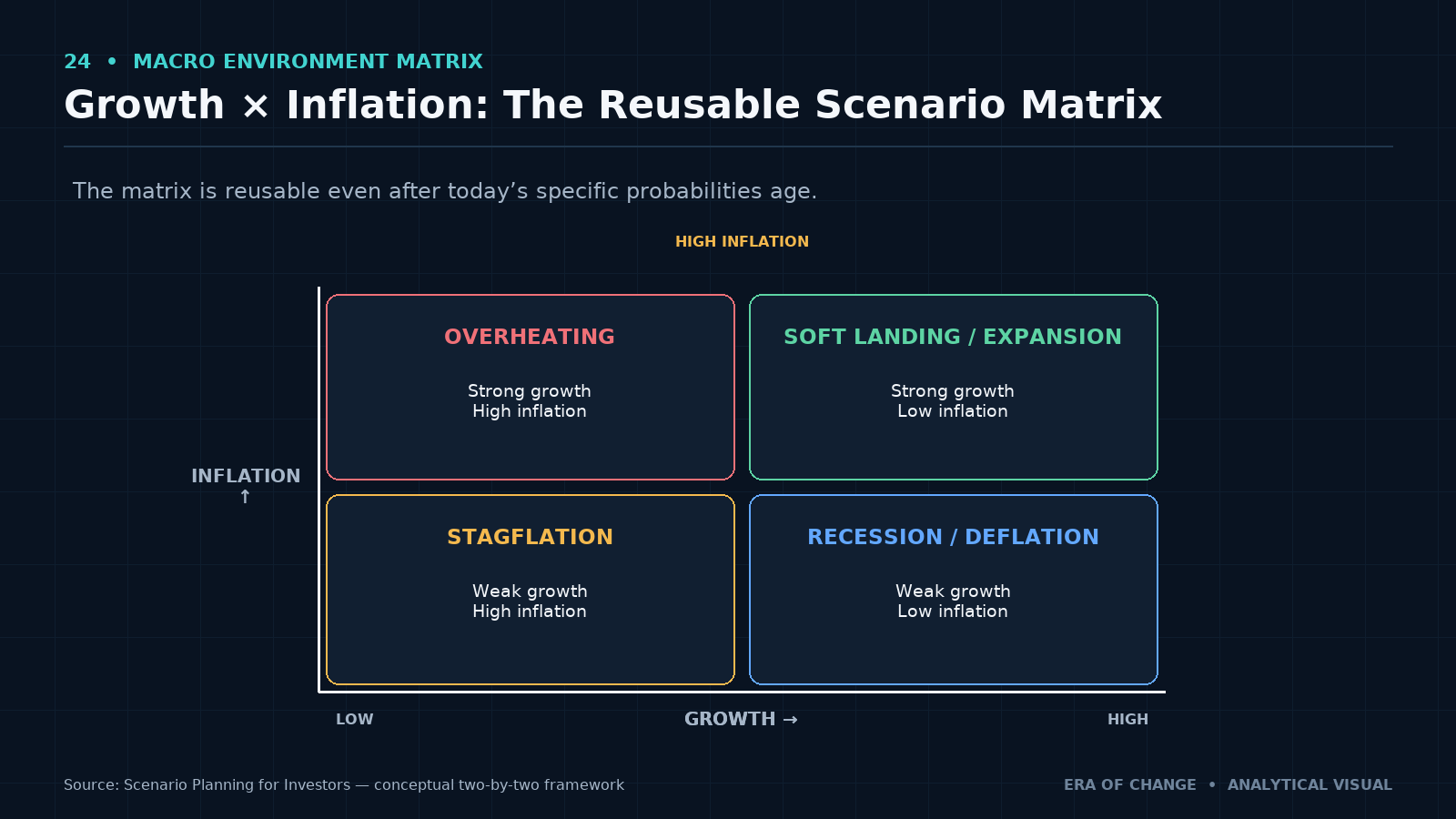
A simple, reusable way to visualize scenarios is a two-by-two matrix built on two key variables: growth (strong versus weak) and inflation (high versus low). This produces four distinct environments.
Stronger growth paired with lower inflation produces a soft landing or expansion environment. Stronger growth paired with higher inflation produces an overheating environment. Weaker growth paired with lower inflation produces recession or outright deflation. And weaker growth paired with higher inflation produces stagflation, the quadrant our current base case sits in.
For each quadrant, it's worth mapping the expected direction of interest rates, equities, bonds, gold, commodities, the dollar, and credit conditions. This matrix is a tool you can rebuild for any 12-month period going forward, the specific scenario probabilities above will age, but the matrix itself doesn't.
Common Scenario-Planning Mistakes
Treating the base case as certainty. A 60% probability still means a 40% chance of something else entirely, and portfolios built as though the base case were guaranteed inherit all the fragility of a single-narrative approach while feeling more sophisticated than one.
Creating scenarios that are too similar. If your three scenarios all produce roughly the same portfolio implications, you haven't actually built three scenarios, you've built one scenario with cosmetic variations.
Ignoring second-order effects. A geopolitical event rarely affects just the asset it seems to touch first. The Hormuz disruption we've referenced throughout this piece affects oil directly, but also inflation, interest-rate policy, sovereign debt-servicing costs, and equity valuations simultaneously, missing those downstream links is how a scenario ends up underestimating its own impact.
Assigning false precision. Probabilities like 60%, 25%, and 15% are structured judgments, not mathematically certain outputs from a formula. Treating them as more precise than they actually are defeats the purpose of building them at all.
Failing to define invalidation signals. Without them, investors tend to defend a failing thesis indefinitely, reinterpreting each new piece of contrary evidence as confirmation rather than disconfirmation.
Updating the narrative but not the portfolio. Scenario planning has no value at all unless it actually influences risk limits, liquidity, and position sizing. A beautifully built scenario framework that never changes what you actually hold is an intellectual exercise, not a risk-management tool.
Scenario Planning vs. Market Timing
Scenario planning does not require predicting the exact date a market move happens. That distinction matters enormously, because it's the one most likely to get lost when people first encounter this framework. Instead, it helps investors prepare before volatility actually rises, avoid all-or-nothing decisions made under pressure, adjust exposure gradually as evidence shifts rather than in one dramatic move, define clear conditions for increasing or reducing risk in advance, and preserve liquidity specifically so it's available when a genuine opportunity appears rather than locked into a position that needs to be sold at the worst possible moment.
The purpose isn't to trade every headline that moves through the news cycle. It's to prevent one unexpected outcome from permanently damaging a portfolio that was otherwise built soundly.
Era Analyst's Perspective
From Nikolai Fainizkii, CEO & Senior Analyst, Era of Change
"People ask me constantly which of our three scenarios I personally believe will happen, and I think the question itself misses the point of the whole exercise. I don't build a portfolio, or advise anyone else to build one, around a 60% probability being correct. I build around the fact that 40% of the probability mass sits somewhere else entirely, and a serious investor needs to survive that 40% too, not just the base case.
The risk I keep coming back to, the one that doesn't fit neatly into stagflation, recession, or soft landing, is the operational one, a coordinated attack on clearing and settlement infrastructure.
We already got a preview of what this looks like in November 2023, when a ransomware attack on one bank's U.S. unit caused $62 billion in Treasuries to fail delivery in a single day and forced staff back onto USB drives to process trades by hand. That was one institution. Imagine that mechanism hitting multiple clearing points simultaneously, deliberately, during a period when markets are already stressed for entirely separate reasons.
What makes this risk genuinely different from everything else in this piece is that central-bank liquidity, our answer to almost every other form of financial stress, does nothing for it. You can't inject reserves into a system that has stopped being able to confirm who owns what. That's precisely why I think every serious investor should have at least a basic answer to the question of what happens to their liquidity and their custody arrangements if the plumbing itself freezes for a week, not because I think it's likely next month, but because the cost of having no answer at all is asymmetric in exactly the wrong direction."
— Nikolai Fainizkii, CEO & Senior Analyst, Era of Change
How Era Updates Its Scenarios
Scenario probabilities should change as evidence changes, treating them as fixed once published defeats the purpose of building them this way in the first place. We monitor Era CrisisMeter readings, inflation trends, M2 and broader liquidity conditions, credit spreads, labor-market data, energy prices, yield-curve shifts, geopolitical escalation, and options-market skew on an ongoing basis.
Our recurring review process runs in a consistent sequence: review new data as it arrives, reassess the underlying assumptions behind each scenario, adjust probability weights where the evidence justifies it, record material changes with a date attached rather than silently revising history, and compare actual outcomes against our prior calls in the Forecast Scoreboard. The full logic behind how we weight models against analyst judgment throughout this process is covered in Era Forecasting Methodology.
A Practical Scenario-Planning Template
This is a reusable structure you can apply to your own portfolio, regardless of which specific scenarios you end up building.
| Field | Question |
| Scenario name | What environment are we testing? |
| Probability | How likely is it today? |
| Assumptions | What must be true for this to develop? |
| Triggers | What observable event would move us toward it? |
| Asset impact | What rises, falls, or becomes illiquid? |
| Portfolio exposure | Where specifically are we vulnerable? |
| Planned action | What would we actually change? |
| Invalidation | What evidence would prove the scenario wrong? |
| Review date | When will we reassess it? |
Frequently Asked Questions
What is scenario analysis?
Scenario analysis is a structured process for evaluating several plausible future outcomes rather than relying on a single forecast. It involves identifying distinct environments, defining the variables that distinguish them, estimating relative probabilities, measuring the effect on a portfolio, and preparing decisions in advance of each outcome actually occurring.
What is scenario planning in investing?
Scenario planning in investing means constructing a small set of distinct macroeconomic or market environments, each with defined assumptions, trigger events, and portfolio implications, and using that framework to guide position sizing, hedging decisions, and risk limits, rather than positioning a portfolio around one expected future.
How is scenario analysis different from forecasting?
Forecasting seeks the single most likely outcome and often produces one point estimate, which can create false confidence. Scenario analysis evaluates several plausible outcomes simultaneously and is judged by how well it prepares an investor for a range of environments, not by how accurately it predicted the one that actually happened.
How do investors assign scenario probabilities?
Probabilities are built from a combination of historical frequencies for comparable environments, current macroeconomic data, market-implied probabilities embedded in derivatives pricing, options-market volatility skew, credit-market pricing, geopolitical risk indicators, and analyst judgment layered on top. They represent a disciplined estimate of relative plausibility given current evidence, not a guarantee.
What is investment scenario analysis?
Investment scenario analysis applies the broader scenario-analysis framework specifically to portfolio construction, identifying how different macro and market environments would affect specific holdings, asset classes, and overall portfolio risk, then using that analysis to inform hedging, diversification, and position-sizing decisions.
How many scenarios should an investor create?
There's no fixed number, but three to four distinct scenarios is typically enough to capture the meaningfully different paths without becoming unwieldy. What matters more than the exact count is that each scenario produces genuinely different portfolio implications, building five scenarios that all lead to similar conclusions adds complexity without adding insight.
What is an asymmetric risk-reward opportunity?
An asymmetric risk-reward opportunity is a position where the potential gain is meaningfully larger than the capital genuinely at risk, or one that performs reasonably across several different scenarios while the downside in each remains controlled. Building a portfolio around this kind of asymmetry reduces dependence on correctly predicting which single scenario actually occurs.
How often should scenarios be updated?
Scenarios should be revisited whenever meaningful new evidence arrives, a significant data release, a policy shift, a geopolitical escalation, or a material change in liquidity conditions, rather than on a fixed calendar alone. Era reviews its scenario probabilities on an ongoing basis and formally reassesses them as part of its monthly Forecast Scoreboard process.
Can scenario planning protect against market crashes?
Scenario planning cannot prevent a market crash, and no framework can guarantee protection against every possible outcome. What it can do is reduce the odds that a single unexpected event permanently damages a portfolio, by ensuring that hedges, liquidity, and position sizing were determined in advance rather than improvised under stress.
How are options used in scenario analysis?
Options-market data, particularly implied volatility and volatility skew, such as the pricing pattern captured by the CBOE SKEW Index, reveals which outcomes other market participants are actively hedging against and where downside protection has become expensive. This provides a market-based input into probability estimates, though it should be treated as one input among several rather than a definitive forecast on its own.
About Era of Change
Era of Change is an independent macroeconomic research and geopolitical intelligence firm providing institutional-quality analysis for investors worldwide. Its research combines macroeconomics, financial markets, blockchain analytics, artificial intelligence, and geopolitical risk within proprietary forecasting frameworks designed to identify structural market changes before they become broadly recognized.
Era uses scenario analysis to assess multiple plausible macroeconomic outcomes, assign conditional probabilities, evaluate market transmission mechanisms, and identify asymmetric risk-reward opportunities, rather than building its research around a single deterministic forecast. Our full methodology, live index reading, and forecast archive are available at eraperemen.info/en.
The content published by Era of Change is for informational and educational purposes only and does not constitute financial, investment, legal, or tax advice. All views expressed are the personal analytical perspective of the author. Past forecast accuracy does not guarantee future results. Readers should conduct their own research and consult a qualified financial professional before making any investment decisions.
Sources
Market and Derivatives Data
- Cboe: Dawn of a New Era Brings on the Existence of Skew
- Wikipedia: CBOE SKEW Index
- FRED: ICE BofA US High Yield Index Option-Adjusted Spread (BAMLH0A0HYM2)
Cyber and Operational Risk
- CNBC: China's ICBC, the World's Biggest Bank, Hit by Cyberattack That Disrupted Treasury Markets
- The DESK: Impact of ICBC Hack on Trading US Treasuries
- BIS Working Papers No. 1039: Cyber Risk in Central Banking
- Black Kite: 2026 Financial Services Cybersecurity Report
Official Economic Data
Internal Research
- Era Global Risk Index
- Era CrisisMeter Explained
- Era Forecasting Methodology
- 2026 Mid-Year Global Outlook
- Inflation Forecast H2 2026
- What Is Stagflation?
- How Recessions Are Measured
- M2 Money Supply Explained
- Era Forecast Scoreboard archive
— Nikolai Fainizkii, CEO & Senior Analyst, Era of Change