Executive Summary
I believe the period of effortless, broad-based asset appreciation is ending. H2 2026 is likely to reward active risk management considerably more than passive exposure to market-wide growth. Sticky inflation, geopolitical fragmentation, elevated valuations, narrow equity leadership, and refinancing pressure are all reducing the market's structural margin of safety at the same time, not as isolated stories, but as a converging set of pressures.
Mega-cap technology companies remain genuinely profitable businesses. That was never the question. The question is whether their current valuations leave any room for a disappointment, and I don't think they do. The Magnificent Seven now represents roughly 33.8% of the S&P 500's total weight, a level of concentration with no real precedent outside the late-1990s technology bubble, and the group actually underperformed the broader index in 2026, growing just 2.6% while the S&P 500 kept climbing on the back of everything else.
My practical priority for readers isn't abandoning markets entirely. It's rebalancing concentrated portfolios, preserving genuine liquidity, managing tail risk before volatility repricing makes it expensive, and identifying which businesses actually retain pricing power in the environment ahead. The monthly subscription expands on the specific scenarios, portfolio stress tests, and indicators Era is monitoring through the rest of H2 2026.
Key Takeaways
- Broad passive exposure may become measurably less effective in a fragmented, inflationary environment than it was through most of the last decade.
- Capital preservation should take priority over maximizing short-term returns in the current structural setup.
- Big-tech concentration creates real vulnerability to even modest earnings disappointments, given how much valuation is already priced in.
- Portfolio rebalancing is different from abandoning high-quality companies entirely, the distinction matters and gets lost constantly.
- Investors should evaluate credit conditions, liquidity, inflation persistence, and geopolitical transmission channels directly, not headlines about them.
- Independent risk analysis should focus on where the system can actually fail, not primarily on reasons markets might keep rising.
- The monthly subscription provides a deeper scenario and portfolio-risk framework built specifically for the second half of 2026.
Introduction
For years, investors were genuinely rewarded for buying broad indices, tolerating volatility as background noise, and trusting that liquidity would eventually support asset prices through almost any drawdown. That approach worked remarkably well for a long stretch, and I understand why it's the default instinct most people still carry into this cycle.
I think the environment underneath that instinct has changed in ways worth taking seriously. Inflation remains structurally persistent rather than cleanly resolving toward target. Geopolitical fragmentation is raising input and supply-chain costs in ways that show up directly in corporate margins. Interest rates remain restrictive relative to where the economy actually needs them to sit. Market leadership has concentrated into a genuinely small number of companies.
Debt-refinancing pressure keeps building beneath a headline market that still looks calm. And central banks have measurably less flexibility to respond than they carried into earlier cycles.
The practical question this piece is built to answer: how should investors manage portfolio risk when the market itself remains resilient on the surface, even as the structural vulnerabilities underneath it continue to build?
The Central H2 2026 Thesis
My view, stated directly: the era of passive growth across almost every asset class simultaneously has ended. Investors are entering a phase where active risk management and genuine capital preservation matter more than chasing incremental returns on top of an already-extended cycle.
I want to be precise about what this does and doesn't mean, because it's easy to overcorrect in either direction. It does mean concentration should be reviewed honestly rather than rationalized. Liquidity should be intentional rather than an afterthought. Risk limits should be defined in advance, not improvised during a drawdown. Portfolio assumptions should be genuinely stress-tested against scenarios that don't currently look likely. And hedges may need to be considered before volatility actually spikes, while protection is still reasonably priced. It does not mean selling every risk asset you own. It does not mean holding only cash and waiting on the sidelines indefinitely. It does not mean attempting to time every individual market move. That's a different discipline entirely, and usually a losing one. And it does not mean abandoning long-term investing as a philosophy.
What Is Market Risk Analysis?
Market risk analysis evaluates how changes in interest rates, inflation, equity valuations, credit conditions, currency markets, commodities, liquidity, and geopolitical events could affect asset prices and, ultimately, portfolio losses.
The core components run in a consistent sequence: identify the specific risk, estimate its probability, estimate its likely market impact, identify where a given portfolio is actually exposed to it, define a concrete mitigation, and monitor the signals that would tell you the risk is either escalating or resolving. It's worth distinguishing market risk from company-specific risk (a single business's execution failure), operational risk, legal risk, and pure volatility measurement, which describes price movement itself rather than the underlying forces actually driving it.
The Five Risks Defining the Second Half of 2026
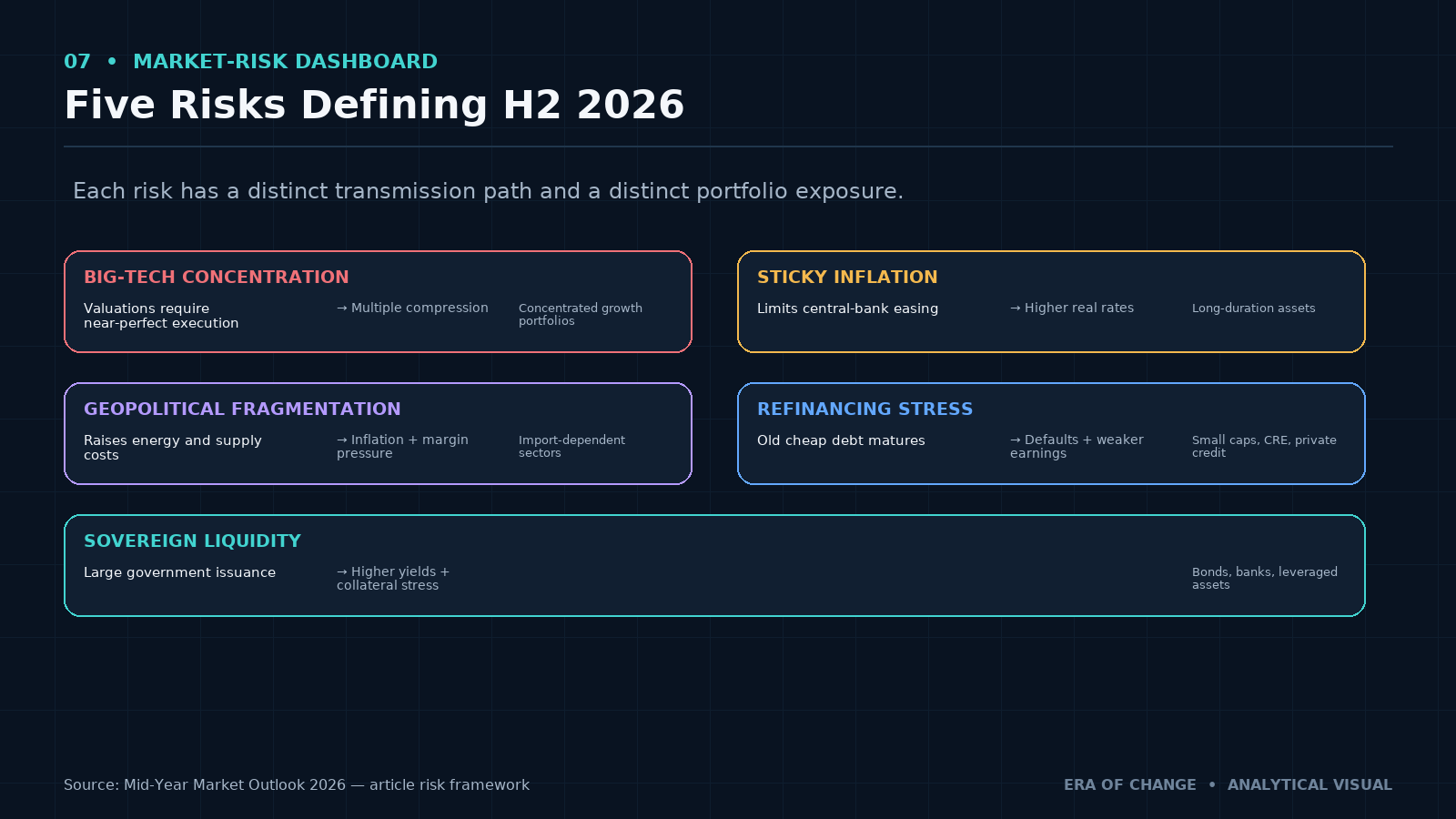
| Risk | Current Concern | Market Transmission | Most Exposed Areas |
| Big-tech concentration | Valuations require near-perfect execution | Multiple compression | Concentrated growth portfolios |
| Sticky inflation | Limits central-bank easing | Higher real rates | Long-duration assets |
| Geopolitical fragmentation | Raises energy and supply costs | Inflation and margin pressure | Import-dependent sectors |
| Refinancing stress | Old cheap debt matures | Defaults and weaker earnings | Small caps, CRE, private credit |
| Sovereign liquidity risk | Large government issuance | Higher yields and collateral stress | Bonds, banks, leveraged assets |
Risk 1: Big-Tech Concentration
A small group of companies now contributes disproportionately to headline index performance. Strong businesses can still be genuinely poor investments at excessive valuations. Those are two entirely separate judgments that get conflated constantly. Further gains from here likely require near-flawless earnings, revenue growth, forward guidance, and capital-expenditure discipline simultaneously, and any single disappointment across those dimensions can produce a sharp repricing. The question isn't whether the largest technology companies are strong businesses. The question is whether current valuations already price in near-perfect execution and I think, for several of them, the answer is yes.
Risk 2: Sticky Inflation
Services inflation, shelter costs, energy exposure, structural underinvestment in physical capacity, and deglobalization all keep inflation running above the level that would let central banks ease comfortably. That persistence restricts policy flexibility directly and keeps discount rates elevated for longer than most current equity valuations appear to assume, the mechanics of which we cover in full in Inflation Forecast H2 2026.
Risk 3: Geopolitical Fragmentation
Middle East escalation, contested shipping routes, energy-security concerns, food and resource restrictions, trade barriers, and payment-system fragmentation all feed through the same basic chain: a political event produces a physical disruption, that disruption raises costs, higher costs feed inflation, inflation forces tighter policy, and tighter policy compresses corporate margins from the other direction. It's a chain we've traced in specific, numeric detail through the Strait of Hormuz situation elsewhere in our research.
Risk 4: Refinancing Stress
Small-cap companies, commercial real estate, and private credit all carry meaningful exposure to floating-rate loans and looming corporate maturity walls. This is a delayed risk by nature, the pain doesn't arrive on the schedule of the rate hikes themselves, but on the far more irregular schedule of when each borrower's specific debt actually comes due, a dynamic we cover in full in How Interest Rate Hikes Affect Markets.
Risk 5: Sovereign Debt and Liquidity
Heavy Treasury issuance, government refinancing needs, repo-market pressure, eurozone peripheral risk, and emerging-market dollar debt all sit underneath the broader market as structural risk that doesn't require an actual default to matter: dysfunction alone is enough, exactly as we've documented in Global Debt Risks 2026.
Should Investors Take Profits in Big Tech?
I'll answer this directly, because I think vague hedging on this specific question does readers a disservice: yes, concentrated portfolios should be rebalanced.
Rebalancing Is Not the Same as Abandoning the Sector
Rebalancing can mean several distinct things depending on a given portfolio: reducing an oversized position that's grown disproportionately through appreciation alone, realizing a portion of genuinely large unrealized gains, reallocating toward broader market exposure rather than a handful of names, increasing overall liquidity, and reducing dependence on a single earnings narrative carrying an outsized share of total portfolio risk.
Why Valuation Matters
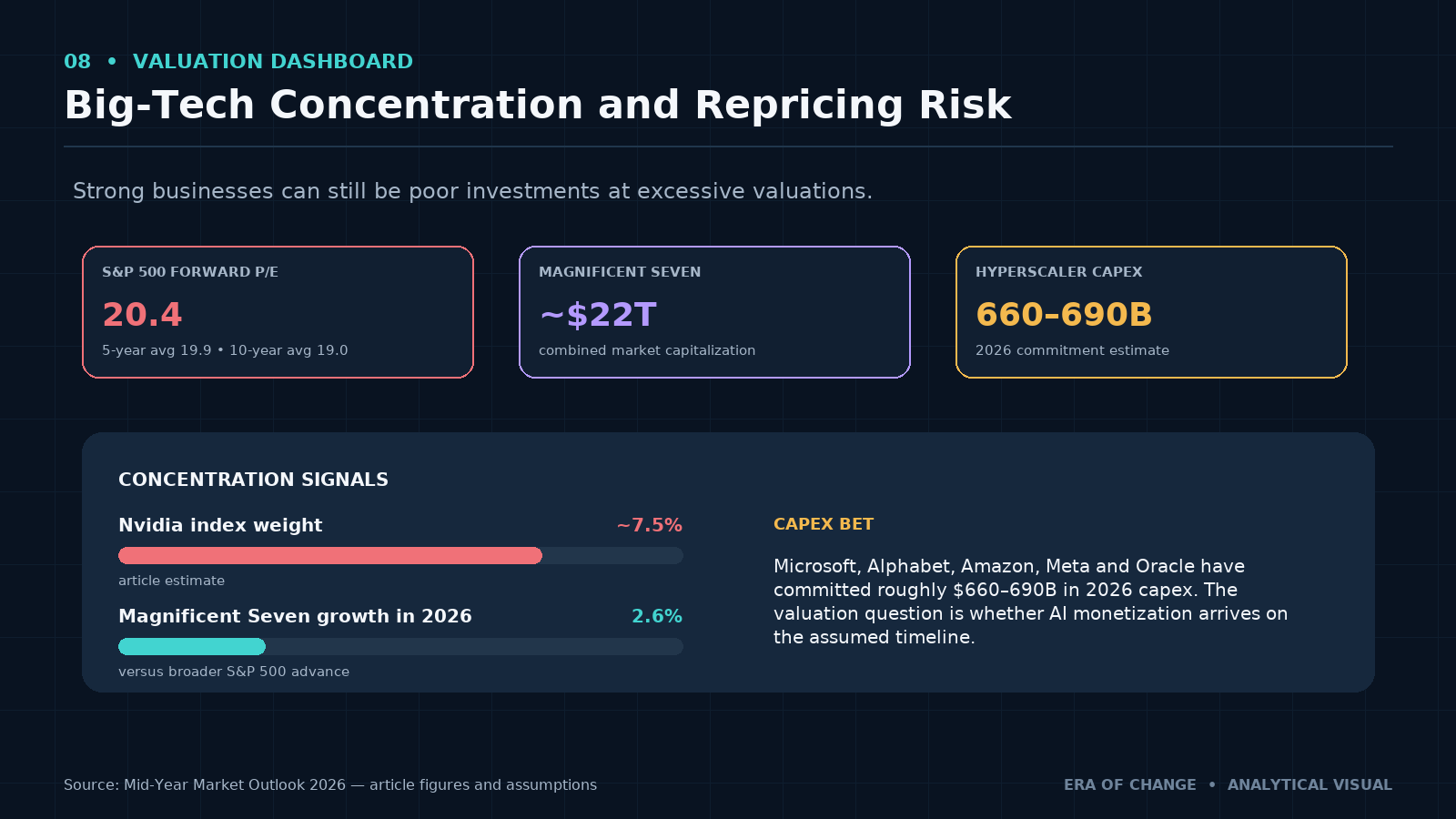
The S&P 500's forward P/E currently sits at 20.4, above both its 5-year average of 19.9 and its 10-year average of 19.0, even after the multiple compressed roughly 7.7% year-to-date as strong earnings growth outran price appreciation. That compression is a genuinely good sign on its own. It means the market isn't purely being driven by multiple expansion right now. But it doesn't change the underlying concentration problem: the Magnificent Seven's combined market capitalization reached roughly $22 trillion by July 2026, with Nvidia alone carrying close to 7.5% of the entire index, a concentration level that has climbed from roughly 11% in 2015, through 24% in 2021, 28% in 2023, and above 34% at its 2025 peak. Capital expenditure sensitivity compounds this: the largest hyperscalers, Microsoft, Alphabet, Amazon, Meta, and Oracle, have committed to roughly $660 to $690 billion in 2026 capital expenditure alone, nearly double 2025 levels, with Goldman Sachs projecting a combined $5.3 trillion in hyperscaler capex from fiscal 2025 through fiscal 2030. That's an enormous, ongoing bet that AI monetization actually arrives on the timeline current valuations assume.
What Could Trigger Repricing?
A single earnings miss from any of the largest names, weak forward guidance even alongside a beat, slower-than-expected cloud or AI monetization relative to the capital being spent, unexpectedly higher capital-expenditure guidance without a matching revenue story, meaningful regulatory action, rising long-term bond yields that raise the discount rate applied to these companies specifically, or narrowing liquidity generally could each independently trigger a real repricing.
What Would Support Continued Upside?
I want to be balanced here rather than presenting this as an unconditional bearish call: continued earnings acceleration across the group, market participation genuinely broadening beyond the current leaders. It’s worth noting the Magnificent Seven already underperformed the broader index in 2026, growing just 2.6% while the S&P 500 as a whole climbed further, a real signal that broadening may already be quietly underway: falling inflation that gives the Fed genuine room to ease, lower long-term yields, improved productivity from AI investment actually showing up in the numbers, and strong free-cash-flow conversion from the capital currently being deployed would all argue for continued strength rather than repricing.
Portfolio Risk Management for H2 2026
Portfolio risk management includes diversification, position sizing, liquidity planning, hedging, rebalancing, scenario analysis, drawdown limits, and correlation analysis, working together rather than any single discipline in isolation.
Review Concentration
Ask directly: how much of the portfolio depends specifically on mega-cap technology? How much depends on lower interest rates materializing on a particular timeline? How many individually named holdings actually share the same underlying economic driver, even if they look diversified on paper?
Preserve Strategic Liquidity
Cash and highly liquid instruments provide genuine optionality, protection against margin calls, real capacity to rebalance when opportunities appear, and reduced risk of forced selling into a falling market. It's worth acknowledging the honest tradeoff on the other side: liquidity carries an inflation drag while sitting idle, and that cost is real, not hypothetical.
Define Tail-Risk Protection
Put spreads, long-dated index protection, and direct volatility exposure can all provide protection during a genuine systemic event. These come with real premium decay if the event doesn't materialize on the timeline hedged for, and genuine derivatives complexity and risk that make them appropriate as a sized, deliberate position rather than a default holding.
Increase Exposure to Pricing Power
Businesses genuinely capable of passing rising input costs through to customers without a severe drop in demand hold up meaningfully better across most of the scenarios covered in this piece than businesses that can't.
Evaluate Real-Asset Exposure
Gold, energy, broader commodities, agriculture, and infrastructure each react differently depending on whether the environment ahead turns out to be inflationary, recessionary, or some combination of both: worth evaluating as a category rather than assuming any single real asset behaves the same way across every scenario.
A Mid-Year Portfolio Stress Test
For every major position currently held, work through the same set of questions in sequence.
| Question | Purpose |
| What macro assumption supports this position? | Identify hidden dependency |
| What happens if rates remain high? | Test duration and refinancing risk |
| What happens if inflation accelerates? | Test pricing power |
| What happens if equities fall 20%? | Estimate drawdown |
| Can the position be sold quickly? | Assess liquidity |
| Does it diversify or duplicate existing risk? | Test concentration |
| What would invalidate the thesis? | Prevent emotional attachment |
| What action is pre-planned? | Improve discipline |
Era's Three H2 2026 Risk Scenarios
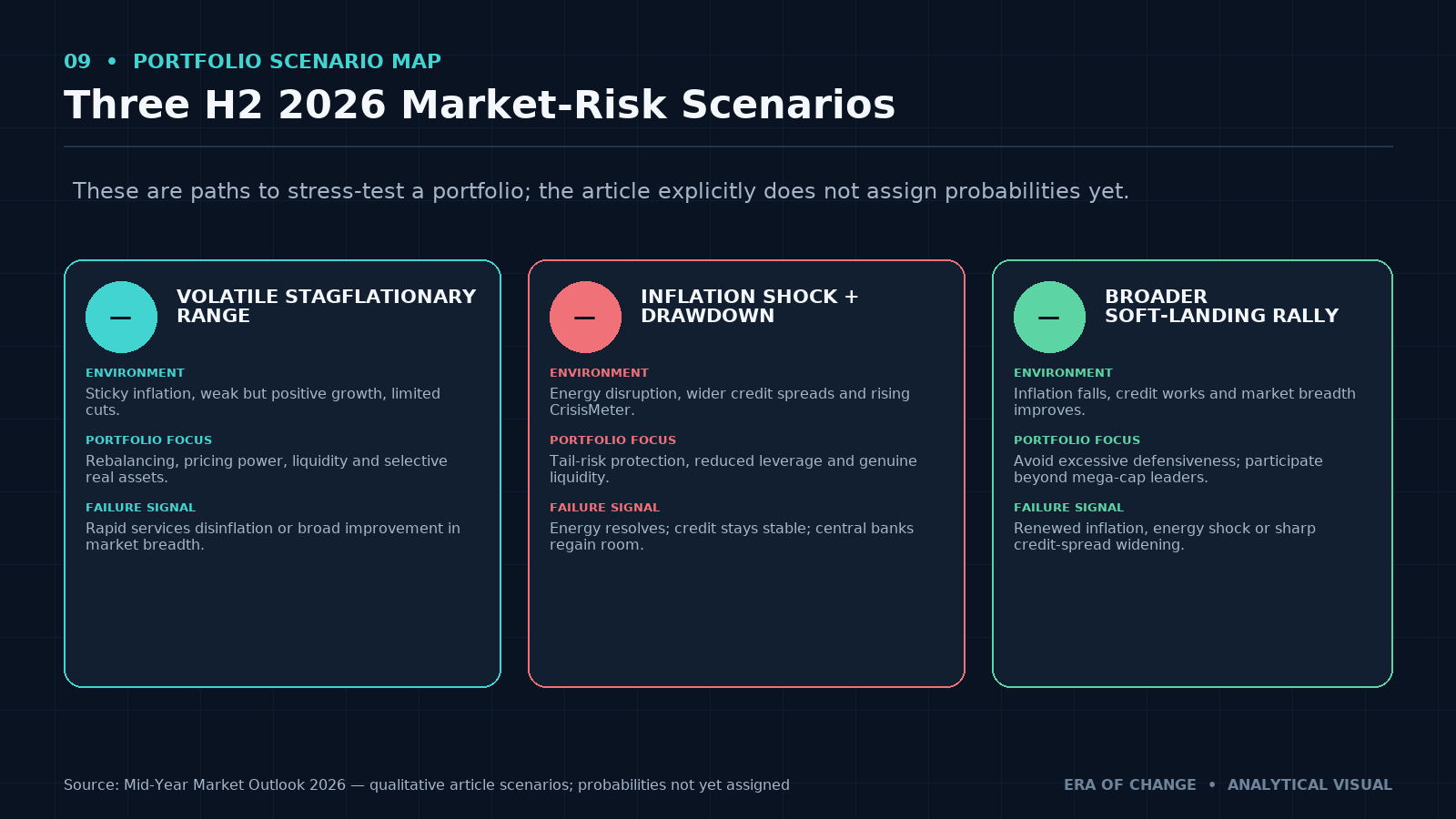
Base Case: Volatile Stagflationary Range. Sticky inflation persists. Growth stays weak but positive. Rate cuts, if they come, stay limited. The broad market stays range-bound with continued sharp dispersion between sectors. Portfolio focus: rebalancing, pricing power, liquidity, and selective real-asset exposure.
Stress Case: Inflation Shock and Market Drawdown. An energy disruption drives inflation higher. Credit spreads widen. The S&P 500 corrects meaningfully. The Era CrisisMeter continues rising. Portfolio focus: tail-risk protection, reduced leverage, genuine liquidity, and defensive positioning generally.
Optimistic Case: Broader Soft-Landing Rally. Inflation genuinely falls. Credit conditions remain stable. Market breadth improves meaningfully. Small caps and cyclical sectors participate alongside the current leaders. Rates normalize gradually. The portfolio risk under this case runs in the opposite direction from the other two: an excessively defensive portfolio may underperform materially if this is actually the path that develops.
These scenarios connect directly to the full methodology covered in Scenario Planning for Investors, and probabilities will be added only once dated and approved for publication.
The Indicators Era Is Watching
For equity risk: market breadth, mega-cap contribution to index returns, earnings revision trends, forward valuation multiples, and Russell 2000 performance relative to large caps.
For credit risk: high-yield spreads, default rates, bank lending standards, private-credit non-accrual trends, and the corporate maturity wall.
For liquidity risk: M2, repo rates, the SOFR-OIS spread, the cross-currency basis, and primary-dealer balance-sheet capacity.
For inflation risk: core CPI, supercore inflation specifically, shelter costs, Brent crude, and freight costs.
For geopolitical risk: the Strait of Hormuz situation, energy infrastructure generally, trade restrictions, sanctions activity, and resource export controls.
For systemic risk: the Era CrisisMeter, Treasury auction quality, sovereign spreads, and options-market volatility skew, including the VVIX.
What Makes Era's Risk Analysis Different?
Our research is designed to identify where the system may actually fail, not to justify perpetual optimism, and not to sell a predetermined financial product wrapped in analysis. That independence carries real structural advantages: no requirement to support investment-banking relationships, no obligation to promote a proprietary fund, no incentive to maintain permanently bullish messaging regardless of what the data shows, a public Forecast Scoreboard, a transparent methodology, and explicit invalidation conditions attached to every published thesis.
I want to phrase this carefully rather than making broad, unprovable accusations against any specific institution: traditional financial institutions may face structural incentives related to product distribution, ongoing corporate relationships, client retention, consensus positioning, and internal communication constraints that don't apply to an independent research firm in the same way. Era's differentiator is meant to be skeptical risk analysis and genuine transparency, not hostility toward institutions operating under a different, and entirely legitimate, business model.
Why Independent Analysis Still Needs Accountability
Independence on its own does not guarantee accuracy, and I don't want to overstate what it buys you. Genuine credibility requires transparent sources, a published methodology, explicit forecasts rather than vague directional hints, dated assumptions, clearly stated invalidation conditions, and public review of the calls that turned out to be wrong, the full discipline covered in Era Forecasting Methodology and reviewed continuously in the Forecast Scoreboard.
Era Analyst's Perspective
From Nikolai Fainizkii, CEO & Senior Analyst, Era of Change
"The question I get asked most right now is whether I'm bearish on the entire market, and the honest answer is no, I'm bearish on complacency about concentration, which is a genuinely different thing. The Magnificent Seven sits at roughly 34% of the S&P 500's weight, higher than at any point since data on this composition became reliable, and in 2026 that same group actually underperformed the index it dominates, growing just 2.6% while the broader market found support elsewhere. That divergence is the market quietly telling you something the headline index level isn't.
The hyperscalers are committing close to $690 billion in capital expenditure this year alone, nearly double what they spent in 2025, betting that AI monetization arrives on a timeline that justifies it. I'm not calling that bet wrong. I'm saying current valuations already assume it's right, with very little room left for it to arrive late, or arrive smaller than expected.
What separates our view from a standard bank research note isn't pessimism. It's that we have no product to sell you on the back of this call, no corporate relationship with any of the seven companies I just named to protect, and a public scoreboard that will hold us accountable either way this actually plays out. That's the entire differentiator, and I think it's a real one."
— Nikolai Fainizkii, CEO & Senior Analyst, Era of Change
Frequently Asked Questions
What is market risk analysis?
Market risk analysis evaluates how changes in interest rates, inflation, equity valuations, credit conditions, currencies, commodities, liquidity, and geopolitical events could affect asset prices and portfolio losses. It differs from company-specific, operational, or legal risk analysis, and from pure volatility measurement, by focusing on the broader structural forces transmitting through markets as a whole.
What are the biggest market risks in H2 2026?
Era identifies five converging risks for H2 2026: extreme big-tech concentration requiring near-flawless execution to sustain current valuations, sticky inflation limiting central-bank flexibility, geopolitical fragmentation raising energy and supply-chain costs, refinancing stress building in small-cap companies, commercial real estate, and private credit, and sovereign debt and liquidity risk tied to heavy government issuance.
Should investors take profits in big-tech stocks?
Era's view is that concentrated portfolios should generally be rebalanced given current valuation levels and the roughly 34% weight the Magnificent Seven now carries in the S&P 500. Rebalancing means reducing oversized positions and reallocating toward broader exposure. It does not mean abandoning high-quality technology companies entirely.
What is portfolio risk management?
Portfolio risk management is the practice of managing diversification, position sizing, liquidity, hedging, rebalancing, scenario analysis, drawdown limits, and correlation between holdings to control potential losses while remaining positioned to participate in continued market gains.
How can investors stress-test a portfolio?
Investors can stress-test a portfolio by evaluating each major position against a consistent set of questions: what macro assumption supports it, how it would behave if rates stay elevated or inflation accelerates, what a 20% equity decline would do to it, how quickly it could be sold if needed, whether it duplicates risk already held elsewhere, and what evidence would prove the original thesis wrong.
What indicators reveal rising market risk?
Key indicators include market breadth and mega-cap contribution to index returns, high-yield credit spreads and bank lending standards, M2 and repo-market liquidity conditions, core and supercore inflation trends, geopolitical developments around critical energy and shipping routes, and the Era CrisisMeter, which synthesizes structural risk across all of these categories into a single score.
Is Era bearish on the entire stock market?
No. Era's concern is specifically about concentration risk and valuation levels in the largest technology companies, not a blanket bearish view on equities as an asset class. The recommended approach is rebalancing and disciplined risk management rather than exiting markets entirely.
About Era of Change
Era of Change is an independent macroeconomic research and geopolitical intelligence firm providing institutional-quality analysis for investors worldwide. Its research combines macroeconomics, financial markets, blockchain analytics, artificial intelligence, and geopolitical risk within proprietary forecasting frameworks designed to identify structural market changes before they become broadly recognized.
Era's market risk analysis focuses on liquidity, credit, inflation, valuations, geopolitical transmission, and portfolio vulnerability. Its forecasts and methodology are reviewed publicly through the Era Forecast Scoreboard. Our full methodology, live index reading, and forecast archive are available at eraperemen.info/en.
The content published by Era of Change is for informational and educational purposes only and does not constitute financial, investment, legal, or tax advice. All views expressed are the personal analytical perspective of the author. Past forecast accuracy does not guarantee future results. Readers should conduct their own research and consult a qualified financial professional before making any investment decisions.
Sources
Market and Credit Data
- Forbes: S&P 500's Weight in Mag 7 Stocks Passes 30% — Is This a Diversification Risk? June 2026 Edition
- FactSet: Earnings Insight — S&P 500 Forward P/E
- Futurum Group: AI Capex 2026 — The $690B Infrastructure Sprint
- Goldman Sachs: Why AI Companies May Invest More Than $500 Billion in 2026
Internal Research
- Era CrisisMeter Explained
- Monthly Forecast Review: June Review (Forecast Scoreboard)
- 2026 Mid-Year Global Outlook
- Inflation Forecast H2 2026
- How Interest Rate Hikes Affect Markets
- Global Debt Risks 2026
- Scenario Planning for Investors
- Era Forecasting Methodology
— Nikolai Fainizkii, CEO & Senior Analyst, Era of Change