.
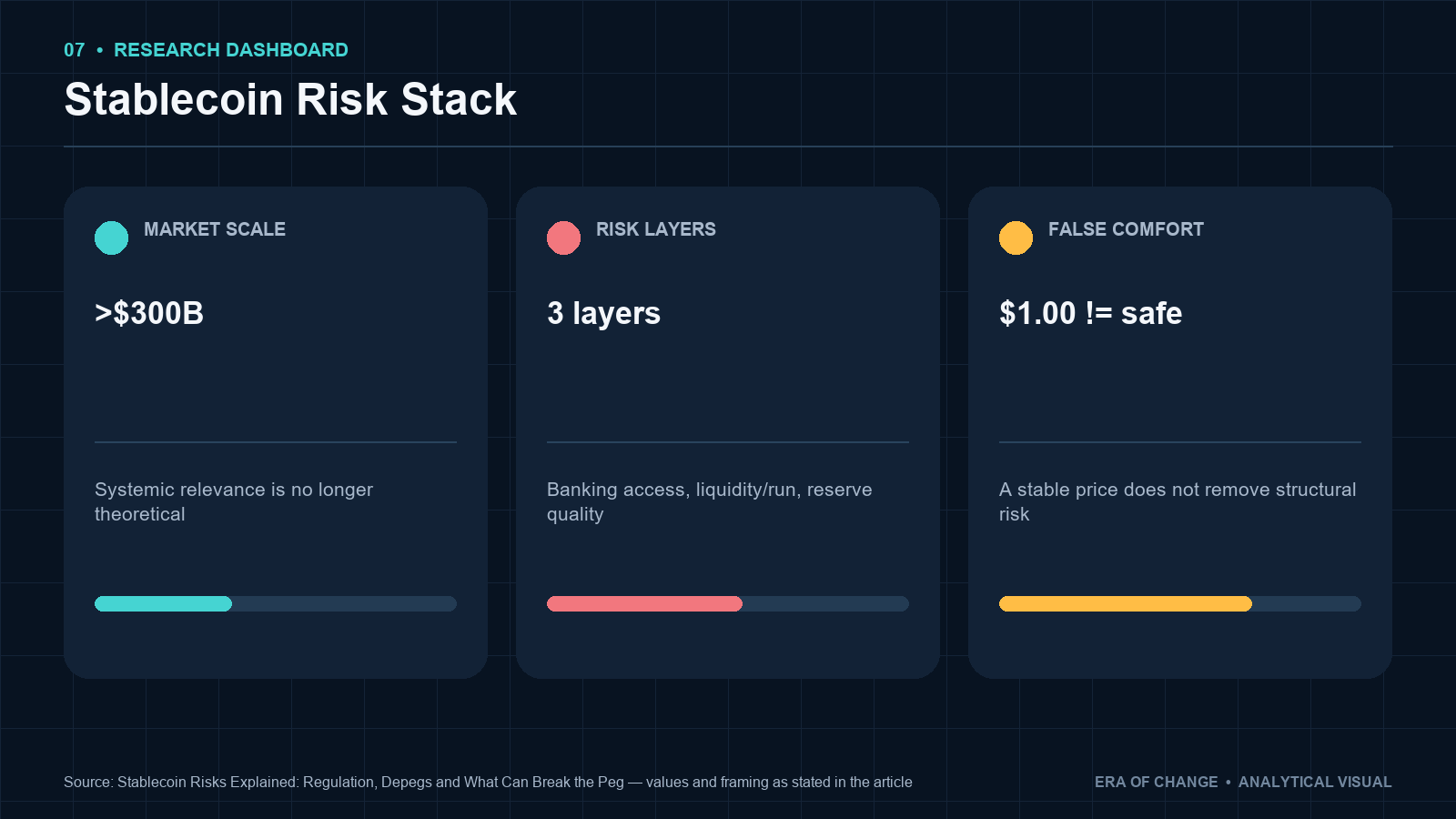
Stablecoins are designed to maintain a stable value (usually against the U.S. dollar), but stability in normal conditions is not the same as safety in all conditions. A stablecoin may trade at $1.00 for years while quietly accumulating risk layers that only become visible during stress.Era identifies three major risk layers in descending order of severity. First, regulatory and banking-access risk: the infrastructure through which tokens are redeemed for real dollars can be interrupted by regulators or custodian banks before a holder ever has a chance to exit. Second, liquidity and run risk: confidence losses can trigger cascading redemptions through DeFi liquidity pools that exhaust even well-capitalized issuers before reserves can be liquidated. As of June 30, 2026, Tether reported $114.96 billion in U.S. Treasury bills and $25.62 billion in overnight and term reverse repos, against $187.75 billion in total assets, or about 74.9 percent. Circle reported $73.3 billion of USDC in circulation at quarter-end. Source. Source 2.
At sufficient scale, forced stablecoin redemptions can reach into Treasury bills, money markets and custodian banks. With total stablecoin market capitalization crossing $300 billion in mid-2026, that threshold is no longer theoretical. Evaluating a stablecoin means evaluating the entire chain: reserves, custody, regulation, redemption access, liquidity and smart-contract exposure, not just the price on a chart.
Key Takeaways
- Stablecoins are not risk-free cash equivalents, even when they trade consistently at $1.00.
- Regulatory and banking-access risk may be more consequential than reserve quality alone: a stablecoin can fail without any actual reserve shortfall.
- A stablecoin peg depends on functioning redemption and arbitrage mechanisms, not reserves alone.
- Bank-run dynamics can turn a confidence problem into a liquidity crisis faster than issuers can act.
- Even high-quality reserves (such as U.S. Treasury bills) can be difficult to monetize quickly at tens of billions of dollars of scale.
- Smart-contract, custody and address-freeze risks differentiate stablecoins from traditional money-market funds in ways that compound the tail-risk profile.
- Yield from stablecoin strategies should be meaningfully higher than comparable Treasury or money-market yields to compensate for the additional risk layers: Era estimates the appropriate premium at approximately 300 to 500 basis points above risk-free rates.
Introduction
A stablecoin trading at $1.00 may be treated as a digital dollar balance, but it is a crypto asset rather than a bank deposit: its peg targets nominal value, not purchasing power, and the token itself is not FDIC-insured. The price is stable. The yield is visible. The transfer settles in seconds. Everything about the surface experience suggests safety. Source. Source 2.
The surface experience is not the full picture.
A fiat-backed stablecoin at $1.00 depends, simultaneously, on an issuer holding adequate reserves, custodian banks processing movements of those reserves, regulators permitting the issuer to operate, blockchain infrastructure remaining secure, smart contracts holding if the token is deployed in DeFi protocols, market makers being willing to bid at or near par, and redemption channels remaining open to whoever needs to exit. The token on your screen is the end of a very long chain. Every link in that chain is a potential failure point.
The central question I want to answer here is not “what is a stablecoin.” It is the harder one: what can actually break the peg, and in what order of probability?
What Is a Stablecoin?
A stablecoin is a crypto token designed to maintain a relatively stable value against a reference asset, most commonly the U.S. dollar. The mechanism through which that stability is maintained differs substantially by structure, and the risk profile changes accordingly.
Fiat-backed stablecoins (the dominant category by market share) are issued by a centralized entity that holds reserve assets, predominantly cash and short-term government securities, and commits to redeeming tokens for dollars at or near par. As of June 30, 2026, Tether reported approximately $184.6 billion in USD₮ issued, and Circle reported $73.3 billion of USDC in circulation, a combined approximately $257.9 billion. Crypto-collateralized stablecoins replace fiat reserves with over-collateralized crypto assets held in smart-contract vaults, relying on liquidation mechanisms to maintain the peg when collateral values fall. Algorithmic stablecoins attempt to maintain the peg through supply mechanisms, protocol incentives, or partial collateral rather than full backing: the structure that produced the UST/LUNA collapse of May 2022, which erased approximately $40 billion in value in seventy-two hours. Source. Source 2.
The risk structures of these three categories are so different that treating them as a single asset class leads to systematic misanalysis.
Are Stablecoins Safe?
Some stablecoins carry substantially lower risk than others. None should be treated as completely risk-free.
The phrase “risk-free” carries specific meaning in finance: an asset whose return is guaranteed with no probability of loss. No stablecoin currently satisfies that definition, because every stablecoin contains at least some combination of counterparty risk, regulatory risk, technical risk, and liquidity risk. The relevant question is not whether risk is present but which risks are most significant, how they interact, and whether the yield premium offered over a genuine risk-free instrument (U.S. Treasury bills) adequately compensates a holder for accepting them.
The distinction I return to repeatedly is this: price stability is not the same as capital safety. A stablecoin can maintain a $1.00 price for years through market conditions that never stress the underlying system, while accumulating risk that is invisible until the conditions that reveal it actually arrive.
The Stablecoin Risk Stack
The way I think about stablecoin risk is as a layered stack, not a single variable. The peg remains credible only if the entire chain functions. Remove any link and the system can break even if every other link holds.
That chain runs in sequence: the stablecoin holder holds a token, which represents a claim on an issuer, who holds reserve assets through custodian banks, which are accessed through financial infrastructure, which operates under regulatory permission, which terminates in a redemption mechanism that converts tokens back to dollars. Each of those elements is a separate risk category, and each can fail independently of the others.
My hierarchy of risk severity, which I have laid out for Nikolai’s interview and which forms the backbone of this analysis, places regulatory and banking-access risk at the top, liquidity and run dynamics in the second position, and reserve-quality risk third, not because reserves are unimportant, but because the first two risks can cause a collapse even when reserves are adequate.
Risk #1: Stablecoin Regulation and Banking Access
This is where I want to spend the most time, because it is the risk that is most systematically underestimated.
Most stablecoin investors evaluate the peg by asking about reserve quality. How much is in T-bills? Is there an attestation? Has anyone audited the books? These are legitimate questions, but they address the wrong layer of the risk stack. A stablecoin issuer can hold 100 percent of its reserves in short-term U.S. Treasuries and still face severe stress if regulators or banking partners interrupt the infrastructure required to convert those Treasuries into dollars and deliver those dollars to redeeming holders.
The pathway for a fiat-backed stablecoin to function is as follows: dollars enter the banking system when a user purchases tokens, the issuer creates new tokens and deploys reserves, the tokens circulate, and when a holder wants to redeem, the issuer instructs its custodian banks to send dollars back through the traditional payment system. The blockchain part of that cycle (issuance, transfer, settlement) can operate at any hour without interruption. The fiat rails on either side are governed by U.S. banking law, FinCEN anti-money-laundering requirements, OFAC sanctions programs, and the regulatory status of the banks involved.
Any disruption to the fiat side of that cycle is enough to create a depeg. OFAC-administered sanctions may require U.S. persons to block property or interests in property of designated or otherwise blocked persons when that property is within U.S. jurisdiction or in a U.S. person's possession or control; FinCEN itself does not have authority to freeze assets or block funds transfers. A reserve shortfall is not required for sanctions blocking to apply. A custodian bank can lose its license, face FDIC action, or decline to process stablecoin-related flows under pressure from its primary regulator. An issuer can be classified as operating an unlicensed money transmission business, triggering immediate restrictions on operations. An exchange that provides the primary secondary-market liquidity can be delisted or restricted by regulators in a key jurisdiction. Each of these events would impair arbitrage, which restores the peg when it deviates, and confidence in redemption would fall accordingly. Source. Source 2.
The GENIUS Act, signed into U.S. law by President Trump on July 18, 2025 as the first federal statute governing payment stablecoins, moves in the direction of clarifying these rules. It requires payment stablecoins to be backed one-to-one by high-quality liquid reserves, disclosed monthly, and subject to examination by an independent accounting firm. Issuers are treated as financial institutions under the Bank Secrecy Act, meaning AML programs, customer-identification obligations, and mandatory sanctions-compliance programs are required. Final implementing rules were still pending as of August 2026, with the Act’s enforcement provisions scheduled to take effect no later than January 18, 2027. The regulatory framework is becoming clearer, but clarity can increase regulatory risk as much as it reduces it, because a clearer legal framework creates defined thresholds at which issuers can be found non-compliant.
Why Banking Rails Matter More Than Most Crypto Investors Realize
The blockchain part of a stablecoin’s operation is the part most investors can see: transactions in real time, token supply on-chain, transfer costs transparent. The banking infrastructure beneath it is largely invisible until it fails.
In March 2023, Circle’s USDC experienced one of the most instructive stress events in stablecoin history. Circle disclosed that $3.3 billion of its approximately $40 billion in reserves was held at Silicon Valley Bank at the moment SVB was closed by the FDIC. USDC depegged to approximately $0.87 within hours. The blockchain was functioning perfectly. Smart contracts were intact. The $3.3 billion was recoverable (the FDIC later guaranteed SVB deposits), but the market had no certainty about that during the critical weekend. By Monday, when the Treasury and FDIC announced a backstop, USDC recovered fully. But the depeg was caused entirely by uncertainty about one banking relationship, not by any deficiency in the reserve assets themselves.
The lesson is structural, not historical. Fiat-backed stablecoin stability depends on the uninterrupted function of banking counterparties that are regulated by entities (the OCC, the FDIC, the Federal Reserve, FinCEN) that operate entirely outside the crypto ecosystem and have no obligation to maintain stablecoin functionality as a policy objective. The blockchain can continue operating without interruption while the stablecoin itself is in crisis.
Risk #2: Stablecoin Bank Runs
The second layer of risk is how quickly confidence losses can become liquidity crises through the mechanics of DeFi and secondary markets.
A traditional bank run unfolds over days as depositors queue at branches. A stablecoin run can unfold in hours because secondary-market selling in DeFi liquidity pools (particularly large Curve Finance pools, where billions in stablecoin depth can be swapped in a single block) creates immediate visible price pressure that reads to every market participant as a confirmation of the thing they feared. The sequence is self-reinforcing. Holders question the peg. Large holders begin redeeming directly or selling in secondary markets. Curve pool ratios become imbalanced as one stablecoin is sold against others. The imbalanced pool signals stress to on-chain monitors. That signal attracts more selling. The stablecoin price falls below par. Each fraction of a cent below $1.00 becomes a data point that validates the fear that started the process.
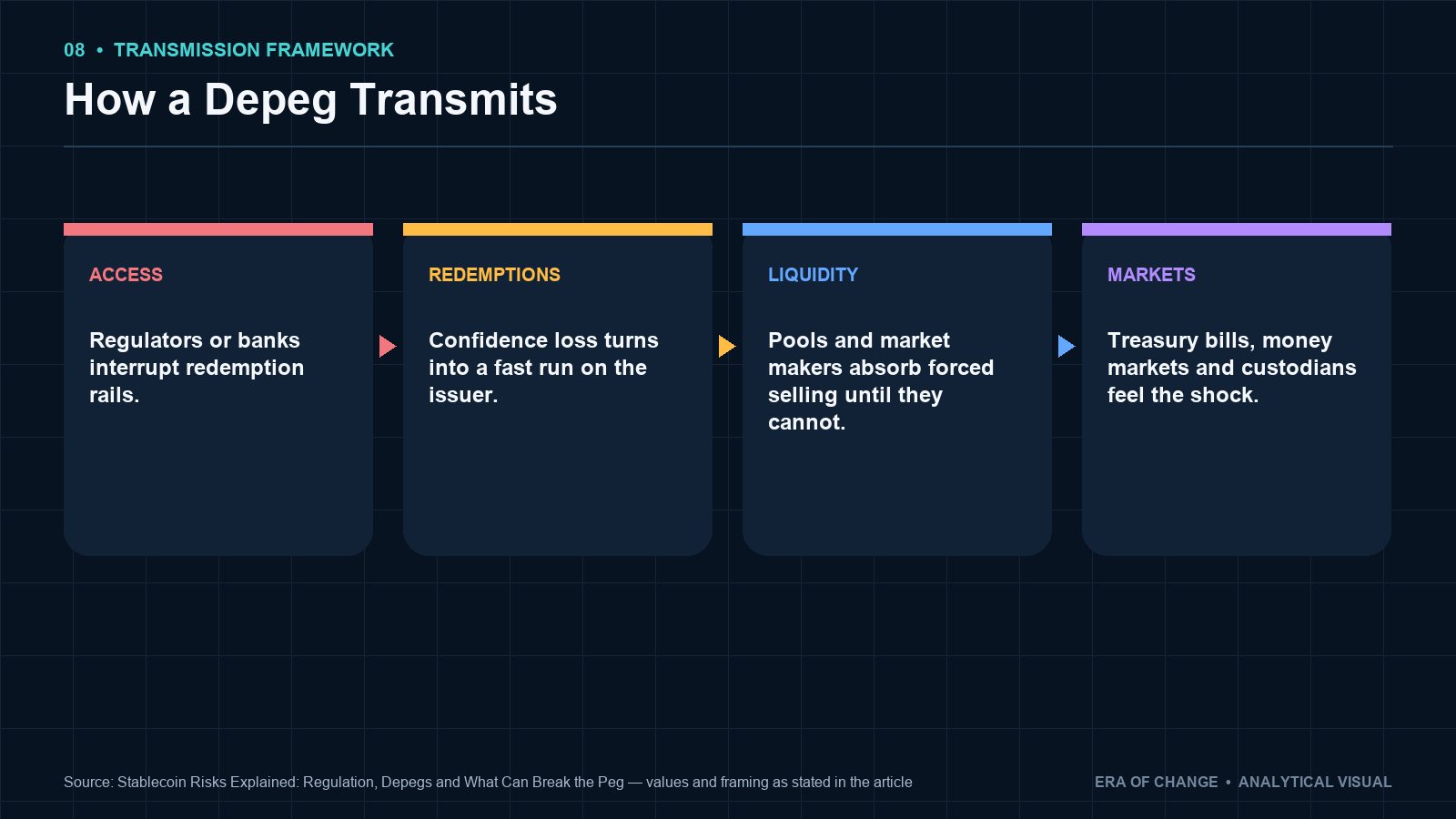
At $30 to $50 billion in redemptions within a few days (the scale Nikolai identifies as the threshold at which a major issuer would face genuine liquidity stress), the issuer must liquidate reserve assets through primary dealers at speed. Even a portfolio of 80 percent U.S. Treasury bills can create meaningful market impact at that volume over that timeframe. The T-bills are sold. Dealers absorb them. Short-term funding market spreads can widen. Custodian banks holding large stablecoin-issuer deposits face sudden outflows. The mechanism by which stablecoin stress reaches traditional money markets has already appeared in outline in the 2023 Silicon Valley Bank episode, where the direction of travel ran from a bank’s failure to crypto, rather than from crypto to a bank, but the plumbing is the same.
What Is a Stablecoin Depeg?
A depeg occurs when a stablecoin trades materially away from its intended reference value. For a dollar-pegged stablecoin, the target is $1.00. Minor deviations of a fraction of a cent occur routinely as a function of market friction and do not indicate systemic stress. What matters is whether the deviation is persistent, widening, or accompanied by signs of impaired redemption.
Not all depegs have the same cause, and the cause determines whether recovery is likely and on what timeline. A temporary liquidity depeg happens when secondary-market supply briefly exceeds demand: the arbitrage mechanism restores par quickly if redemption remains open and trust in the issuer is intact. A redemption depeg occurs when the market questions whether tokens can be exchanged for full value, which is what happened to USDC in March 2023: the reserve assets were adequate but access to them was uncertain. A collateral depeg occurs when the assets backing the token have declined in value below liabilities, which is the failure mode for crypto-collateralized stablecoins facing a rapid drop in collateral prices. A regulatory depeg occurs when legal or banking action interrupts access to reserves or the redemption mechanism itself, even when reserves are theoretically adequate. And an algorithmic collapse is what destroyed TerraUSD in May 2022: the peg maintenance mechanism failed because confidence collapsed, arbitrage incentives inverted, and there were insufficient hard reserves to absorb the selling.
Each type requires a different analysis, and conflating them (because they all result in a price below $1.00) produces wrong conclusions about the nature and severity of the risk.
How Arbitrage Normally Restores the Peg
The mechanism that keeps fiat-backed stablecoins near par is elegant in theory. If USDT trades at $0.98, a market participant with access to direct redemption buys tokens at $0.98 in secondary markets, submits them to Tether for redemption at $1.00, and earns two cents on the trade. That buying pressure pushes the market price back toward par. The arbitrage loop is self-correcting as long as its preconditions hold.
Those preconditions are: redemption remains open and timely, the banking infrastructure processes the resulting dollar transfer, transaction costs are manageable relative to the spread, the issuer remains trusted, and there is sufficient arbitrage capital willing to put money to work during the stress period. The USDC/SVB episode demonstrated what happens when one of those preconditions is uncertain: during the weekend of March 10–12, 2023, arbitrageurs with redemption access did not know if they would actually receive dollars, so many declined to step in at scale. The peg recovered only when policy certainty was restored. Until that moment, the arbitrage mechanism was effectively on hold.
Risk #3: Reserve Quality
For the two largest fiat-backed issuers, reserve quality is, paradoxically, the least acute of the three major risk categories under current conditions. That is not a statement about the importance of reserves; it is a statement about their current composition.
Tether’s Q2 2026 BDO assurance report lists $187.75 billion in total assets as of June 30, including $114.96 billion in U.S. Treasury bills, $18.63 billion in overnight reverse repos, and $6.99 billion in term reverse repos. Circle’s USDC reserves are held in a dedicated Circle Reserve Fund managed by BlackRock, primarily in Treasury bills and overnight Treasury repo. The composition of both major issuers has improved substantially since the earlier period when reserve quality was a genuine open question. Source.
The important caveat Nikolai raises is about reserve liquidity rather than reserve quality. A T-bill is a high-quality asset. A portfolio of $150 billion in T-bills is a high-quality portfolio. But if an issuer needs to convert $40 billion of that portfolio into dollars within forty-eight hours to meet redemptions, the relevant questions shift from “are these good assets?” to “how large is the transaction relative to daily market volume, what price impact will it cause, how quickly can the custodians settle the cash, and are dealers prepared to absorb that volume without widening spreads?” Solvency and liquidity are not the same question. A stablecoin issuer can be solvent (assets exceed liabilities) and still face a liquidity crisis if redemption volume arrives faster than reserves can be monetized.
Could a Stablecoin Depeg Affect Traditional Finance?
Era Analyst’s Perspective
The question most people ask about stablecoins is whether USDT or USDC will break. The question I think is more analytically important is at what size stablecoin redemption flows would create observable consequences in traditional money markets.
Here is the arithmetic. As of mid-2026, Tether alone holds over $100 billion in U.S. Treasury bills. That figure, if Tether were a sovereign state, would rank it among the top 20 holders of U.S. government debt globally. Total stablecoin market capitalization crossed $300 billion in 2026, the lower bound of the systemic-risk range I identify. When an entity holding that concentration of short-term government debt faces a $30 to $50 billion redemption event compressed into seventy-two hours, it becomes a forced seller at volume. The primary dealers absorbing those sales experience balance-sheet pressure. Short-term funding spreads (SOFR, repo, money-market rates) can widen as dealer capacity tightens. Custodian banks holding stablecoin issuer deposits face rapid drawdowns. The transmission from crypto into traditional short-term credit markets is not hypothetical. It already appeared in outline in March 2023.
My threshold estimate ($300 to $500 billion in total stablecoin market capitalization, with reserves concentrated in Treasury bills at the level of top-five sovereign holders) is not a regulatory definition. It is a scenario framework. We are inside the lower bound of that range right now. I am not predicting a crisis. I am saying the structural conditions for contagion have already been established, and investors in traditional money markets who ignore stablecoin-sector dynamics are not ignoring an irrelevant corner of crypto. They are ignoring a structural buyer of Treasury bills that would become, under stress, a large forced seller.
The contagion mechanism runs in sequence. A stablecoin loses holder confidence, triggered by a regulatory event, a banking failure, or a liquidity shock in DeFi pools. Redemptions accelerate. The issuer raises cash by selling Treasury bills and reverse repo into primary dealer networks. Dealers absorb supply, tightening their capacity. Short-term funding spreads widen as Treasury bill prices are pushed down. Custodian banks face sudden outflows of large deposits. If those custodians have made lending decisions or reserve calculations based on the stability of those deposits, the rapid withdrawal creates its own pressure. And if DeFi protocols using the affected stablecoin as collateral begin experiencing cascading liquidations, the on-chain stress creates additional forced selling pressure in crypto assets more broadly.
As of June 30, 2026, Tether reported approximately $184.6 billion in USD₮ issued, and Circle reported $73.3 billion of USDC in circulation, a combined approximately $257.9 billion. For context on how sovereign-debt dynamics interact with this institutional scale, see Global Debt Risks 2026 and De-Dollarization Report. Source. Source 2.
Stablecoins vs. Money Market Funds
The comparison investors most commonly reach for is money market funds, and it is a useful one, but the differences are material and are frequently understated.
| Stablecoins | Money Market Funds |
|---|---|
| Blockchain-native, 24/7 transferability | Traditional securities infrastructure, market-hour constraints |
| Smart-contract exposure in DeFi use cases | Fund and custodian exposure only |
| Addresses can be frozen by the issuer | Traditional account restrictions apply |
| Peg mechanism with arbitrage enforcement | Net asset value structure, redemption at NAV |
| Crypto-native liquidity venues | Regulated securities infrastructure |
| Additional blockchain-specific technical risk | No blockchain-specific risk |
| Regulatory status actively evolving | Established regulatory framework |
| Interest/yield sharing legally restricted under GENIUS Act | Yield distributed as fund income |
Money market funds are not risk-free instruments: the history of the Reserve Primary Fund breaking the buck in September 2008 during the Lehman Brothers collapse, falling to $0.97, established that clearly. But the specific risks they carry (credit risk of underlying assets, liquidity management during runs) are well-understood, extensively regulated, and operate within a framework of deposit insurance, Fed backstop facilities, and SEC oversight that has been refined over decades. Stablecoins carry those risks plus several additional layers. That distinction matters when the yields being offered are similar.
The Stablecoin Risk Premium
This is where the analytical framework becomes directly useful for an investment decision. The question is straightforward: if a stablecoin strategy offers a yield of 4 to 6 percent and U.S. Treasury bills are yielding 4 to 5 percent, what is the marginal return per unit of additional risk being accepted?
At matching yields, the additional risks accepted by holding stablecoin exposure instead of Treasury bills include: smart-contract failure in the protocol through which the yield is generated; the issuer’s solvency and regulatory status; the custodian bank relationships that enable dollar redemption; potential address freezing or blacklisting by the issuer; depeg risk if confidence in the peg erodes; and regulatory action that could interrupt operations before redemption is possible. Each of these risks is low-frequency. None of them are zero-frequency. The tail risk in the worst case (a regulatory freeze or protocol exploit) is loss of 100 percent of the position.
Era’s risk-premium framework for stablecoin yield is this: in an environment where comparable Treasury bill yields are in the 4 to 5 percent range, a stablecoin strategy should offer approximately 300 to 500 basis points of additional yield, 3 to 5 percentage points, to provide adequate compensation for the additional tail-risk layers being accepted. This is Era’s analytical estimate, not a universal standard or a regulatory requirement.
The mathematics breaks down when the yield differential narrows. A stablecoin offering 5 percent when T-bills yield 4.5 percent is offering 50 basis points of additional return for risks that, in the right conditions, can eliminate the entire position. Expected-return logic is clear: the probability-weighted outcome of accepting 50 basis points per year in additional yield needs to be compared with the probability-weighted loss from tail events. If a tail event carrying even a 1 percent annual probability can erase 100 percent of the position, the expected loss from that event alone (100 basis points per year) exceeds the yield premium being offered. A holder accepting such a structure is, in formal terms, not being compensated for the risk they are taking.
Smart-Contract Risk
Stablecoins used through DeFi protocols add a layer of risk that is entirely separate from the stablecoin issuer. A USDC or USDT token can be completely solvent, with adequate reserves and functioning redemption, while being lost through a vulnerability in the protocol through which it is deployed.
Smart-contract exploits have a documented history of producing total or near-total losses: the Ronin bridge exploit in March 2022 ($625 million), the Wormhole bridge exploit in February 2022 ($320 million), the Nomad bridge exploit in August 2022 ($190 million), and numerous protocol-specific hacks involving lending markets, DEX liquidity pools, and yield aggregators. These events did not reflect failures by stablecoin issuers. They reflected failures by the protocols through which stablecoins were deployed as collateral or liquidity.
Oracle risk (the risk that the price feeds used to trigger smart-contract actions send incorrect data) creates a separate exposure. A manipulated or incorrect oracle can trigger improper liquidations, create artificial arbitrage opportunities, or break the assumptions on which a lending protocol’s risk management depends. Bridge risk, the risk that the infrastructure connecting different blockchain networks fails, introduces yet another exposure layer whenever a stablecoin is used across multiple chains. A perfectly secure token on Ethereum is not automatically secure when bridged to another network through an improperly audited bridge.
The practical implication is that risk assessment for stablecoin exposure must include the full deployment chain, not just the token itself.
Custodian and Blacklisting Risk
Centralized fiat-backed stablecoin issuers have the technical and legal ability to freeze addresses, block transfers, reverse transactions in some cases, and reject redemptions in compliance with regulatory orders. Both Tether and Circle have exercised this capability: as of 2024, Tether had frozen over $1.5 billion across hundreds of addresses in response to law-enforcement requests and OFAC sanctions compliance.
This creates a dual structure that is worth acknowledging without trying to resolve it one-sidedly. The ability to freeze addresses is what makes major stablecoins acceptable to regulated financial institutions: it provides a compliance mechanism that pure-bearer assets do not offer. It is also a censorship mechanism that introduces jurisdictional dependence. A holder in a jurisdiction that becomes subject to U.S. OFAC sanctions, or that is involved in a transaction flagged by law enforcement, can lose access to their stablecoin balance through no action of their own against the stablecoin issuer.
The relevant analytical question for each holder is: what is my exposure to the conditions that trigger freezing, and how does that exposure compare with the access benefits the centralized structure provides?
Lessons From Previous Depegs
Three episodes provide the clearest historical evidence for the risk hierarchy described above.
UST/LUNA, May 2022. TerraUSD was an algorithmic stablecoin with partial reserve backing, relying on an incentive mechanism involving its sister token LUNA to maintain the peg. When confidence weakened in early May 2022, LUNA began falling, the arbitrage incentives that were supposed to restore the UST peg inverted, and a reflexive collapse erased approximately $40 billion in combined UST and LUNA value over seventy-two hours. No layer of the risk stack held: not the reserve structure, not the redemption mechanism, not the peg-maintenance algorithm. The lesson from UST is that algorithmic stability mechanisms, when they depend on market confidence that can disappear instantaneously, have no floor when confidence goes to zero.
USDC, March 2023. Circle’s USDC held $3.3 billion at Silicon Valley Bank when SVB was closed by the FDIC on March 10. USDC, which at the time had approximately $40 billion in total reserves, depegged to $0.87 at the low before the FDIC announced a full deposit guarantee. Reserve quality was not the problem: the reserves were real and the $3.3 billion was recoverable. Banking counterparty risk was the problem. The layer that failed was the third element in the fiat-stablecoin chain: the custodian bank. This is the clearest real-world demonstration of the hierarchy I describe: regulatory and banking-access risk above reserve quality.
The broader takeaway. In both cases, recovery happened: USDC through policy action, UST not at all. The difference was the structure beneath the peg. Fiat-backed stablecoins with diversified, high-quality reserves and multiple banking relationships are substantially more resilient than algorithmic stablecoins with no external collateral floor. But “substantially more resilient” is not the same as “safe.”
Three Stablecoin Stress Scenarios
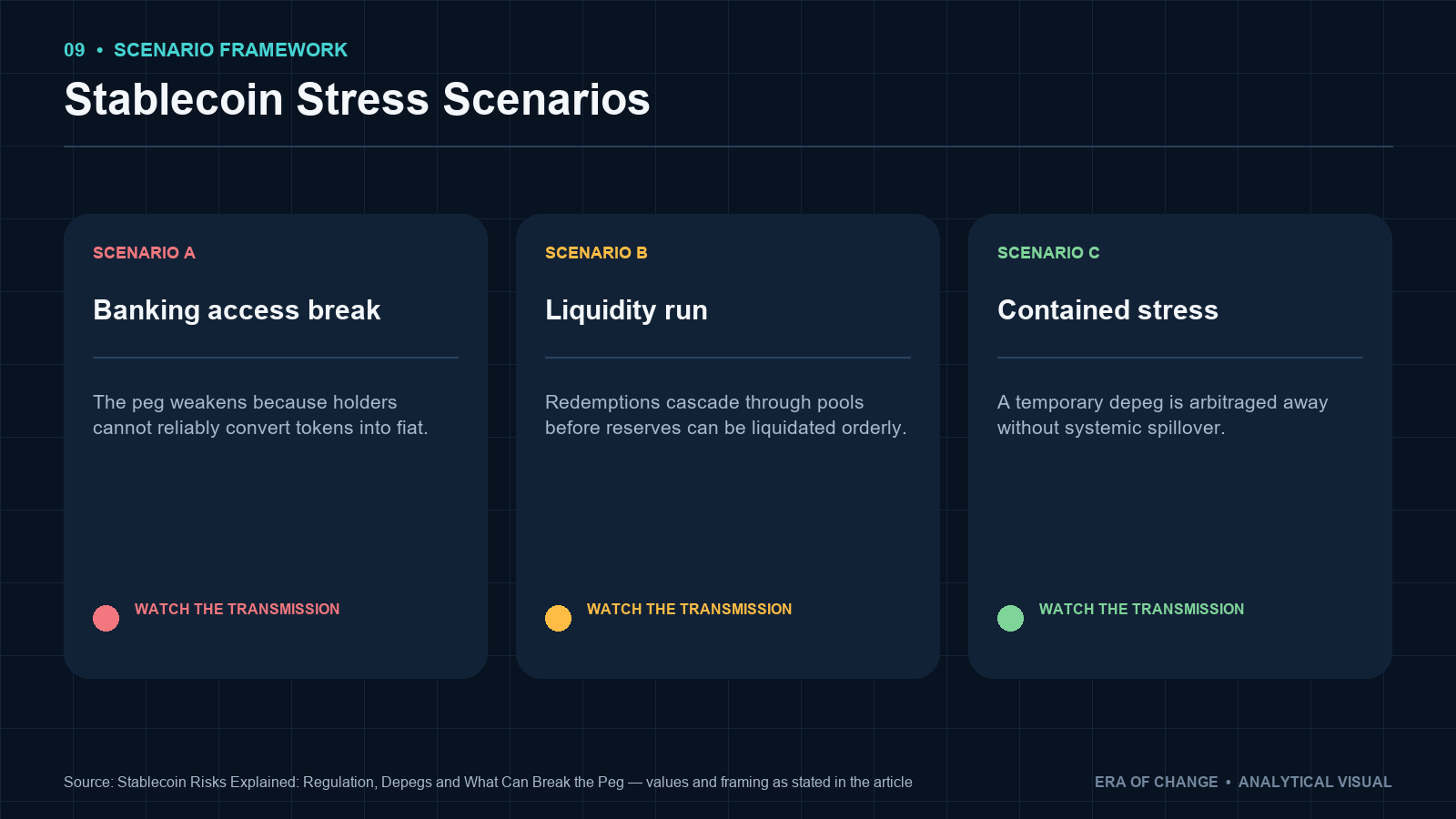
Scenario 1: Temporary Liquidity Depeg. A short-lived market imbalance creates selling pressure in secondary markets. Redemption channels remain open. Arbitrageurs buy the discount, submit for redemption, and restore par within hours or days. Banking infrastructure functions normally. Contagion to other stablecoins or traditional markets is minimal. This is the most common type of depeg event in a well-functioning market, and historical resolution time is typically under 48 hours.
Scenario 2: Regulatory or Banking Freeze. A regulatory order, banking license action, or sanctions designation interrupts the fiat-side infrastructure through which tokens are redeemed. The blockchain continues operating. Token transfers continue. But the pathway from token to dollar is blocked or uncertain. Arbitrage capital withdraws because the redemption trade cannot be completed with confidence. Secondary market prices fall materially below par. Curve pool imbalances spread the stress to correlated stablecoins. Recovery depends on whether the regulatory or banking action is reversed or clarified (a timeline that is neither predictable nor guaranteed). This is the scenario Nikolai identifies as the highest-risk category, and it is the scenario that neither reserve quality nor blockchain security can prevent.
Scenario 3: Systemic Stablecoin Run. A major issuer (or multiple issuers simultaneously) faces $30 to $50 billion in redemptions over a compressed window. Reserve liquidation begins at scale. Treasury bill sales flow through primary dealers. Short-term funding markets experience spread widening. Custodian banks face rapid large-deposit outflows. DeFi protocols using the affected stablecoin as collateral begin liquidating positions, accelerating the crypto-side selling. Cross-platform contagion extends the stress beyond the originating stablecoin. Traditional money-market participants notice elevated repo spreads. This is a tail scenario, not a base case. But with total stablecoin market capitalization exceeding $300 billion in 2026, it is a tail scenario that describes a meaningful magnitude of systemic exposure. For the full context on how short-term funding stress transmits through financial markets, see Era CrisisMeter Explained.
Frequently Asked Questions
Are stablecoins safe?
Some stablecoins carry substantially lower risk than others, but none should be treated as risk-free cash equivalents. Price stability in normal market conditions is not the same as capital safety under all conditions. A stablecoin can trade at $1.00 for years while accumulating regulatory, banking, or smart-contract risks that only become visible during stress. Evaluating a stablecoin means evaluating the entire chain: reserves, custody, regulation, redemption access, liquidity, and technical infrastructure.
What are the biggest stablecoin risks?
In Era’s risk hierarchy, the most consequential is regulatory and banking-access risk: a stablecoin can fail without any reserve shortfall if the infrastructure required to redeem tokens for dollars is interrupted. The second is liquidity and run risk, where confidence deterioration cascades through DeFi pools and secondary markets faster than issuers can respond. Third is reserve-quality risk, which for the leading fiat-backed issuers is currently lower than the first two because reserves are concentrated in short-term U.S. Treasuries, though this does not eliminate it.
What is a stablecoin depeg?
A depeg occurs when a stablecoin trades materially below its intended reference value, below $1.00 for a dollar-pegged token. The cause determines the severity and the recovery path. A temporary liquidity depeg can resolve in hours through arbitrage. A redemption depeg caused by banking or regulatory uncertainty can last days and recover only with policy clarity. An algorithmic collapse can be permanent, as in the TerraUSD collapse of May 2022.
Why do stablecoins lose their peg?
Stablecoins lose their peg when one or more elements of the stability mechanism fails: confidence collapses and triggers selling faster than arbitrage can respond; the issuer’s banking access is interrupted, preventing redemption; reserve assets are insufficient or illiquid under stress; the smart-contract or algorithmic mechanism fails; or a regulatory action restricts operations. The most dangerous depegs are those where the arbitrage mechanism breaks, because then price discovery has no floor.
How does stablecoin regulation affect investors?
Regulation determines whether an issuer can legally operate, what reserve assets are permitted, what redemption rights holders possess, and what compliance obligations (including address freezing and sanctions enforcement) the issuer must meet. The U.S. GENIUS Act, signed in July 2025 and being implemented through 2026, establishes mandatory reserve standards, monthly disclosure requirements, and AML/sanctions frameworks for payment stablecoin issuers. Regulatory clarity can reduce some risks while introducing new ones: clear rules create defined thresholds at which issuers can be found non-compliant.
Are stablecoins backed by U.S. dollars?
Fiat-backed stablecoins are backed primarily by U.S. Treasury bills and short-term government securities, not dollar cash directly. Tether’s Q2 2026 BDO assurance report lists $187.75 billion in total assets as of June 30, including $114.96 billion in U.S. Treasury bills and $25.62 billion in overnight and term reverse repos. Circle’s USDC reserves are held in a dedicated BlackRock fund of Treasury bills and overnight repo. The distinction matters: Treasury bills are extremely liquid but are not dollar cash, and converting large positions under time pressure creates market impact. Source.
What happens during a stablecoin bank run?
Holders question the peg and begin redeeming or selling in secondary markets. Large sales in DeFi liquidity pools (Curve Finance pools are the most significant venue) create price pressure below par. Other holders interpret the price move as confirmation of the risk and accelerate selling. The issuer must liquidate reserve assets to meet redemption demand. If redemption volume compresses into a short timeframe, reserve liquidation becomes a forced sale with potential market impact on Treasury bill prices and short-term funding spreads.
Can a stablecoin depeg affect traditional financial markets?
Yes, at sufficient scale. A major stablecoin issuer holding over $100 billion in Treasury bills (as Tether does) becomes a significant participant in short-term government debt markets. Large forced redemptions would require selling Treasury bills through primary dealers at volume, potentially widening short-term funding spreads and creating custodian-bank deposit outflows. Era identifies a total stablecoin market capitalization of $300 to $500 billion, with reserves concentrated in Treasury bills at the level of top sovereign holders, as the threshold at which this transmission becomes materially relevant for traditional finance. The market is inside the lower bound of that range in 2026.
Are stablecoins safer than money market funds?
Money market funds carry different risks but operate within a more established regulatory framework with explicit SEC oversight, investment constraints and, in some cases, access to Federal Reserve liquidity facilities. Fiat-backed stablecoins add smart-contract risk, address-freeze risk, blockchain-specific technical risk, and a regulatory framework that is still being defined. Neither is risk-free, but the risk categories are different. The yield differential between the two should reflect these additional stablecoin-specific risk layers.
What is the difference between USDT, USDC and algorithmic stablecoins?
USDT (Tether) and USDC (Circle) are fiat-backed: reserves are primarily held in U.S. Treasury bills, and tokens can be redeemed directly by eligible holders. Their primary risks are regulatory, banking access, and, at scale, reserve liquidation under stress. Algorithmic stablecoins attempt to maintain the peg through market incentives or supply mechanisms rather than full reserve backing. TerraUSD, the most prominent algorithmic stablecoin, collapsed entirely in May 2022. The risk profiles are not comparable.
Can stablecoin issuers freeze funds?
Yes. Both Tether and Circle have the technical and legal capability to freeze addresses in compliance with law-enforcement requests, OFAC sanctions orders, and regulatory directives. As of 2024, Tether had frozen over $1.5 billion across hundreds of addresses. This capability is what makes centralized stablecoins acceptable to regulated institutions (it provides compliance infrastructure) and also introduces censorship risk for holders in affected jurisdictions.
How much additional yield should investors demand for stablecoin risk?
Era’s risk-premium framework estimates that stablecoin-based yields should provide approximately 300 to 500 basis points above comparable U.S. Treasury or money-market fund yields to adequately compensate for the additional tail-risk layers: smart-contract failure, issuer and custodian risk, regulatory action, depeg, and liquidity failure. This is Era’s analytical estimate, not a regulatory standard. When the yield differential between a stablecoin strategy and a Treasury bill narrows to 50 to 100 basis points, the incremental return does not, in our assessment, adequately compensate for the incremental risk.
About E.R.A. OF CHANGES
E.R.A. OF CHANGES is an independent macroeconomic research and geopolitical intelligence firm providing institutional-quality analysis to investors worldwide. Our research combines macroeconomics, financial markets, blockchain analytics, and geopolitical risk into proprietary forecasting frameworks designed to identify structural market trends before they become consensus. The Era Global Risk Index (updated daily from 24 structural indicators) serves as the foundation of our analytical methodology, providing a forward-looking measure of systemic financial stress grounded in structural economic evidence rather than market sentiment. Our full methodology, live index reading, and forecast archive are available at eraperemen.info/en.
The content published by E.R.A. OF CHANGES is for informational and educational purposes only and does not constitute financial, investment, legal, or tax advice. All views expressed are the personal analytical perspective of the author. Past forecast accuracy does not guarantee future results. Readers should conduct their own research and consult a qualified financial professional before making any investment decisions.
Sources
- Tether Q1 2026 Attestation: BDO Italia
- GENIUS Act: U.S. Congress S.1582, signed July 18, 2025
- OCC GENIUS Act Notice of Proposed Rulemaking, 2026
- U.S. Treasury: GENIUS Act AML/Sanctions Proposed Rules, April 2026
- DefiLlama: Stablecoin Market Cap
- Stablecoin Market Cap Tops $321B, Bitcoin Foundation
- BIS Working Paper No. 1270: Stablecoins and Safe Asset Prices
- Federal Reserve: Financial Stability Report (stablecoin systemic risk discussion)
- Financial Stability Board: Assessment of Risks to Financial Stability from Crypto-Assets
- FDIC: Silicon Valley Bank Resolution, March 2023
- Era Global Risk Index
- Era CrisisMeter Explained
- Era Forecasting Methodology
- Global Debt Risks 2026
- Currency Crises Explained
- De-Dollarization Report
- Crypto Research & Blockchain Analysis
- Crypto Market Analysis