Prepared by: E.R.A. OF CHANGES Editorial Team
Reviewed by: Nikolai Fainizky, CEO & Senior Analyst, E.R.A. OF CHANGES
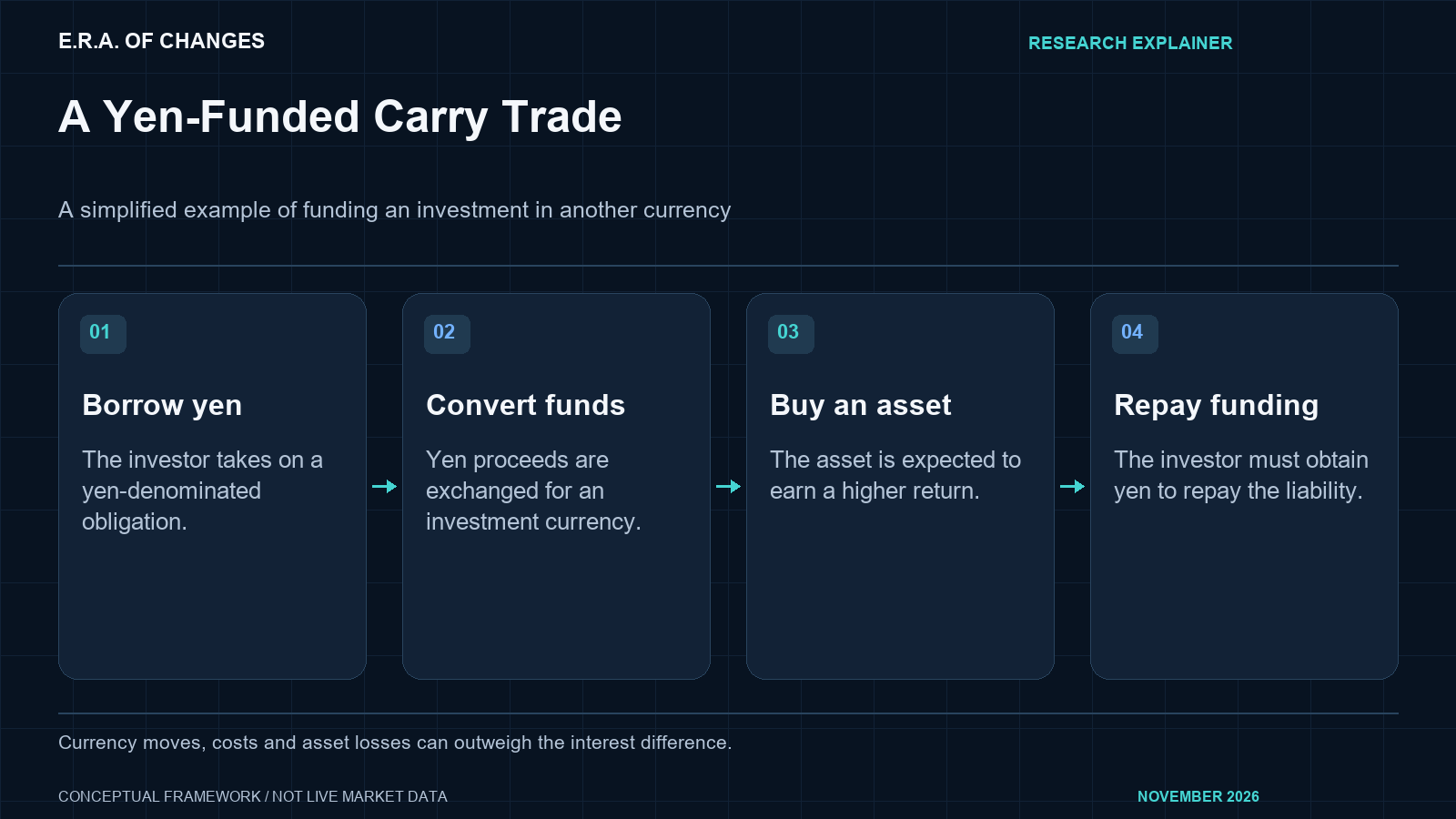
A yen carry trade uses relatively inexpensive yen funding to acquire an asset expected to earn a higher return elsewhere. The apparent attraction is the difference between financing cost and investment return. The danger is that the exchange rate, the asset price or the cost of funding can move against the position before the expected return is earned.
When many leveraged investors reduce similar positions at once, the effects can extend beyond the yen. But not every rise in the Japanese currency is evidence of a global carry-trade unwind, and there is no single public statistic that captures every version of the trade.
How does a yen carry trade work?
Imagine an investor borrows yen, converts the proceeds into another currency and purchases a higher-yielding asset. If exchange rates and prices were unchanged, the difference between the asset's return and the yen financing cost might look attractive. In practice, those conditions are uncertain, and fees, hedges, collateral and tax can materially change the result.
The yen liability remains. If the yen strengthens against the investment currency, the investor needs more of that currency to buy the yen required for repayment. A sufficiently large exchange-rate move can overwhelm the income earned from the asset. Losses on the asset itself can add to the problem.
Carry exposure does not always take the form of a simple bank loan followed by an unhedged bond purchase. Investors can use foreign-exchange derivatives or other instruments. Hedged and unhedged positions have different economics, and Japanese investors holding overseas assets should not automatically be treated as speculative carry traders.
What causes an unwind?
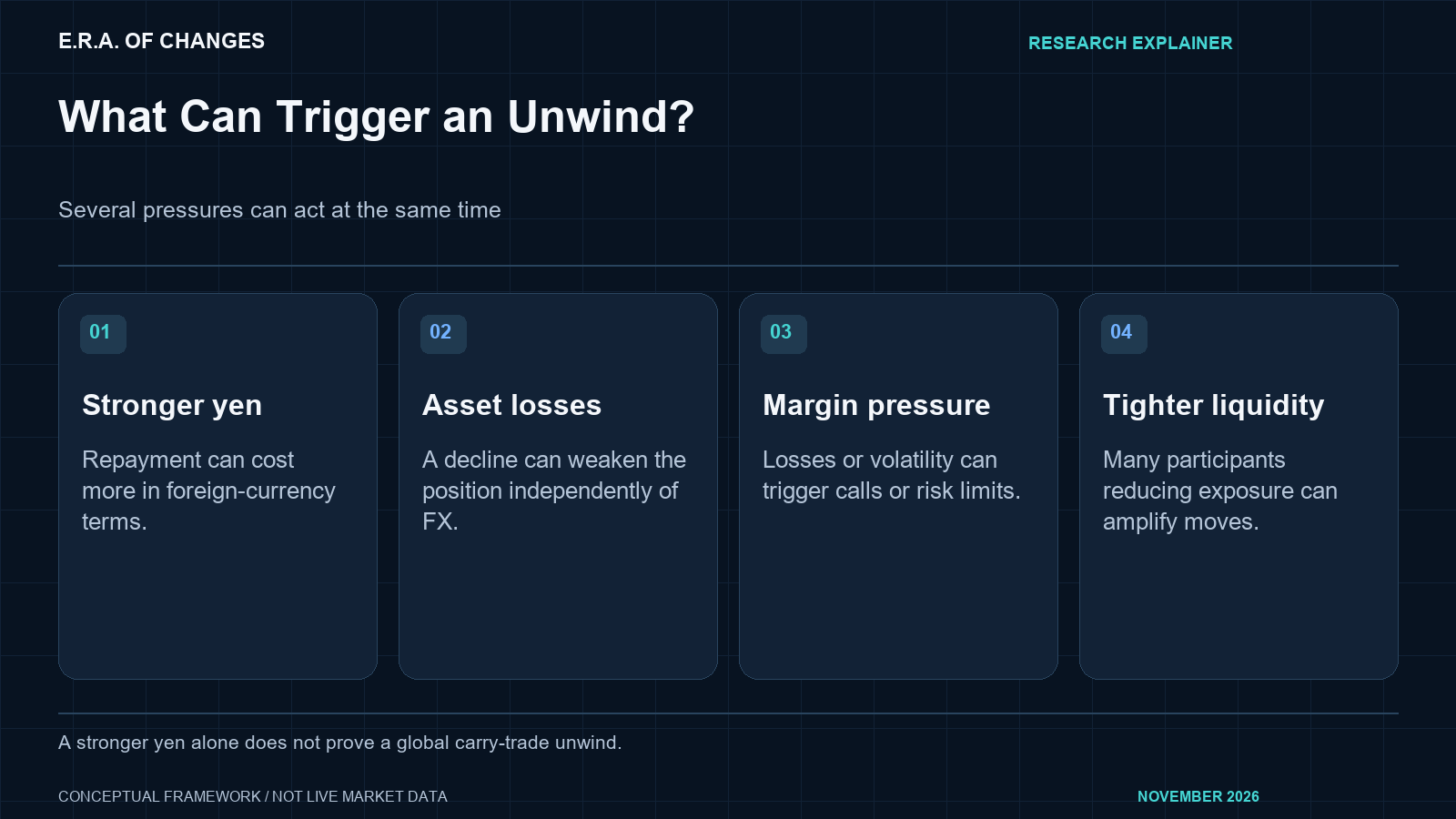
An unwind is a reduction or closing of positions. It can be triggered by one factor or several acting together:
- Exchange-rate moves: a stronger yen increases the cost of repaying an unhedged yen liability in foreign-currency terms.
- Changing rate expectations: a narrowing expected interest-rate gap can reduce the attraction of new positions.
- Asset losses: a decline in the purchased asset can weaken the position even if the yen is stable.
- Leverage and collateral: losses or volatility can cause margin calls, risk-limit breaches or voluntary deleveraging.
- Liquidity: when many participants need to transact at once, execution can become harder and market moves can amplify one another.
None of these factors operates in isolation. A position may be reduced because of changes in expected returns or risk limits even if the funding rate itself has barely changed.
What happened in 2024?
The Bank for International Settlements' September 2024 review describes pressure on leveraged positions during that summer's turbulence. After a disappointing US employment release on 2 August, the yen appreciated further on 5 August and Japan's TOPIX suffered a double-digit daily loss; volatility spread to other markets. The BIS linked the episode to unwinding carry trades but also identified several concurrent shocks.
That distinction is important. An observable move in futures positioning may show that some speculative positions changed, but it cannot measure the entire universe of yen-funded activity. The IMF's October 2024 stability report also discusses the difficulty of estimating the overall position. Treating every contemporaneous decline in risk assets as proof of the same trade would overstate what the data can establish.
The BIS also studied hedge-fund return sensitivity to carry strategies as an indirect sign of exposure building before the episode. Its data did not cover early August, however, so that analysis could not directly measure the unwinding itself. This is an important distinction between evidence of vulnerability and a measurement of what caused each day's selling.
How can effects reach other markets?
Nikolai Fainizky has previously identified the unwinding of yen-funded carry trades as a possible channel of deleveraging across global risk assets. His concern was that a change in funding conditions could affect positions well beyond Japan, not just the yen exchange rate.
That earlier view describes a vulnerability rather than a prediction of a particular selloff. To assess a specific episode, examine the speed of the currency move, available positioning data and funding pressure, while allowing for other causes of changes in asset prices.
The transmission depends on who holds the position and what must be sold or hedged. An investor seeking to reduce leverage may sell a foreign asset, purchase yen to reduce a liability, or alter a derivatives hedge. If many investors respond to the same shock, exchange rates, bonds and equities can move together for a period.
That does not mean the yen mechanically determines global stock prices. Corporate earnings, valuations, monetary policy and other investors' orders remain important. The scale of any spillover depends on position size, leverage, market liquidity and whether other participants step in.
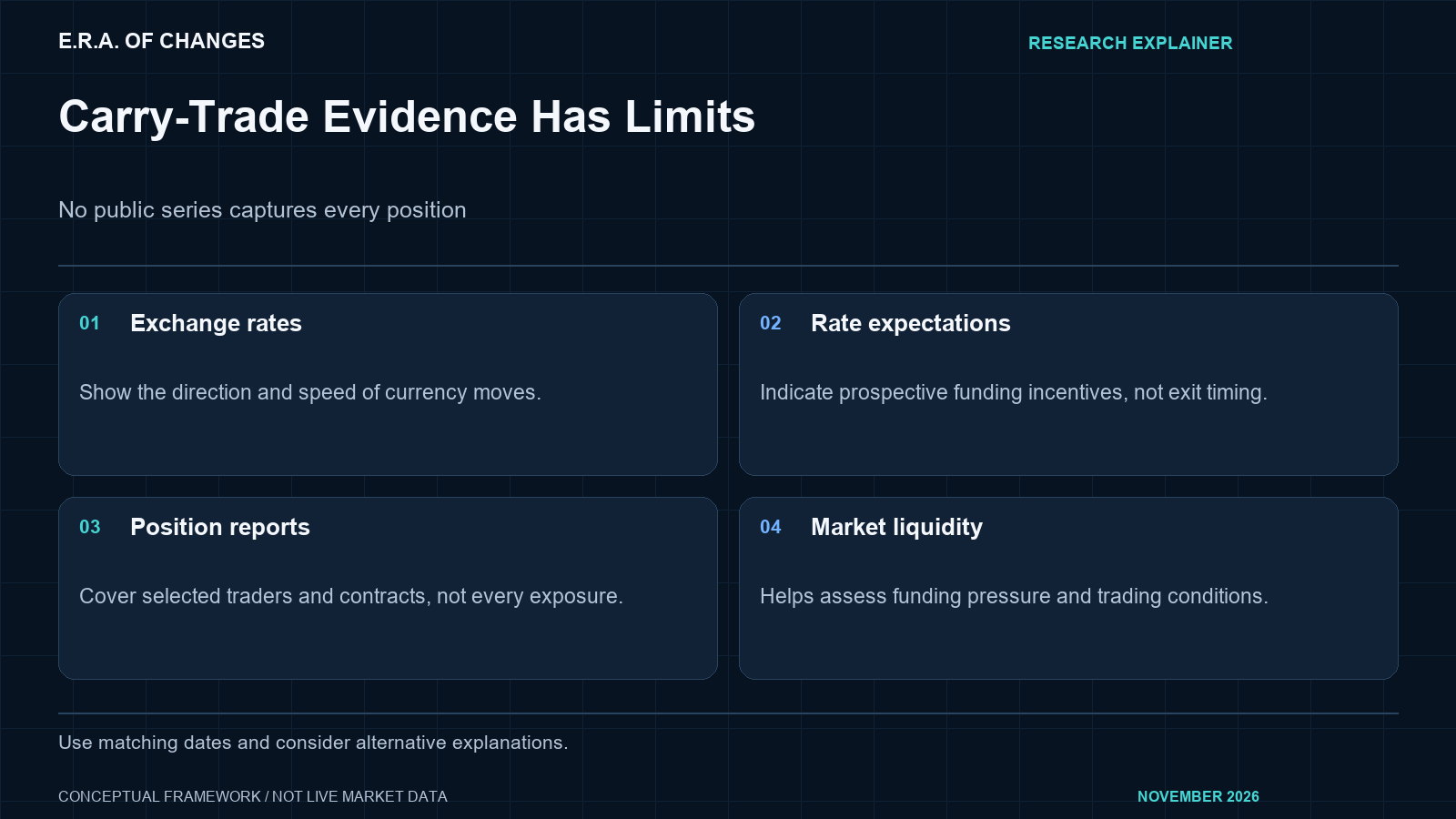
| Indicator | What it can help assess | What it cannot prove alone |
|---|---|---|
| Yen exchange rates | The direction and pace of currency moves | The size of all carry positions |
| Policy-rate expectations | Changes in prospective financing incentives | The timing of forced selling |
| Volatility and funding conditions | Whether risk and funding pressure are rising | Which strategy caused each trade |
| Published positioning data | Changes in covered market participants' positions | Every position across banks and derivatives |
A numerical example: income is not the whole return
Suppose a hypothetical investor borrows ¥15 million and converts it at ¥150 per dollar, obtaining $100,000 before transaction costs. If the yen later strengthens to ¥135 per dollar, repaying the same ¥15 million principal requires about $111,111. That is roughly $11,111 more before interest, hedging, collateral and taxes. Any return on the purchased asset would need to be considered against that extra cost.
This is a simplified illustration, not a prediction or a complete profit-and-loss calculation. The actual exchange rate, financing terms, investment return and whether the position is hedged can change the result. The calculation also assumes the yen principal is unchanged and ignores interim cash flows. A weakening yen can work in the other direction, but it is no guarantee that the purchased asset will gain.
Leverage changes the investor's capacity to tolerate the path. An adverse move can lead to a margin call even if the position might later recover. When risk limits are triggered across many participants, trades that seemed independent can become correlated through the need to raise cash or reduce exposure.
Why the 2024 episode is a case study, not a forecast
The IMF's 2024 stability analysis likewise discusses the episode and the challenge of measuring aggregate carry positions. The case illustrates a transmission mechanism; it does not establish that every subsequent yen move will have the same scale or consequences.
Several shocks can arrive at once. A change in Japanese policy expectations, weaker US data and a decline in a popular investment can affect both legs of a carry trade. It is therefore difficult to assign a precise percentage of a market move to a single strategy without position-level evidence. Even sophisticated market-wide estimates are approximations.
Which data can improve the assessment?
Rate expectations and funding terms. Compare relevant interest-rate expectations over the life of a position, not just today's overnight rates. A narrowing differential changes the prospective carry but does not tell us exactly when an investor will close a trade.
Exchange-rate volatility. Expected currency volatility matters because a large move can exceed the interest differential. The cost of hedging and the investor's ability to fund collateral can matter as much as the quoted rate gap.
Positioning, with coverage limits. The CFTC's Commitments of Traders reports provide categorized data for covered futures markets. They are not a census of all global yen funding, and the CFTC notes that it does not know the specific reason for each trader's position. A net short futures position alone does not prove a carry trade.
The investment side of the trade. Ask which assets investors hold, how liquid those markets are and whether a move is affecting funding, asset prices or both. A selloff in one asset can stem from its own earnings or valuation news rather than a currency unwind.
Hedged versus unhedged: the trade-off changes
An investor may use a forward or another derivative to reduce a currency mismatch. That can make the payoff less sensitive to a yen appreciation over the hedge period, but the hedge has a cost and may require collateral. It can expire before the underlying investment is sold or be imperfectly sized. Comparing the yield on a foreign asset with the yen borrowing rate while ignoring hedging costs can therefore overstate the expected carry.
A different investor may leave the exposure open because the expected return looks higher. That investor bears more exchange-rate risk. Neither approach removes the risk that the foreign asset loses value, nor does a hedge guarantee that a counterparty will perform under every condition.
This distinction helps explain why not all cross-border holdings respond at once. A long-term institution with liabilities and a planned hedge may have a different horizon from a leveraged fund operating under tight margin limits. Grouping both under a single “yen carry” number can create a false sense of precision.
A practical monitoring sequence
Begin with an observable change, such as a rapid yen move or a shift in expected rates. Then examine whether covered futures positioning changed, whether volatility and financing costs moved, and whether exposed asset markets were also under pressure. Record the date and coverage of each observation. If the evidence points in different directions, say so rather than forcing it into a single narrative.
Finally, identify an alternative explanation. An equity selloff following a currency move may also reflect company earnings, changes in US rates or unrelated geopolitical news. The hypothesis becomes stronger when independent pieces of evidence line up; it never becomes a mathematical certainty from one chart.
For wider context, see our discussion of global inflation trends, the mechanisms behind currency crises, and the distinct drivers of emerging-market currencies. Historical observations and prior forecasts in those articles relate to their stated periods.
The separate guide to Fed liquidity, the Treasury account and reverse repo explains US balance-sheet mechanics; it should not be treated as a direct measure of yen carry positions.
Frequently asked questions
Does a stronger yen always cause a global selloff?
No. The effect depends on the size and leverage of exposed positions, the speed of the move and other market conditions. Currencies can strengthen for many reasons.
Can investors know the exact size of the carry trade?
Not from one public series. Different instruments and participants are recorded in different datasets, and borrowing in yen does not reveal every borrower's purpose.
Does a Bank of Japan rate change automatically unwind carry trades?
No. The effect depends on market expectations, rates elsewhere, hedging costs, leverage and the exchange rate. An anticipated change may already be reflected in prices.
Does hedging eliminate every carry-trade risk?
No. A hedge can reduce a specified currency exposure but introduces its own costs and terms. The investment asset, funding and collateral can still create losses.
Putting carry-trade risk in context
Carry trades connect yen funding to assets far from Japan. Their vulnerability lies not in the interest-rate gap alone, but in its interaction with currency exposure, leverage, liquidity and crowded positions. Because total exposure is difficult to measure, no single indicator can provide the full picture.
Sources
- BIS: Carry Off, Carry On.
- IMF: Global Financial Stability Report, October 2024.
- CFTC: Commitments of Traders Reports and FAQs.
Explore financial-market research for broader analysis of currencies and funding conditions.
This article is for informational and educational purposes only and is not investment advice.