Prepared by: E.R.A. OF CHANGES Editorial Team
Reviewed by: Nikolai Fainizky, CEO & Senior Analyst, E.R.A. OF CHANGES
A corporate debt maturity wall is a concentration of loans and bonds coming due within a relatively short period. The phrase sounds alarming, but the size of the wall alone does not tell us whether a crisis is coming. A borrower that can repay with cash or issue affordable new debt faces a different problem from one with weak income, a falling asset value and limited access to lenders.
The risk lies in the gap between the money a borrower needs when debt matures and the financing available on acceptable terms. That gap can appear gradually, years after interest rates have changed. As a result, the market may look stable while refinancing pressure is building.
Why maturity is different from interest cost
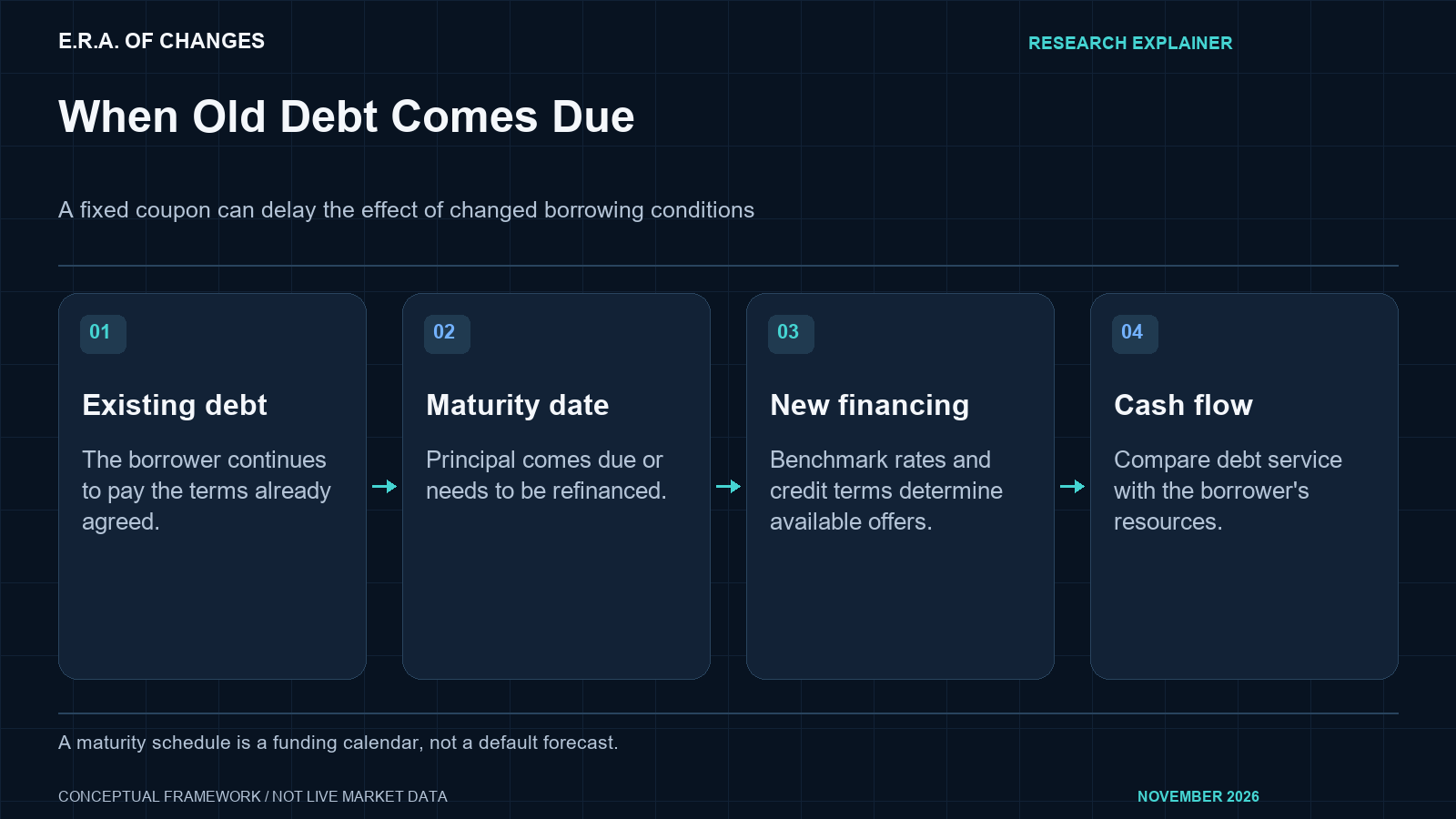
A company with fixed-rate debt may continue paying its original coupon even after market rates rise. Its immediate interest bill does not necessarily change. But when that debt comes due, the company may need to refinance at a different benchmark rate, a different credit spread, or both.
Consider a hypothetical company with $100 million of fixed-rate debt. At a 4% annual coupon, its annual interest cost is $4 million. If it replaces the same amount at 7%, the simple annual interest cost becomes $7 million, before fees and other debt changes. This example is not a forecast. The actual outcome depends on the borrower's finances, loan terms, payment schedule and market conditions.
Refinancing risk is the possibility that the borrower cannot replace debt on reasonable terms when it needs to. The US Office of the Comptroller of the Currency identifies loans with substantial balances remaining at maturity, including some commercial real-estate and leveraged loans, as particularly exposed to that risk.
What turns a maturity wall into a problem?
The 2008 financial crisis illustrates why the calendar must be read alongside access to credit. In its April 2009 stability report, the IMF warned that wide spreads could make refinancing difficult, especially for smaller and lower-quality companies. It expected high-yield borrowers to need to refinance nearly 50% more debt in 2009 than in 2008 and identified additional pressure from 2011 onward as debt from the 2005–07 leveraged-buyout boom matured. Those were contemporaneous projections, not a tally of subsequent defaults.
The distinction matters: debt did not become unpayable simply because it appeared on a maturity schedule. The risk came from the intersection of a future funding need, weaker borrower cash flows and disrupted markets. When assessing another period, check whether refinancing has already shifted the calendar, whether lenders are available and what portion of the debt belongs to vulnerable borrowers.
1. The maturity schedule
The amount due next year matters differently from an identical amount spread across a decade. Analysts also need to distinguish debt outstanding from debt that must actually be replaced. Cash reserves, asset sales, amortization and previously arranged funding can reduce the requirement.
2. The borrower's ability to service debt
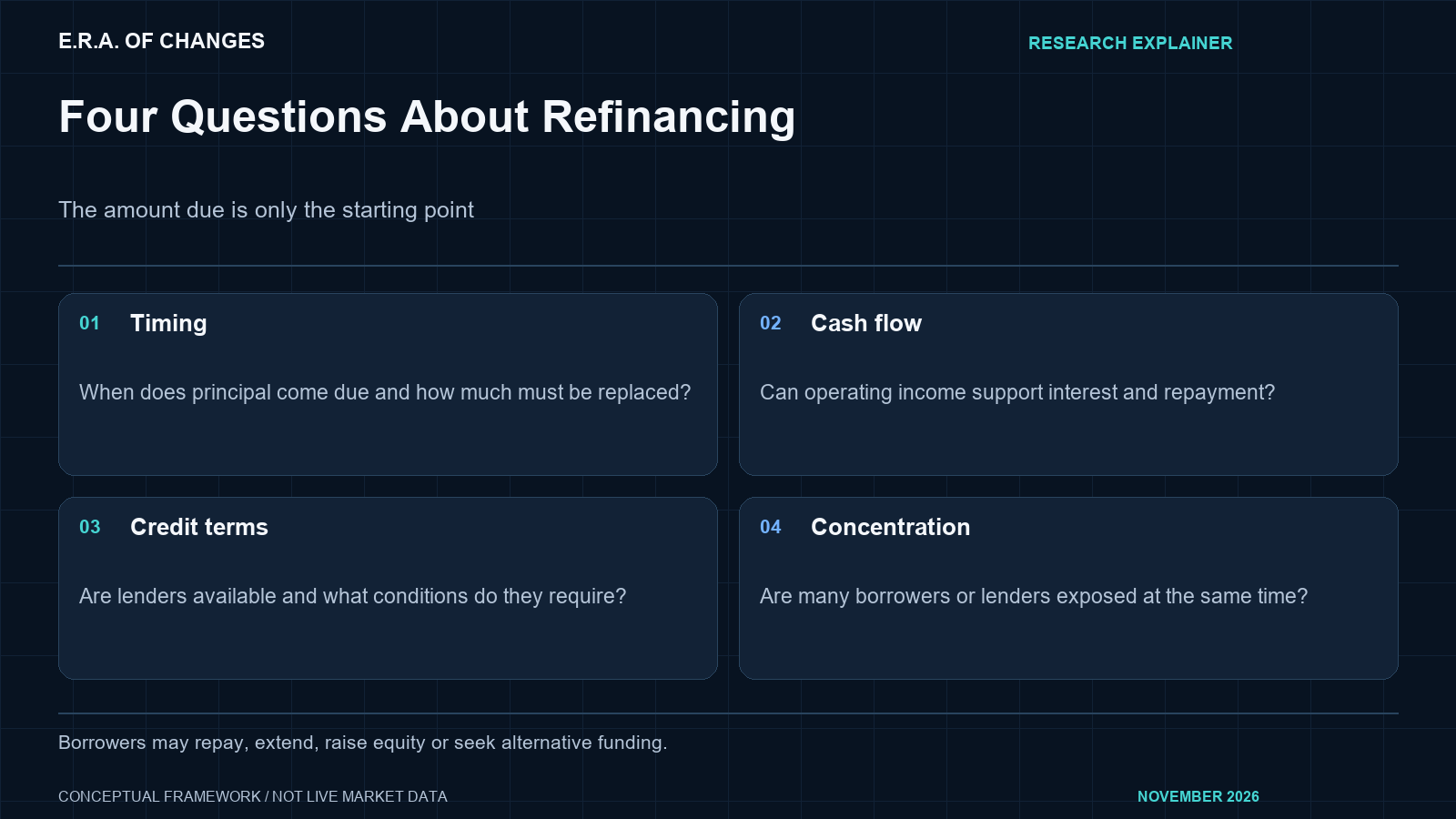
Revenue is not the same as cash available to pay interest. A useful review considers operating cash flow, capital spending, debt service and liquidity. Interest coverage can deteriorate because borrowing costs rise, because earnings fall, or because both happen together. A single ratio is not sufficient: definitions and accounting choices differ.
3. The state of credit markets
The benchmark rate is only part of the borrowing cost. Lenders may demand a wider credit spread, stronger covenants, collateral or a shorter maturity. In stressed markets, funding can become less available altogether. Our article on financial stress indicators explains why market prices and financing conditions need to be read together.
4. Concentration and timing
A single borrower with maturing debt is not automatically a systemic issue. Risks become broader when many exposed borrowers face the same deadline, use the same lenders or depend on the same collateral market. That does not mean every refinancing will fail; it means the financial system has less room for a shared shock.
Why commercial real estate deserves separate attention
In an earlier assessment of recession risk, Nikolai Fainizky highlighted refinancing pressure in corporate debt and commercial real estate as a possible channel of broader stress. Maturing loans can coincide with tighter lending conditions: higher financing costs or lower property values may limit what lenders offer.
This is a risk to investigate, not a finding that those conditions are present for every borrower today. The test is whether a particular loan's maturity, property cash flow, collateral value and available financing leave a gap. An extension, an equity contribution or a sale may change the outcome.
Commercial property loans may have a substantial principal payment at maturity even though the asset is expected to produce income for much longer. At refinancing, lenders may reassess property value, occupancy, rental income, debt service and loan-to-value ratios. If the value is lower or interest expense is higher, the borrower may need to contribute additional equity or negotiate new terms.
The impact varies by building, market, lender and loan structure. An office property facing sustained vacancy has a different risk profile from a well-let asset with a strong borrower. Extensions can give time for an adjustment, but an extension is not the same thing as eliminating the underlying risk. An IMF discussion of US commercial property illustrates the interaction of refinancing needs, property values and lending; its figures refer to the period of that 2024 analysis.
How could problems spread?
The transmission path is conditional:
- A borrower faces more expensive or unavailable refinancing.
- It cuts spending, sells assets, restructures or misses payments.
- Lenders and investors reassess expected losses and collateral values.
- If losses are sufficiently broad, lending conditions can tighten for other borrowers.
That chain can stop at any stage. Strong cash buffers, new equity, better earnings or orderly workouts can contain losses. Conversely, a downturn that weakens many borrowers at once can make the process harder to absorb.
Reading a company's maturity schedule
Start with the company's own filings and debt notes. A schedule may separate secured and unsecured obligations, bonds, bank loans, revolving facilities and leases. Those instruments can have different collateral, covenants and renewal conditions. A revolving facility may be available today but subject to limits or a maturity date; it should not be counted as unrestricted cash without checking its terms.
Next distinguish gross maturities from the amount that genuinely needs to be replaced. A company may have cash it can use for repayment, but some cash may be required for operations, held in a restricted entity or needed for another obligation. Asset sales could raise funds, although the eventual proceeds depend on the buyer, timing and market. Netting every dollar of cash against near-term debt without these distinctions can understate the problem.
The same schedule can look very different under two interest-rate paths. If the borrower can refinance at a modestly higher rate and earnings remain stable, coverage may remain comfortable. If rates, spreads and operating costs rise while revenue falls, the same debt balance can be much harder to service. Comparing these scenarios is more informative than declaring the maturity date itself a crisis trigger.
Fixed-rate, floating-rate and amortizing debt
Floating-rate borrowers can feel changes in a reference rate before maturity, subject to the terms of any hedges or rate floors. Fixed-rate borrowers may be insulated temporarily, but the eventual refinancing may reset a large portion of their interest bill at once. A hedge can reduce a specific interest-rate exposure and still expire before the debt does.
Fully amortizing loans repay principal over their term, while a loan with a large balloon payment leaves a greater amount to refinance at maturity. This difference is central to the OCC's refinancing guidance. The type of facility matters as much as the headline maturity year.
From property values to bank balance sheets
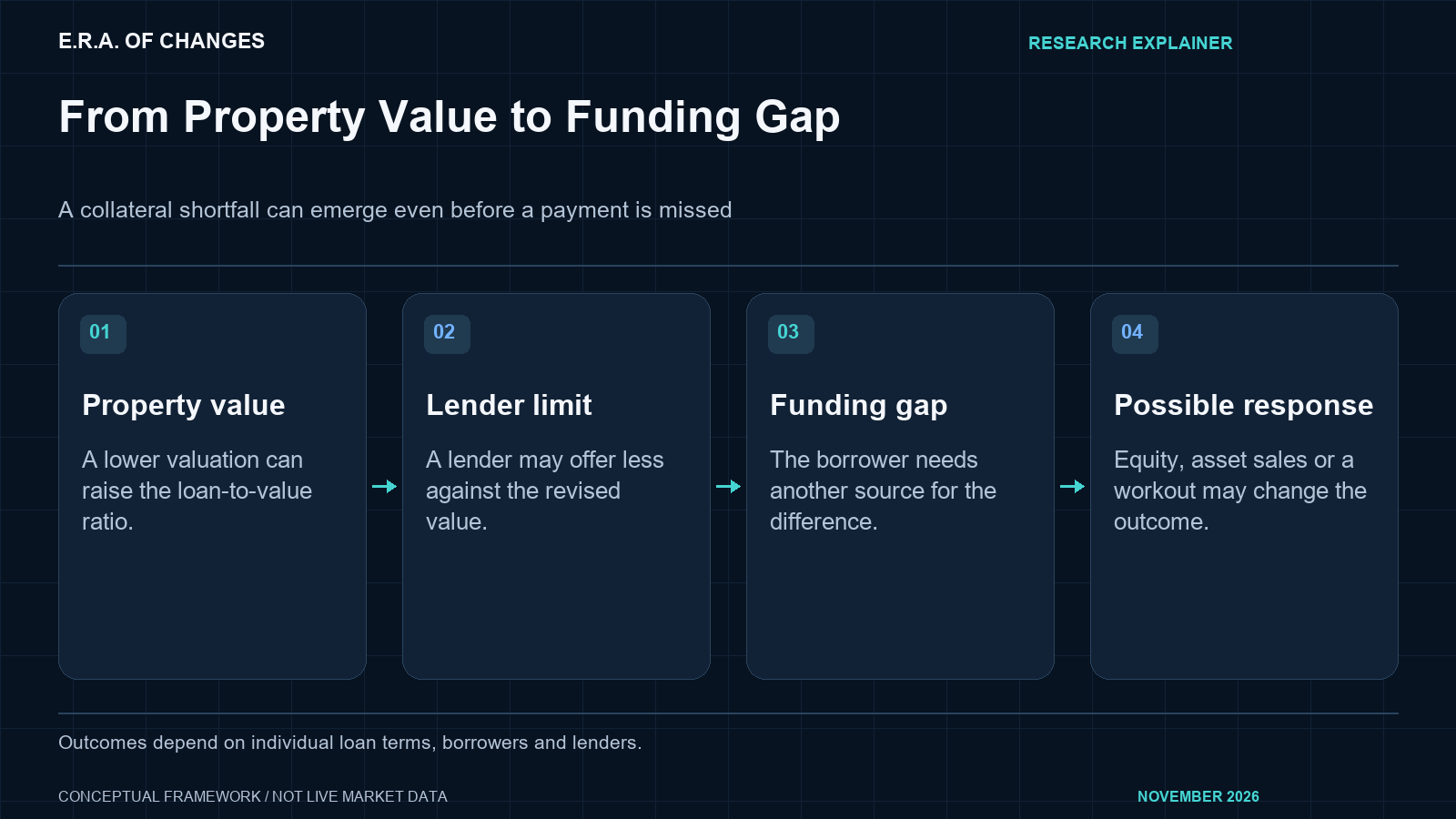
Imagine a property originally financed with a loan of $60 against a value of $100. Its initial loan-to-value ratio is 60%. If the loan balance remains $60 and the property is later valued at $75, the ratio rises to 80%. The calculation is hypothetical and excludes fees and amortization. A lender applying a 60% maximum to the new valuation would lend $45, leaving a $15 financing gap before transaction costs.
That gap need not result in default: the borrower might contribute equity, sell another asset, agree to a workout or find alternative financing. But each route has conditions, and several borrowers attempting the same solution can put pressure on prices. Higher interest expense can create a separate debt-service problem even if the collateral value is unchanged.
Bank exposure must also be evaluated relative to capital, reserves, loan diversification and collateral. The Federal Reserve's financial stability reports assess vulnerabilities across borrowing, leverage and funding. A single troubled property is not evidence that an entire banking system is insolvent.
The distribution across lenders matters as much as the national total. A Federal Reserve research note on local deposits and commercial-property lending examines how local property-market conditions and local bank funding can be connected. Its analysis highlights a potential regional vulnerability, not a conclusion that all property loans or community banks face the same outcome.
Distinguishing an extension from a cure
When a borrower cannot refinance on the original schedule, a lender may extend the maturity or modify terms. An extension can be a sensible workout when the underlying business remains viable and the parties have a credible plan. It can also delay recognition of an unresolved shortfall. The difference depends on updated cash-flow assumptions, collateral, the borrower's contribution and the likelihood of repayment under the new schedule.
For an investor examining a lender, ask how exposures are classified and disclosed, whether reserves reflect the relevant risks, and whether a substantial number of loans depend on optimistic refinancing assumptions. Accounting and regulatory treatment vary, and an extension alone is not proof of concealment or of a future loss.
At the borrower level, distinguish a temporary liquidity issue from a structural shortfall. A company waiting for a receivable faces a different problem from one whose operating earnings cannot cover sustainable interest expense. Both can become serious if funding is unavailable, but the remedy and time horizon differ.
How to compare a company with the market
Market-wide spreads can change faster than a borrower's accounting data; company filings give detail but arrive less frequently. Compare both. A widening spread may indicate that the market is pricing greater risk, while an individual company could still have years before its next large maturity. Conversely, a company may face an immediate refinancing need even when a broad index looks calm.
Watch for a deterioration in available funding, interest coverage and management's refinancing plan together. If one measure worsens but the others remain sound, examine alternative explanations before concluding that a default is imminent. The guide to leading indicators places such evidence within a broader economic framework.
A practical framework for reading the risk
| Question | Why it matters |
|---|---|
| When does the debt mature? | It identifies the period when funding is needed. |
| Is the debt fixed or floating? | Floating-rate borrowers may feel changes sooner. |
| Can the borrower cover interest and principal? | Debt service depends on cash flow, not just the debt balance. |
| What collateral and lender exposure are involved? | Losses can be concentrated in particular assets or institutions. |
| Are funding markets open? | The rate and availability of replacement capital can change together. |
Corporate refinancing and commercial real estate are potential channels through which tighter conditions can reach the economy, not evidence that a specific default or recession is certain. Our recession probability analysis and global debt risks overview provide broader context; date-specific figures in those articles should be read for their stated periods.
For the market-price side of refinancing conditions, see our guide to high-yield credit spreads.
Frequently asked questions
Does a maturity wall mean companies must default?
No. Borrowers may repay debt, refinance, raise equity or negotiate an extension. The risk depends on their ability to do so and the conditions available at maturity.
Why can fixed-rate borrowers be affected after rates rise?
Their existing coupon may remain fixed until maturity, but replacement debt is priced under the conditions prevailing when they refinance. The effect can therefore appear with a delay.
Can a company refinance before maturity?
Often it can, subject to the contract, lender consent and market conditions. Early repayment fees, call provisions and the availability of new financing can affect that choice.
Is a large maturity wall always worse than a small one?
Not without context. Compare the amount with borrowers' cash resources, debt-service capacity, lender exposure and the period over which financing is required.
What makes refinancing risk serious?
The maturity wall is best understood as a calendar of financing needs, not a prediction. To assess it, combine the timing of maturities with total borrowing costs, cash flow, lender exposure and the condition of credit markets. The most important risk is not that debt exists, but that too many borrowers need new financing at the same time under conditions they cannot meet.
Sources
- OCC: Commercial Lending and Refinance Risk.
- IMF: US Commercial Real Estate Risk.
- Federal Reserve: Financial Stability Reports.
- Federal Reserve: Local Deposits and Commercial Real Estate Lending.
- IMF: Global Financial Stability Report, April 2009.
Explore financial-market research for related analysis.
This article is for informational and educational purposes only and is not investment advice.