Prepared by: E.R.A. OF CHANGES Editorial Team
Reviewed by: Nikolai Fainizky, CEO & Senior Analyst, E.R.A. OF CHANGES
A large inflow into a spot Bitcoin exchange-traded product is often interpreted as a wave of investors betting that Bitcoin will rise. Some buyers do want directional exposure. Others may hold the product as one part of a hedged trade, paired with a short futures position. The flow number alone cannot tell us which motive dominates.
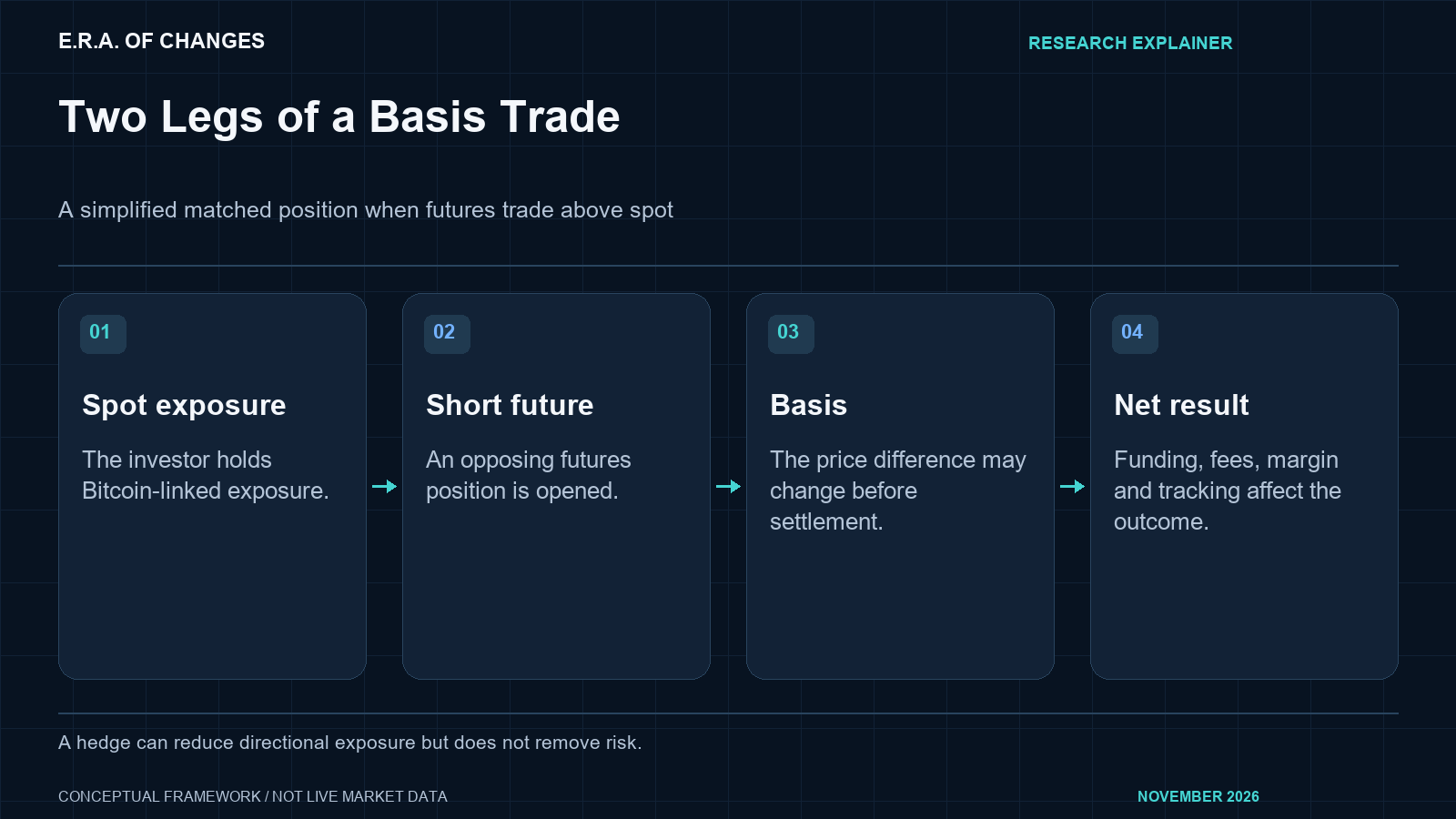
The basis trade is one reason the distinction matters. It seeks to capture a difference between spot-linked exposure and a futures price. Although the positions are designed to offset much of the exposure to Bitcoin's direction, the trade still carries funding, collateral, execution and tracking risks.
What is the basis?
In this context, the basis is the difference between a futures price and a comparable spot reference. If a futures contract trades above spot, the difference is positive. Analysts may annualize it to compare contracts with different times to expiration, but that annualized figure is not a guaranteed annual return.
As a simplified illustration, suppose spot-linked Bitcoin exposure costs $100 and a comparable futures contract is priced at $102 for a later settlement date. A trader buys the spot-linked exposure and sells the future. If the two prices converge exactly at settlement and the exposures match, the initial difference may be captured before costs. The figures are hypothetical and do not describe an available trade.
This simplified example excludes fees, financing, margin, taxes, product expenses and mismatches between the ETF and futures settlement reference. Those details can determine whether a real trade is profitable. More importantly, the investor must be able to maintain both positions until they are closed or settled.
Why use a spot Bitcoin ETF as one leg?
For some institutional participants, a spot Bitcoin exchange-traded product offers a way to obtain exposure through securities-market infrastructure. A trader can pair that long exposure with a short Bitcoin futures position. CME Group's discussion of spot ETFs and basis trading describes this structure and the growth in related institutional activity after spot-product launches. CME operates futures markets, so its discussion is also a market participant's perspective, not evidence that every ETF purchase is a basis trade.
US spot Bitcoin products can have different legal structures and operational terms. Buying an existing ETF share from another investor is not the same as creating a new share, and a creation does not reveal whether its ultimate owner also holds a futures hedge. Our Bitcoin ETF flows guide explains the distinction between secondary-market trading, creations and Bitcoin sourcing.
The Federal Reserve Bank of New York's analysis of Bitcoin exchange-traded products also examines trading costs and liquidity around the introduction of US spot products. Its observations concern the period of that study, not a current measure of the basis trade.
If Bitcoin rises or falls, what happens?
In a near-matched position, a rise in the spot-linked holding may be offset by a loss on the short future. If Bitcoin falls, a gain on the short future may offset a loss on the long holding. That is the intended hedge; real results depend on how closely the legs track and when they are entered and exited.
Futures contract specifications and settlement conventions also differ. CME's introduction to Bitcoin futures describes its cash-settled contract and reference rate; an ETF's own documents determine its separate benchmark and operating terms.
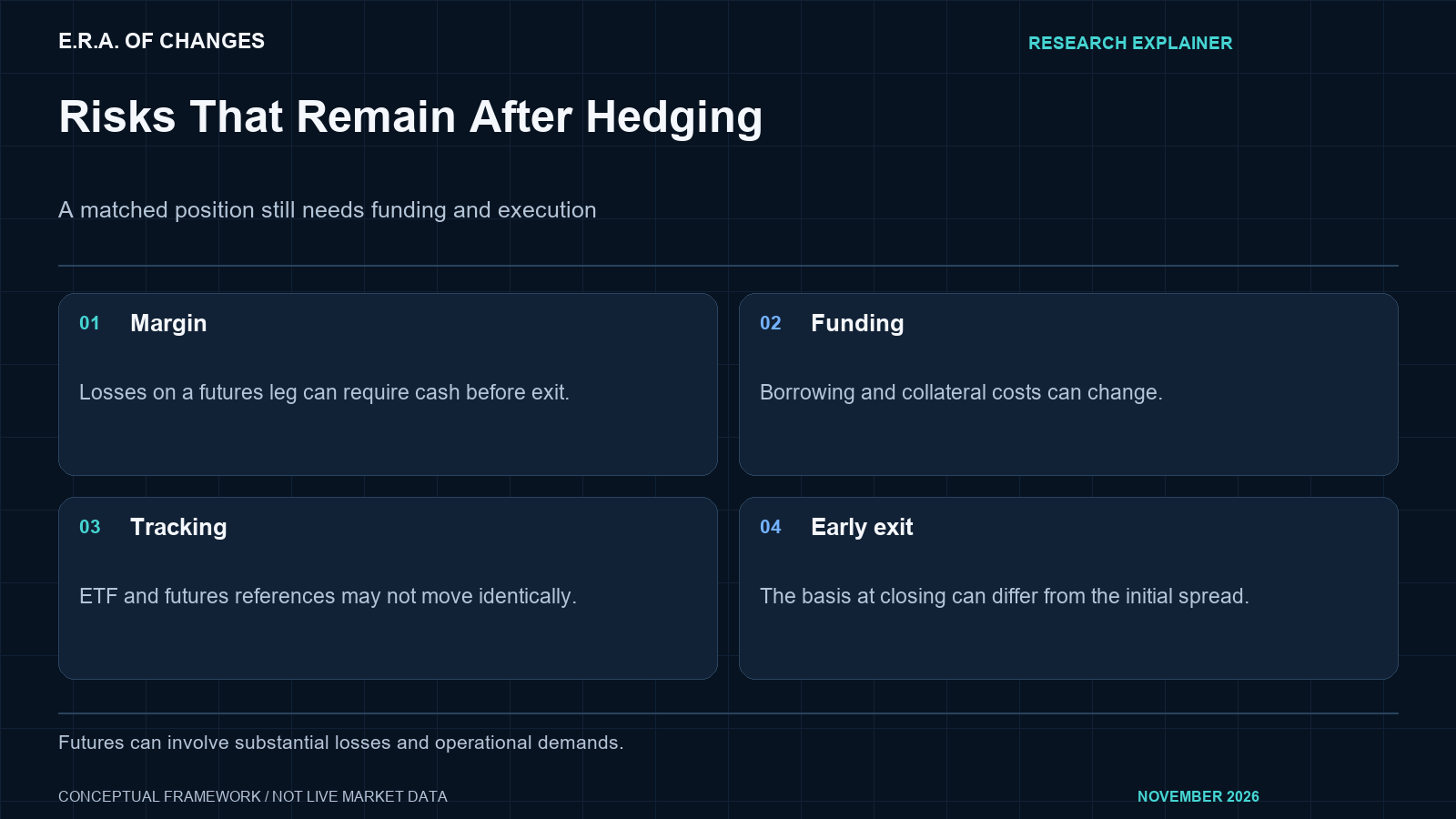
The position is not risk-free:
- Margin and liquidity: a losing futures leg can require cash before a gain on the other leg is realized.
- Funding and leverage: borrowing costs can change and lenders can tighten terms.
- Tracking and timing: ETF shares, net asset value, spot prices and futures settlement can differ, especially across trading hours.
- Execution: bid-ask spreads, market impact, fees and imperfect position sizing can reduce or eliminate the expected return.
- Early exit or roll: closing before expiration or replacing a contract introduces a new basis and new execution risk.
A hypothetical trade at settlement
Suppose an investor buys $100,000 of spot-linked Bitcoin exposure and sells an equivalent future for $102,000. At expiry, imagine that both are priced at $105,000: the long exposure has gained $5,000, while the short future has lost $3,000, leaving a $2,000 gross difference. If both instead settle at $90,000, the long has lost $10,000 and the short future has gained $12,000, again leaving $2,000 before costs.
The numbers show the idealized arithmetic, not a trading recommendation or guaranteed outcome. The positions must be matched, the investor must hold both through settlement, and the ETF must track the relevant reference closely. Financing, fund expenses, exchange fees, spreads, taxes and margin costs reduce the gross result. The future can be cash-settled while the ETF remains a separate security, so proceeds from one leg do not automatically fund every obligation on the other.
The path can matter as much as the ending
If Bitcoin rises sharply before expiry, the short futures leg may generate variation-margin payments. The long ETF may have gained value, but that gain is not necessarily available as cash unless it is sold or financed. An investor lacking sufficient liquidity may be forced to close the position early, potentially before convergence and at an unfavorable basis.
The reverse can also present operational problems: the long ETF can fall, collateral terms can change and the fund can trade at a discount or premium to its net asset value. The CME's futures risk disclosure notes the role of leverage in amplifying risk. A hedge of price direction does not remove the need to fund the trade.
Why ETF share creation and a futures short are different observations
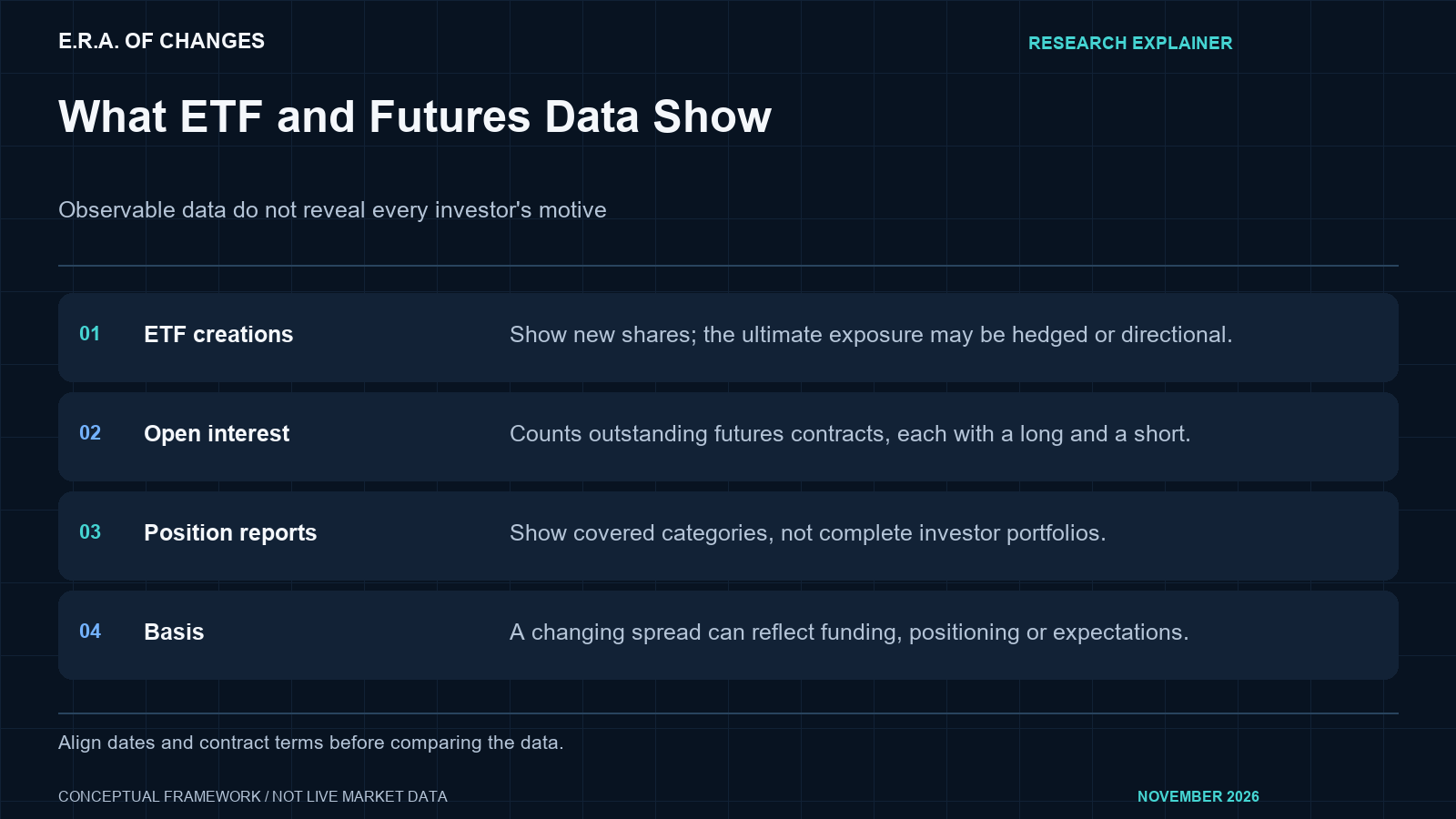
An exchange-traded product's creation data describe shares entering the fund's primary-market process. They do not report the complete portfolio of the eventual buyer. A market maker may also hedge temporarily while handling orders and later adjust that hedge. A short futures position can serve several purposes, including offsetting exposure held elsewhere or expressing a market view.
The CFTC's Commitments of Traders explanation explicitly notes that published trader categories do not reveal the specific reason for each position. A change in reported leveraged-fund shorts may therefore be consistent with basis activity without measuring the exact dollar amount of ETF hedging. Timing matters too: a weekly positioning report and a daily ETF-flow figure cover different snapshots.
What the post-launch data actually show
The SEC approved the listing and trading of US spot Bitcoin ETP shares on January 10, 2024. That decision created an additional exchange-listed way to obtain spot-linked exposure; it did not reveal whether subsequent buyers were directional investors or hedged traders. The distinction matters because a new vehicle can serve several investor types at once. The SEC's approval statement also makes clear that approval of the products was not an endorsement of Bitcoin itself.
In a November 2025 study, CME Group reported that Bitcoin futures open interest rose from roughly 30,000 contracts in early 2024 to 45,000 in November 2024, then eased to the low 30,000s by May 2025. It also observed increased net short positioning by leveraged funds after the ETP launch. Those are historical figures from an exchange that operates the market, not current readings. CME presents the pattern as consistent with increased basis trading; public positioning data alone do not show the corresponding ETF holdings of each trader.
That distinction changes how an analyst should read a headline. Rising futures open interest means more contracts remain open, with a long and short for every contract; it does not by itself identify the net direction of all market participants. Even if reported shorts and ETF holdings rise over the same period, an analyst would need investor-level position data to establish how much belongs to the same hedged portfolio. Comparing a weekly positioning snapshot with daily flow numbers without aligning their dates can create a false impression of precision.
From gross basis to an economic return
Suppose a three-month futures contract trades 2% above matched spot exposure. That is a gross difference over three months, not a 2% return after costs and not a promise that the spread can be repeated four times. If, purely for illustration, financing and other holding costs total 1.2% of the initial exposure over that period and execution and product costs add another 0.3%, the remaining gross-to-net difference is about 0.5% before taxes and any tracking or early-exit loss. Actual costs and the capital required to support margin vary by participant.
The return on capital is a separate calculation. A leveraged trader and an unleveraged investor may commit different amounts of capital and face different funding and liquidation risks for an otherwise similar position. Annualizing the starting basis without specifying the holding period, costs and capital denominator can make a trade appear more attractive than its realized result. The example assumes successful settlement and is not a quote or a recommendation.
Three different interpretations of the same inflow
Imagine an ETP reports a large net creation on the same day Bitcoin rises. A directional buyer could have increased long exposure. An institution might instead have added a long ETP position and sold futures to capture a basis. A market intermediary could have created shares while managing client orders and its own inventory. Each explanation can coexist with the others; the creation figure does not disclose the proportions.
The next step is to compare evidence rather than choose the most convenient story: examine the product's creations and redemptions, futures basis by expiry, changes in open interest and positioning reports, making sure the periods and contract units align. A narrowing basis, lower futures open interest and ETP outflows could be consistent with some positions being unwound, but they would still not prove that the same investors caused every move. Conversely, a rise in ETP inflows without a comparable futures change does not prove that all buyers are unhedged.
Comparing a basis trade with a directional position
| Position | Main intended exposure | A risk that remains |
|---|---|---|
| Long spot-linked ETF only | Bitcoin price direction, subject to fund tracking and costs | A Bitcoin decline and product-specific frictions. |
| Long ETF and short matched future | The difference between the two legs rather than full directional exposure | Margin calls, basis movement and imperfect matching. |
| Short future without a matching long | Negative directional exposure to the futures reference | Potentially substantial losses if the reference rises. |
These are simplified descriptions, not an inventory of all strategies. Different contracts settle against different reference rates and at different times. Comparing prices without matching the contract's expiry, unit and settlement methodology can produce a misleading apparent basis.
What happens if the trader exits before expiry?
The initial spread is not automatically earned the moment the trade is opened. If the investor closes both legs early, the realized result depends on the basis at exit, costs incurred and any mismatch between the ETF and the futures reference. A wider basis can produce a mark-to-market loss for a long-spot/short-futures position even if the initial spread looked attractive.
Rolling into a later contract is a new transaction at then-current prices. A trader cannot assume that the previous spread, liquidity or financing cost will continue. Holidays, weekends and different trading hours can also make it harder to adjust both legs at the same time. These frictions are especially important during volatile markets.
For an observer of ETF flows, the distinction matters because a hedged position may be opened, resized or closed for reasons unrelated to a long-term bullish view. The data can support several hypotheses; they do not identify a trader's exact motive without additional evidence.
What can ETF flows and futures positioning tell us?
Net creations in an ETF show a change in shares outstanding. Futures open interest shows outstanding contracts under the exchange's reporting conventions. Positioning reports can describe exposures for covered participant categories. Together, these data provide context; none automatically identifies the full strategy of every investor.
For example, higher ETF inflows alongside increased futures open interest may be consistent with additional hedging or basis activity. It may also reflect unrelated directional trades or other strategies. A credible assessment needs matched dates, product coverage and an understanding of what each data series measures.
Nikolai Fainizky previously noted that some institutional ETF exposure may be paired with futures hedges. That is a reason to interpret flows carefully, not a verified statement that a particular share of today's inflows comes from basis trades.
In earlier answers, he also highlighted CME open interest and the futures premium as indicators to consider alongside ETF activity. They can help frame competing explanations, but neither identifies the complete portfolio of an ETF holder. A stronger reading compares contract maturities and reporting dates and asks whether the pattern could also reflect directional trading or unrelated hedges.
A practical reading framework
| Observation | Possible explanation | What remains unknown |
|---|---|---|
| ETF creations increase | Demand for new shares or intermediary inventory management | Whether the final exposure is directional or hedged. |
| Futures open interest rises | More contracts remain outstanding | Whether the position is a basis trade, a hedge or a directional trade. |
| The futures basis changes | Financing, positioning or expectations have shifted | Which factor caused the entire move. |
| Bitcoin's price rises | Buyers and sellers transacted at higher prices | The separate contribution of ETF flows. |
How this fits the wider Bitcoin market
The basis trade is one mechanism, not a replacement for analyzing liquidity, adoption or supply. See our Bitcoin ETF adoption report for the wider investor base and Bitcoin market drivers for a broader market discussion. The latter is an existing article; any dated forecasts or figures in it should be read in their original context.
Frequently asked questions
Does every ETF inflow represent a basis trade?
No. Investors use spot Bitcoin products for different purposes. Fund-flow data do not identify each investor's separate futures positions.
Is a hedged basis trade risk-free?
No. A hedge can reduce directional exposure but does not remove margin, funding, tracking, execution or early-exit risk.
Does higher futures open interest prove institutions are buying Bitcoin?
No. Open interest counts outstanding contracts, not a single directional motive. A short future can hedge another position or express a separate view.
Is the ETF share price always equal to its net asset value?
No. ETF shares trade in the market and can trade at a premium or discount. The size and persistence of any difference vary with liquidity and market conditions.
Reading ETF demand in context
ETF inflows can matter to the market even when some buyers hedge their exposure. A basis trade shows why the flow figure alone does not reveal investors' motives. Read it alongside financing conditions, futures positions and other available evidence before drawing conclusions about demand.
Sources
- CME Group: Spot ETFs and Crypto Basis Trading.
- CME Group: Bitcoin Futures.
- CFTC: Commitments of Traders Reports and FAQs.
- New York Fed: Bitcoin Exchange-Traded Products and Liquidity.
- SEC: Statement on Approval of Spot Bitcoin ETPs, January 2024.
Explore crypto-market analysis for related research.
This article is educational and is not a recommendation to use leverage, futures or any trading strategy. Derivatives can cause substantial losses.