Prepared by: E.R.A. OF CHANGES Editorial Team
Reviewed by: Nikolai Fainizky, CEO & Senior Analyst, E.R.A. OF CHANGES
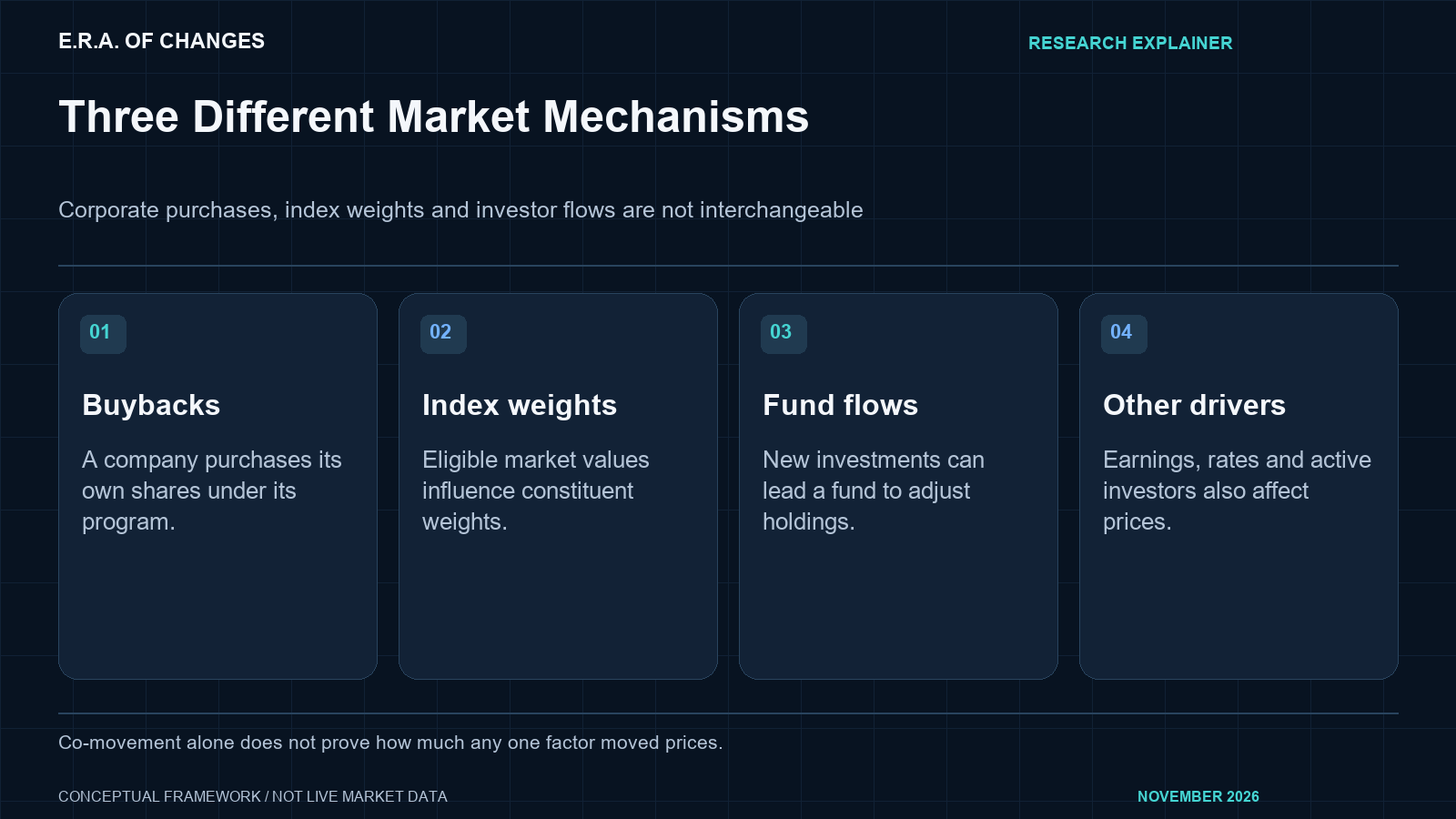
A market index can rise while a small group of companies accounts for a large share of its value. At the same time, corporations may repurchase shares and investors may allocate money to index funds. These forces can interact, but they are not the same thing, and none proves that an index is destined to fall.
Corporate share purchases, index weights and investor flows into funds have different causes and effects. Looking at them together helps explain why a portfolio that appears diversified can still depend heavily on a small number of companies or themes.
What does a share buyback do?
In a buyback, a company purchases its own shares. Depending on the jurisdiction and the transaction, shares may be retired or held in treasury. If the number of shares outstanding falls and other things remain equal, earnings per share can rise even when aggregate earnings do not. “Other things equal” is important: the price paid, financing, dilution from compensation and future operating performance all matter.
Buybacks can return capital to shareholders or offset dilution. They can also consume cash or increase leverage if financed with borrowing. A company repurchasing shares is not proof that its stock is undervalued, and a buyback does not guarantee a rising price.
How does index concentration arise?
In a market-capitalization-weighted index, a constituent's weight broadly reflects its eligible market value relative to the rest of the index, subject to the index provider's rules. Companies that become larger can represent a greater share of the benchmark. An index with hundreds of constituents can therefore still be substantially influenced by the largest members.
Concentration is not automatically a defect. Large companies may have substantial earnings, global operations and liquidity. The risk is that an investor may assume broad diversification while holding a portfolio that is sensitive to a small number of businesses, industries or valuation assumptions.
What do passive flows do?
An index fund seeks to track a benchmark under its stated methodology. When a fund receives money, it typically needs to invest in a way consistent with that objective, but implementation differs across funds and markets. Secondary-market trading in ETF shares is not identical to the creation of new ETF shares or an immediate purchase of every underlying security.
Passive investing can offer low-cost, transparent exposure. It does not remove valuation risk, liquidity risk or concentration in the chosen benchmark. Investor.gov's guide to index funds explains tracking and its limits. Research by the International Monetary Fund on investment funds and financial stability discusses potential concentration and market-liquidity vulnerabilities across fund structures; it does not imply that all passive funds behave identically or cause market bubbles.
How the mechanisms can interact
An earlier review by Nikolai Fainizky provides a reason to examine these mechanisms rather than assume that valuations alone determine timing. He described expecting a faster correction in technology stocks and, in retrospect, pointed to large buybacks as one reason the market held up longer than his model anticipated. He also said the framework subsequently gave greater weight to passive index flows.
That is his account of a previous forecast and model adjustment, not independent proof that buybacks or passive flows caused the delay. Testing the explanation would require the dates of the original forecast, the relevant executed repurchases, fund flows and competing influences such as earnings and interest rates. Without that evidence, the episode is best used as a lesson in checking assumptions about timing.
Consider a hypothetical sequence: a group of large companies grows faster than the broader market, their index weights rise, and investors continue to allocate to the benchmark. Some of those companies also buy back shares. The result may be meaningful demand for the same securities from several sources.
That observation does not establish the contribution of each source to the price move. Companies may repurchase shares at different times; ETF investors may trade existing fund shares; active investors may sell; and changes in earnings or interest rates can dominate. A chart showing rising passive assets beside rising stock prices is not, on its own, proof of causation.
Even when both buybacks and fund inflows occur, their gross purchases are not a measure of net demand for the market as a whole: every purchase has a seller. Their effect on price depends on who would otherwise trade, at what price and when. Aggregate flows alone cannot identify that counterfactual.
A simple concentration example
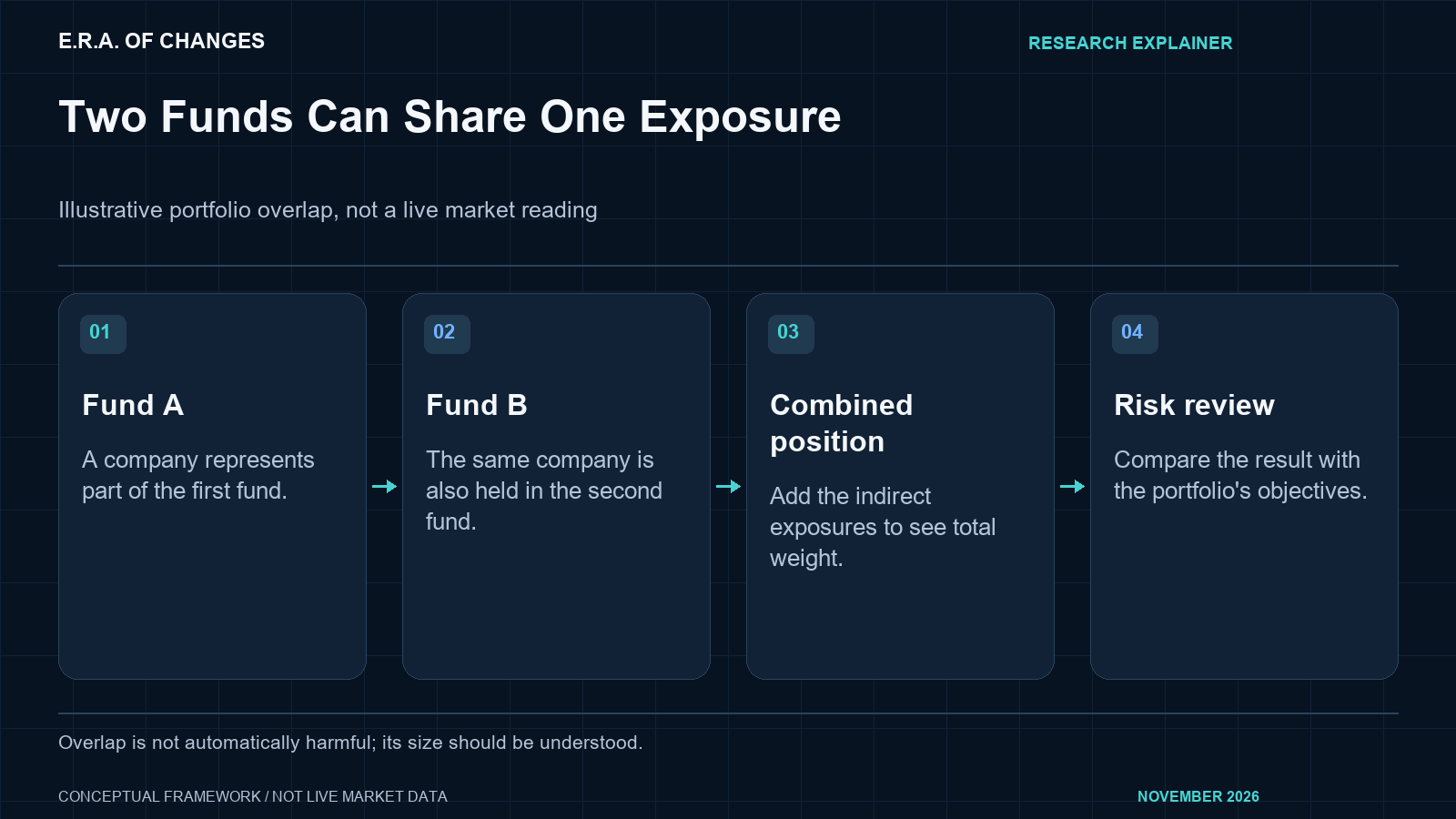
Suppose an investor holds two hypothetical index funds. In the first, a company has a 10% weight; in the second, the same company has an 8% weight. If the investor allocates $60,000 to the first fund and $40,000 to the second, the indirect exposure to that company is $6,000 plus $3,200, or $9,200. On a $100,000 combined investment, that is 9.2% before other holdings, fees and price changes.
The example illustrates overlap. Holding two fund names does not necessarily mean holding two independent sets of economic risks. But overlap is not automatically harmful: a large company may reasonably be important to both benchmarks. The point is to know the exposure and decide whether it fits the investor's objectives and risk capacity.
Concentration can also occur at the level of a driver rather than an issuer. Several different companies may depend on the same customers, interest-rate environment, semiconductor supply chain or valuation assumptions. Conversely, companies in the same broad sector may have different balance sheets and sources of revenue. Both a holdings view and an economic-exposure view are useful.
Why a buyback does not always reduce the share count
A company can buy shares and still see its diluted share count fall by less than the amount purchased, remain stable or rise if new shares are issued at the same time. Stock-based compensation, acquisitions and convertible instruments can affect the outcome. “Cash spent on repurchases” and “net reduction in diluted shares” are different observations.
Price also matters. Repurchasing shares at an expensive valuation is not equivalent to repurchasing the same number cheaply. A company can fund buybacks from operating cash flow, existing cash or borrowing; each choice has different implications for liquidity and leverage. Comparing aggregate buyback announcements with executed purchases also requires care because an authorization is not necessarily a completed transaction.
For evidence, use the company's filings, statement of cash flows and share-count disclosures, and distinguish announced programs from amounts actually spent. The SEC's EDGAR system provides public company filings; figures still need to be read in context and reconciled across periods.
Index flows: what can and cannot be inferred
An index fund's inflows can lead the manager to purchase securities or adjust derivatives and cash, depending on the fund. However, an ETF share traded between two existing holders does not necessarily lead to a creation or a new purchase of the underlying basket. Creation and redemption activity involve authorized participants and depend on fund structure and market conditions.
There is also a difference between an index weight rising because a company's market value increased and a fund buying shares because it received new capital. Both can occur in a capitalization-weighted market, but one should not be substituted for the other. Price movements themselves change weights even without an investor contributing new money.
The SEC's investor guide to diversification recommends examining underlying holdings, including overlap between funds. The relevant question is not whether a fund is passive or active in isolation; it is which exposures the investor actually holds and how those exposures might behave together.
What changes when markets become stressed?
Liquidity can fall and several funds can face selling pressure at the same time. Yet it would be inaccurate to claim that passive vehicles always sell first or that all funds respond in the same way. Fund mandates, cash buffers, redemptions, portfolio composition and the instruments being traded vary. Research can identify possible amplification channels without proving that they caused a particular drawdown.
The Federal Reserve's financial stability framework distinguishes valuation pressure, leverage and funding vulnerabilities. Applying the same discipline to equity concentration means checking whether high weights are accompanied by elevated leverage, thin liquidity or fragile expectations rather than treating a large weight as a standalone crash signal.
Market breadth is a question, not a verdict
Breadth asks how widely participation is distributed across a market. One simple approach compares the number of stocks rising with the number falling over a specified period; another compares a capitalization-weighted index with an equal-weighted version. Each measure answers a different question. An equal-weighted index also has its own rebalancing, sector exposure and transaction costs.
If a cap-weighted benchmark rises while many constituents lag, concentration may be increasing. That does not prove that the leaders will decline: their earnings may justify part of the difference, or the relationship may persist. Conversely, broad participation does not eliminate valuation or macroeconomic risk. Define the measure and period before interpreting it.
For a historical comparison, S&P Dow Jones Indices reported that the largest ten companies' combined S&P 500 weight rose from 17.9% at year-end 2014 to 37.7% at year-end 2024. The identity of the ten can change, and index weights are not the same as an individual portfolio's weights. This describes concentration at two dates; it does not establish that buybacks or passive flows caused the change.
The useful follow-up is to examine the portfolio actually owned. An investor with several broad funds may be exposed to the same leaders more than once, while a narrowly focused active fund can be even more concentrated. Neither the fund label nor the number of holdings replaces that exposure review.
What should investors examine?
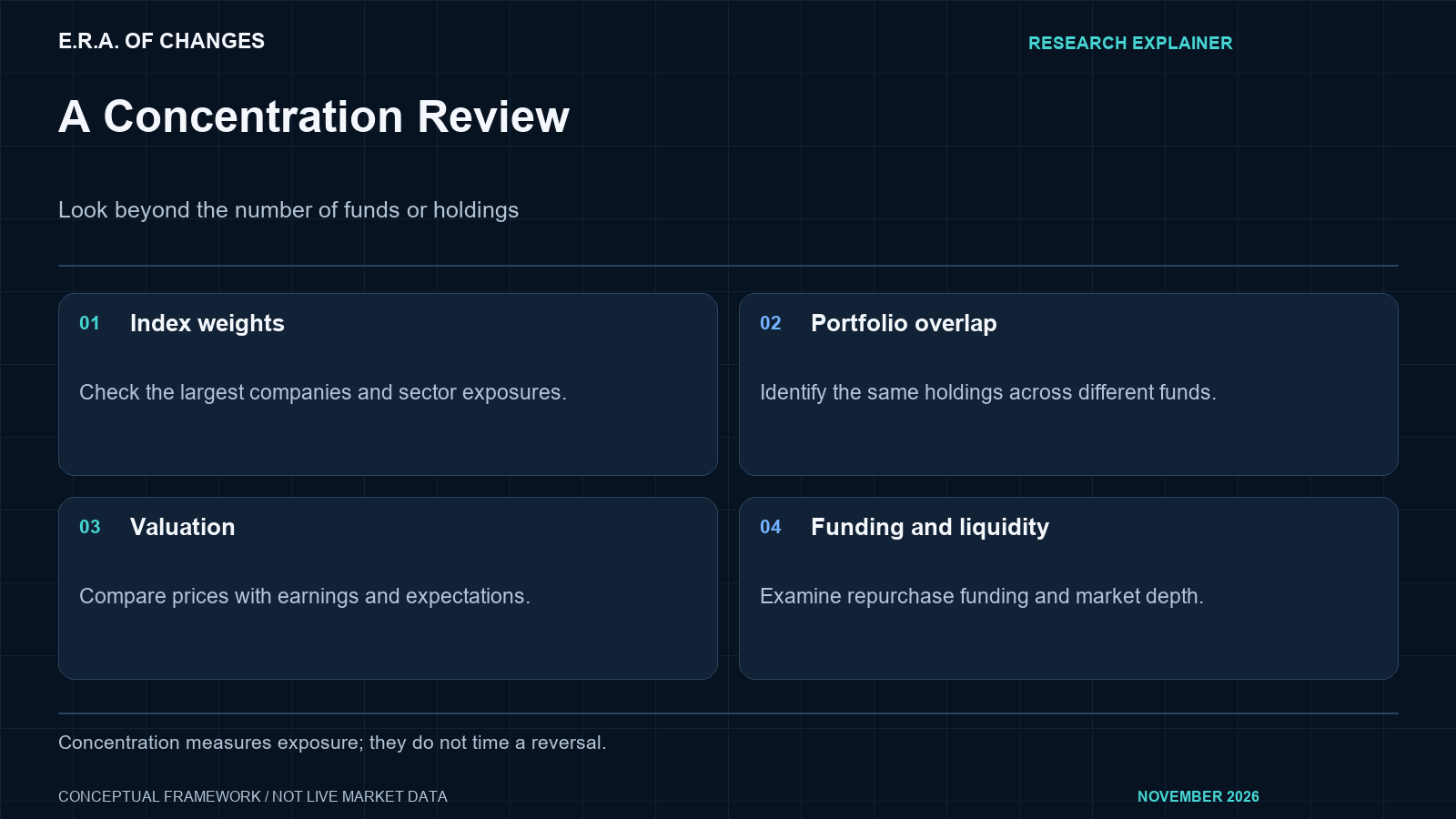
- Index weights. How much exposure comes from the largest constituents and sectors?
- Fund holdings. Do several funds in a portfolio own the same large companies?
- Valuation and earnings. Has market value changed alongside operating results, expectations or both?
- Buyback financing. Is repurchase activity funded from cash flow, existing cash or debt?
- Market breadth and liquidity. Are many stocks participating, and how might liquidity change in stress?
Concentration measures describe exposure; they do not provide a reliable date for a reversal. Some concentrated markets can remain so for long periods, while company and sector leadership can also change.
Three ways the exposure could evolve
| Scenario | What to examine | Limitation |
|---|---|---|
| Leaders continue to outperform | Whether weights and portfolio overlap rise further | A larger weight does not establish overvaluation. |
| Other constituents outperform | Whether breadth improves and weights of leaders decline | Relative underperformance can occur even if leaders' prices rise. |
| Leaders fall together | Portfolio losses, correlations and liquidity under stress | A hypothetical shock is not a forecast of its timing or size. |
For a rough stress test, multiply each holding's portfolio weight by an assumed return and sum the results. For example, a 9.2% exposure falling 20%, with all other holdings unchanged, subtracts about 1.84 percentage points before fees and taxes. This isolates one exposure; actual portfolios have interacting positions and changing correlations.
Connecting concentration to portfolio risk
The project's discussion of interest rates and stock markets explains another influence on equity valuations. Portfolio scenario planning adds a framework for considering more than one market outcome. For a historical example of reviewing forecasts and errors, see the Month 3 forecast scoreboard.
When companies finance repurchases with debt, the terms and timing of that debt matter. Our guide to corporate refinancing risk explains the maturity and cash-flow questions.
Frequently asked questions
Do buybacks guarantee that a share price will rise?
No. The effect depends on the purchase price, financing, earnings, dilution and other market participants. A buyback does not eliminate business or valuation risk.
Is an index fund automatically diversified?
Not necessarily across every risk. A fund may hold many securities while still having substantial exposure to a few large constituents, one sector or a particular market.
Does a buyback announcement mean the company has already purchased shares?
No. An authorization can permit purchases without requiring them to be completed immediately or in full. Review executed purchases in company filings.
Is an equal-weighted index free from concentration risk?
No. Equal weighting reduces concentration by individual weight at a rebalance, but sector, market and economic-factor exposures remain. Weights can also drift between rebalances.
What concentration means for a portfolio
Buybacks, benchmark weights and fund flows can each shape market structure. The risk to examine is not “passive investing” in the abstract, but an investor's actual exposures and assumptions. A diversified process looks at the underlying holdings, funding and potential behavior of those holdings under different conditions.
Sources
- Investor.gov: Index Funds.
- Investor.gov: Asset Allocation and Diversification.
- IMF: Investment Funds and Financial Stability.
- Federal Reserve: Financial Stability Reports.
- SEC: EDGAR Company Filings.
- S&P Dow Jones Indices: S&P 500 Concentration and Dispersion.
Explore financial-market research for related market analysis.
This material is for informational and educational purposes only and is not investment advice.