Prepared by: E.R.A. OF CHANGES Editorial Team
Reviewed by: Nikolai Fainizky, CEO & Senior Analyst, E.R.A. OF CHANGES
Oil does not need to stop being produced for a geopolitical event to affect its price. A route can become less reliable, insurance can become more expensive, or ships can take longer journeys. Each change alters the cost or timing of getting oil to buyers. The eventual market impact depends on the volume affected, the duration of disruption, inventories and the availability of alternatives.
Chokepoints are narrow maritime routes through which significant energy flows pass. Their importance is real, but a tense headline is not the same thing as an actual closure, and a temporary disruption does not by itself establish a particular oil price.
What is an oil shipping chokepoint?
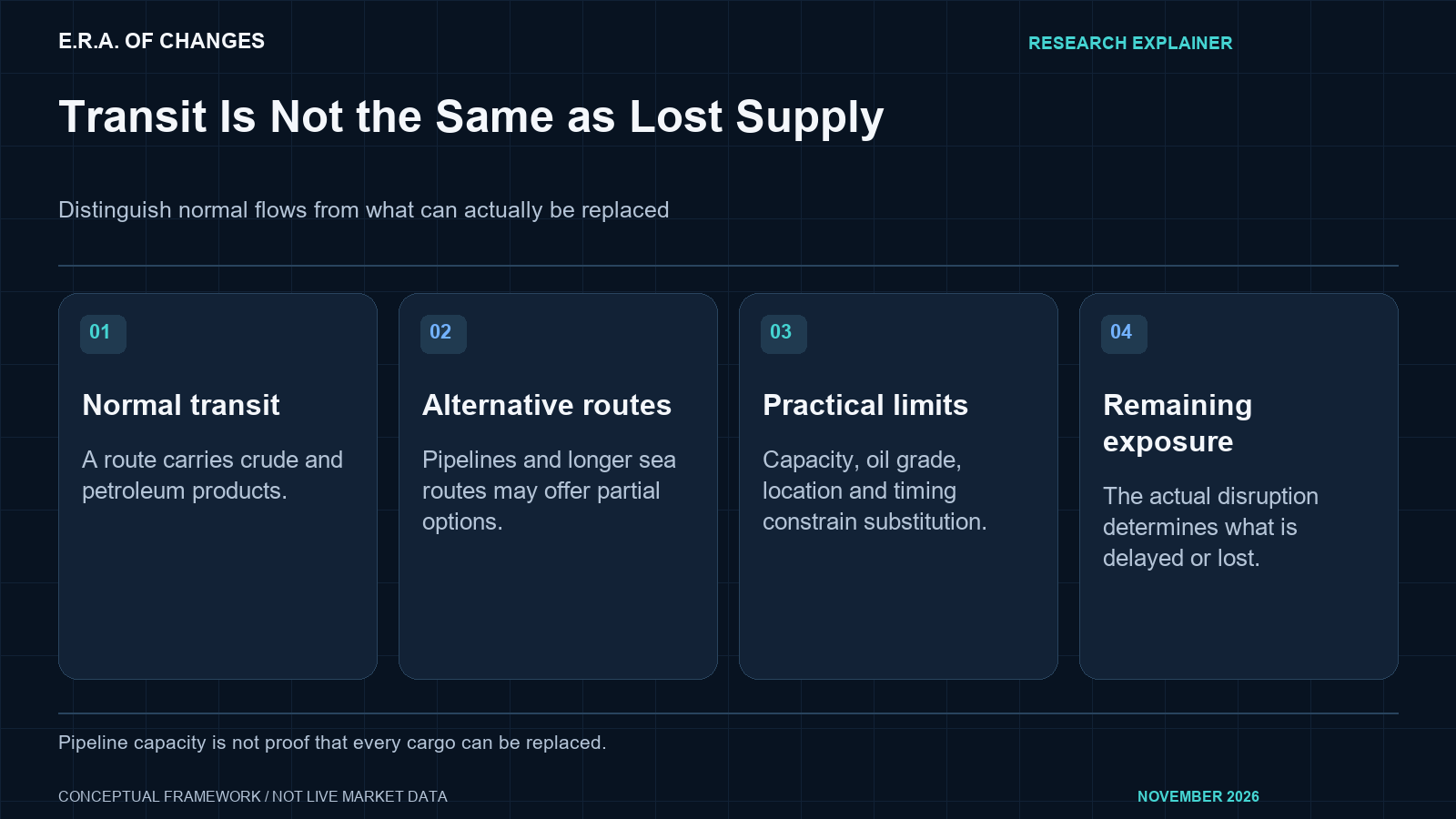
The US Energy Information Administration's overview examines routes including the Strait of Hormuz, the Strait of Malacca, Bab el-Mandeb, the Suez Canal and other passages. The geography and the type of cargo differ by route. For some disruptions, pipelines, alternate sea routes or inventories offer partial alternatives; for others, switching may add substantial time and cost.
An estimate of how much oil normally passes through a route should not be equated with the volume permanently lost in a disruption. Some cargo can be rerouted or delayed, and flows can change with production, refinery demand and trade patterns. Always check the data period and whether figures include crude oil, refined products or both.
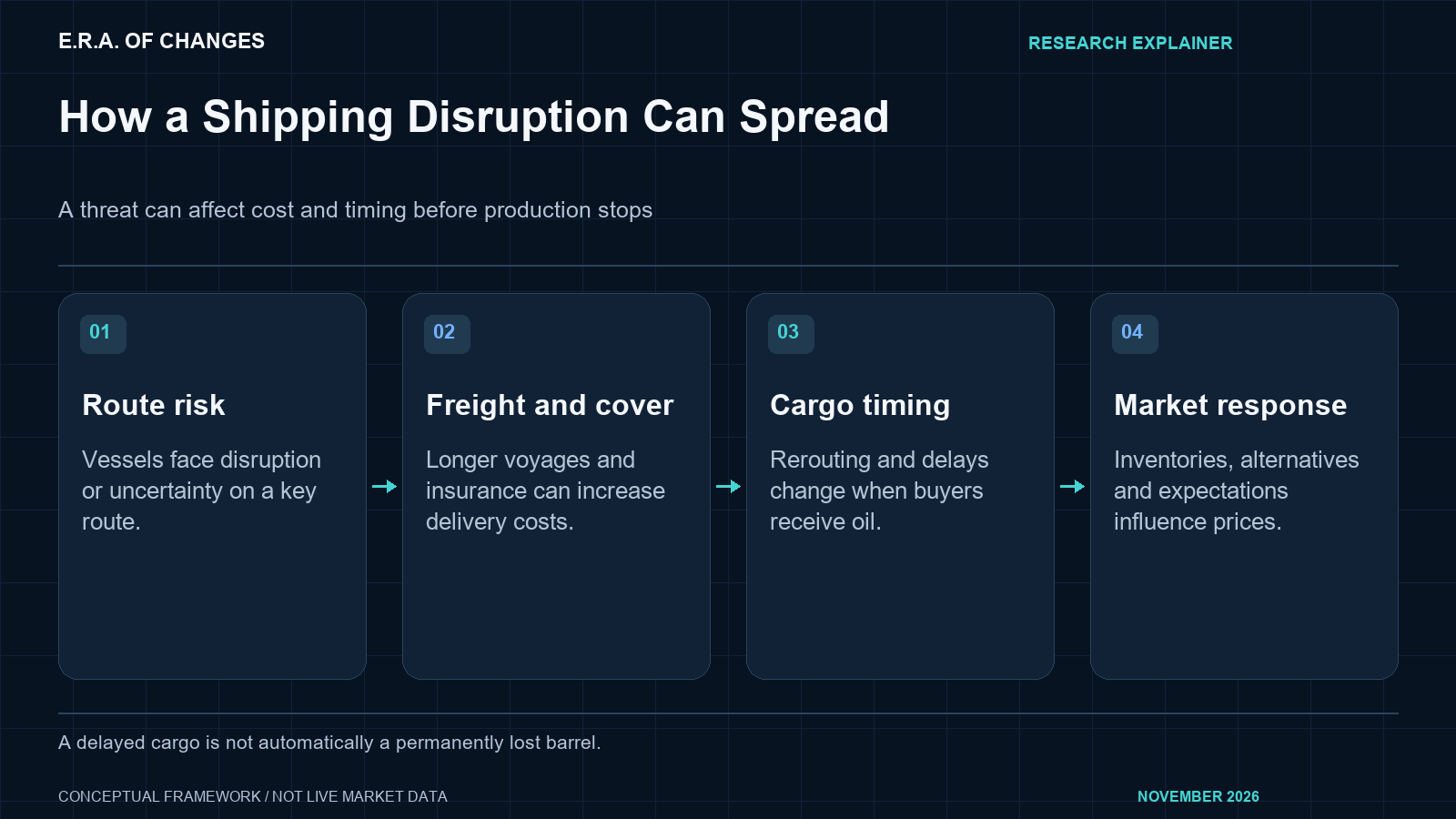
The transmission path from a threat to a price
1. Physical supply and timing
An interruption can delay cargoes, restrict exports or make delivery schedules less certain. Buyers may seek alternative grades and suppliers, but the suitability of replacement oil depends on refinery configuration, location and contract terms. Spare capacity is useful only if the oil can be produced and transported to the buyer in time.
2. Freight and insurance
Even when ships continue to move, perceived danger can affect war-risk insurance, freight rates and the willingness of crews or vessel owners to use a route. Longer voyages can tie up tankers and change shipping availability. Higher delivery costs do not translate into the same price change for every crude grade or destination.
3. Inventories and expectations
Inventories can absorb some disruptions, but stocks differ by location, quality and ownership. The EIA's explanation of petroleum inventories describes their role as a buffer and market signal. Traders also price possible future outcomes: a risk premium can rise before a physical shortage occurs and fall if expected disruption does not materialize. Neither the size nor the duration of that premium can be measured precisely from a single price observation.
4. Inflation and financial conditions
Higher energy costs can affect transport, production and consumer prices. The economic effect depends on the persistence of the move, exchange rates, taxation, government policy and other inputs. Central banks face a trade-off when an energy shock raises inflation while also weakening purchasing power.
The Strait of Hormuz: volume is not the same as lost supply
The Strait of Hormuz connects the Persian Gulf with the Gulf of Oman. It is important because a large share of seaborne oil moves through it. The EIA's chokepoint analysis describes regional flows and the limited ability of pipelines to bypass the strait. The agency's estimates apply to the periods and product definitions in that report; they should be updated before using them as current figures.
Suppose, hypothetically, a disruption affects a route that normally carries ten units of oil per day. It does not follow that the world permanently loses ten units of production each day. Some cargoes may be delayed, some may use available alternative routes and some demand may be served from inventories. Other barrels could become unavailable for longer. The relevant calculation separates production, exports, deliveries and final consumption.
The capacity of an alternative pipeline is not necessarily its immediately available spare capacity. Existing commitments, crude quality, infrastructure, storage and the location of the destination matter. Adding the headline capacities of several routes can therefore overstate what can actually be substituted during a particular event.
For scale, the EIA estimated that flows of crude oil and petroleum products through Hormuz averaged 20 million barrels per day in 2024, equivalent to about one-fifth of global petroleum liquids consumption. In June 2025 it estimated that Saudi and UAE pipelines could provide about 2.6 million barrels per day of bypass capacity in a disruption. These are different measures: the first is estimated transit; the second is estimated available pipeline capacity, not a demonstrated replacement for every cargo. The estimates are historical, not a current closure-loss forecast.
Bab el-Mandeb and the cost of a longer voyage
Bab el-Mandeb links the Red Sea with the Gulf of Aden. When ships avoid a route through the Red Sea and Suez Canal, some voyages can take the longer route around southern Africa. That can increase voyage time and operating costs and temporarily tie up ships for longer. The final impact depends on the cargo, origin, destination and availability of vessels; not every oil shipment uses the same route.
The IMF's analysis of Red Sea disruptions discusses the wider effects of rerouting and shipping costs during that episode. Freight pressure is not identical to a loss of crude production. A delayed delivery, a higher transportation bill and the destruction of supply are separate events and should be measured separately.
In the first two months of 2024, the IMF estimated that Suez Canal trade volume fell 50% year over year while trade around the Cape of Good Hope rose 74%; diversions added ten days or more on average to delivery times. These figures cover trade generally, not oil alone, and do not quantify lost oil production. They illustrate how rerouting can preserve a trade connection while changing its timing and cost.
Why spare capacity and reserves are not a single number
Spare production capacity, commercial inventories and government strategic reserves perform different functions. Capacity refers to potential production, subject to operational limits and timing. Inventories are barrels already stored, but they are held in particular locations and grades. Strategic reserves can be released only under the relevant authorities and operational arrangements.
A policy announcement can affect expectations before barrels reach a refinery. Likewise, a refinery cannot necessarily process every crude grade in the same way. The EIA's discussion of oil supply, capacity and prices explains why limited spare capacity and low inventories can make markets more sensitive to a disruption.
An analysis should therefore compare usable alternatives with the specific interruption: how quickly can oil be supplied, what quality is required and can it reach the affected buyer? It should also consider how demand responds if prices remain higher. Those constraints are more useful than assuming either an immediate global shortage or a frictionless replacement.
The time dimension: what happens first?
The first market response may occur when participants reassess the probability of a disruption, before a ship changes course. If vessels are rerouted, the next effects may appear in freight, insurance and expected delivery times. Only later might a sustained interruption show up in refinery runs or inventories. The ordering is not guaranteed, and data releases can lag events.
For a consumer or refinery, the location of available stock matters as much as the global total. Oil held far from the affected destination cannot necessarily replace a delayed cargo immediately. A temporary rise in freight can persist after a route reopens if tankers and cargoes take time to return to their previous schedules.
This is why comparing one day's benchmark price with one geopolitical headline is insufficient. Revisit the actual route and flow data, then ask whether the initial risk premium remained, reversed or was overwhelmed by other market news. Our geopolitical-risk overview provides wider context while retaining its original period of analysis.
A recent observation: routes can adapt without returning to normal
In its November 2026 review of Middle East oil flows, the EIA described increased use of smaller vessels and ship-to-ship transfers as well as infrastructure used to bypass areas of higher risk. This is a dated observation about the period analyzed by the agency, not a statement that every route was fully restored or that rerouting eliminated cost and risk.
The distinction is useful when assessing a developing event. A partial recovery in measured exports can coexist with higher insurance costs, longer delivery times or reduced flexibility. Conversely, a rise in shipping activity does not by itself identify how much production was lost earlier or how much oil reached a particular consuming country.
An analyst should therefore compare the same measure over time: production with production, exports with exports and delivered cargoes with delivered cargoes. Mixing them can make the market look either more disrupted or more resilient than the underlying data support.
How to separate a risk premium from other drivers
In a previous assessment of oil volatility, Nikolai Fainizky ranked demand uncertainty and supply discipline ahead of the geopolitical risk premium among the factors he was watching. That ranking is a historical analytical view, not a fixed rule: the importance of each driver can change when the size or duration of a disruption changes.
The ranking provides a useful check against attributing every price move to a headline. Examine demand and producers' decisions alongside actual cargo disruptions, freight and insurance. If the evidence changes, the relative weight of the factors may need to change too.
There is no observable label on an oil price that says how many dollars come from geopolitics. An analyst might compare market prices with a model or with prices before an event, but those comparisons rely on assumptions. Demand forecasts, output decisions, inventories, exchange rates and other news may change over the same interval.
A more defensible approach is to describe the evidence: changes in freight or insurance, reported cargo movements, prices for relevant grades and inventories. State what is observed, what is inferred, and which alternative explanation could fit the data. A prior estimate of a geopolitical premium should remain dated and should not be reused as a current number without new analysis.
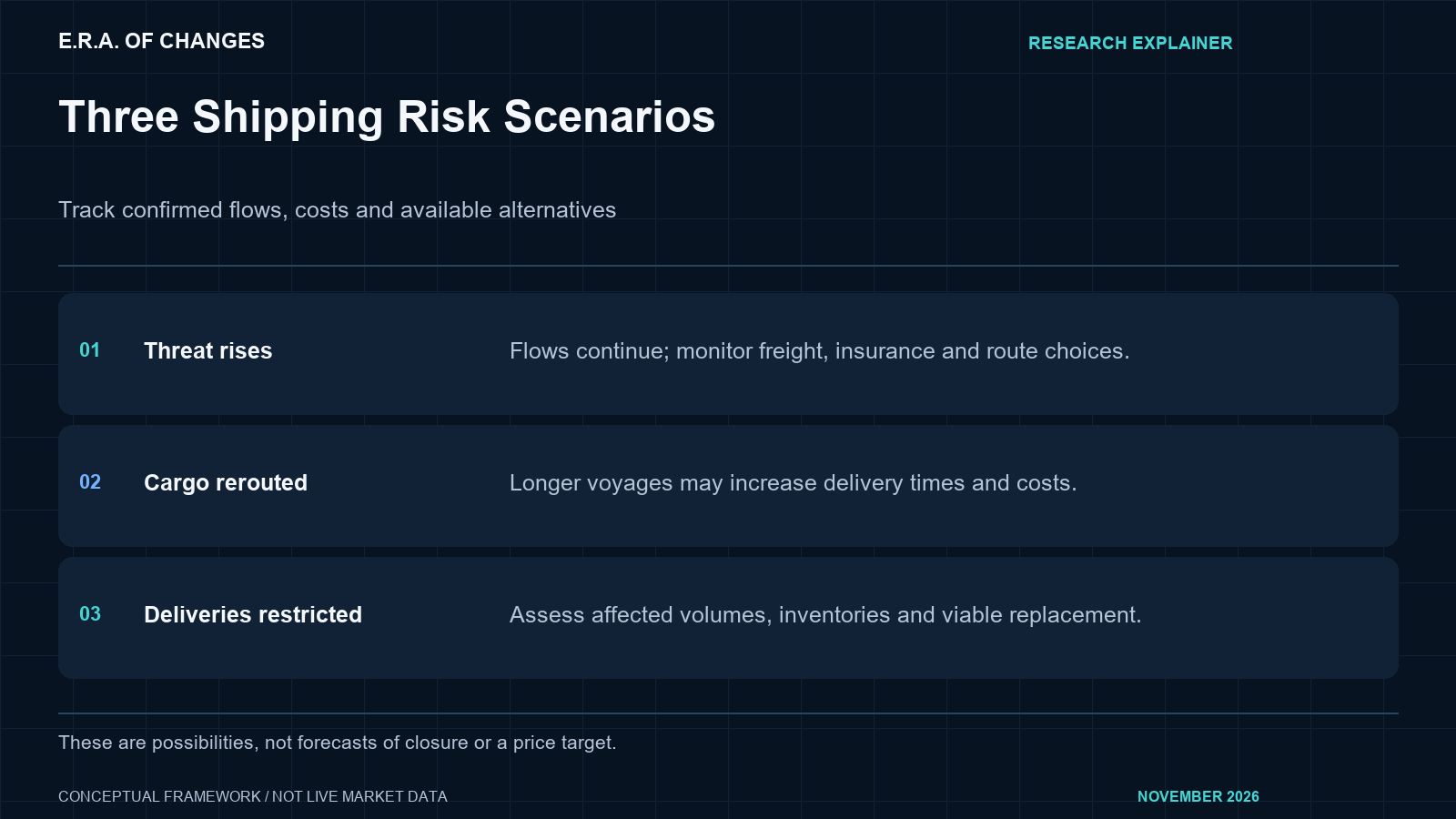
Three scenarios, not three forecasts
| Situation | What to investigate | Why the outcome remains uncertain |
|---|---|---|
| Threats rise but physical flows continue | Freight, insurance and evidence of changing routes | The perceived risk may fade or intensify. |
| Cargoes are delayed or rerouted | Transit time, available tankers, inventories and alternate routes | The same disruption can affect regions differently. |
| A sustained disruption restricts deliveries | The scale of lost or delayed supply and viable replacement | Policy responses, demand and production elsewhere can change. |
The table describes analytical possibilities, not a forecast that any route will close. To distinguish them, compare confirmed daily flows with a pre-event baseline, then track freight and delivery times alongside inventories. A return in transit volumes alone does not establish that costs or delivery schedules have normalized.
How to follow the evidence
Start with the reported event: is it a warning, a change in insurance, a vessel rerouting or a confirmed interruption? Then look for independent data on cargo movements and affected volumes. Compare different grades and delivery locations; a global benchmark can move for reasons unrelated to a particular route.
Next, ask whether demand and supply elsewhere are changing. A geopolitical premium can coexist with weak consumption or rising production, so the observed price is the result of multiple forces. Our guide to oil price volatility places geopolitics alongside demand and producer decisions. The analysis of sanctions and global trade covers another route through which political decisions affect logistics.
Our analysis of copper and China examines a separate commodity market where supply disruptions and demand must also be considered together.
Frequently asked questions
Does a disruption at a chokepoint always mean a global oil shortage?
No. The outcome depends on actual cargoes affected, duration, inventories, alternate routes and other supply. A delayed shipment is not necessarily a permanently lost barrel.
Can oil prices rise before deliveries are interrupted?
Yes. Markets can price expected risk before a physical interruption, but that risk premium may change if expectations or other market conditions change.
Are strategic reserves the same as spare production capacity?
No. Reserves are stored oil subject to release decisions and logistics. Spare capacity is potential additional production subject to operational constraints and timing.
Does rerouting eliminate the impact of a disruption?
Not necessarily. A longer route can increase transport time and costs even when the cargo ultimately reaches its destination. The effect varies by route and cargo.
Separating disrupted flows from market expectations
Oil markets depend on shipping routes, vessels, insurance and delivery schedules. The effect of a disruption depends on what actually happens and how suppliers and buyers respond. Confirmed changes in cargo flows should therefore be distinguished from the risks investors expect.
Sources
- EIA: World Oil Transit Chokepoints.
- EIA: Strait of Hormuz Flows and Alternatives, June 2025.
- EIA: Oil Prices and Outlook.
- EIA: Inventories and the Oil-Market Balance.
- EIA: Middle East Chokepoint Flows, November 2026.
- IMF: Red Sea Shipping Disruptions.
Explore geopolitical research for more on how international events affect markets.
This article is for informational and educational purposes only and is not investment advice.