.
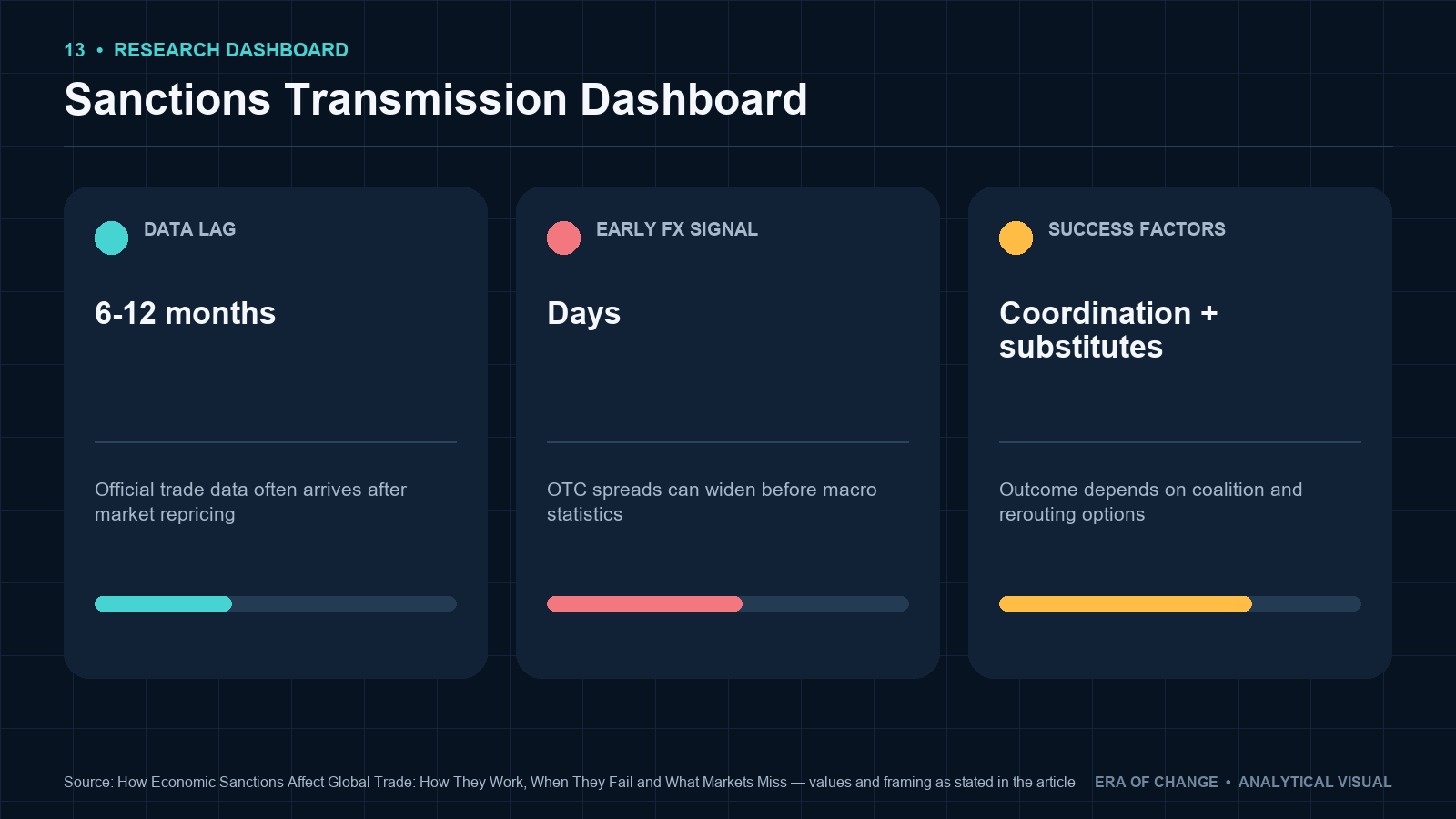
When most people hear that a country has been sanctioned, they assume trade simply stops. It rarely does. Economic sanctions attempt to change behavior by restricting access to trade, capital, technology, payment infrastructure, or financial assets, and their effectiveness depends almost entirely on international coordination, the availability of substitutes, and whether the target can reach alternative trade and payment channels that sit outside the sanctioning coalition.I want to draw a distinction that most coverage of this topic misses entirely: sanctions that genuinely isolate an economy are a different animal from sanctions that mainly reroute trade through new intermediaries. Iran’s 2012 financial isolation is the clearest example I know of relatively effective multilateral pressure. The sanctions imposed on Russia after 2022 are, in my assessment, a case where incomplete global participation produced substantial trade diversion and a parallel financial infrastructure that didn’t exist at scale before. The full economic effects typically take six to twelve months to appear, because companies initially run on existing inventories, prior contracts, and financing arranged before the restrictions took hold. Markets move faster than that: cross-border FX spreads and freight-risk premiums can shift within days, well before any official trade statistic catches up.
Sanctions, in other words, should be analyzed as a change in the architecture and cost of trade, not as an on/off switch for commerce.
Key Takeaways
- Economic sanctions can target finance, trade, technology, individuals, companies, or entire sectors, and each form transmits through the economy differently.
- Sanctions are most effective when international participation is broad and alternative channels are genuinely limited.
- Incomplete sanctions coalitions tend to redirect trade rather than stop it.
- The first observable market effects show up in FX conversion costs, freight rates, and insurance premiums, well before headline economic data.
- Full macroeconomic effects typically take six to twelve months to become visible.
- Trade restrictions can generate inflation, supply-chain inefficiency, and permanent geographic rerouting of commerce.
- Financial sanctions can accelerate the buildout of non-dollar settlement infrastructure that outlasts the sanctions themselves.
- The success of a sanctions regime should be measured against its stated strategic objective, not simply by how much economic disruption it produces.
Introduction
When a country gets sanctioned, the common assumption is that trade with it simply stops. In practice, sanctions produce a much wider range of outcomes than that assumption allows for.
Trade can collapse outright. It can continue at a steep discount. Supply chains can reroute through new geography entirely. New intermediaries can appear almost overnight to fill the gap. The currency used to settle transactions can change. Domestic substitution can increase inside the sanctioned economy. And the costs involved can fall disproportionately on the sanctioned country, on the sanctioning countries, or get split unevenly between both, sometimes alongside the emergence of entirely new parallel financial infrastructure that didn’t exist before the sanctions were imposed.
So the real question worth asking isn’t whether sanctions work in some abstract sense. It’s this: why do some economic sanctions achieve their stated goals while others end up reorganizing global trade without actually stopping it?
What Are Economic Sanctions?
Economic sanctions are restrictions imposed by governments or international institutions to influence another country, organization, company, or individual through economic pressure rather than direct military force. That pressure takes several distinct forms, and conflating them is one of the more common mistakes I see in how this topic gets covered.
- Financial sanctions restrict access to banking relationships, foreign-exchange transactions, capital markets, sovereign reserves, and cross-border payment systems: the mechanism behind Iran’s 2012 isolation, which I’ll walk through in detail below.
- Trade sanctions restrict specific imports, exports, particular goods, or entire sectors of an economy.
- Technology and export controls restrict access to semiconductors, industrial equipment, software, dual-use technology, and advanced manufacturing inputs, the primary tool in the current U.S.-China technology competition.
- Commodity restrictions can target oil, gas, metals, agricultural goods, or strategic minerals directly.
- And individual and corporate sanctions apply asset freezes and transaction restrictions to specifically designated people and entities, rather than to an entire country’s economy.
How Do Sanctions Work?
The basic mechanism runs in sequence: a restriction is imposed, transaction costs rise as a direct result, access to markets or capital shrinks, economic pressure builds, and policymakers hope that pressure eventually produces the behavioral change they were actually after.
Sanctions can attempt to reduce export revenue, restrict imports, increase the cost of financing, limit access to technology, freeze foreign assets, restrict international payments, reduce foreign investment, or simply increase domestic political pressure on a government.
The point I want to be precise about: economic damage is almost always an intermediate mechanism, not the actual policy objective. The ultimate goal is behavioral or strategic change: a negotiated settlement, a policy reversal, a change in military posture. Sanctions that produce enormous economic disruption without moving that underlying objective have not actually succeeded, no matter how dramatic the disruption looks on a chart.
What Determines Whether Sanctions Succeed?
- International coordination matters more than any other single variable. The more countries participate in a sanctions regime, the fewer substitute markets remain available to the target, and the harder it becomes to simply redirect trade around the restriction.
- The availability of alternative buyers matters just as much on the commodity side: an exporter facing sanctions from one bloc can often redirect goods toward other large economies that continue purchasing, provided those economies exist and are willing.
- Alternative payment infrastructure determines whether restrictions actually bite: sanctions are structurally weaker when trade can settle outside the dominant banking network entirely.
- The substitutability of the targeted product shapes the outcome directly: restricting a specialized technology with few alternative suppliers is far more effective than restricting a globally fungible commodity like crude oil, where buyers can simply source from elsewhere.
- Foreign-exchange reserves give a target government a buffer that can delay the onset of real pressure, sometimes for years.
- Domestic production capacity lets a target substitute some restricted imports internally, cushioning the blow.
- And political tolerance for economic pain is the variable most often ignored: economic pressure does not automatically translate into political concessions, and a government’s willingness to absorb suffering on behalf of a strategic objective can be considerably higher than outside observers assume.
When Economic Sanctions Work: Iran as a Case Study
The 2012 Financial Isolation
Following an EU Council decision on March 15, 2012, SWIFT was instructed to discontinue its messaging services to Iranian financial institutions subject to European sanctions, with the disconnection taking effect two days later. This ran alongside a broader package under the U.S. Iran Threat Reduction and Syria Human Rights Act and an EU oil embargo, targeting Iran’s energy and financial sectors simultaneously rather than in isolation.
Why This Case Was Relatively Effective
International coordination here was unusually broad, the U.S. and EU acted together, and Iran had comparatively few alternative payment channels available given how central the SWIFT network was to global trade finance at the time. The results were severe and fast. Iran’s crude oil and lease-condensate exports fell to their lowest level since 1986, with net oil export revenue dropping to $69 billion in 2012 from $95 billion in 2011. By May 2013, exports had collapsed to roughly 700,000 barrels per day, down from 2.2 million barrels per day in 2011, a decline that cost Iran an estimated $4 to $8 billion in lost revenue every month it persisted.
I want to state the editorial caveat plainly, because sanctions effectiveness is a genuinely contested question and overclaiming here would undermine the credibility of everything else in this piece: sanctions alone did not produce the 2015 nuclear agreement. What I’d argue instead is that this was a case in which unusually broad financial isolation materially increased the economic pressure surrounding the negotiations that ultimately produced the JCPOA. When Iranian banks were reconnected to SWIFT following the 2015 deal, oil exports recovered accordingly, a fairly clean before-and-after illustration of how directly financial connectivity and export capacity were linked in this specific case.
When Sanctions Reroute Trade Instead: Russia After 2022
This is my own interpretation of a genuinely contested case, and I want to frame it as exactly that rather than an uncontested conclusion.
The Missing Global Consensus
Western economies imposed extensive restrictions on Russia beginning in 2022, but many major emerging economies did not participate fully in the embargo structure. That incomplete coalition is, in my view, the single biggest difference from the Iran case, and it explains most of what followed.
Trade Diversion Toward Asia
The EU cut its fossil-fuel imports from Russia sharply, from roughly $16 billion per month in early 2022 to around $1 billion per month by the end of 2023, following a coal embargo in August 2022, a crude oil embargo in December 2022, and an oil products embargo in February 2023. But that volume didn’t disappear from the market; it moved. Since December 2022, China has purchased 49% of Russia’s crude oil exports and 37% of its coal exports, with India taking 37% of crude and 19% of coal, and Turkey absorbing a meaningful share of both. The trade didn’t stop. It redirected toward buyers outside the sanctioning coalition, at a price the market itself set.
That price has moved with the broader geopolitical backdrop in a way worth watching closely. Urals crude traded at premiums of $7 to $8 a barrel to Brent in April and May 2026, as Middle East supply disruptions strengthened Russia’s negotiating position with its remaining buyers. By June 2026, as Chinese demand softened, that had reversed into a discount of $2 to $3 a barrel, a swing of roughly $10 a barrel in two months driven almost entirely by shifting demand among the handful of buyers still willing to purchase Russian crude at all. Earlier in 2026, discounts on cargoes bound for India had reached $10 a barrel to dated Brent. That discount is the price of trading outside the dominant settlement and insurance infrastructure: a direct, quantifiable measure of what incomplete sanctions actually cost the target, even when the trade itself continues.
European Adjustment Costs
I want to be careful here not to make a simplistic claim that sanctions alone caused Europe’s industrial competitiveness problems, that would be exactly the kind of overreach I want this piece to avoid. But the loss of cheap, pipeline-delivered Russian gas did raise input costs across European industry at a moment when the continent was already contending with weak growth and an aging capital base, and that adjustment has been genuinely expensive in a way the aggregate EU import numbers understate.
Alternative Financial Infrastructure
The redirected trade needed a way to settle, and that need accelerated the buildout of financial infrastructure that didn’t previously exist at meaningful scale, a dynamic I cover in far more depth in De-Dollarization Report, where this specific mechanism sits at the center of the broader thesis.
Sanctions Do Not Necessarily Stop Trade: They Change Its Route
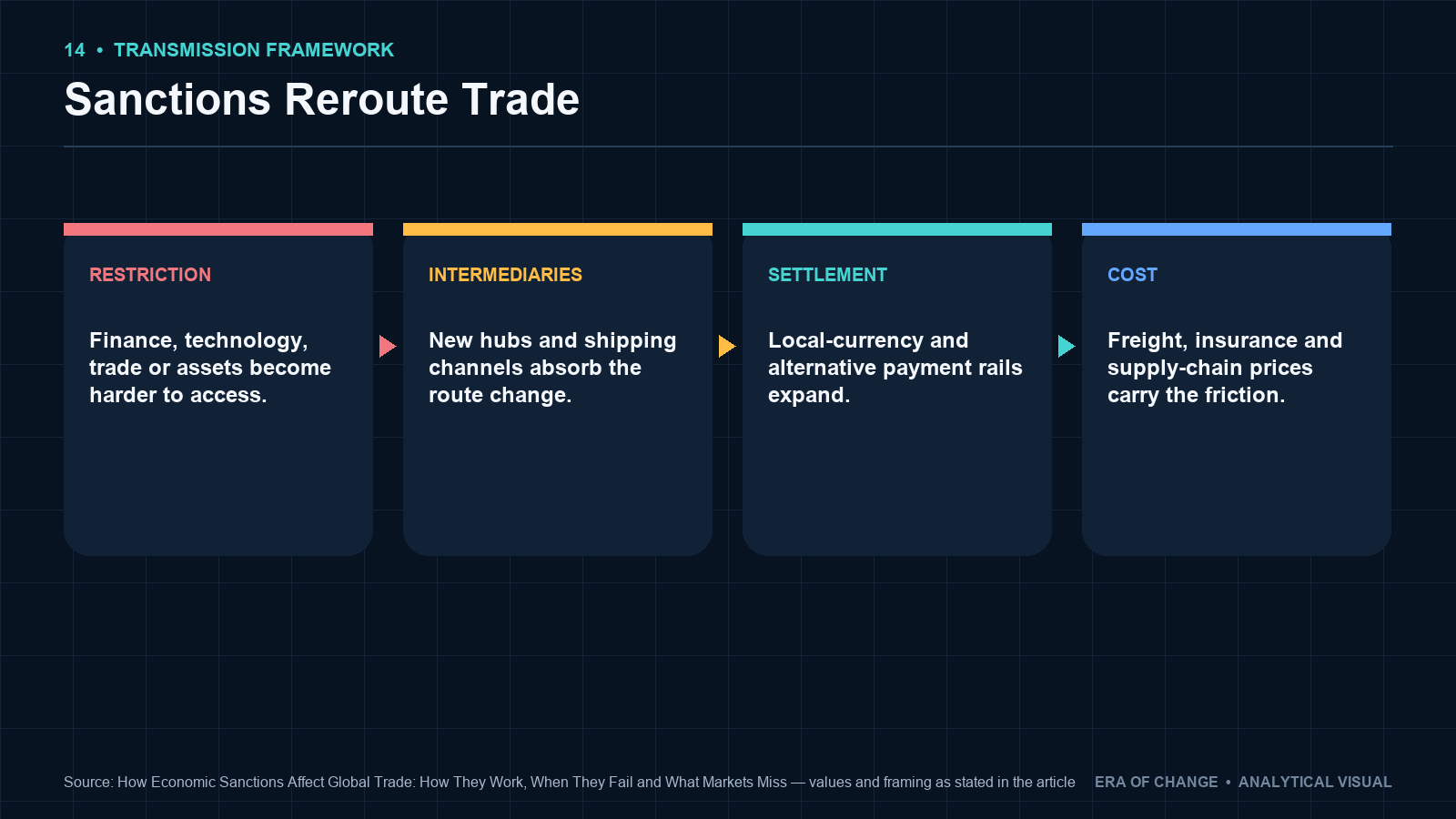
This is one of the most important structural points in this entire piece, so I want to state it plainly. Sanctioned trade doesn’t disappear. It becomes longer, more expensive, less transparent, more intermediary-heavy, harder to finance, and harder to insure. The economic impact of a sanctions regime can be measured, in large part, through the additional friction introduced into every single transaction that continues despite the restriction.
Picture the difference between direct trade, where an exporter sells straight to a buyer, and fragmented trade, where the same goods now move from exporter to intermediary, to a financing hub, onto an alternate shipping route, and finally to the buyer. Every one of those additional links adds cost, adds time, and adds a point where something can go wrong. I want to be clear that I’m describing this as an observed pattern in market structure and compliance risk, not offering a how-to guide, the mechanics matter for understanding the economics, not for anyone looking to replicate them.
How Sanctioned Trade Is Rerouted
Shipping Intermediaries and the “Shadow Fleet”
Regulators and maritime researchers have documented a specific set of characteristics in vessels used to move sanctioned commodities: older fleets, complex and frequently changing ownership structures, jurisdiction-hopping, opaque insurance arrangements, and ship-to-ship transfers conducted away from normal port infrastructure. The scale here is no longer marginal.
The shadow fleet passed 1,300 vessels in 2026, controlling roughly one-fifth of global oil tanker capacity, while Ukraine’s GUR tracker lists vessels involved in transporting sanctioned oil and petroleum products. KSE Institute estimates that 96 percent of the 78 shadow-fleet tankers carrying crude from Russian ports in February 2026 were more than 15 years old. By early 2026, G7-plus-sanctioned tankers were responsible for transporting roughly 68% of Russian crude exports, and KSE Institute estimated that 143 shadow-fleet tankers carried Russian crude oil and oil products from Russian ports in February 2026.. Iran runs a parallel operation of its own: EIA estimated that Iran’s crude oil and condensate exports had recovered to nearly 1.4 million barrels per day by 2023, based on tanker-tracking data. Source. Source. Source.
Why this raises real costs rather than simply evading them entirely: older vessels carry higher operational and safety risk, insurance becomes harder to obtain through normal channels and correspondingly more expensive when it is obtained, and enforcement risk itself becomes a cost every participant in the chain has to price in.
Trading and Re-Export Hubs
Third-country hubs gain outsized importance in a fragmented-sanctions environment precisely because they sit outside the sanctioning coalition while remaining connected to both sides of the restricted trade. This shows up in trade statistics as a jump in re-exports, a proliferation of intermediary trading companies, and rising compliance risk for any bank or corporation trying to verify the actual origin of goods moving through these hubs.
Local-Currency Settlement
Sanctioned trade increasingly settles in currencies other than the dollar (the yuan, the rupee, the dirham, and a growing list of others), precisely because settling in dollars requires routing through correspondent banks that are themselves exposed to the sanctioning jurisdiction’s enforcement reach. This is one of the more concrete, measurable threads connecting sanctions policy directly to the broader de-dollarization trend covered in De-Dollarization Report.
The Most Overlooked Mechanism: Internal Netting
This is, in my view, the single most underappreciated feature of how modern sanctioned trade actually functions, and it rarely gets discussed outside specialist trade-finance circles.
Large multinational trading networks can reduce the number of cross-border bank transfers they actually need by matching obligations internally, across subsidiaries, counterparties, and jurisdictions, rather than settling every transaction independently through the international banking system. Conceptually: Company A owes Company B, and Company B owes Company C. Rather than each of those obligations crossing the international banking system as a separate wire transfer, they can sometimes be offset against each other before any final settlement actually crosses a border. That reduces gross cross-border payment volume, reduces the FX conversion actually required, and reduces exposure to correspondent banks that sit inside sanctioned jurisdictions’ regulatory reach.
I want to note, without providing operational detail, that alternative settlement assets and private credit arrangements can sometimes appear inside fragmented trading environments as this kind of netting becomes more common, but the point here is descriptive, not instructional. The key insight worth taking away: trade becomes genuinely harder for regulators to observe when goods keep moving while the financial flows behind them become increasingly netted, localized, or separated from the correspondent-banking system that sanctions enforcement was originally built to monitor.
Why Sanctions Take 6–12 Months to Show Up in Economic Data
Existing inventories get consumed first, businesses run down stock already sitting in warehouses before they change any behavior at all. Old contracts continue delivering goods under agreements signed before the restriction took effect. Letters of credit and previously arranged trade financing can keep transactions flowing for months after a sanction is announced, simply because the financing was locked in beforehand. Alternative suppliers get tested before companies actually cut production entirely. And new trade routes, the intermediary structures described above, take real time to establish, staff, and trust.
The message worth remembering: sanctions can move market prices within hours of an announcement, while taking several full quarters to become fully visible in GDP, industrial production, or headline inflation data. Anyone judging a sanctions regime’s effectiveness purely off slow-moving macro statistics is reading the story several months behind where it actually started.
What Reacts First After Sanctions Are Announced?
Two signals move first, well ahead of anything in official trade or GDP data: cross-border OTC FX spreads, and freight rates carrying a fresh risk premium.
OTC FX Spreads: The Early Currency Signal
There’s a meaningful distinction between the official exchange rate a central bank publishes and the effective rate actually available for real cross-border conversion once sanctions are in place. Restrictions raise settlement risk, counterparty risk, currency-conversion costs, and demand for whatever intermediary currencies remain usable, and all of that shows up as a widening gap between the official rate and what businesses actually pay to move money across a border.
In our own analysis, this gap can begin widening within roughly 48 to 72 hours of a major restriction being announced, an Era analytical estimate based on observed patterns, not a universal rule that applies identically to every sanctions episode. It’s the same underlying dynamic we track through the parallel-market premium framework in Currency Crises Explained, where the gap between an official and an effective rate is one of the earliest and most reliable signals available to investors.
Freight and Insurance: The Early Trade Signal
Shipping reacts fast because it has to: vessel operators, insurers, and charterers are pricing real-time risk on every voyage, not waiting for a quarterly report. Sanctions announcements can trigger immediate route changes, higher insurance premiums, fewer vessels willing to take on the risk, longer journeys as ships avoid restricted waters or ports, additional compliance checks at every stop, outright port restrictions, and genuine difficulty securing financing for a voyage at all.
Worth watching in practice: freight indices, war-risk premiums specifically, commodity shipping rates, vessel utilization, and delivery times. We’ve documented exactly this kind of rapid freight repricing in a different but structurally similar context in Top 5 Global Geopolitical Risks to Watch in 2026, where Gulf shipping risk premiums moved within days of escalation, well before any trade statistic caught up.
How Sanctions Affect Supply Chains
The transmission runs in sequence: sanctions disrupt a supplier, companies search for alternative sourcing, costs rise as a direct consequence, lead times lengthen, inventory strategies shift in response, and margins come under pressure throughout the chain. Manufacturing, autos, electronics, energy, agriculture, aviation, and industrial machinery are all exposed, though not equally: complex, multi-tier industries with specialized inputs tend to be considerably more vulnerable than commodity markets, where a barrel of oil or a ton of wheat from one supplier is a reasonably close substitute for the same commodity from another.
How Sanctions Affect Inflation
Sanctions can push inflation higher through energy costs, commodity shortages, elevated freight and insurance expenses, currency depreciation, forced import substitution, and reduced supply-chain efficiency generally, a set of mechanisms we cover in structural detail in What Causes Inflation?.
It’s worth distinguishing where that inflation actually lands. In the target country, it’s typically driven by currency depreciation, direct import restrictions, and outright shortages of specific goods. In the sanctioning countries, it tends to arrive through higher commodity costs, more expensive and less efficient supply chains, and reduced access to whatever cheap inputs the sanctioned country used to provide, with Europe’s post-2022 energy cost experience being the clearest recent example of the second pattern.
How Sanctions Affect Currencies
The targeted currency can face capital flight, reduced convertibility, the emergence of multiple effective exchange rates, wider offshore spreads, and tightening capital controls. But currency behavior can become genuinely misleading once capital controls are in place, official trading gets restricted, and onshore FX liquidity effectively disappears: a stable official exchange rate under those conditions does not mean sanctions are having little effect. It often means the real effect has simply moved to a market the official rate no longer reflects, exactly the dynamic we map in detail in Currency Crises Explained.
How Financial Sanctions Affect Global Payments
Restrictions on banks and their correspondent relationships change which currency gets used for settlement, how payments get routed, which counterparties get selected, how trade finance gets arranged, and how reserves get managed at the sovereign level. Over time, this accelerates regional clearing arrangements, national-currency settlement, and alternative payment-messaging infrastructure built specifically to operate outside the sanctioning coalition’s reach, the same structural shift covered in full in De-Dollarization Report.
Sanctions and the Fragmentation of Global Trade
This is where the sanctions story connects directly to Era’s broader macro thesis. The global trading system has spent decades optimizing for efficiency: the lowest-cost supplier, wherever that supplier happened to sit geographically. Sanctions, layered on top of broader geopolitical fragmentation, are pushing the system toward resilience instead: friend-shoring, nearshoring, deliberately redundant suppliers, duplicate logistics networks, regional payment systems, and strategic commodity reserves held specifically against the risk of future disruption.
That shift is not free. Greater resilience generally means higher prices, lower efficiency, more capital tied up sitting in inventory rather than working, and duplicate infrastructure that a purely efficiency-optimized system would never have built. Geopolitical resilience is economically expensive; that’s not a criticism of the strategy, it’s simply the honest cost side of the ledger that gets left out of most political discussion of it.
Economic Sanctions vs. Trade War
| Economic Sanctions | Trade War |
|---|---|
| Usually a geopolitical or security objective | Usually an economic or trade objective |
| Can prohibit transactions outright | Usually raises the cost of trade rather than prohibiting it |
| Can target banks and frozen assets directly | Primarily works through tariffs, quotas, export controls |
| May freeze reserves or accounts | Usually does not touch reserves or accounts |
| May remove entire counterparties from the market | Often changes relative prices rather than access |
| Frequently legally restrictive | Trade may continue, just at a higher cost |
Modern geopolitical conflicts increasingly blur this distinction: export controls, tariffs, technology restrictions, and investment screening now frequently operate together as a single, layered policy toolkit rather than as cleanly separate categories.
What Is the Economic Impact of a Trade War?
A trade war can raise import costs, force supply-chain relocation, trigger retaliatory tariffs, move currencies, reduce trade volumes, increase business uncertainty, alter capital-expenditure plans, and add to inflation, a set of effects that overlaps meaningfully with sanctions but isn’t identical to it. A trade war and a sanctions regime are related tools operating through some shared mechanisms, but they are not the same instrument, and treating them interchangeably obscures more than it clarifies.
The Hidden Cost of Sanctions: Parallel Infrastructure
This is one of the strongest strategic points in this entire analysis. Sanctions create a direct incentive for both the target and neutral third countries to invest in alternative payment networks, new logistics routes, local-currency settlement, domestic technology, and regional commodity markets, infrastructure that, once built, doesn’t simply disappear when the immediate crisis passes.
That has a genuinely important second-order consequence: the more frequently sanctions get used as a policy tool, the greater the incentive for exposed economies to build durable alternatives to the very infrastructure sanctions depend on to be enforceable in the first place. Every sanctions episode that pushes a meaningful volume of trade into alternative settlement rails makes the next sanctions episode somewhat less effective against that same infrastructure, a dynamic directly connected to the broader thesis in De-Dollarization Report.
How to Measure Whether Sanctions Are Working
No single metric tells the whole story, which is exactly why we track a full scorecard rather than any one number in isolation. On trade: export volume, import volume, trade diversion patterns, and commodity discounts. On finance: FX spreads, capital flows, sovereign spreads, and banking access. On logistics: freight rates, delivery times, and insurance premiums. On the broader economy: industrial production, inflation, GDP, and investment. On technology: access to advanced inputs, the pace of import substitution, and productivity trends. And underneath all of it, the question that actually matters most: did the sanctions produce the strategic behavioral change they were designed to achieve? A sanctions regime that devastates a target economy’s GDP while leaving the underlying political objective completely unmoved has not succeeded by any meaningful definition, no matter how dramatic the economic damage looks in isolation.
Era’s Sanctions Transmission Framework
The sequence runs: a sanction gets announced, financial markets react immediately, FX and freight spreads widen, companies draw down inventories and lean on existing contracts, trade reroutes and substitutes begin to emerge, supply-chain costs rise, macroeconomic data gradually deteriorates or adjusts, and eventually a political response follows.
Mapped to an approximate timeline: within the first 0 to 72 hours, FX markets, commodities, equities, and freight-risk pricing move first. Over the following one to three months, rerouting accelerates, inventories get consumed, and payment systems adapt. By three to six months, the actual composition of imports and exports shifts, and industrial margins start showing real pressure. And by six to twelve months, the broader effects on GDP, inflation, and investment become fully visible in the official data. I’d treat this timeline as an analytical framework rather than a universal law; every sanctions episode moves through it at a somewhat different pace depending on the specific factors covered above.
Three Sanctions Scenarios
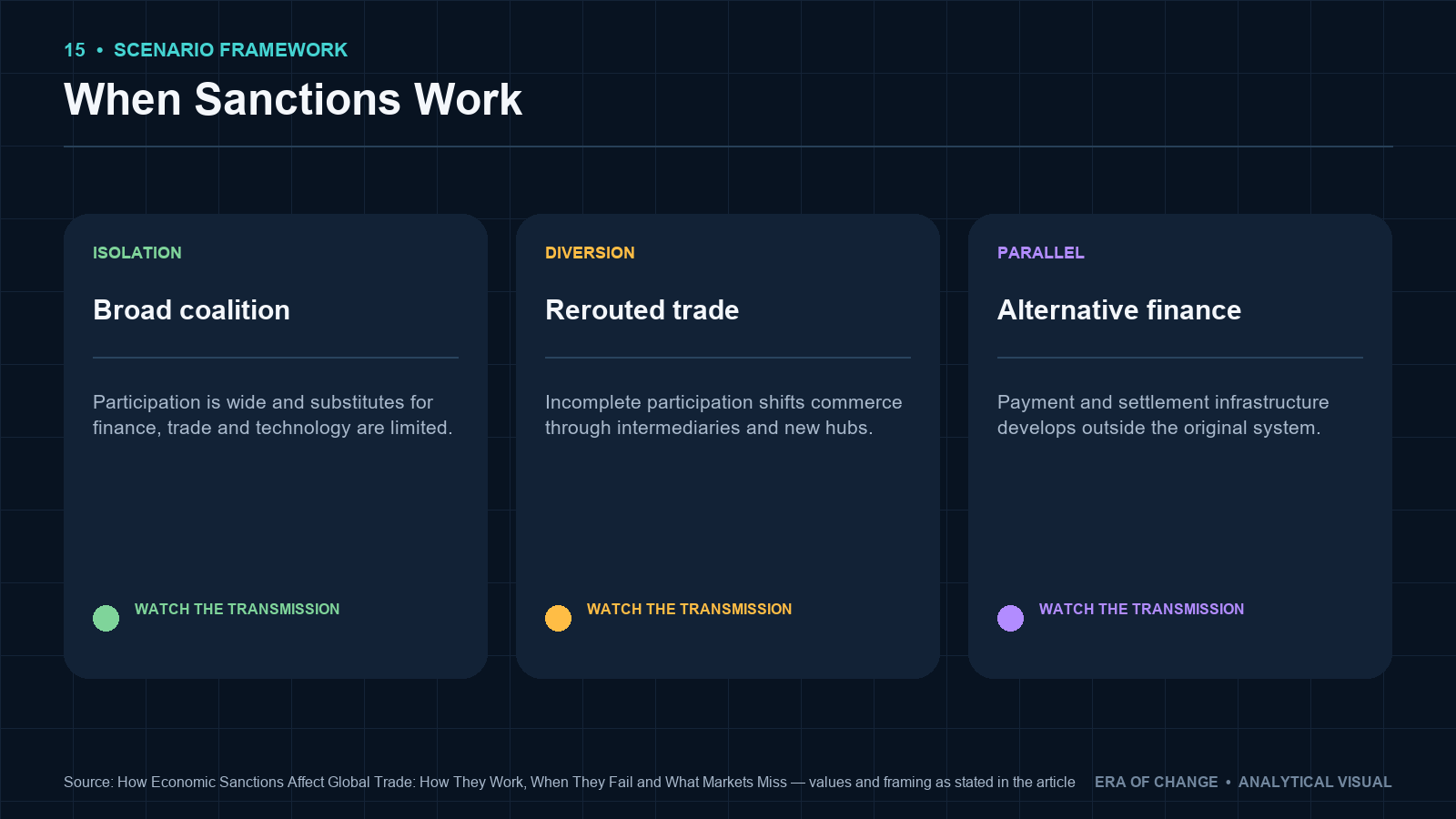
Scenario 1: Effective Multilateral Isolation. Broad international participation, few alternative buyers, restricted payment access, limited substitutes for the targeted product. The likely outcome: genuine economic pressure and meaningful policy leverage, closer to the Iran 2012 pattern than to anything else covered in this piece.
Scenario 2: Trade Diversion. Partial participation, alternative buyers remain willing and available, intermediary hubs grow in importance, discounts widen, and new payment routes emerge to accommodate the redirected trade. The likely outcome: trade continues, but less efficiently and at meaningfully higher cost, the pattern we’ve documented in detail in the Russia case above.
Scenario 3: Systemic Fragmentation. Sanctions become a persistent, recurring feature of policy rather than a one-off event, major economies build genuine parallel infrastructure in response, currency blocs strengthen, and trade and finance regionalize on a durable basis. The likely outcome: permanent changes to the global financial and trading architecture; this is, in my view, the most important long-run scenario Era tracks, and the one current trends increasingly point toward.
What Investors Should Watch
On currency markets: the gap between official and offshore FX spreads, the cross-currency basis, and any new capital-control announcements. On shipping: freight indices, insurance premiums, and observable vessel-routing changes. On commodities: regional price discounts, export volumes, and futures-curve behavior. On credit: sovereign spreads, corporate financing costs, and signs of bank stress tied to sanctioned exposure. On trade itself: bilateral trade data, the growth of re-export hubs, and shifting settlement currencies. And across all of it, the Era CrisisMeter, whose geopolitical risk component and liquidity-conditions readings synthesize these signals into a single structural score.
Era Analyst’s Perspective
From Nikolai Fainizky, CEO & Senior Analyst, E.R.A. OF CHANGES
“The comparison everyone wants me to make is simple: did sanctions work on Iran, and do they work on Russia? I think that question is the wrong one. Iran in 2012 lost roughly two-thirds of its oil exports within eighteen months of the SWIFT disconnection, dropping from 2.2 million barrels a day to 700,000, because the U.S. and EU moved together and Iran genuinely had nowhere else to route that oil. Russia after 2022 never faced that same wall. China alone has absorbed 49% of Russia’s crude exports since the sanctions began, and by mid-2026 that trade was still settling, just at a discount that swung from an $8 premium to a $3 discount inside two months as buyer demand shifted. That’s not isolation. That’s a market finding its price.
What I think gets missed entirely is the mechanism most people never look at: internal netting inside trading networks that lets goods keep moving while the financial trail behind them gets thinner and harder to trace. I watch two things before anything else lands in a GDP report: the gap between official and effective FX conversion rates, which can move within 48 to 72 hours of a major announcement, and freight-risk premiums, because insurers and shipowners are pricing real risk in real time, not waiting for a quarterly release.
The part I think markets consistently underprice is the permanence of what gets built in response. Every incomplete sanctions coalition teaches the rest of the world how to route around the next one. Over 1,300 vessels in the shadow fleet, handling roughly a fifth of global tanker capacity, didn’t exist at that scale before 2022. That infrastructure doesn’t get dismantled when a specific conflict ends. It becomes the default option for the next one.”
Frequently Asked Questions
What are economic sanctions?
Economic sanctions are restrictions imposed by governments or international institutions on trade, finance, technology, or specific individuals and entities, designed to pressure a target into a behavioral or strategic change without resorting to direct military force. They can take financial, trade, technological, commodity-specific, or individually targeted forms.
How do sanctions work?
Sanctions work by raising the cost of a specific transaction, restricting access to markets or capital, and applying sustained economic pressure in the hope that pressure eventually produces a change in the target’s behavior. Economic damage is generally an intermediate mechanism rather than the actual policy goal; the objective is almost always a negotiated or strategic outcome, not disruption for its own sake.
How do sanctions affect global trade?
Sanctions rarely stop trade outright. More often, they raise its cost and complexity: lengthening supply routes, adding intermediaries, restricting available financing, and increasing insurance and freight expenses. When international participation in a sanctions regime is incomplete, trade frequently reroutes toward buyers and intermediaries outside the coalition rather than disappearing.
Do economic sanctions actually work?
It depends heavily on international coordination and the availability of substitutes. Sanctions with broad multilateral participation and few alternative channels, like Iran’s 2012 financial isolation, tend to produce genuine economic pressure. Sanctions with incomplete global participation, as with Russia after 2022, tend to redirect trade rather than eliminate it, at a real but measurable cost to the target.
What happens when a country is sanctioned?
The immediate effects show up first in financial markets: widening FX spreads and rising freight-risk premiums, often within days. Companies initially continue operating on existing inventories, prior contracts, and previously arranged financing, which delays the visible economic impact. Over six to twelve months, the fuller effects on GDP, inflation, industrial production, and investment typically become apparent.
How do financial sanctions affect banks?
Financial sanctions can restrict a bank’s access to correspondent banking relationships, foreign-exchange transactions, and international payment messaging systems like SWIFT. This can force affected institutions and their customers toward alternative currencies, regional clearing systems, and new payment infrastructure that may persist well beyond the specific sanctions episode that prompted its creation.
Why do sanctions affect exchange rates?
Sanctions raise settlement risk, counterparty risk, and currency-conversion costs, which widens the gap between a country’s official exchange rate and the effective rate available for genuine cross-border conversion. This gap can begin widening within 48 to 72 hours of a major sanctions announcement, well before it shows up in official currency data.
How long does it take sanctions to affect an economy?
Financial markets typically react within hours to days. Full macroeconomic effects, visible in GDP, industrial production, and inflation data, generally take six to twelve months to materialize, as companies initially rely on existing inventories, prior contracts, and previously arranged financing before those buffers are exhausted.
Can countries trade while under sanctions?
Yes, frequently. Sanctioned countries can continue trading through intermediary hubs, alternative payment currencies, shadow fleet shipping arrangements, and internal netting within multinational trading networks, though typically at higher cost, reduced efficiency, and increased compliance and counterparty risk compared to unrestricted trade.
How do sanctions affect inflation?
Sanctions can raise inflation in both the target and sanctioning countries, though through different channels. In the target country, inflation is often driven by currency depreciation and shortages of restricted goods. In sanctioning countries, it typically comes from higher commodity costs and more expensive, less efficient supply chains that replace previously cheaper sources.
What is the difference between sanctions and a trade war?
Sanctions typically pursue a geopolitical or security objective and can prohibit specific transactions outright, including freezing assets or removing counterparties from the market entirely. A trade war typically pursues an economic objective through tariffs, quotas, and export controls that raise the cost of trade without necessarily prohibiting it. Modern conflicts increasingly blend both tools together.
Do sanctions accelerate de-dollarization?
Yes, at the margin. Financial sanctions create a direct incentive for both sanctioned countries and neutral third parties to build alternative payment infrastructure, settle trade in non-dollar currencies, and reduce dependence on correspondent banking relationships exposed to the sanctioning jurisdiction’s enforcement reach, infrastructure that tends to persist well beyond the specific sanctions episode that prompted its creation.
About E.R.A. OF CHANGES
E.R.A. OF CHANGES is an independent macroeconomic, financial-market, cryptocurrency, and geopolitical research firm providing institutional-quality analysis for investors worldwide. Its research combines macroeconomics, financial markets, geopolitical developments, liquidity conditions, and proprietary risk frameworks designed to identify structural changes before they become broadly recognized. Era analyzes sanctions not simply as political announcements, but through their measurable transmission into currencies, payments, logistics, commodity flows, inflation, credit conditions, and the broader global financial architecture. Our full methodology, live index reading, and forecast archive are available at eraperemen.info/en.
The content published by E.R.A. OF CHANGES is for informational and educational purposes only and does not constitute financial, investment, legal, or tax advice. All views expressed are the personal analytical perspective of the author. Past forecast accuracy does not guarantee future results. Readers should conduct their own research and consult a qualified financial professional before making any investment decisions.
Sources
Sanctions and Policy - SWIFT: SWIFT Instructed to Disconnect Sanctioned Iranian Banks Following EU Council Decision - Al Jazeera: What SWIFT Is and Why It Matters in the US-Iran Spat - U.S. Energy Information Administration: Iran Sanctions and Oil Exports
Russia Sanctions and Trade Data - Bruegel: The European Union-Russia Energy Divorce, State of Play - Centre for Research on Energy and Clean Air: April 2026 Monthly Analysis of Russian Fossil Fuel Exports and Sanctions - The Moscow Times: Russian Urals Oil Returns to Discount as Asian Refiners Cut Purchases - Yahoo Finance / Reuters: Russian Urals Oil Trades at Close to Widest Discounts Since 2022 in India
Shipping and Shadow Fleet Data - Shipfinex: Shadow Tanker Fleet 2026, Size, Ships and Sanctions Explained - The Middle East Insider: Iran’s Dark Fleet 2026, How 1.5M Barrels a Day Still Move
Internal Research - Era CrisisMeter Explained - Era Forecasting Methodology Deep Dive - Global Debt Risks 2026 - Currency Crises Explained - What Causes Inflation? - How Political Events Affect Financial Markets - Top 5 Global Geopolitical Risks to Watch in 2026 - De-Dollarization Report, pending confirmed live URL