Prepared by: E.R.A. OF CHANGES Editorial Team
Reviewed by: Nikolai Fainizky, CEO & Senior Analyst, E.R.A. OF CHANGES
Tokenized Treasury products use a digital token or ledger entry to represent a financial interest connected to US government securities. They aim to combine exposure to short-term government instruments with features of digital infrastructure, such as programmable transfers or a shared record of ownership.
But a token labeled “Treasury-backed” is not necessarily the same thing as a Treasury bill held directly in a brokerage account. The holder may own an interest in a fund, a claim against an issuer or another legally defined right. The most important questions are what the token represents, who holds the underlying assets and how the holder can redeem or transfer the interest.
What does tokenization mean?
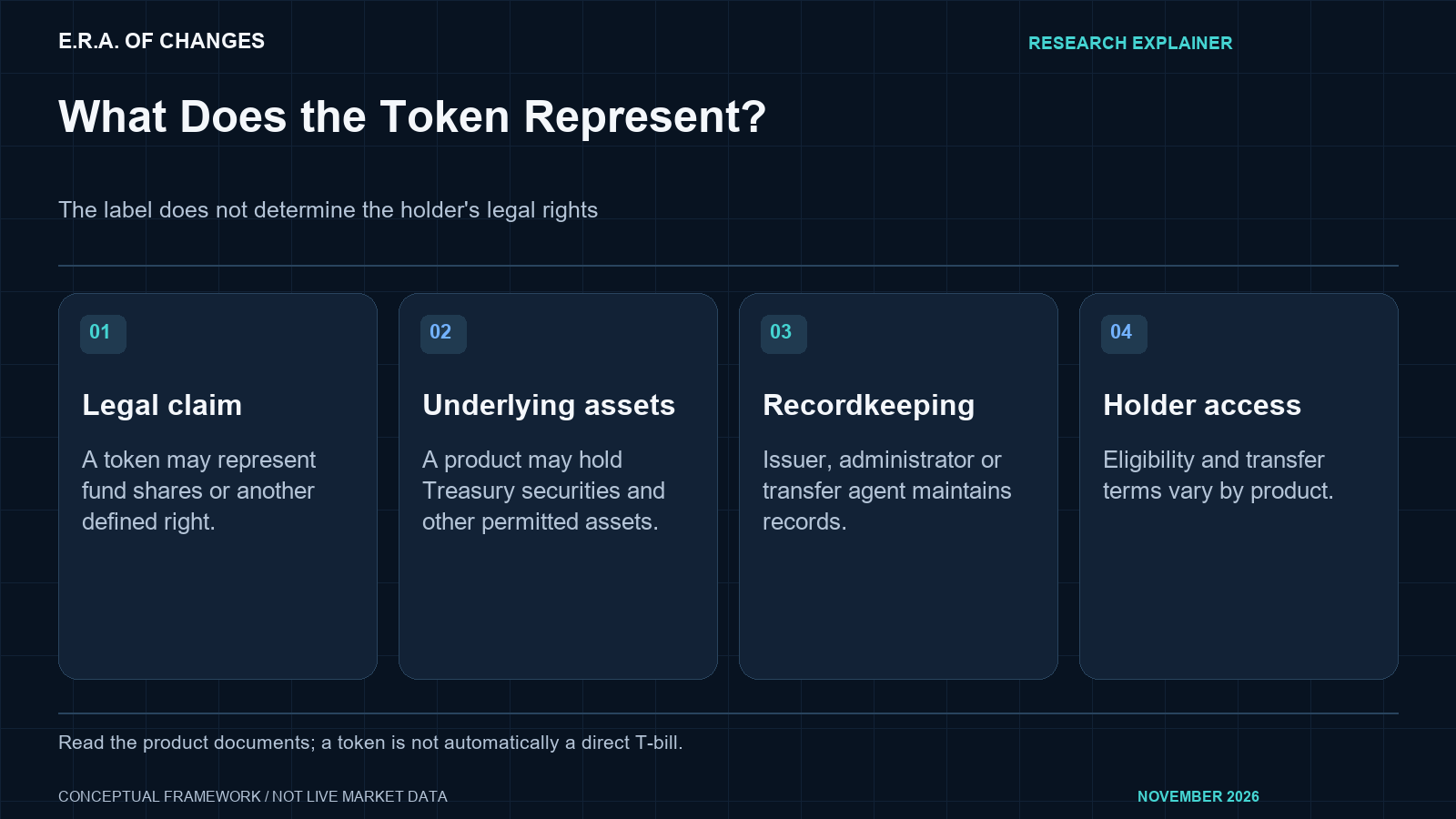
Tokenization can describe the issuance or representation of an asset or claim on a distributed ledger. The legal and operational arrangements vary. A token may represent shares in a fund that invests in Treasury bills and other permitted assets; another structure may give its holder a different contractual claim. The token's label does not settle that distinction.
In a direct Treasury holding, the investor's rights depend on the custody and account arrangements. In a tokenized product, an additional issuer, fund, transfer agent, custodian or technology provider may be involved. The prospectus, offering terms, fund disclosures and redemption procedures determine what the holder actually owns.
The Bank for International Settlements' overview of tokenization risks discusses potential efficiencies alongside legal, operational, liquidity and third-party dependencies. The Financial Stability Board's 2024 report also examines liquidity mismatch, interconnectedness and operational vulnerabilities. Digital infrastructure changes the way interests are recorded or transferred; it does not automatically remove the economic or legal risks of the underlying arrangement.
Treasury risk is not the whole product risk
Short-term US government obligations are often discussed in terms of government credit quality and interest-rate sensitivity. A tokenized product can add other layers:
- Legal structure: Is the holder a fund shareholder, a secured creditor, an unsecured creditor or the owner of a directly recorded security?
- Custody: Who holds the assets, and how are they segregated? What happens if a custodian or intermediary fails?
- Redemption: Who can redeem, in what currency, at what times and subject to which minimums or restrictions?
- Liquidity: Can the token be sold to another eligible buyer, and at what price under stress?
- Technology: Which ledger, smart contracts, administrators and service providers support transfers?
The answers may differ materially between products. A digital wallet displaying a token does not, by itself, establish that the holder has an unrestricted direct claim on the underlying Treasury bills.
A fund token is not automatically a Treasury bill
A fund that invests primarily in Treasury bills can also hold cash or other assets under its permitted mandate. Its value, fees, expenses and distribution policy depend on the fund. Investors should examine whether a quoted return is a historical yield, a distribution, an estimate or a current rate; none should automatically be assumed to persist.
Similarly, whether a holder can transfer or redeem a token depends on the product. Some arrangements may use permissioned access, intermediaries or restricted transfer lists. Others may have different technology and eligibility rules. Continuous blockchain availability does not guarantee continuous redemption, unlimited market depth or a stable transaction price.
What can go wrong in a stress event?
Consider a hypothetical disruption at a service provider. The Treasury securities held by a fund may continue to exist, but transfers, valuation or redemption processing could be delayed. Alternatively, the token may remain technically transferable while buyers demand a discount because they are uncertain about redemption timing. These are different risks and should not be collapsed into a single question of whether Treasury bills are safe.
Smart-contract vulnerabilities, private-key management, administrative controls and reliance on outside data or bridges can introduce further operational dependencies. Their importance depends on the actual design; no particular vulnerability should be assumed without reviewing that product's documentation and controls.
A real structure: fund shares recorded with blockchain technology
The Franklin OnChain U.S. Government Money Fund provides an example of why the legal wrapper matters. Its prospectus describes a government money market fund whose transfer agent maintains the official record of share ownership using a blockchain-integrated system. The prospectus also describes permissioned wallets and administrative controls. Investors own fund shares under the fund's terms; the presence of a token does not mean each holder directly owns a specific Treasury bill.
The fund's permitted investments include government securities, cash and fully collateralized repurchase agreements under the prospectus. That composition is not identical to a promise that every dollar is held in a particular Treasury bill. Product terms and holdings can change, so the current prospectus and disclosures are the starting point for any assessment. This example illustrates a structure, not an endorsement or a claim that all tokenized Treasury products operate the same way.
The distinction between a tokenized fund and a bank account is equally important. The SEC's investor bulletin on money-market funds explains that these funds are investment products, not the same as bank deposit accounts. A stable target value is not a government guarantee against loss, and redemption arrangements are subject to the fund's terms and applicable rules.
Who issued the token matters as much as the asset
In January 2026, staff from three SEC divisions described two broad models: securities tokenized by or on behalf of their issuer, and tokenized arrangements created by a third party unaffiliated with the original issuer. This is a staff statement about securities structures, not a ruling that every Treasury-linked token fits one category or has the same rights.
In an issuer-sponsored model, the token or linked ledger entry can form part of the issuer's own recordkeeping arrangement. In a third-party model, a holder may instead have an interest or contractual claim through another entity that holds or references the underlying security. The second model does not necessarily mean the structure is defective; it does mean that the intermediary's obligations, custody arrangements and the holder's remedies require separate review.
The difference becomes practical if a wallet balance conflicts with an administrator's records, a transfer is reversed or an intermediary fails. Ask which record controls under the governing documents, who can correct it and which entity is obliged to honor redemption. A token visible in a wallet, a fund share in a transfer-agent register and a directly held Treasury bill are not interchangeable descriptions of ownership.
Following a hypothetical redemption
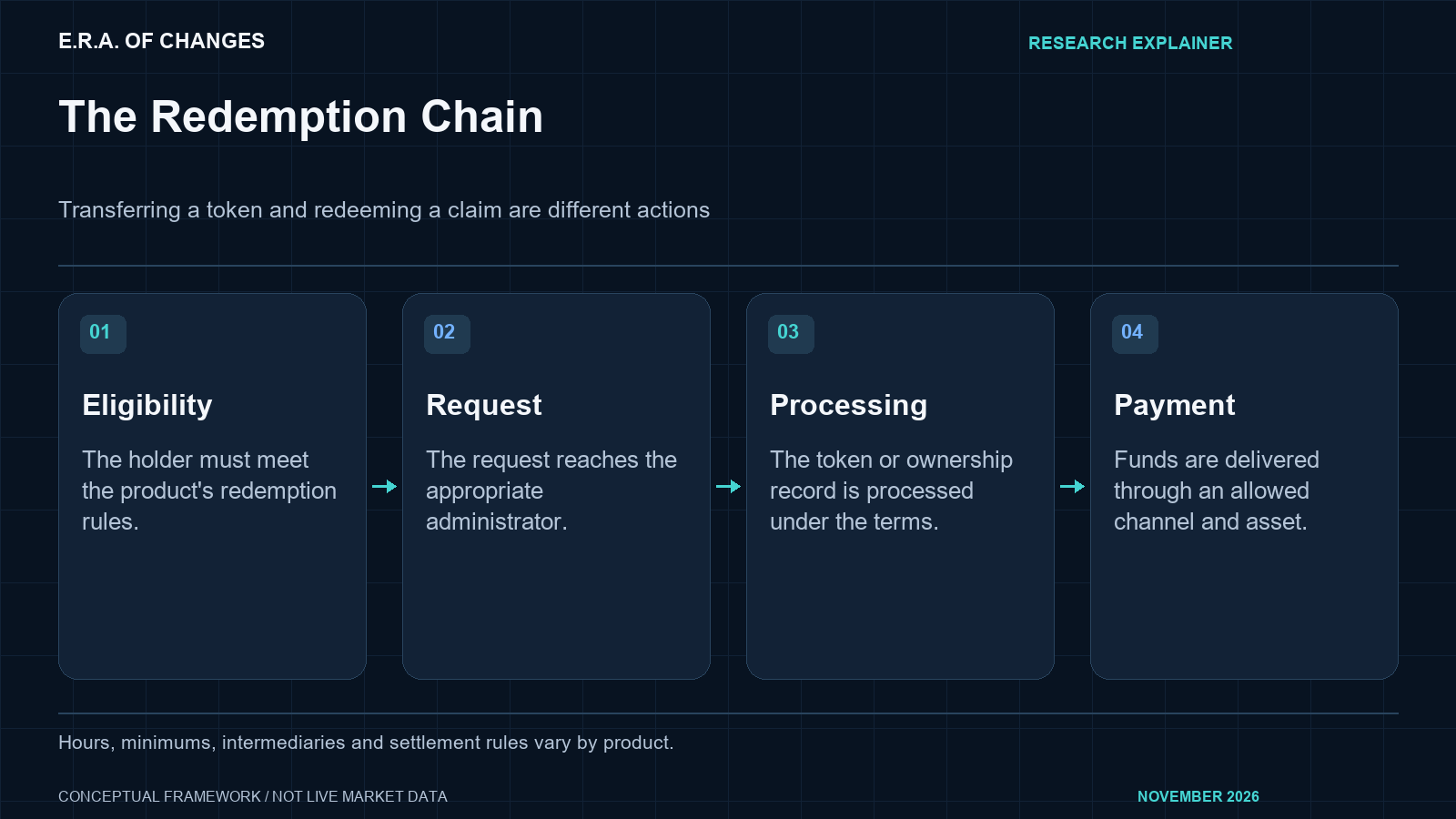
Imagine a holder requests to redeem a token representing an interest in a Treasury-backed fund. The holder first has to be eligible under the product's rules. The request must reach the appropriate administrator, the token or ownership record must be processed, and the payment has to be made in the asset and through the channel permitted by the documents.
That chain can depend on business hours, banking access, settlement infrastructure and minimum redemption amounts. If a token is sold to another investor on a secondary market, the holder is not necessarily redeeming with the issuer at all. The price received then depends on available buyers and market conditions. In stress, a token could trade at a discount even if the underlying assets have not suffered a comparable loss.
If the product allows settlement in a stablecoin, the final payment introduces the separate characteristics and risks of that settlement asset. A redemption described as “instant” in a normal operating setting may rely on a provider's prefunded liquidity or discretionary service arrangements. Check the binding terms rather than assuming that every part of the chain is continuous and unconditional.
Yield, fees and what the quoted number measures
A Treasury bill does not necessarily pay an ordinary periodic coupon; it is typically issued at a discount and redeemed at face value, subject to the terms of the security. A fund investing in short-term instruments may distribute income or reflect it in its share value according to its own structure. A token platform might display an annualized historical yield, a trailing distribution or an estimate. These are not interchangeable measures.
To compare two products, identify the observation date, calculation period, fee treatment, payout frequency and currency. A stated gross yield is not the same as the return after management expenses, network fees, entry and exit spreads, taxes and changes in the token's market price. A rate observed yesterday is also not a promise for the next year: underlying instruments mature and are reinvested under future conditions.
The US Treasury's explanation of Treasury bills describes their basic structure. It does not define the terms of a private token or fund. Those must be checked separately in the product's current materials.
Who can change or halt a transfer?
A token can sit on a public network while transfers remain permissioned. The relevant contract or transfer agent may have authority to approve wallets, correct records, pause transfers or apply compliance restrictions. Those controls can address legal and operational needs, but they mean that “on-chain” should not be equated with unrestricted, irreversible access.
For the reader, practical questions include whether administrative keys are controlled by one party or several, how lost credentials are handled, and whether the legal ownership register aligns with the token balance. Public descriptions may not answer every question. If a provider cannot explain the process, the correct conclusion is uncertainty, not an invented assurance or accusation.
Liquidity at three different layers
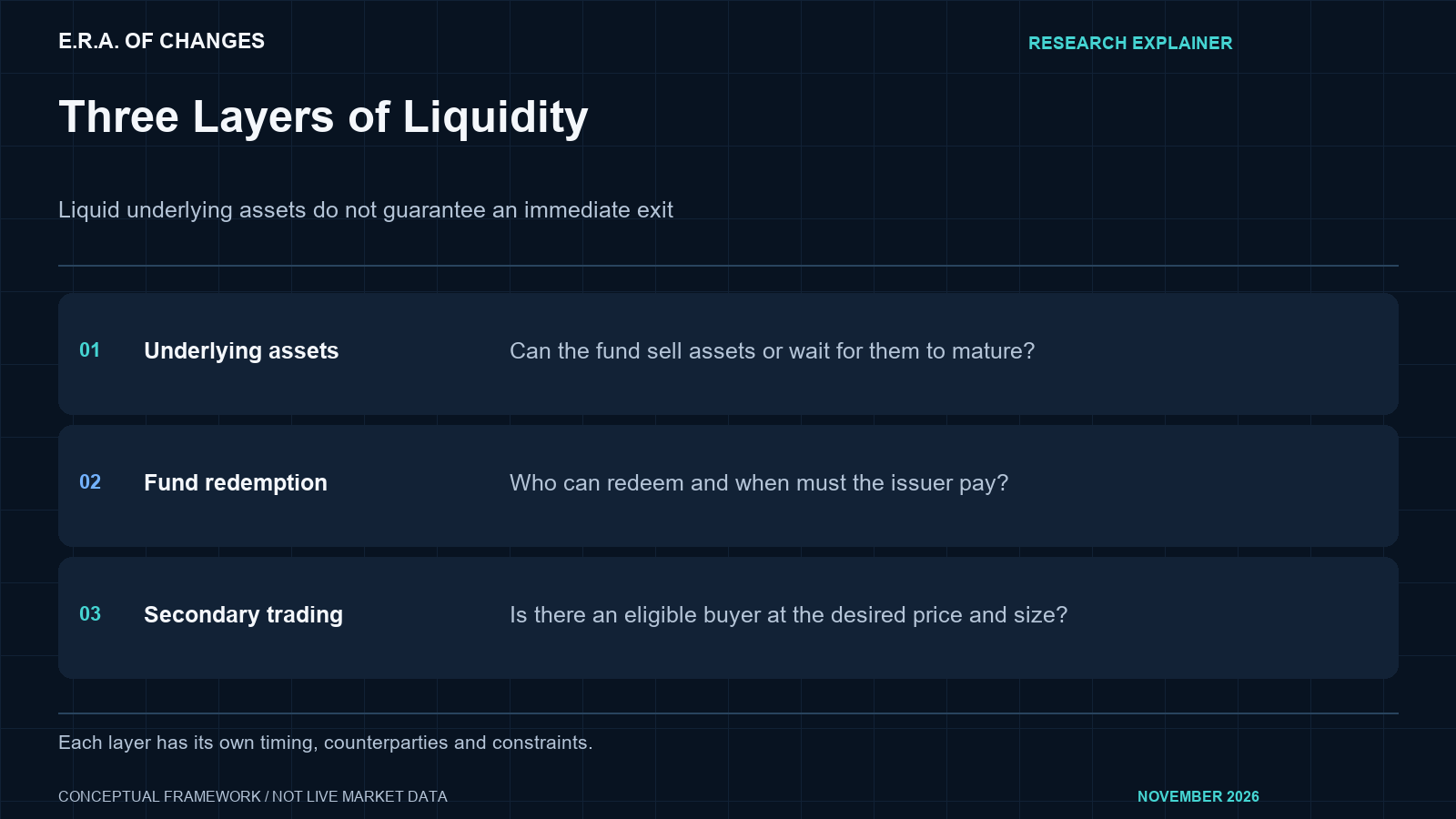
The phrase “liquid Treasury assets” can describe the fund's portfolio without describing the holder's immediate exit. Separate the process into three layers:
- Underlying assets: what can the fund sell or allow to mature, at what cost and through which counterparties?
- Fund or issuer redemption: who can request redemption, how is its value calculated, and when is payment due under the documents?
- Token trading: is there a secondary buyer eligible to hold the token, and how far could the execution price move for the size being sold?
The BIS's November 2025 bulletin on tokenized money-market funds identifies liquidity mismatch and operational dependencies as potential risks. It also notes that allow-lists can constrain direct holding. This does not establish that a particular fund will restrict redemptions or suffer a loss. It does show why the availability of Treasury bills in the wider market is not, by itself, a complete answer to whether an individual token holder can exit immediately at the displayed price.
Consider a hypothetical holder who is eligible to transfer a token but not to redeem directly with the fund. If the intermediary through which that holder normally exits becomes unavailable, the holder's practical choices may depend on other approved buyers and the contract with that intermediary. A different holder with direct redemption rights may face a different process. The distinction should be confirmed in the relevant documents, not inferred from the token's name.
Comparing the headline yield with the actual holding period
Suppose a platform displays an annualized yield of 4.0%. It does not follow that a holder will earn 4.0% over the next month or that the number is net of every cost. If the rate were hypothetically constant, a simple 30-day illustration gives approximately 0.33% before any costs, using 4.0% × 30 ÷ 365. That is a scaling exercise, not a forecast; the rate can change and the provider's calculation method may differ.
For example, an entry spread of 0.10% and an exit spread of 0.10%, if both apply to the position, would reduce that illustrative 30-day gross amount by about 0.20 percentage points, before any other fees or price changes. Do not subtract a fund fee twice if it is already reflected in the stated yield. Equally, a quoted yield should not be compared with a Treasury bill's discount rate until both are converted to consistent measures and periods.
What happens if a service provider fails?
There is no single answer. The outcome depends on which entity failed, who legally owns or holds the fund assets, the segregation and recordkeeping arrangements, applicable law and the product's contracts. A blockchain record may help identify transfers without independently resolving a dispute over ownership or access to assets held by an intermediary.
An investor should distinguish three questions: can the underlying assets be identified; can the holder's claim be established; and can that claim be processed promptly? Those questions can have different answers. An audit, attestation or smart-contract review may provide useful evidence, but its scope and date matter. A code audit is not automatically an audit of custody, legal rights or the issuer's balance sheet.
The BIS analysis of tokenized money-market funds discusses their use and the infrastructure around them. It is a market-level analysis, not a guarantee for a particular token. Product-specific due diligence remains necessary.
Questions for a product-by-product review
| Question | Why it matters |
|---|---|
| What legal right does the token represent? | It determines the holder's claim and remedies. |
| What assets are held and by whom? | It identifies underlying exposure and custody arrangements. |
| Who can redeem and under what conditions? | Technical transfer and contractual redemption are not the same. |
| What are the fees and distribution rules? | Gross asset yields and investor returns can differ. |
| Which service providers and controls are involved? | They can introduce operational and counterparty dependencies. |
| Is there an active secondary market? | A token's transferability does not establish market depth. |
How does this relate to stablecoins?
Some stablecoin issuers and tokenized funds may hold similar categories of short-term assets, but their legal claims, redemption mechanisms, objectives and price behavior can differ. A stablecoin generally seeks a reference value, while a tokenized fund interest represents the value of its own assets under its terms. Neither label alone guarantees liquidity or redemption in stress.
For a complementary analysis, see stablecoin risks, institutional crypto adoption and blockchain adoption by industry. These articles cover broader questions; product-specific claims require the relevant current documents.
Frequently asked questions
Is a tokenized Treasury fund the same as owning a Treasury bill directly?
Not necessarily. A fund token may represent an interest in a fund rather than direct ownership of a particular bill. The governing legal documents define the holder's claim.
Does a token's ability to transfer 24/7 mean it can be redeemed 24/7?
No. Transfer rules, service providers, eligible holders and redemption hours depend on the product. Transferability also does not guarantee a liquid market.
Is a tokenized money-market fund an insured bank deposit?
No. A money-market fund is an investment product, not a bank deposit. Its legal structure, protections and risks differ from those of an insured deposit account.
Can a token lose value if its underlying assets are Treasury bills?
Yes. The token's market price, fund value, fees or access to redemption can change. The exact exposures and legal rights depend on the product's structure.
What to check before investing
Tokenization may change how an interest is recorded and transferred, but it does not make every Treasury-linked product equivalent. Start with the holder's legal claim and follow the chain through assets, custody, redemption and technology. Those details are more informative than the token's marketing label.
Sources
- BIS: Financial Stability Implications of Tokenisation.
- Financial Stability Board: The Financial Stability Implications of Tokenisation.
- Franklin Templeton: OnChain U.S. Government Money Fund Prospectus.
- Investor.gov: Money Market Funds.
- TreasuryDirect: Treasury Bills.
- SEC Staff: Statement on Tokenized Securities, January 2026.
- BIS: The Rise of Tokenised Money Market Funds, November 2025.
Explore crypto research for more on digital-asset infrastructure and risks.
This material is for informational and educational purposes only and is not investment, legal or tax advice.