.....
De-dollarization is real. What it is not is a clean, linear process that ends with the dollar being replaced by something else on a predictable schedule.Historical COFER reporting put the dollar’s share of disclosed foreign-exchange reserves at roughly 71 percent in 2000; the IMF’s July 2026 COFER brief reports a 57.13 percent share in 2026Q1. The IMF revised its COFER series back to 2000Q1 in 2025Q3, so the historical figure is approximate context rather than a precise like-for-like comparison. That is a meaningful structural shift. No single currency absorbed the decline in the dollar’s COFER share; the change was distributed among other reported currencies. Separately, IMF data show gold’s share of total official reserves exceeded that of U.S. Treasuries in 2025, almost entirely because higher gold prices lifted gold’s market value. Source. Source. Source 3. Source 4.
In global FX markets, the dollar remains on one side of approximately 90 percent of all transactions, according to the BIS Triennial Central Bank Survey published in late 2025. Its role as the world’s primary funding currency, collateral asset, and cross-border settlement vehicle is structurally intact.
The picture is different in each market, and conflating them produces noise. My position, after reviewing three distinct data circuits, is this: the dollar is not being replaced. Its monopoly is being eroded at the margins in ways that matter asymmetrically. The most underpriced risk is not the gradual erosion everyone is tracking. It is a sudden confidence shock triggered by geopolitical or sanctions-driven events that forces sovereign institutions to reprice the legal and jurisdictional risk of holding Western reserve assets.
Key Takeaways
- De-dollarization is not the same thing as the collapse of the dollar.
- The process is strongest in reserve diversification, gold accumulation, and bilateral trade settlement, and it is progressing at meaningfully different speeds across these three circuits.
- The dollar remains overwhelmingly dominant in global FX markets, present on one side of 90 percent of all trades by value.
- A true BRICS common currency is politically and technically impossible within the next five years: Era puts the probability below 5 percent.
- A BRICS-linked clearing and settlement infrastructure operating outside SWIFT is far more plausible: Era puts the five-year probability above 65 percent.
- The voluntary diversification of Gulf oil settlement currencies carries a different and larger signal than Russia’s forced de-dollarization under sanctions.
- Central-bank gold purchases and Treasury auction indirect bidder trends are earlier and more reliable de-dollarization signals than the DXY.
- The biggest tail risk is a geopolitical or sanctions-driven confidence shock that accelerates reserve reallocation in a nonlinear way.
Introduction
Every few months, financial media announces the death of the dollar. A BRICS summit ends. A headline mentions yuan-denominated oil contracts. A central bank buys a hundred tonnes of gold. And somewhere, someone publishes a chart showing China’s declining Treasury holdings alongside a caption suggesting the end of dollar dominance is imminent.
I am skeptical of both versions of this story. The “dollar is finished” narrative is the easier one to dismiss: the structural and institutional depth that makes the dollar uniquely irreplaceable has not evaporated. But the “everything is fine” counterclaim (the one that relies on DXY levels and short-term Treasury demand to wave away structural shifts) is equally misleading. Something is happening. It is just not happening the way most of the commentary suggests.
There are really three separate questions embedded in the de-dollarization debate, and they are moving at very different speeds. Are central banks holding fewer dollars? Are countries settling less trade in dollars? Is the dollar losing its role at the center of global financial markets? The answers to those three questions are distinct, and they do not point in the same direction.
The dollar can lose marginal share without losing systemic dominance. That distinction matters enormously for how investors should think about this risk.
What Is De-Dollarization?
De-dollarization is the process through which governments, central banks, corporations, and financial institutions reduce their dependence on the U.S. dollar: as a reserve asset, a trade settlement currency, a commodity pricing standard, a borrowing currency, and a payment infrastructure. It is not a single event. It is not a declaration. It is a shift in revealed preferences that shows up first in data that most investors do not monitor in real time.
It does not mean the dollar disappears. It does not mean U.S. Treasuries stop functioning. It does not mean a new global reserve currency appears the morning after. These are the sensationalist frames that make for effective headlines and ineffective analysis.
The better mental model is that de-dollarization is a diversification process rather than a binary transition. The world is not moving from “dollar” to “non-dollar” on a scheduled date. It is developing parallel systems, allocating marginal reserves into alternatives, building settlement infrastructure that reduces (not eliminates) dollar dependence. The speed and ultimate endpoint of that process are genuinely uncertain. The direction is not.
How Far Has De-Dollarization Actually Gone?
The answer depends entirely on which market you are examining. Let me walk through the three circuits that produce the most reliable data.
1. Global Foreign-Exchange Reserves
This is where de-dollarization is most clearly visible and most carefully measured. The IMF’s COFER database tracks the currency composition of central-bank reserves worldwide and publishes it quarterly.
In the IMF’s revised COFER series, the dollar’s share of foreign-exchange reserves was 56.42 percent in 2025Q4 and 57.13 percent in 2026Q1. The IMF says dollar appreciation accounted for around half of the Q1 increase. The IMF introduced this revised series in 2025Q3 and revised observations back to 2000Q1; the historical comparison to roughly 71 percent in 2000 should therefore be treated as approximate, not an exact like-for-like change. Source. Source 2. Source 3. Source 4.
What replaced it is the key question. No single currency absorbed that shift. The euro sits at roughly 20 percent of disclosed reserves, below its 2009 peak of around 28 percent. The renminbi is at approximately 2 percent of disclosed global reserves, a meaningful gain from near-zero a decade ago but far below its weight in global trade and output. The rest of the movement went into what the IMF categorizes as “other currencies,” including the Australian and Canadian dollars and the Swiss franc, and most importantly into gold.
In 2025, gold surpassed U.S. Treasuries as a share of official global reserves. That is a statement worth sitting with. It happened without a single announcement, without a policy summit, without a currency bloc declaration. The IMF reported that gold’s share of official reserves exceeded U.S. Treasuries’ in 2025, driven almost entirely by gold-price valuation effects; that comparison alone does not show central banks sold Treasuries to buy gold, and the mainstream financial press covered it primarily as a commodity story. Source.
2. International Payment and Trade Settlement
SWIFT’s Global Currency Tracker, which expanded beyond its former RMB Tracker mandate in early 2026, provides the most comprehensive public data on currency shares in cross-border payments. As of June 2026, the dollar accounted for approximately 50 percent of total transaction value processed through the SWIFT network. The euro represented roughly 22 percent. The renminbi came in at approximately 3.1 percent, placing it fifth globally by payment value, up from under 2 percent three years ago, and up from essentially zero as a global payment currency a decade before that.
The SWIFT data tells part of the story. It does not tell all of it. SWIFT does not capture the bilateral settlement arrangements between Russia and China, which have largely migrated to ruble-yuan corridors. It does not capture the Russia-India channels that developed after the 2022 sanctions. It does not capture local-currency trade inside the Eurasian Economic Union, or the growing set of bilateral payment agreements between emerging-market central banks that bypass dollar intermediation entirely. Payment de-dollarization may be meaningfully further advanced than any single public dataset suggests.
3. The Global Foreign-Exchange Market
This is where the dollar’s dominance is most structurally intact, and where the de-dollarization narrative requires the most careful handling.
The BIS Triennial Central Bank Survey, published in late 2025 with April 2025 trading data, found the dollar present on one side of approximately 90 percent of all global FX transactions, up from 88 percent in the 2022 survey. Total OTC FX turnover reached $9.5 trillion per day. The dollar was present in virtually every aspect of that system: currency conversion, cross-border lending, derivatives, hedging, commodity pricing, and global banking. These functions are deeply embedded in financial infrastructure built over decades, and they do not shift because a central bank buys gold or a country settles a bilateral trade agreement in local currency.
Reserve diversification is real. Structural dollar embedment in global finance is equally real. Both things are true simultaneously.
Why Reserve Currency Status Matters
A reserve currency is not merely a coin people prefer to hold. It is a financial system. The institutions that manage global capital need deep liquid markets in which to park trillions of dollars in savings, reliable sovereign debt with genuine risk-free characteristics, free capital movement without political interference, legal predictability under rule of law, and a monetary institution credible enough that its currency retains value across political cycles.
The dollar offers all of this at a scale no competitor currently matches. Replacing a reserve currency does not require finding a currency people want to use. It requires finding a financial system large enough to absorb the world’s accumulated savings (approximately $12 trillion in disclosed currency reserves) and to replicate the depth, liquidity, and legal infrastructure that makes those reserves genuinely useful in a crisis.
This is why reserve-currency transitions happen slowly. The pound sterling took decades to cede primacy to the dollar, even after the United States had already become the world’s largest economy. The structural weight is enormous, and no government currently on offer has demonstrated the willingness to run the open capital account and deep sovereign debt markets that come with that role.
Is the Dollar Losing Its Reserve Currency Status?
Not yet, but its monopoly position is weakening at the margins, and that distinction matters.
Losing marginal share and losing systemic reserve status are different phenomena. The dollar today faces the former. The latter would require something more specific: a sharp decline in foreign Treasury demand, a sustained loss of global dollar funding demand, significant commodity settlement migrating outside dollars, alternative collateral markets achieving comparable depth, and a credible non-dollar clearing network operating at genuine scale. None of these conditions currently describe the global monetary system.
The dollar’s reserve status is not primarily held in place by fiat or political agreement. It is held in place by network effects: it is rational for each individual institution to use the currency that every other institution also uses. That is the actual moat. Breaking it requires building a credible alternative that achieves sufficient scale to make the switch rational for participants who currently have no incentive to be first movers.
BRICS Currency: Could It Really Replace the Dollar?
I want to be direct here, because there is an enormous amount of noise around this topic and vagueness serves no analytical purpose. A single BRICS currency comparable to the euro is not happening in the next five years. Era puts the probability below 5 percent. That is not rhetorical skepticism. It is a structural conclusion that follows from examining what a common currency actually requires.
What a Real BRICS Currency Would Require
The euro required two decades of institutional preparation: a supranational central bank with genuine monetary independence, common fiscal rules among participating governments, deep integration of sovereign debt markets, open capital accounts across all member states, and the political willingness of national governments to transfer monetary sovereignty to an external institution. The eurozone still struggles with several of these conditions today, which is why it continues to face periodic sovereign debt crises that would be impossible in a country with a unified fiscal system.
Apply that standard to BRICS. China maintains a closed capital account, a deliberate policy choice driven by the desire to retain control over domestic credit conditions and prevent speculative capital flows. India has no intention of harmonizing monetary policy with China, a neighbor with whom it has a disputed border and no strategic trust. Russia is under comprehensive Western financial sanctions that effectively exclude it from the dollar-denominated clearing infrastructure that any BRICS currency would need to interface with at launch. The Gulf states that recently joined the BRICS framework have pegged currencies to the dollar and financial systems deeply integrated with Western capital markets.
Who sets interest rates for all of them? The moment you ask that question, the architecture collapses. Common currencies require common monetary policy. Common monetary policy requires shared political legitimacy over economic decisions. That political legitimacy does not exist among BRICS members, and it will not be constructed in five years.
What Is More Likely Than a BRICS Currency?
A multilateral settlement and clearing network is far more plausible, and Era puts the five-year probability of a functional alternative to SWIFT above 65 percent.
The distinction is critical. A clearing network does not require common monetary policy, shared political sovereignty, or open capital accounts. Each participating nation retains its own currency. Transactions are routed through shared digital infrastructure, obligations are netted periodically (perhaps quarterly), and the settlement unit may be a reference basket tied to commodities or gold rather than any single national currency.
This is the direction that mBridge, the multi-CBDC platform developed by the central banks of China, Hong Kong, Thailand, and the UAE with the BIS Innovation Hub before BIS withdrew from the project in October 2024, has been moving toward. As of mid-2026, mBridge has settled approximately $55 billion in cross-border transactions. That is a fraction of SWIFT’s multi-trillion-dollar daily volume, but it demonstrates that the technical infrastructure can function. BRICS Pay, still in a pilot phase as of 2026, is aimed at extending similar logic to a broader membership. An IRIAS-led UNIT project says it minted an initial 100 tokens on October 31, 2025, to track a reserve basket it describes as 40% gold and 60% BRICS currencies, with one UNIT corresponding to one gram of gold. This was a project-level pilot, not an official BRICS-issued currency; its description is not independent proof of reserve backing. The pilot signals a broader settlement ambition, although UNIT remains at an early stage. Source. Source 2. Source 3.
The biggest challenge to dollar dominance may not be a new currency at all. It may be infrastructure that makes the dollar less necessary in a growing share of bilateral trade, quietly, without a single summit announcement.
The Petrodollar Explained
The “petrodollar” is a term that carries significant explanatory weight and is frequently misrepresented. It is not a formal treaty or a single binding pact. It refers to the structural relationship (deepened through U.S.–Saudi financial and security ties during the 1970s) through which global oil transactions were denominated in dollars, oil exporters accumulated dollar revenues, and those revenues were recycled into Western financial assets, principally U.S. Treasuries and dollar-denominated equity and real estate.
The mechanism it created is best understood as a closed loop. Oil demand generates dollar demand, which generates dollar reserves, which generates Treasury demand, which funds U.S. government borrowing at lower rates than would otherwise clear the market. The system has operated largely uninterrupted for fifty years and is one of the foundational structural supports of dollar primacy.
Every country that imports energy priced in dollars must hold dollar reserves to manage that exposure. Every central bank that prices its exports against dollar commodity benchmarks operates within the same structure. The petrodollar is, in a meaningful sense, a structural tax on global energy consumers that flows toward dollar reserve asset demand, and that demand has funded fifty years of U.S. current account deficits at artificially low borrowing costs.
Is the Petrodollar System Breaking Down?
At the edges, yes. At the center, not yet.
The dollar remains the dominant pricing and settlement currency for global oil and commodity markets, and that is unlikely to change in a binary way. What is changing is that the system is becoming less exclusive. Saudi Arabia has publicly acknowledged accepting yuan in oil payments to China. The UAE dirham and Indian rupee have appeared in bilateral energy settlement arrangements. Russia, excluded from dollar settlement by sanctions, has moved significant volumes to ruble-yuan and ruble-rupee corridors.
The question I keep returning to is: what is structural versus what is forced? Russia’s de-dollarization is sanctions-driven: it represents a constrained outcome, not a revealed preference among actors with genuine alternatives. China’s push for yuan oil settlement is constrained by its own closed capital account: exporters who receive yuan cannot easily deploy that capital outside China’s domestic market without running into convertibility barriers. These are real limits on the renminbi’s role even where geopolitical will exists.
Why Gulf Oil Settlement Could Be the Bigger Signal
The most underpriced development in this entire space (the one I believe the market is not adequately weighting) is the potential voluntary diversification by Gulf Cooperation Council states of the currencies in which they accept energy payment.
Russia’s de-dollarization did not happen by choice. It was imposed by the comprehensive sanctions regime introduced after February 2022. What Russia does in bilateral settlement with China or India reveals the resilience of those channels under duress, but it does not reveal what any actor would choose if given genuine alternatives. China’s constraints come from its own deliberate policy: the capital account is closed precisely because Beijing values monetary control over currency internationalization.
The Gulf states are different. Saudi Arabia, the UAE, and Qatar remain integrated with Western capital markets. Their sovereign wealth funds hold vast allocations in dollar-denominated assets. Their banking systems maintain correspondent connections to New York and London. Any diversification of energy settlement currencies they undertake is therefore genuinely voluntary.
The entire global system of dollar dominance in reserve management since 1974 rests on the petrodollar mechanism. If major energy exporters who face no forced incentive to move begin accepting yuan, dirham, rupee, or commodity-basket units as routine settlement vehicles, the mandatory dollar demand that the petrodollar loop creates begins to erode structurally rather than marginally. That is the signal to watch, not the next BRICS summit declaration.
Gold: The Quiet De-Dollarization Trade
Era Analyst’s Perspective
The gold trade is the de-dollarization trade nobody wants to call by its name. Central banks globally bought a net 863 tonnes of gold in 2025, more than double the 400 to 500 tonne annual average that prevailed before 2022, and the third consecutive year of purchases above 800 tonnes. The World Gold Council’s July 2026 update revised estimated Q1 2026 central-bank net buying from 244 tonnes to 57 tonnes. The World Gold Council’s July 2026 outlook expected central banks to remain significant buyers, but annual demand to finish below 2025’s 863 tonnes. These are not commodity cycle numbers. These are reserve management decisions. Source. Source 2. Source. Source 2. Source 3.
This follows directly from what happened to Russia’s foreign reserves in February 2022, when approximately $300 billion in sovereign assets held in Western jurisdictions were frozen. The message that sent to every central bank in the Global South (every institution managing national reserves for a country that is not firmly inside the Western political alliance) was unambiguous: dollar-denominated reserves held in Western-jurisdiction custodians are conditionally accessible. They are accessible until they are not.
Gold has no counterparty. It has no issuer. It cannot be sanctioned when held in domestic vaults. I track three categories of purchases with particular attention: China’s additions, which the People’s Bank has historically disclosed with significant delay and which independent analysts estimate are meaningfully higher than official figures suggest; India’s accelerating accumulation; and the Gulf states, whose disclosed purchases remain modest relative to the scale of their sovereign wealth. In 2025, central banks in 29 countries were net buyers of gold. The breadth of that buyer list is itself a map of which sovereign institutions have begun pricing political-jurisdiction risk into their reserve allocation.
The market frames this as a commodity story and monitors gold through ETF flows and retail sentiment. I monitor it as a proxy for sovereign-reserve risk appetite, and on that basis the signal it is currently sending is clear and consistent.
Gold offers a reserve-diversification option that solves a problem no competing fiat currency can solve: there is no issuing government. The renminbi is issued by Beijing. The euro is issued by Frankfurt. Gold is issued by nobody. For a central bank whose relationship with the United States, the European Union, or the G7 is uncertain, gold is the one reserve asset that carries no foreign counterparty credit exposure and is structurally immune to sanctions applied at the level of the custodian or the payment system.
The limitations are real. Gold produces no yield. It has storage and insurance costs. It does not work for day-to-day trade settlement. Its price in dollar terms is volatile, which creates valuation noise in reserve accounting. These constraints mean gold cannot replace fiat currencies in global finance, but they do not prevent it from playing an increasingly large role as a reserve anchor within a more multipolar monetary system. That is exactly what it is doing.
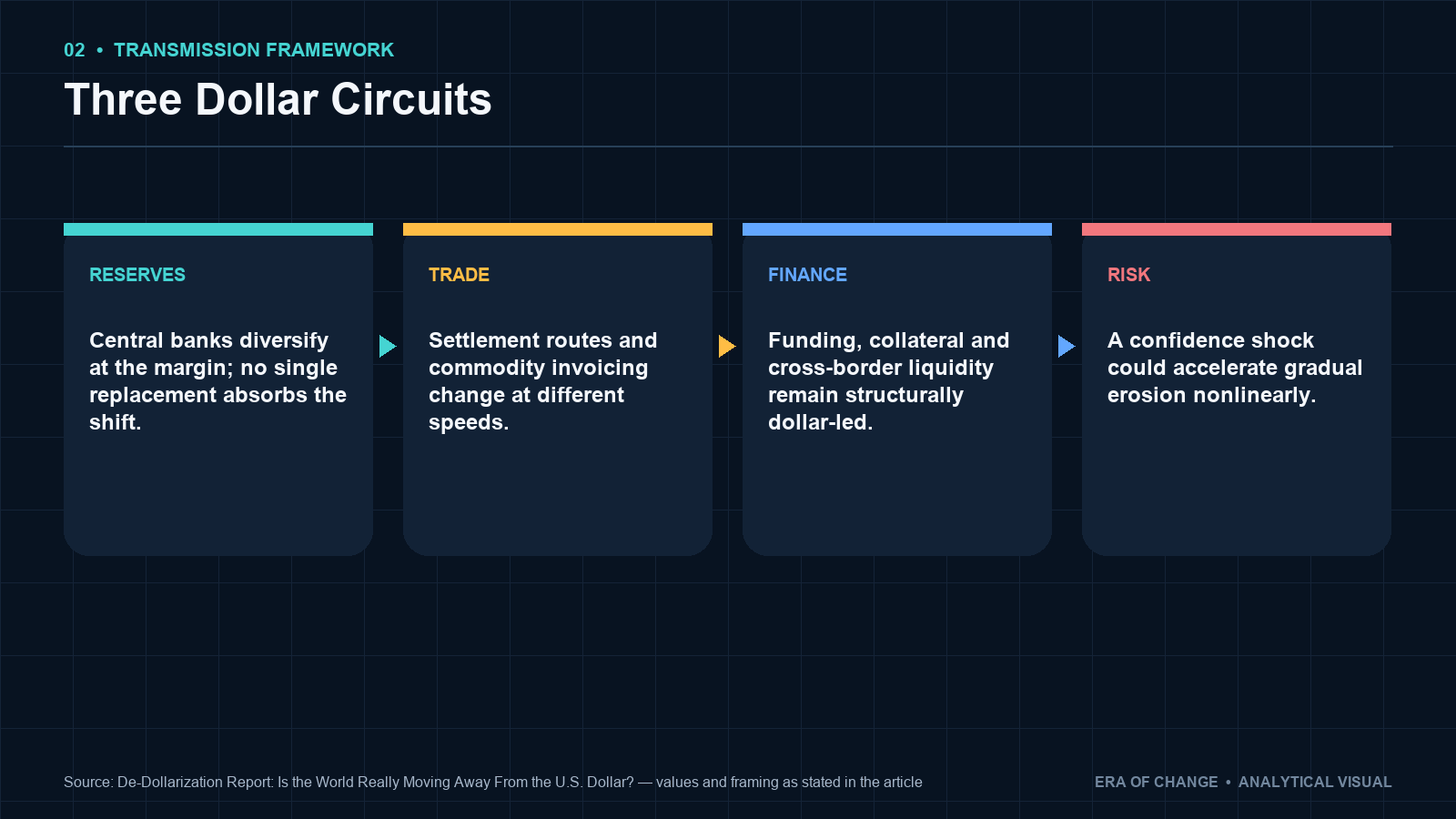
The Three Indicators Era Watches for Accelerating De-Dollarization
Every analytical framework requires observable signals, not theoretical proxies. These are the three data series I monitor most closely.
1. Central-Bank Gold Purchases
The most important leading indicator is the pace and geographic distribution of central-bank gold buying, particularly purchases that are disclosed late, disclosed in aggregate, or discovered through discrepancies between BIS international reserve data and national central-bank balance sheets. China’s gold additions have historically been reported with significant delay. The People’s Bank disclosed no additions for nearly two years before suddenly reporting 16 tonnes in December 2022 and resuming additions through 2023. The gap between official Chinese holdings (approximately 2,300 tonnes as of mid-2026) and what independent analysts estimate from gold import and domestic production data is material.
The signal I watch for is not month-to-month variation. It is a sustained acceleration of purchases by institutions that previously held minimal gold: Gulf sovereign wealth funds, South and Southeast Asian central banks, African central banks where commodity export revenues have historically been recycled into Treasuries. The broader the geographic distribution of buyers, the more clearly it reflects a structural rather than idiosyncratic portfolio shift.
2. U.S. Treasury Auctions
Treasury auctions are one of the most public real-time tests of global dollar demand. The key metrics are bid-to-cover ratios, auction tails (the spread between the clearing yield and the pre-auction when-issued rate), primary dealer take-down, and indirect bidder participation. Indirect bidders primarily capture foreign central banks and institutional investors bidding through custodian banks. They are the most direct observable proxy for foreign official demand that the public auction system produces.
The data through 2025 and into 2026 is mixed rather than alarming, but the variance has increased significantly. Some auctions have shown indirect bidder participation falling below 54 percent of total take-down, the weakest foreign participation in multi-year windows. Others have rebounded above 80 percent in episodes of risk-off flight to safety. The volatility itself is informative: demand that was once structurally predictable is now episodic and condition-dependent. That is a change in the character of the bid, not just its level. For the full sovereign-debt context, see Global Debt Risks 2026.
3. Offshore Dollar Funding Stress
The cross-currency basis (the cost of swapping non-dollar funding into dollars in global markets) is one of the most sensitive real-time gauges of dollar scarcity. A widening basis indicates that dollars are harder to obtain outside the United States than the interest-rate differential would predict. This indicator carries a counterintuitive implication worth stating explicitly: a world gradually reducing its structural dollar dependence is not necessarily a world with fewer episodes of acute dollar scarcity.
Reduced willingness to hold dollars as reserves does not automatically reduce demand for dollars during crises. Institutions that maintain dollar-denominated liabilities continue to need dollar access under stress regardless of what they hold as reserves on a normal day. The dollar can simultaneously face long-term diversification pressure and short-term scarcity during global stress events. Both dynamics can be true. The relevant question is whether the network of Fed swap lines (currently extending to fourteen central banks including those of the EU, UK, Japan, Canada, and Australia) would absorb future stress in a world where fewer institutions hold precautionary dollar reserves. The Era Global Risk Index monitors this funding layer as part of its 24-indicator systemic stress framework.
Why DXY Is a Poor De-Dollarization Indicator
The Dollar Index measures the dollar’s exchange rate against a basket of six currencies: the euro at 57.6 percent of index weight, the yen at 13.6 percent, the pound at 11.9 percent, the Canadian dollar at 9.1 percent, the Swedish krona at 4.2 percent, and the Swiss franc at 3.6 percent. Every single one of those currencies represents a developed economy with its own sovereign-debt trajectory and no particular incentive to diverge structurally from the dollar over the time horizons that matter for reserve management.
None of the dynamics that actually define de-dollarization appear in the DXY. It does not capture the renminbi’s share of SWIFT payments. It does not capture central-bank gold purchases. It does not capture bilateral settlement arrangements between China and Russia, or China and Saudi Arabia. It does not capture Treasury indirect bidder participation. It does not capture the pace at which Global South institutions are substituting gold for dollar-denominated reserves.
A strong DXY tells you the dollar is performing well against the euro and the yen. It tells you very little about whether the dollar’s structural role in global monetary infrastructure is strengthening or weakening. These are different questions, and conflating them produces the misleading conclusion that de-dollarization is a narrative rather than a process.
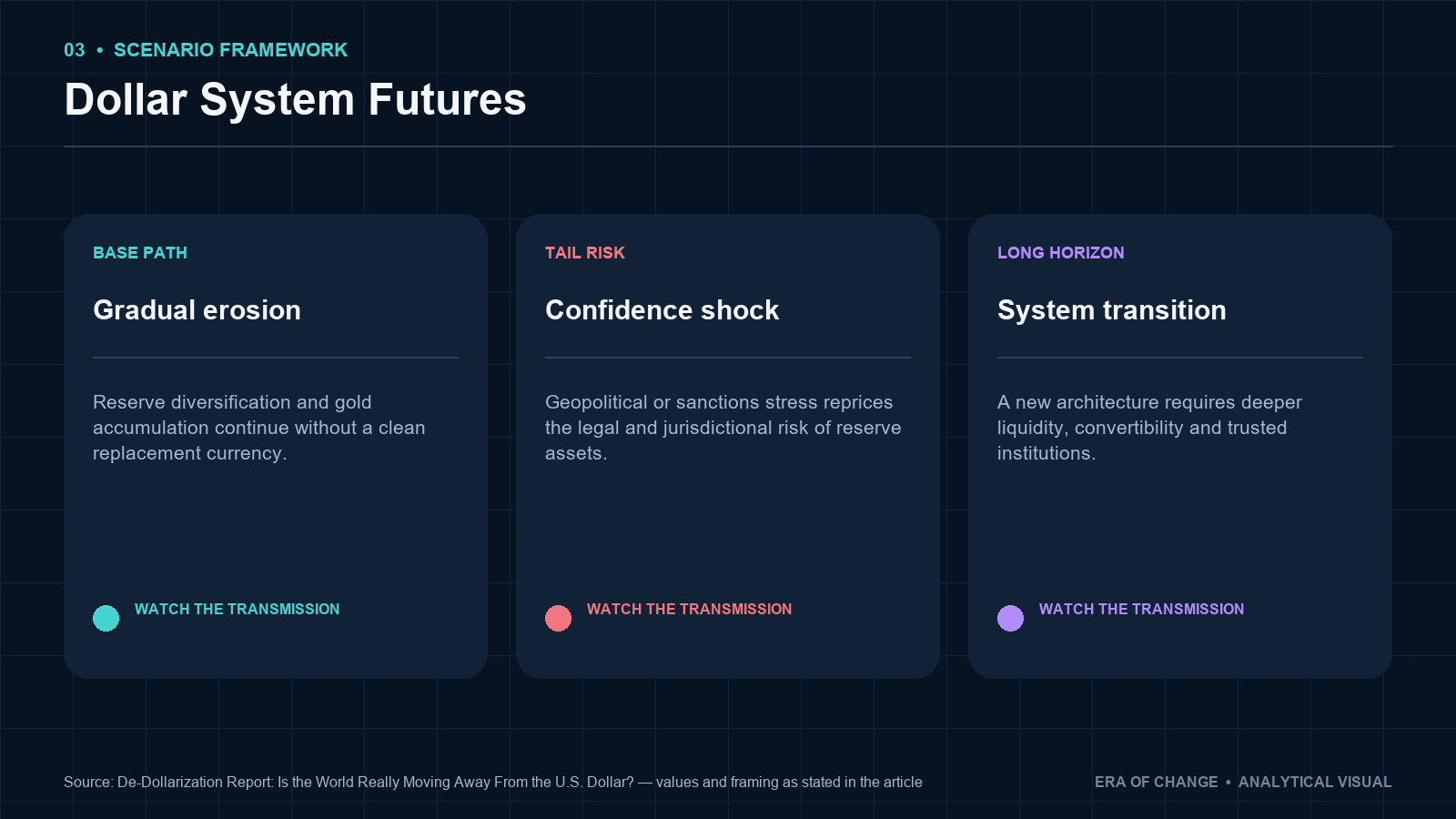
Gradual Erosion vs. Sudden Confidence Shock
I want to spend time on the risk distribution here, because I believe the market is pricing the wrong scenario as the primary one.
Scenario 1: Gradual De-Dollarization
The scenario most investors are implicitly modeling is a slow, orderly, decades-long process. Dollar reserve share declines by a percentage point or two per year. Gold allocations rise gradually. Regional payment systems develop alongside SWIFT rather than replacing it. More bilateral trade settles in local currencies at the margin. The dollar remains dominant in FX turnover and global funding markets throughout. Outcome: a multipolar monetary system achieved through decades of incremental adjustment, without a triggering event. This scenario is plausible and probably represents the central case.
Scenario 2: Sudden Confidence Shock
The scenario I believe is most underpriced is a rapid, nonlinear event triggered not by economic fundamentals but by legal and jurisdictional risk. The trigger would be one of the following: the permanent confiscation and redistribution of frozen Russian sovereign reserves by Western jurisdictions, which would transform the precedent from “frozen for coercive purposes” to “seized as punishment”; the application of secondary sanctions to the clearing banks of major neutral-country participants (China, UAE, India) in ways that make their dollar-system participation legally uncertain; or restrictions targeting financial infrastructure that neutral sovereign wealth funds and central banks depend on for custody, settlement, and counterparty access.
Any of these events would not destroy confidence in the U.S. economy. They would destroy confidence in the legal predictability of holding Western reserve assets for institutions that are geopolitically neutral or unaligned. The transmission would run in sequence: a legal or geopolitical shock triggers reassessment of reserve risk, institutions that cannot afford frozen reserves begin reducing Western-asset exposure, Treasury selling pressure increases, term premiums widen, funding conditions tighten, and potentially central-bank intervention follows. The critical point is that this scenario does not require investors to lose faith in U.S. economic fundamentals. It requires them to begin pricing the legal-jurisdiction risk of reserve custody, a consideration that was essentially zero-rated before February 2022 and is now, quietly, a live variable in sovereign reserve management.
The Frozen-Reserve Precedent
I want to be careful here, because this is an area where the analytical and the political intertwine in ways that require precision.
Central banks have historically treated foreign-exchange reserves as liquid, safe, and accessible during emergencies: the classic rainy-day fund. The principal risks priced into sovereign reserve management were exchange-rate risk and credit risk of the issuer. Political-access risk (the possibility that a reserve asset held in a foreign jurisdiction could become inaccessible because of geopolitical alignment) was essentially not modeled as a meaningful probability in reserve allocation decisions.
The freezing of approximately $300 billion in Russian sovereign reserves by G7 jurisdictions in February 2022 was the single most consequential event in reserve management thinking in the post-Bretton Woods era. It demonstrated that reserves held in foreign custodians are legally conditional in a way that was previously theoretical rather than operational. Whether one agrees or disagrees with the policy decision, the analytical consequence is unavoidable: any central bank managing reserves for a government that cannot fully guarantee its permanent alignment with Western policy preferences now faces a risk that did not previously appear in the probability distribution it uses to allocate reserves.
The ongoing debate about whether those frozen assets should be permanently confiscated (proposed as a mechanism to fund reconstruction) is continuing as of mid-2026. If that proceeds, the precedent shift is qualitative, not quantitative. I believe that event, if it materializes, would represent the confidence-shock trigger in its clearest form. It would not be the end of the dollar. It would be the beginning of a much faster version of what is currently happening slowly.
What Would the End of Dollar Dominance Actually Look Like?
Not a single announcement on a single morning. The dollar’s dominance would erode through balance-sheet and infrastructure changes that accumulate over years before any formal acknowledgment that the monetary system has shifted.
The observable markers would be: dollar reserve share declining materially below 50 percent and continuing to fall; energy routinely priced and settled in multiple currencies at scale, not as exceptional bilateral arrangements; large non-dollar sovereign bond markets deep enough to absorb global reserve flows; BRICS or equivalent clearing infrastructure handling significant volumes of global trade; global banks substantially reducing dollar funding dependence; U.S. Treasury indirect bidder participation declining structurally across auction types; dollar FX turnover share declining materially from its current 90 percent; and alternative collateral (gold, SDR-linked instruments, possibly CBDC baskets) achieving wide acceptance in global clearing.
We are not there. We are at the beginning of some of these dynamics, in some of these markets, some of the time. That is what makes the analytical question difficult, and what makes the confidence-shock scenario particularly consequential, because it could accelerate a decades-long process into a much shorter timeframe.
Why the Renminbi Cannot Yet Replace the Dollar
I want to answer this question with precision rather than bias in either direction.
The renminbi’s constraints are structural and largely self-imposed. China’s capital account remains closed by deliberate policy choice. A yuan earned by a Russian energy company, a Saudi oil producer, or a Brazilian commodity exporter cannot be freely converted into other currencies or deployed outside China’s domestic financial system without running into convertibility restrictions. This limits the incentive for any counterparty to hold yuan as a reserve asset: you cannot put it to work the way you can a dollar, a euro, or even a yen. The offshore yuan market provides limited liquidity by comparison.
China’s domestic bond market (the world’s second largest by size) is not sufficiently open, transparent, or legally predictable for foreign institutions to hold trillions in reserve-quality assets. Legal recourse for foreign holders of Chinese sovereign debt in a dispute remains opaque by comparison with U.S. Treasuries, where the rule-of-law infrastructure is, whatever its political imperfections, institutionally deep.
And yet the renminbi is gaining real ground. Its share of SWIFT payments has grown from near-zero to over 3 percent in five years. China’s commodity demand has given it genuine leverage to negotiate yuan-settlement agreements in energy and raw materials. The CIPS (China’s Cross-Border Interbank Payment System) processed over $12 trillion in transactions in 2024. These are not trivial developments. The honest conclusion is that the renminbi can gain significant share without becoming the singular global reserve anchor. It may settle into a role analogous to the euro in the early 2000s: important in its own region and in bilateral corridors connected to China’s economy, but not yet a genuine alternative to the dollar’s global anchor function, while still representing a measurable decline in dollar dominance.
What De-Dollarization Means for U.S. Treasuries
This is where de-dollarization connects most directly to market prices that investors hold today. The petrodollar loop (energy demand generates dollar demand generates reserve accumulation generates Treasury demand) has provided a structural bid for U.S. government bonds for five decades. If that loop weakens, the consequences flow through the term premium, through funding costs for U.S. government borrowing, and ultimately through the rates that American businesses and consumers pay for credit.
The transmission is not binary. Foreign central banks are one component of Treasury demand, not the whole. Domestic U.S. financial institutions, money market funds, banks, insurance companies, pension funds, remain critical buyers. Fed monetary policy provides a further backstop. But structural weakening of foreign official demand would require either higher yields to clear the market, greater domestic absorption, or Fed intervention, all of which have secondary consequences for financial conditions. For the full context of U.S. sovereign debt dynamics, see Global Debt Risks 2026.
What De-Dollarization Means for Investors
The implications are scenario-dependent rather than directionally simple, and I want to resist the temptation to offer a neat trade thesis that oversimplifies a genuinely complex structural shift.
For the U.S. dollar, gradual diversification pressure coexists with continued safe-haven demand in crisis episodes. The dollar can weaken structurally over years while strengthening sharply during any global stress event that triggers flight to quality. These are not contradictory: they operate on different timescales and in response to different triggers.
For U.S. Treasuries, the key variable is whether the structural demand base is widening or narrowing. Over a five-year horizon, the answer is likely narrowing at the margin, which means greater sensitivity to supply, term premium, and auction quality than investors accustomed to structurally suppressed Treasury yields have needed to price.
For gold, the de-dollarization environment is structurally supportive. Central-bank purchases at the current pace represent a demand floor that operates independently of retail sentiment or ETF flows. For commodities broadly, the shift toward multi-currency settlement introduces complexity for hedging and pricing models without necessarily changing fundamental demand dynamics. For multinational companies, the growing fragmentation of payment infrastructure and the risk of being caught between competing compliance regimes (Western sanctions on one side, potential secondary regulatory pressure from alternative systems on the other) creates a risk management challenge that most corporate treasury functions are not yet equipped to handle well. For the geopolitical risk transmission mechanism in full, see How Political Events Affect Financial Markets and Currency Crises Explained.
Three De-Dollarization Scenarios for the Next Five Years
I use scenarios as an analytical discipline rather than a prediction methodology. They are not a forecast of what will happen. They are a map of what different futures would require to be true.
In the base case (gradual multipolarization), the dollar retains its dominant position but continues losing reserve share at a pace of one to two percentage points annually. Gold purchases remain elevated. The renminbi’s SWIFT share expands toward 5 to 6 percent. Regional payment systems develop and scale, handling growing volumes of bilateral trade without replacing SWIFT as the primary global network. Gulf states settle a growing minority of energy exports in non-dollar currencies without publicly departing from the petrodollar framework. Outcome: dollar dominance weakens at the margin, the term premium on Treasuries rises gradually, and investors in gold and commodity-linked assets benefit from structural diversification demand.
In the accelerated case (which Era assigns a probability above 65 percent within five years), a functional non-SWIFT clearing infrastructure achieves meaningful operational scale, Gulf states make a more public and formal shift in energy settlement practices, and reserve diversification accelerates. The renminbi’s SWIFT share approaches 8 to 10 percent. mBridge or equivalent CBDC infrastructure begins handling hundreds of billions in annual volume. Central-bank gold purchases remain at current levels or higher. This is the scenario where de-dollarization transitions from a narrative to a measurable structural shift visible to mainstream financial markets.
In the shock case (which I believe is underpriced relative to its actual tail probability), a geopolitical or sanctions event triggers rapid, nonlinear reallocation of sovereign reserves. Treasury selling pressure spikes. Gold demand accelerates abruptly. The Fed faces a choice between allowing yields to rise to clear the market or intervening in ways that create second-order inflationary consequences. This scenario does not require a war or an economic crisis. It requires a legal or geopolitical decision that crosses a threshold, forcing institutions that have been passively reducing dollar exposure to do so actively and immediately. That threshold is closer today than it was in January 2022. The full geopolitical context of the shock scenario is detailed in Top 5 Global Geopolitical Risks 2026.
Frequently Asked Questions
What is de-dollarization?
De-dollarization is the process through which governments, central banks, corporations, and financial institutions reduce their dependence on the U.S. dollar as a reserve currency, trade settlement vehicle, commodity pricing standard, borrowing currency, and payment infrastructure. It is not a single event or transition point. It is a structural diversification process progressing at meaningfully different speeds across different markets and different types of dollar use.
Is de-dollarization actually happening?
Yes, but the word covers three distinct processes moving at very different speeds. Central-bank dollar reserve share was roughly 71 percent in historical COFER reporting for 2000; the IMF reported 57.13 percent in 2026Q1. The dollar’s share of SWIFT payment value sits at around 50 percent as of June 2026. But in the global FX market, the dollar remains on one side of 90 percent of all transactions. De-dollarization is real in reserve management and gradually real in trade settlement. It has not yet reached the core of global financial infrastructure. Source. Source 2. Source 3. Source 4.
Is the U.S. dollar losing reserve currency status?
Not yet in a systemic sense, but its monopoly position is weakening. Losing marginal reserve share is different from losing systemic reserve status. The dollar remains the primary reserve, collateral, funding, and settlement currency in global finance by a wide margin. The trend in reserve share is downward; the markers of genuine systemic displacement have not yet appeared.
Will BRICS create a new currency?
Not within the next five years. Era puts the probability below 5 percent. A common currency requires a supranational central bank, shared monetary policy, common fiscal rules, open capital accounts, and willingness by member governments to transfer monetary sovereignty: none of which is present among BRICS members in any realistic near-term scenario. China’s closed capital account alone makes it structurally incompatible with the requirements of a functioning common currency.
What is more likely than a BRICS currency?
A multilateral clearing and settlement infrastructure that reduces dependence on the dollar without creating a common currency. National currencies remain sovereign, transactions route through shared digital infrastructure, and settlement uses a reference basket or CBDC framework rather than a new fiat currency. Era puts the probability of a functional alternative settlement system within five years above 65 percent, based on the current pace of mBridge development and BRICS payment system planning.
What is the petrodollar?
The petrodollar refers to the structural system through which global oil is primarily traded and priced in dollars, generating mandatory dollar demand from any country that imports energy, and recycling oil exporters’ dollar revenues into U.S. Treasuries and dollar-denominated financial assets. It is not a formal treaty. It is a structural arrangement deepened through U.S.–Saudi financial ties in the 1970s and has been the foundational source of structural non-U.S. demand for the dollar and for Treasuries for five decades.
Is the petrodollar ending?
It is becoming less exclusive, not ending. The dollar remains the dominant pricing and settlement currency in global energy markets. What is changing at the margins is that some bilateral energy transactions (particularly between China and Gulf producers, and between Russia and its remaining trade partners) are settling in non-dollar currencies. The structural mechanism remains intact, but cracks in its exclusivity are now visible.
Why are central banks buying gold?
Because gold is the only reserve asset with no counterparty risk, no issuer, and no jurisdiction that can sanction its holders when it is stored domestically. The freezing of Russian sovereign reserves in February 2022 demonstrated that dollar assets held in foreign jurisdictions are conditionally accessible: accessible until geopolitical circumstances make them inaccessible. Central banks that cannot guarantee their permanent alignment with Western policy preferences are now pricing that risk into their reserve allocation. Gold is the hedge against jurisdictional risk.
Can the Chinese yuan replace the U.S. dollar?
Not in the near to medium term, and not in its current form. The yuan’s capital account is closed by deliberate policy choice. Yuan earned outside China cannot be freely converted or invested globally. China’s bond market lacks the openness, legal predictability, and depth that reserve-quality asset status requires. The renminbi can gain significant share in bilateral corridors and regional trade without becoming the global reserve anchor.
What would end dollar dominance?
A combination of structural and event-driven developments: dollar reserve share falling materially below 50 percent and continuing to fall; energy routinely settled in multiple currencies at scale; large non-dollar sovereign bond markets deep enough to absorb global reserve allocation; BRICS or equivalent infrastructure handling substantial global trade; structural decline in Treasury indirect bidder participation; and dollar FX turnover share declining materially from its current 90 percent. We are at the beginning of some of these dynamics. We are not at their endpoint.
How does de-dollarization affect U.S. Treasuries?
Primarily through the structural demand channel. The petrodollar recycling mechanism has provided a structural bid for Treasuries for decades. As foreign official demand becomes more episodic and condition-dependent, the term premium required to clear Treasury supply rises, which increases U.S. government borrowing costs and transmits into broader financial conditions. The process is gradual, not binary, but the direction of the structural demand base over a five-year horizon is likely narrowing.
What indicators show de-dollarization is accelerating?
The three I monitor most closely: the pace and geographic distribution of central-bank gold purchases, particularly from Global South and Gulf institutions; U.S. Treasury auction metrics including indirect bidder participation and auction tails; and the cross-currency basis, which measures dollar scarcity in offshore funding markets. DXY is the least useful single indicator because it measures the dollar only against other developed-market currencies facing similar structural pressures.
About E.R.A. OF CHANGES
E.R.A. OF CHANGES is an independent macroeconomic research and geopolitical intelligence firm providing institutional-quality analysis to investors worldwide. Our research combines macroeconomics, financial markets, blockchain analytics, and geopolitical risk into proprietary forecasting frameworks designed to identify structural market trends before they become consensus. The Era Global Risk Index (updated daily from 24 structural indicators) serves as the foundation of our analytical methodology, providing a forward-looking measure of systemic financial stress grounded in structural economic evidence rather than market sentiment. Our full methodology, live index reading, and forecast archive are available at eraperemen.info/en.
The content published by E.R.A. OF CHANGES is for informational and educational purposes only and does not constitute financial, investment, legal, or tax advice. All views expressed are the personal analytical perspective of the author. Past forecast accuracy does not guarantee future results. Readers should conduct their own research and consult a qualified financial professional before making any investment decisions.
Sources
- IMF COFER: Currency Composition of Official Foreign Exchange Reserves
- IMF Data Brief: COFER Q1 2026
- IMF Blog: Dollar’s Share of Reserves Held Steady in Q2 2025 When Adjusted for FX Moves
- SWIFT Global Currency Tracker, July 2026
- SWIFT RMB Tracker, January 2026
- BIS: OTC Foreign Exchange Turnover in April 2025 (Triennial Survey)
- World Gold Council: Gold Demand Trends, Full Year 2025
- World Gold Council: Central Bank Gold Statistics, July 2026
- Era Global Risk Index
- Era CrisisMeter Explained
- Era Forecasting Methodology
- Global Debt Risks 2026
- Currency Crises Explained
- How Political Events Affect Financial Markets
- Top 5 Global Geopolitical Risks 2026
- Scenario Planning for Investors