Executive Summary
When a recession begins, most investors assume the central bank simply cuts rates and growth comes back. It’s a reasonable assumption, and it’s wrong often enough to matter. Central banks do not fix recessions directly. What they actually do is try to restore liquidity, lower borrowing costs, stabilize credit markets, and stop an economic slowdown from turning into a financial crisis. Those are related goals, but they are not the same goal, and the gap between them is where most of the confusion about monetary policy lives.
Their toolkit runs from interest-rate cuts through quantitative easing, emergency lending facilities, forward guidance, and a set of quieter reserve and collateral measures that rarely make headlines but matter enormously when funding markets seize up. These tools work best when inflation is contained and the banking system is structurally sound. They work far less well when the economy is facing stagflation, when debt loads are already excessive, when supply itself is constrained, or when bank balance sheets are damaged rather than merely illiquid.
For an investor, the question that actually matters isn’t whether rates are being cut. It’s why they’re being cut, and whether the liquidity a central bank injects is actually reaching the real economy or just sitting on bank balance sheets. I’ll walk through both, and I’ll be direct about where central bank power runs out.
Key Takeaways
- Central banks fight recessions primarily by easing monetary and liquidity conditions, not by directly creating demand.
- Interest-rate cuts are the first tool used, but they are frequently not sufficient on their own.
- Quantitative easing supports bond markets and system-wide liquidity once policy rates approach their practical lower bound.
- Emergency rate cuts, delivered outside a scheduled meeting, more often signal financial stress than improving conditions.
- Central bank policy transmits through credit markets and bank balance sheets; it does not act on GDP directly.
- High inflation and heavy debt loads can severely constrain how aggressively a central bank is able to respond.
Introduction
When a recession begins, investors often assume the central bank can simply cut interest rates and growth comes back on its own. That assumption isn’t crazy; it’s the mechanism that has worked, more or less, in most postwar U.S. recessions. But it skips over a lot of machinery, and in some environments the machinery breaks.
A rate cut doesn’t put money in anyone’s pocket. It changes the price of borrowing, and then it waits: for banks to actually lend at the new, lower cost, for businesses and households to actually want to borrow, and for that borrowed money to actually get spent or invested rather than parked. Each of those handoffs can fail independently, and when enough of them fail at once, a central bank can cut aggressively and still watch credit conditions tighten.
So the real question, the one this article is built around, is this: what can central banks actually do during a recession, and where exactly do their tools stop working?
What Is Central Bank Policy?
Central bank policy is the set of decisions a monetary authority makes about the price and availability of money and credit in an economy, primarily through interest rates, balance-sheet operations, and bank regulation. It is built around a small number of objectives that show up, in one form or another, in nearly every central bank’s mandate: price stability, financial stability, sustainable employment or economic activity, a functioning payment system, and public confidence in the banking sector.
The four institutions that matter most for global markets each weight these objectives a little differently. The Federal Reserve operates under a formal dual mandate: price stability and maximum employment. The European Central Bank has a single primary objective, price stability, with growth support as secondary. The Bank of England targets inflation directly, currently 2%, with financial stability as a parallel statutory responsibility. The Bank of Japan has spent a generation fighting deflation rather than inflation, which is a genuinely different problem and explains why its policy instincts often run opposite to the others’. I won’t spend more time on institutional history here; what matters for this piece is function, not origin story.
Why Recessions Require a Central Bank Response
A recession doesn’t arrive as a single event. It’s a feedback loop, and understanding the loop is what makes the rest of this article make sense. Economic activity slows. Business revenue weakens as a result. Lending standards tighten because banks see that weakening revenue and reprice their risk accordingly. Investment and hiring decline because credit is now harder and more expensive to get. Defaults start rising among the most leveraged borrowers. Banks respond by becoming even more cautious. And that caution, the tightened lending standards, reinforces the original downturn instead of cushioning it.
Central banks intervene to interrupt that loop, and the distinction I want to draw here is one that gets lost constantly in financial media: central banks cannot directly create demand or productive investment. They cannot make a homebuilder build, or a manufacturer hire, or a household spend. What they can do is influence the financial conditions under which households, companies, and governments borrow and spend: the price of credit, the availability of credit, and the confidence that credit will remain available. Everything downstream of that is up to the actual economy to decide.
The Main Tools Central Banks Use During Recessions
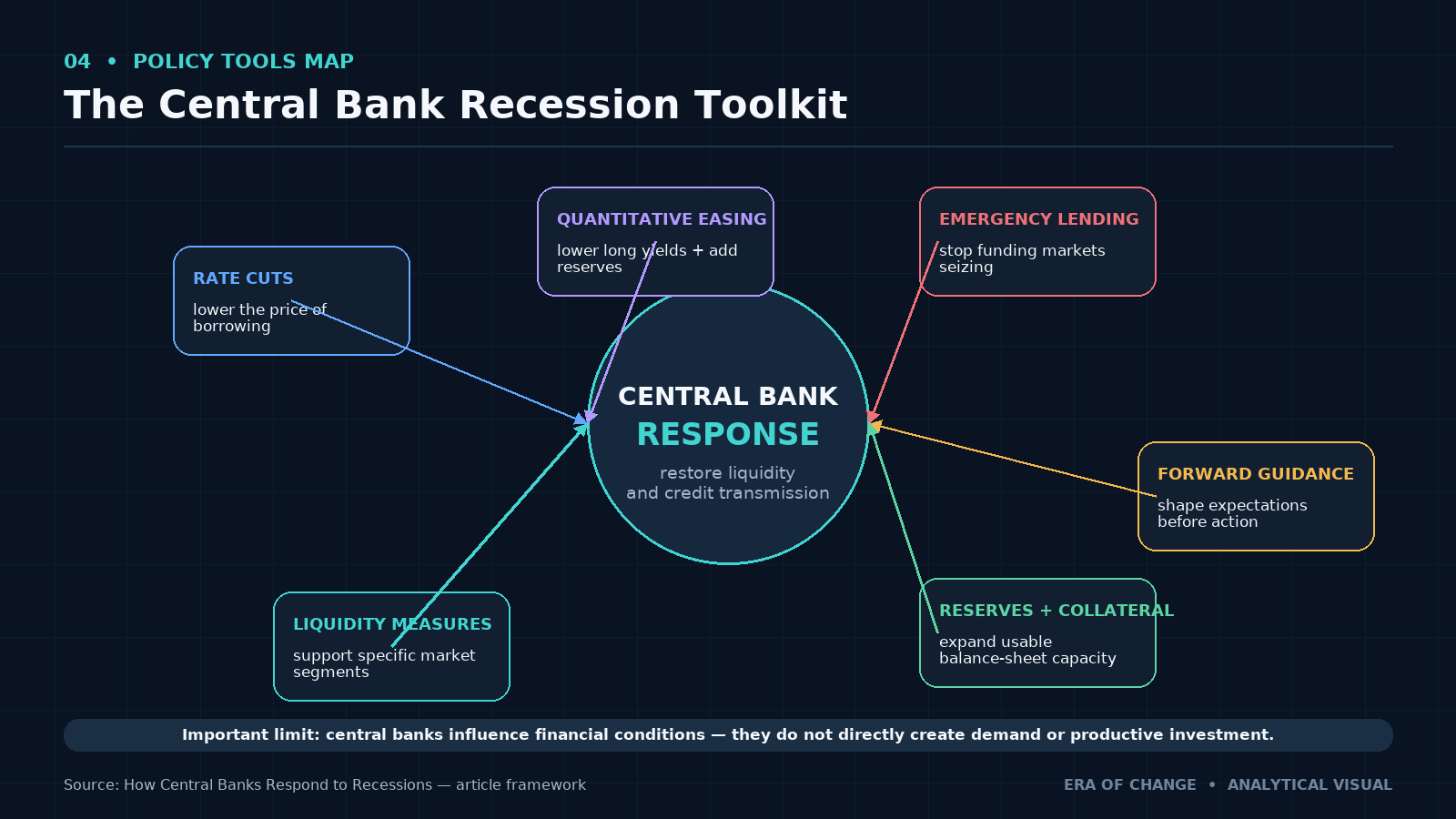
Cutting Policy Interest Rates
The policy rate, the fed funds rate in the U.S., the deposit rate at the ECB, is the rate at which banks lend to each other overnight, and it functions as the anchor for the cost of money throughout the financial system. When a central bank cuts it, the cost of interbank funding falls immediately. What follows is slower: banks gradually pass lower funding costs through to mortgages, corporate loans, and credit lines, and lower rates mechanically raise the present value of future cash flows, which is why equity and bond valuations respond to rate expectations well before any cut actually happens.
That transmission runs with a lag, historically six to eighteen months before the full effect on the real economy shows up, and it doesn’t move uniformly. Mortgage rates, corporate borrowing costs, and credit-card APRs each respond on their own schedule, shaped by competition, credit risk, and how banks are managing their own balance sheets. The investor implication here is one I want to state plainly: a rate cut is not automatically bullish. If the Fed is cutting because credit conditions are deteriorating rapidly rather than because inflation is cooling in an orderly way, the cut is a symptom, not a cure. I’ll come back to that distinction in detail later in this piece, because I think it’s the single most misunderstood part of how markets react to monetary policy.
Quantitative Easing Explained
Quantitative easing is large-scale central bank purchases of government bonds, and in some episodes, other securities such as agency mortgage-backed debt or, briefly in 2020, corporate bonds. The mechanism works in two ways at once. First, buying large volumes of longer-term government debt pushes those bond prices up and yields down directly, which lowers the cost of long-term borrowing throughout the economy: mortgages, corporate bonds, everything priced off the Treasury curve. Second, the purchases inject reserves into the banking system, which supports market liquidity and, through what’s known as the portfolio-rebalancing effect, pushes investors who sold bonds to the Fed into other assets, corporate credit, equities, in search of yield.
QE is generally deployed once conventional rate cuts have run out of room, which is why it became the dominant tool after 2008 and again in 2020, when policy rates were already near zero. Here’s the misconception I want to correct directly: QE creates central bank reserves. It does not guarantee that banks expand lending, and it does not guarantee that households or businesses increase spending. The Fed can flood the banking system with reserves and still watch banks sit on them if the banks themselves see rising default risk in their loan books. Reserves are necessary for credit expansion. They are not sufficient for it.
Emergency Lending Facilities
This is the lender-of-last-resort function, and it’s the part of central banking that gets activated only when something in the plumbing is actually breaking rather than merely slowing. It covers short-term liquidity facilities, lending against eligible collateral at a discount, dollar-swap lines with foreign central banks, and targeted programs supporting commercial paper, money-market funds, or the banking sector directly.
In the 2008 crisis, the Fed built an entire suite of these under Section 13(3) emergency lending authority: the Term Auction Facility launched in December 2007, the Primary Dealer Credit Facility launched March 16, 2008, which peaked at $155.8 billion in outstanding loans on September 29, 2008, larger than the combined discount-window borrowing of every commercial bank in the country at that moment, and the Term Securities Lending Facility, which peaked at $236 billion outstanding on September 26, 2008. The takeaway I want investors to hold onto is this: a central bank can provide temporary cash against good collateral to an institution facing a liquidity squeeze. It cannot permanently rescue an institution that is actually insolvent; that requires fiscal or political involvement, and pretending otherwise is how policymakers end up surprised by a bank failure they thought they’d already contained.
Forward Guidance
Forward guidance is communication used deliberately as a policy tool: the central bank telling markets what it intends to do, or what conditions would need to change before it acts, in order to shape expectations today rather than waiting for the actual policy move. “Rates will stay low for an extended period.” “Policy remains accommodative until inflation or employment conditions improve.” “Balance-sheet support will continue.” Each of these statements moves bond yields, currency markets, mortgage pricing, and equity valuations before a single dollar of actual policy changes hands, because markets price in the expected path of policy, not just the current setting.
Reserve, Collateral and Liquidity Measures
This is the least visible layer of the toolkit, and it’s what differentiates a serious explainer from a basic rate-cut summary. It includes adjustments to bank reserve requirements, broadening the range of collateral a central bank will accept in its lending operations, temporarily relaxing liquidity constraints during acute stress, granting targeted regulatory relief, and standing up funding programs aimed at specific parts of the banking sector. In March 2020, the Fed cut reserve requirements to zero for the first time in its history, a technical move almost nobody outside the industry noticed, but one that materially expanded how much banks could lend against their existing capital base.
How Federal Reserve Tools Reach the Real Economy
The path runs: Fed action, then financial conditions, then bank lending, then business and household behavior, then employment and growth. Each link is a separate transmission channel, and understanding them separately is what lets you diagnose which one is actually working in a given cycle.
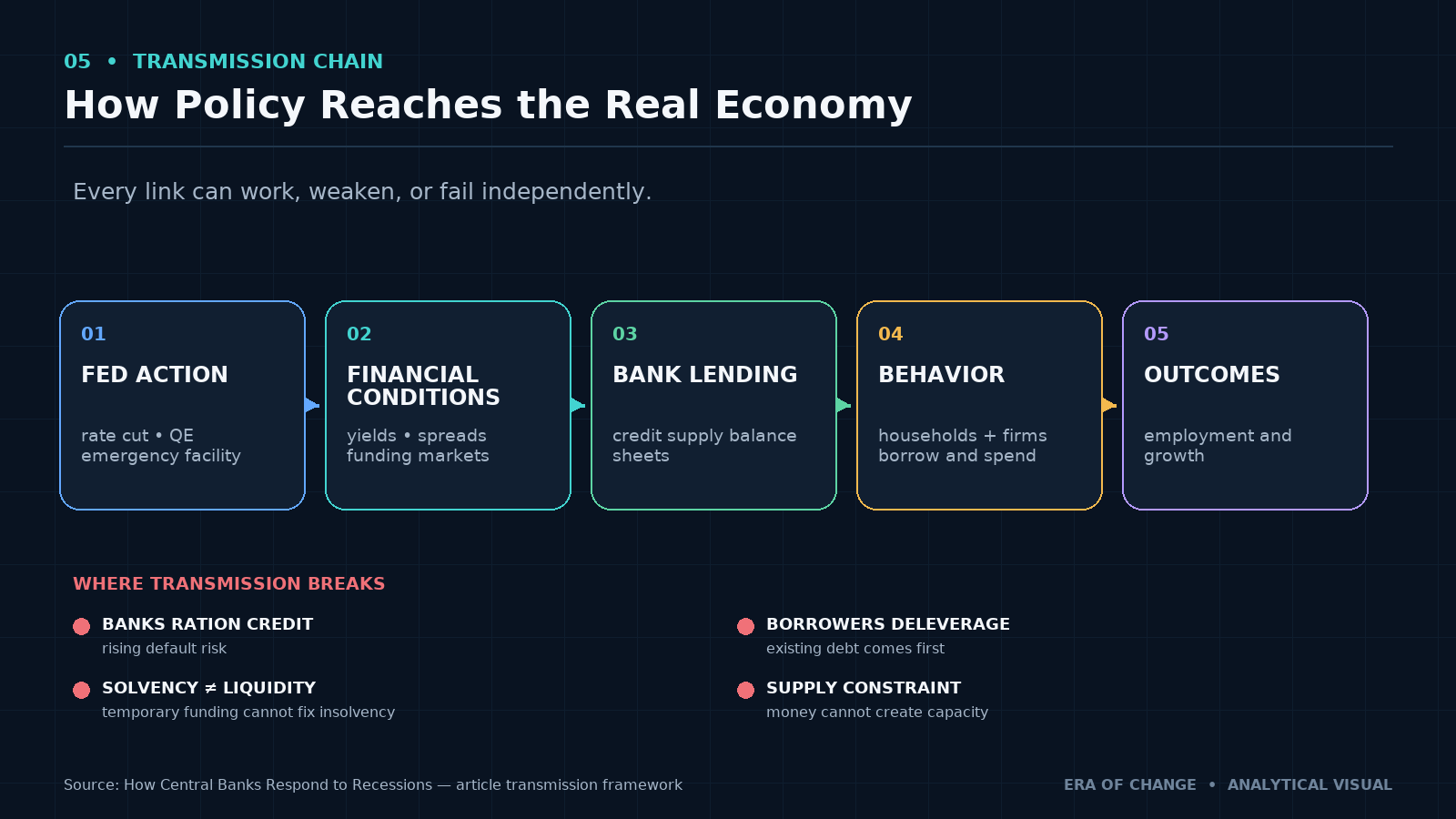
The interest-rate channel is the most direct: lower borrowing costs support housing demand, consumer credit, and business investment. The credit channel works through bank balance sheets: improved liquidity and capital positions reduce the lending stress that would otherwise force banks to ration credit. The asset-price channel runs through valuations: lower yields raise the present value of future cash flows, lifting equity and real estate prices and lowering the effective cost of raising capital. The expectations channel is psychological but real: confidence that policy will remain supportive changes spending and investment decisions today, before any of the mechanical channels have had time to work. And the exchange-rate channel runs through currency markets: lower rates typically weaken a currency, which supports exporters but raises the cost of imports, a tradeoff that matters enormously for any economy dependent on imported energy or food.
Why Central Bank Policy Sometimes Fails
This is the section that separates a serious explainer from a press release, and I want to walk through each failure mode specifically, because they’re not interchangeable.
Banks may simply refuse to lend. Even sitting on abundant reserves, a bank that sees rising default risk in its existing loan book will ration new credit rather than expand it; reserves don’t override a bank’s own risk assessment. Borrowers may not want more debt. Households and businesses coming out of a leveraged period frequently prioritize paying down existing debt over taking on new debt, no matter how cheap that new debt is; this was a defining feature of the post-2008 recovery in the U.S. and remains a defining feature of Japan’s economy after three decades of near-zero rates. Rates may already be very low, which leaves conventional cuts with limited room before they run into their practical floor. The problem may be solvency, not liquidity: a bank or a borrower with a genuinely impaired balance sheet cannot be repaired by temporary funding, no matter how generous the terms; that distinction is the one policymakers get wrong most often, because liquidity support is politically easier to deploy than the recapitalization or restructuring solvency actually requires. Inflation may remain too high, which removes the room to ease aggressively even as growth weakens; this is exactly the bind several major central banks are navigating in mid-2026. And finally, supply constraints cannot be solved with money. A rate cut cannot create additional energy capacity, additional housing supply, additional skilled labor, or additional industrial output. If a recession is being driven by a genuine supply shock rather than a demand collapse, monetary easing addresses the wrong side of the equation entirely, a dynamic we cover in detail in What Causes Inflation?
What Happens When a Recession Arrives With High Inflation?
This is where the policy toolkit stops offering clean answers, and it’s the scenario I think investors are least prepared for. Cutting rates can support growth, but it risks reigniting the inflation the central bank was supposed to be controlling in the first place. Keeping policy tight can control prices, but it deepens whatever downturn is already underway. And quantitative easing, deployed into this environment, can stabilize asset markets in the short run while quietly eroding confidence in the currency’s long-term purchasing power, a cost that doesn’t show up on any dashboard in real time but shows up eventually, in inflation expectations and in how aggressively capital flees toward gold and other hard assets.
There is no clean solution here, only a set of trade-offs that a central bank has to choose among, in public, with every choice visible and second-guessed in real time. This is precisely the terrain we mapped in our What Is Stagflation guide, and it’s worth understanding that terrain before assuming any given rate decision is straightforwardly good or bad news.
Central Bank Independence During a Recession
Central bank independence means a monetary authority can set policy, rates, balance-sheet size, emergency actions, without taking direct instruction from elected officials on a meeting-by-meeting basis. It exists because the alternative has a well-documented failure mode: a government facing an election, or a heavy debt-service bill, has an obvious short-term incentive to pressure the central bank toward lower rates regardless of what inflation is actually doing. Political pressure on central banks intensifies specifically during recessions and debt crises, for the obvious reason that easier money looks like relief to everyone except the people who eventually have to absorb the inflation it can generate. Credibility, a track record of actually doing what you say you’ll do, is what anchors inflation expectations and currency stability. Lose it, and every subsequent policy move gets priced with a risk premium attached.
But I don’t want to present independence as absolute, because it isn’t. Every central bank operates inside political, legal, and debt-market boundaries that constrain what “independent” actually means in practice. A central bank holding a government’s debt, in a country running large and persistent deficits, faces a structural pull toward accommodating the fiscal position whether or not that pull is ever stated openly: what economists call fiscal dominance.
The clearest illustration of what a central bank can do when it genuinely has room to maneuver, in my assessment, is the Swiss National Bank. Over the past two decades, the SNB has run one of the most unconventional and, I’d argue, one of the most effective monetary policies among major economies, not because its toolkit was exotic, but because it was willing to use tools others weren’t. Facing persistent upward pressure on the franc as international capital treated it as a safe haven, the SNB made extensive, sustained purchases of foreign currency to defend the exchange rate and prevent the kind of currency appreciation that would have crushed Swiss exporters and pulled the country toward deflation. It built foreign currency reserves of roughly 720 billion Swiss francs, with about a quarter of that held directly in foreign equities, including stakes in companies like Apple, Microsoft, and Alphabet, as a deliberate mechanism for absorbing liquidity while diversifying the balance sheet’s risk.
No other G10 central bank has run anything close to that playbook at that scale, and the reason is structural, not a lack of imagination: the U.S., the Eurozone, and the U.K. all carry the political weight, fiscal dominance pressures, and reserve-currency responsibilities that make an equity-heavy, currency-defense-first balance sheet strategy politically and practically unworkable for them. Switzerland could do it because Switzerland’s currency isn’t the one the rest of the world depends on.
Rate Cuts Are Not Always a Bullish Signal
This is the section I think matters most for how you should actually read the next Fed decision, and the distinction is simple to state even though markets consistently fail to make it.
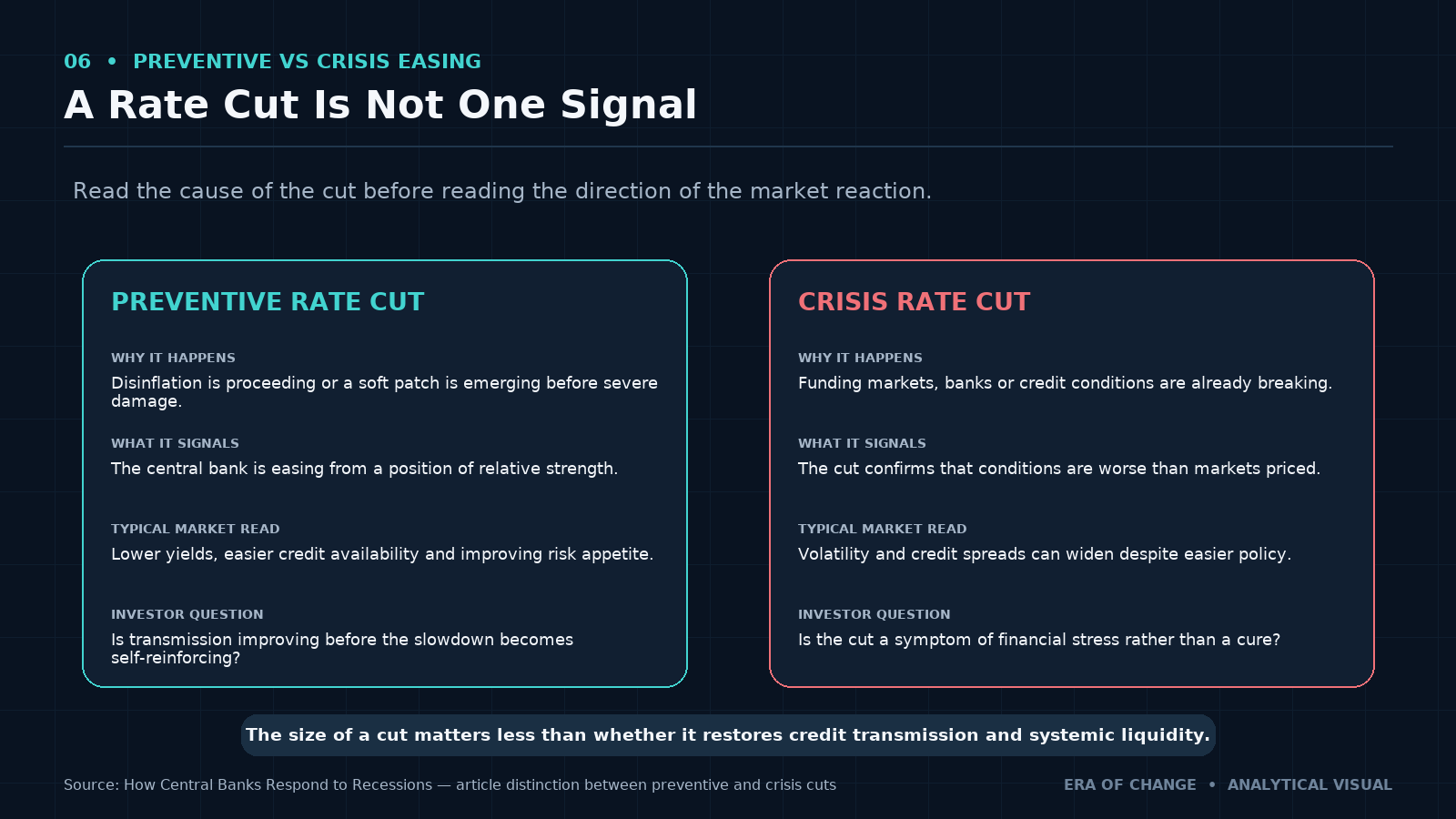
Preventive rate cuts happen when a central bank eases before severe financial damage has occurred: a calibration move, made from a position of relative strength, aimed at extending an expansion or cushioning a soft patch before it becomes something worse. These tend to produce the outcomes people associate with rate cuts generally: lower yields, easier credit availability, and improving risk appetite across asset classes.
Crisis rate cuts happen when a central bank is cutting because funding markets, banks, or credit conditions are already breaking. These frequently produce the opposite of what the headline would suggest: equity volatility spikes rather than calms, credit spreads widen rather than tighten, and capital rushes toward liquidity and safety rather than toward risk assets, because the cut itself is confirming that something in the system is more damaged than the market had priced. Markets can show real weakness in the days immediately following a crisis-driven cut, even though policy just became more accommodative on paper.
The message I want to leave you with is this: don’t evaluate a rate cut by its size. Evaluate it by its cause. A cut that reflects successful, orderly disinflation and a soft landing is a very different signal from a cut that reflects financial distress the central bank is scrambling to contain, even when the two cuts are identical in basis points.
How Different Asset Classes React
I’ll keep this probabilistic rather than absolute, because the relationship between policy and asset prices depends heavily on which of the two scenarios above you’re actually in.
Government bonds tend to benefit from falling policy rates, but that relationship can break down when inflation concerns or sovereign-debt stress push long-term yields higher even as the central bank cuts short-term rates, exactly the dynamic we cover in Yield Curve Explained. Equities, and growth stocks in particular, benefit mechanically from lower discount rates on future earnings, but that support can be overwhelmed entirely if earnings themselves are deteriorating faster than the multiple is expanding. Credit markets split by quality: investment-grade and high-yield debt respond differently depending on how much of the move is driven by falling default risk versus general liquidity conditions; high-yield spreads specifically are one of the cleanest real-time reads on whether credit stress is actually improving or just being papered over. Gold tends to benefit from falling real yields, currency concerns, or outright financial instability, since it carries no yield of its own and its relative appeal rises precisely when confidence in fiat purchasing power is in question. The U.S. dollar typically weakens as U.S. rates fall relative to other currencies, but can strengthen anyway during a genuine global flight to safety, when the dollar’s reserve-currency status dominates the interest-rate differential. And cryptocurrency, based on what we’ve observed across the last two cycles, tracks broad liquidity conditions closely but remains disproportionately sensitive to leverage, regulatory developments, and shifts in speculative risk appetite, meaning it can amplify a liquidity-driven move in either direction well beyond what the underlying policy shift would suggest on its own. For a deeper look at how a shifting rate environment specifically moves each of these markets, see How Interest Rate Hikes Affect Markets.
Historical Examples of Central Bank Recession Responses
The 2001 downturn. Following the dot-com bust, the Fed relied almost entirely on conventional rate cuts, bringing the funds rate from 6.5% down to 1.75% over the course of the year. It worked reasonably well as a demand-side tool, but it also illustrated the limits of rate policy after an asset bubble: cheap money supported a recovery, but it also helped inflate the housing bubble that would eventually produce a far larger crisis seven years later.
The 2008 global financial crisis. This is the case study that defines the modern toolkit, precisely because it was a financial-system crisis, not merely a conventional demand-driven recession. The Fed combined rate cuts down to zero with the emergency lending facilities described above, TAF, PDCF, TSLF, alongside dollar-swap lines with foreign central banks to prevent a global dollar-funding shortage, direct interventions to stabilize specific institutions, and eventually large-scale quantitative easing once conventional rate policy had exhausted its room. The scale of the emergency lending, $236 billion outstanding in TSLF loans alone at the September 2008 peak, reflects just how much of 2008 was actually a liquidity crisis layered on top of a solvency crisis, and untangling those two problems from each other was the real policy challenge.
The 2020 pandemic shock. The Fed cut rates to the zero-to-0.25% range on March 15, 2020, launched a $700 billion asset-purchase program that week, and within days had eliminated bank reserve requirements entirely for the first time in the Fed’s history. By March 23, it had announced emergency corporate credit facilities backing $100 billion in new financing, expanded to a combined $750 billion by April 9, an escalation that took roughly six weeks in 2020 versus the better part of a year in 2008. The speed reflected lessons learned directly from 2008: acting overwhelmingly and immediately, rather than incrementally, to prevent panic from compounding.
The inflation constraint after 2021. By 2022, the Fed faced the opposite problem entirely: inflation running at the highest levels in four decades meant the traditional recession-fighting playbook of aggressive rate cuts and fresh QE was simply unavailable, even as growth slowed and recession risk rose. That constraint is still shaping policy today: the Fed has held its rate at 3.50%–3.75% since June 2026 specifically because core inflation remains meaningfully above target, and rate markets are currently pricing real odds of a hike rather than a cut at the July 28–29 meeting. It isn’t the only major central bank in this position: the ECB actually raised its deposit rate to 2.25% on June 11, 2026, its first hike since 2023, specifically because energy-driven inflation from the Iran conflict left it more worried about price stability than growth. The Bank of England has held its rate at 3.75% through three consecutive 2026 meetings for a similar reason. Meanwhile the Bank of Japan is doing something almost nobody else is: raising rates from roughly 1% toward what one board member has described as a neutral level near 2%, because Japan, uniquely among major economies, is still fighting to normalize policy after a generation of near-zero rates rather than fighting to ease. Four major central banks, four different postures, in the same global cycle, which tells you everything about how much genuine divergence there is in what “recession response” actually means right now.
Era Analyst’s Perspective
From Nikolai Fainizkii, CEO & Senior Analyst, Era of Change
“There’s a tool everyone assumes is still on the table, and I think it’s currently blocked. Aggressive quantitative easing, and rate cuts delivered faster than the data justifies, would be a mistake right now, not because the models say so, but because inflation expectations in this cycle are still fragile enough that flipping the printing press back on hard would trigger a second wave of inflation expectations and put real pressure on fiat purchasing power. That’s not a theoretical risk. It’s the direct lesson of 2022.
What I actually watch for the moment a central bank quietly shifts from ‘managing a slowdown’ into ‘managing a crisis’ isn’t the policy statement, it’s two indicators most people never look at. First, a sharp widening in high-yield spreads, because that’s institutional capital repricing default risk in real time, faster than any official data can confirm it. Second, and this one gets missed constantly: a decline in average hours worked and a pullback in temporary-help employment, both of which historically move six to twelve months ahead of the headline unemployment rate. By the time the unemployment number itself moves, the labor market has already been deteriorating quietly for the better part of a year.
If you want to see what a central bank looks like when it actually has room to be unconventional, look at the Swiss National Bank. Building a balance sheet with a quarter of its reserves in foreign equities, defending the franc that aggressively, for that long, that’s the most effective central bank playbook I’ve studied over the past twenty years. And it’s not replicable by the Fed, the ECB, or the Bank of England, because none of them has the luxury Switzerland has. They’re carrying political pressure, fiscal dominance, and reserve-currency responsibilities that tie their hands in ways the SNB’s never were.”
— Nikolai Fainizkii, CEO & Senior Analyst, Era of Change
How Era Evaluates Central Bank Responses
We don’t evaluate a policy announcement in isolation, and I’d encourage any investor reading this to adopt the same discipline. A rate decision on its own tells you almost nothing about whether it’s working. What we track instead is a cluster of indicators around every policy move: real interest rates, not just nominal ones; M2 and broader credit growth; yield-curve shape and movement; bank lending standards from the Fed’s own Senior Loan Officer Opinion Survey; high-yield spreads; interbank liquidity indicators like the SOFR-OIS spread; market-implied inflation expectations; currency response; and sovereign-debt market stress.
The distinction that actually matters, and the one most coverage of Fed decisions skips entirely, is this: the size of a rate cut matters far less than whether it restores credit transmission and systemic liquidity. A 50-basis-point cut that gets banks lending again and tightens credit spreads is doing real work. A 100-basis-point cut that leaves spreads wide and bank lending standards unchanged has accomplished very little beyond a headline. We track this cluster continuously as part of the Era CrisisMeter, which is itself one layer of the broader Era Global Risk Index.
A Practical Framework for Investors
When a central bank changes policy, I’d suggest working through four questions in order, because the sequence matters.
First, why is it acting? Disinflation proceeding as expected, rising recession risk, emerging banking stress, or outright market dysfunction each call for a different read on what comes next. Second, which tool is actually being used, a rate cut, quantitative easing, an emergency lending facility, or simply forward guidance without any immediate balance-sheet action? Each carries a different signal about how serious the central bank believes the situation is.
Third, is credit transmission actually improving, or is the policy move sitting inert? Watch lending conditions, credit spreads, and funding markets directly rather than taking the policy announcement at face value.
Fourth, what is inflation actually doing, and is the easing now underway likely to reignite the pressure the central bank spent the prior cycle fighting?
And finally, is this response preventive or reactive? Early, calibrated easing and emergency, reactive easing carry fundamentally different implications for how markets should be positioned, even when the policy rate ends up in the same place.
What Investors Should Watch Next
- The federal funds rate and the Fed’s forward guidance language at each FOMC meeting
- Central bank balance-sheet size, tracked weekly via the Fed’s H.4.1 release, currently $6.72 trillion, expanding again since the Fed resumed Treasury purchases in December 2025
- Bank reserve levels, to see whether the system is genuinely ample or merely adequate
- M2 growth, as covered in detail in M2 Money Supply Explained
- Bank lending standards, via the Fed’s quarterly Senior Loan Officer Opinion Survey
- High-yield credit spreads, currently near 2.69% and historically tight relative to the broader risk backdrop
- SOFR-OIS spread and other short-term dollar-funding indicators
- The 2-year and 10-year Treasury yields, and how they’re moving relative to each other, see Yield Curve Explained
- Market-implied inflation expectations, via TIPS breakevens
- Currency movements, particularly in the dollar, euro, and yen given the current policy divergence across major central banks
- Corporate default rates and refinancing activity
- The Era CrisisMeter reading, which synthesizes all of the above into a single structural score
Frequently Asked Questions
How do central banks respond to recessions?
Central banks respond primarily by easing monetary and liquidity conditions: cutting policy interest rates, purchasing government bonds through quantitative easing, opening emergency lending facilities for stressed institutions, and using forward guidance to shape market expectations. The goal is to restore credit availability and prevent an economic slowdown from becoming a financial-system crisis, not to directly create economic demand.
Why do central banks cut interest rates during recessions?
Lower policy rates reduce the cost of borrowing throughout the economy, which is intended to support business investment, consumer spending, and asset valuations. Rate cuts also work through market expectations: investors price in the anticipated path of future policy well before each individual cut actually happens.
What tools does the Federal Reserve use?
The Fed’s primary tools are the federal funds rate, quantitative easing through large-scale asset purchases, emergency lending facilities authorized under Section 13(3) of the Federal Reserve Act, forward guidance about the likely future path of policy, and reserve and collateral adjustments such as changes to bank reserve requirements or the range of assets eligible as collateral in lending operations.
What is quantitative easing?
Quantitative easing is large-scale central bank purchases of government bonds and, in some cases, other securities such as mortgage-backed or corporate debt. The purchases lower long-term interest rates directly, inject reserves into the banking system to support liquidity, and push investors who sold those bonds toward other assets in search of yield, the portfolio-rebalancing effect. It is typically deployed once conventional interest-rate cuts have reached their practical lower bound.
Does quantitative easing cause inflation?
Not automatically. QE increases the reserves available within the banking system, but reserves only become inflationary if banks actually lend them out and that lending translates into real spending against constrained supply. Whether QE is inflationary in a given episode depends heavily on the state of the labor market, supply-chain capacity, and how much of the newly created liquidity actually circulates versus sits idle on bank balance sheets.
Why might rate cuts fail to prevent a recession?
Rate cuts can fail for several distinct reasons: banks may decline to lend even with cheaper funding available if they see rising default risk; households and businesses may prioritize paying down existing debt over taking on new debt; policy rates may already be too close to zero to provide meaningful additional room; the underlying problem may be bank or borrower solvency rather than liquidity, which temporary funding cannot fix; persistent inflation may prevent the central bank from easing as aggressively as the recession would otherwise call for; and if the recession is being driven by a genuine supply-side shock, monetary easing simply addresses the wrong side of the economic equation.
What is the difference between liquidity and solvency?
A liquidity problem means an institution has real assets and is fundamentally sound but temporarily cannot access enough cash to meet its near-term obligations, this is exactly what central bank emergency lending is designed to solve. A solvency problem means an institution’s liabilities genuinely exceed the value of its assets, a structural condition that no amount of temporary lending can fix; solving it requires recapitalization, restructuring, or resolution, typically involving fiscal authorities rather than the central bank alone.
Are interest-rate cuts always good for the stock market?
No. Preventive rate cuts, made from a position of relative economic strength before serious damage has occurred, tend to support equity valuations through lower discount rates and improving risk appetite. Crisis-driven rate cuts, made because credit markets or the banking system are already under acute stress, frequently coincide with equity volatility and widening credit spreads instead, because the cut itself confirms that conditions are worse than markets had priced.
What is central bank independence?
Central bank independence means a monetary authority can set interest-rate and balance-sheet policy without taking direct, meeting-by-meeting instruction from elected officials. It exists to prevent short-term political incentives, particularly the incentive to ease policy ahead of elections or to reduce a government’s own debt-service costs, from overriding the longer-term goal of price stability. Independence is never absolute; every central bank still operates within political, legal, and debt-market constraints that shape what it can realistically do.
Can a central bank stop a recession?
Not on its own, and not reliably. A central bank can materially soften a recession’s severity by restoring liquidity and lowering borrowing costs, and in some cycles, 2001, for instance, that support alone is largely sufficient. But when a downturn is driven by insolvent institutions, excessive existing debt, persistent inflation, or genuine supply constraints, monetary policy alone cannot resolve the underlying problem, and fiscal policy, regulatory action, or simply time becomes necessary alongside it.
About Era of Change
Era of Change is an independent macroeconomic research and geopolitical intelligence firm providing institutional-quality analysis for investors worldwide. Its research combines macroeconomics, financial markets, blockchain analytics, artificial intelligence, and geopolitical risk within proprietary forecasting frameworks designed to identify structural market changes before they become broadly recognized. Era evaluates central bank policy through its actual impact on liquidity, credit creation, inflation, and capital flows — not by treating a policy-rate announcement as an isolated market signal. Our full methodology, live index reading, and forecast archive are available at eraperemen.info/en.
Sources
Central Banks and Official Policy Sources
- Federal Reserve
- Federal Reserve: Recent Balance Sheet Trends
- Federal Reserve: Crisis Response
- Federal Reserve: Actions to Support the Flow of Credit, March 15, 2020
- Federal Reserve: Implementation Note, March 15, 2020
- European Central Bank: Monetary Policy Decision, June 11, 2026
- Bank of England: Bank Rate Maintained at 3.75%, June 2026
- Swiss National Bank: Foreign Exchange Reserves and Bond Investments
- Swiss National Bank: Investment Policy
- Bank for International Settlements
U.S. Economic Data
- FRED: Relevant Foreign Currency Positions of the Swiss National Bank (SNBFORCURPOS)
- FRED: All Employees, Temporary Help Services (TEMPHELPS)
- FRED: Average Weekly Hours of All Employees, Total Private (AWHAETP)
- FRED: Total Assets, Federal Reserve (WALCL)
- Bureau of Labor Statistics: Employment Situation, Table B-2
Academic and Institutional Research
- National Bureau of Economic Research: Business Cycle Dating
- Congress.gov / CRS: Federal Reserve Emergency Lending
- Congress.gov / CRS: The Federal Reserve's Balance Sheet
- Congress.gov / CRS: The Federal Reserve's Response to COVID-19
- Federal Reserve History: Federal Reserve Credit Programs During the Meltdown
- Liberty Street Economics (NY Fed): The Fed's Emergency Liquidity Facilities — The PDCF
- Brookings: What Did the Fed Do in Response to the COVID-19 Crisis?
- CNBC: Federal Reserve Cuts Rates to Zero and Launches $700 Billion QE, March 15, 2020
- Marketplace: Why Temp Workers Are a Labor Market Leading Indicator
- The Conference Board: Employment Trends Index
Internal Research
- Era Global Risk Index
- Era CrisisMeter Explained
- How Recessions Are Measured
- M2 Money Supply Explained
- Yield Curve Explained
- What Causes Inflation?
- What Is Stagflation?
- How Interest Rate Hikes Affect Markets
— Nikolai Fainizkii, CEO & Senior Analyst, Era of Change