Executive Summary
For three years, China’s debt story has been told primarily through the lens of Evergrande, empty apartment towers, and shadow banking. Those are visible symptoms of a deeper structural problem, and in my analysis, focusing on them exclusively has caused investors to misdiagnose the risk and misjudge the timeline.
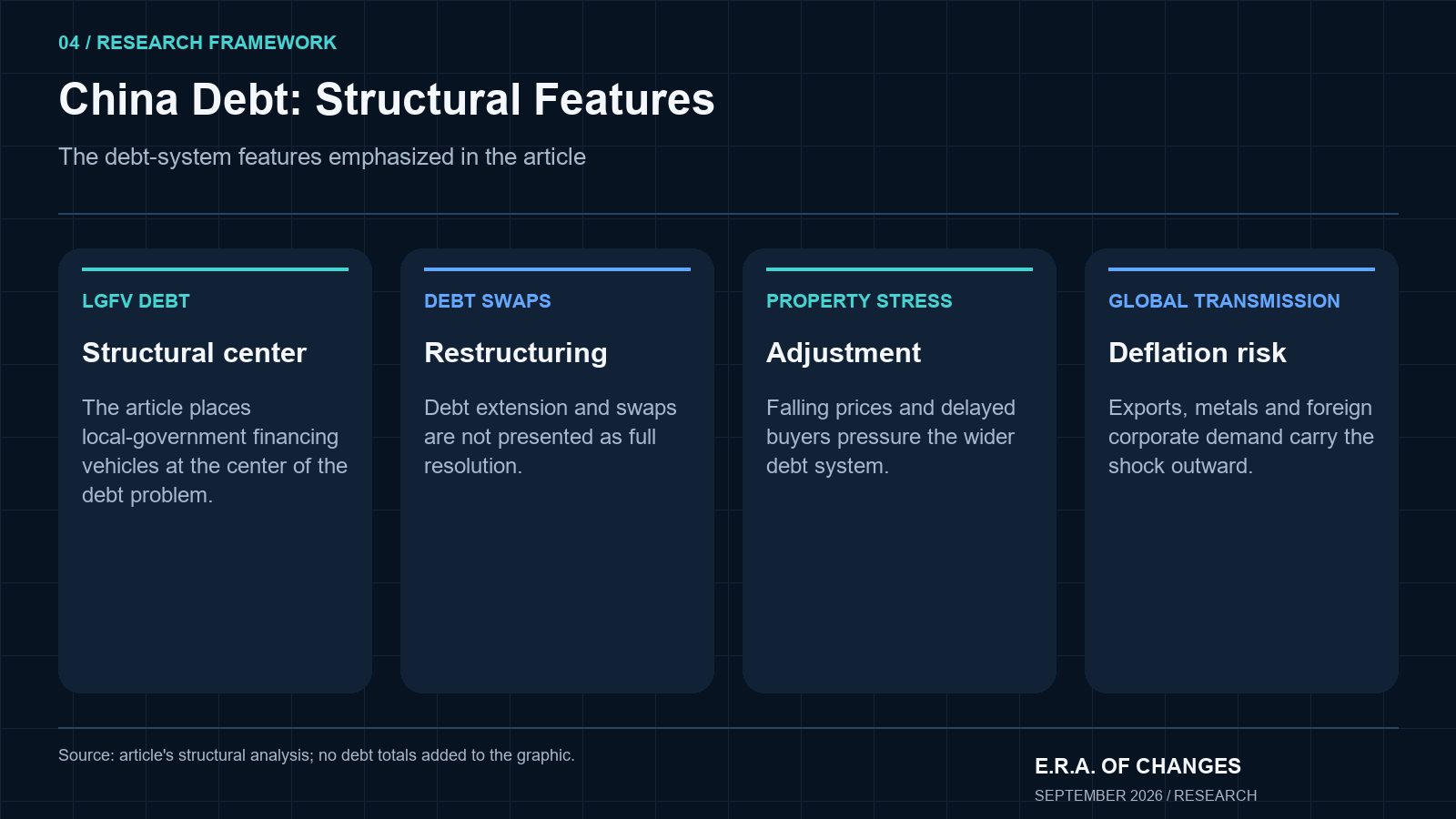
The structural center of China’s debt problem is the local government financing vehicle: the LGFV. These are entities that allowed provincial governments to raise capital for infrastructure and urban development outside their conventional budgets. According to the IMF’s 2025 Article IV consultation, The IMF’s 2025 Article IV estimates China’s augmented government debt at 111.3% of GDP in 2023, versus official general-budgetary debt of 54.7% that typically appears in headlines. That gap is where the real risk resides. Source.
My base case is not a sudden emerging-market-style sovereign collapse. China’s capital controls, the CPC’s direct influence over the banking system, and the overwhelming domestic-currency nature of the debt rule out the classic crisis mechanism of foreign creditors refusing to roll over dollar-denominated borrowing. What I expect instead is a prolonged balance-sheet adjustment: a slow socialization of losses across the financial system, similar in character to Japan’s post-1990 experience, that produces years of weak credit productivity and persistent deflationary pressure. The global transmission channel that matters most to investors is not a financial shock but a sustained reduction in Chinese demand for industrial commodities and premium consumption goods.
Key Takeaways
- LGFVs, not individual property developers, are the structural center of China’s debt problem.
- The IMF’s 2025 Article IV estimates augmented government debt at 111.3% of GDP in 2023, versus official general-budgetary debt of 54.7%. Source.
- China launched a CNY 10 trillion local-government debt-swap program in late 2024; by mid-2026, regions had deployed 94 percent of the initial CNY 6 trillion quota.
- China’s property price index stood at 85.13 in Q1 2026, down from a peak of roughly 113 in 2021, with 37 consecutive months of price declines recorded through July 2026.
- Era’s base thesis is controlled deleveraging and balance-sheet adjustment, not an acute banking crisis or emerging-market default event.
- The primary global risk is deflationary: weaker Chinese demand for commodities, manufactured goods, and premium consumption, not a 2008-style financial contagion.
- Industrial metals, commodity-exporting economies, and European luxury and automotive companies face the most direct transmission channels.
- The critical question is not whether China’s debt eventually defaults; it is who absorbs the losses, on what timeline, and at what cost to productive growth.
The Story the Headlines Are Getting Wrong
For several years, investors watching China’s property sector have been asking the wrong question. The question they keep asking is: will Evergrande, Country Garden, or the next developer trigger a systemic financial collapse? It is a fair concern, but it focuses attention on the symptom rather than the anatomy of the problem.
The more important question is this: who financed the investment model that produced those developers in the first place?
The answer leads you to local government financing vehicles (LGFVs) and to a debt problem that is substantially larger, more structurally embedded, and more analytically interesting than the developer story suggests. Property developers borrowed, built, and now struggle to survive a market correction. LGFVs represent something different: the financing mechanism by which provincial governments in China spent the last two decades building cities, highways, industrial parks, and urban infrastructure outside the visibility of the national budget.
When I look at China’s debt risk, I start here. Not with Evergrande’s restructuring filings. With the local financing vehicle that borrowed to build the road to the development that Evergrande sold apartments in. That is the structural layer, and that is where the durable risk lives.
How Big Is China’s Debt Problem?
Headline figures for China’s debt are misleading in a specific direction: they consistently understate the total exposure by several tens of trillions of renminbi. Understanding why requires separating the system into its component layers rather than accepting a single debt-to-GDP ratio at face value.
Official central government debt stands at approximately 24 percent of GDP, a figure that appears conservative by any international standard. Explicit local government debt, the amount that provincial governments have acknowledged through formal budget channels, adds another 30 percentage points to reach roughly 55 percent of GDP in official estimates. That number, 55 percent of GDP, is the figure most news coverage cites, and it creates a false sense of manageable risk.
The problem emerges when you add the off-budget layer. The IMF’s 2025 Article IV consultation with China, published in February 2026, incorporates LGFV and other quasi-fiscal liabilities into an augmented government debt estimate of 111.3% of GDP at end-2023. The IMF table separately estimates LGFV debt at 49.8% of GDP for 2023 (RMB 64.449 trillion in the table). Add corporate debt, household debt, and state-owned enterprise obligations, and China’s total debt-to-GDP ratio is among the highest in the world for a developing economy. Source.
The definitional issue is not a technicality. When investors ask “how much debt does China have?”, the answer changes by 70 percentage points of GDP depending on whether you accept the official figure or the augmented one. Era’s analysis of global debt risks emphasizes this framework consistently: the gap between the official and augmented numbers is the risk, not just the headline statistic.
What Are Local Government Financing Vehicles?
An LGFV is an entity created or controlled by a local government that can raise financing and invest in projects outside the local authority’s conventional budget. This mechanism emerged because of a fundamental tension built into China’s fiscal architecture: local governments were assigned major spending responsibilities (infrastructure, urban development, land-related investment) but were formally constrained from direct borrowing through bond markets.
The solution was the financing vehicle. A provincial or municipal government would create an entity, transfer land or other assets to it, allow it to borrow against those assets, and use the proceeds to fund the projects the local government needed in order to demonstrate growth performance against its political targets. The vehicle was technically a corporation. The debt appeared corporate in structure. The liability was essentially sovereign in character.
The Bank for International Settlements has described LGFVs as having evolved beyond simple financing conduits into broader investment platforms, noting that excessive diversification and debt accumulation create fiscal and crowding-out risks. That evolution matters: LGFVs did not remain narrowly scoped infrastructure lenders. They became quasi-fiscal entities supporting a wide range of local economic-development priorities, which is precisely what makes their balance sheets so difficult to evaluate from outside the system. Transparency is itself part of the risk: when creditors cannot reliably measure the liability, they cannot price it accurately, and sudden repricing becomes possible when clarity finally arrives.
Why LGFV Debt Matters More Than the Property Headlines
This is the part of China’s debt story that I find most important to get right, and most often see misunderstood.
Property developers (Evergrande, Country Garden, Sunac, and dozens of smaller names) borrowed heavily to finance residential construction, accumulated land banks, and now face a prolonged correction in property prices. Their stress is real. But their liabilities exist at the corporate layer. When a developer defaults, the losses fall on creditors, suppliers, and homebuyers with pre-sold units. The mechanism is painful, but it is also bounded.
LGFV stress operates differently, because LGFVs are connected simultaneously to three critical parts of the system: the local government balance sheet that depends on land revenue, the banking sector that extended the credit, and the construction and property ecosystem that generated the original economic rationale for borrowing. When property prices decline, land-sale revenue falls, LGFV collateral values weaken, banks begin restructuring loans rather than extending new ones, and capital sits tied to low-return legacy assets rather than funding productive new investment. Each step in that chain reinforces the next. That is a feedback loop, not an isolated corporate credit event. Era’s CrisisMeter framework is designed precisely to identify when these feedback loops become self-reinforcing, and this one is currently running.
Era Analyst’s Perspective
The property correction gets the headlines because it is visible: falling home prices in 100 Chinese cities, developers defaulting, construction sites frozen. But what concerns me more is the fiscal channel that runs underneath it.
As of July 2026, China’s property price index has recorded its 37th consecutive monthly decline, sitting at 85.13 against a 2021 peak near 113. In the first seven months of 2026, property investment fell 19.2 percent year-on-year and new construction starts dropped 24 percent. For the first time in roughly three decades, second-hand home transactions outpaced new-build sales, accounting for 50.4 percent of all residential transactions in the first half of 2026.
Every one of those statistics reduces the land-sale revenue that provincial governments depend on to service LGFV obligations. The feedback loop I described above is not theoretical. It is running now, in real time, and the buffer that has slowed it is the CNY 10 trillion debt-swap program that Beijing introduced in November 2024. That program restructures the financing. It does not make the underlying economic loss disappear.
How Large Is the LGFV Problem?
Quantifying LGFV exposure precisely is difficult, and I want to be clear that any estimate carries meaningful uncertainty. Different institutions classify LGFV liabilities differently, some liabilities sit closer to explicit government obligations while others remain formally corporate, and the pace of the debt-swap program is actively changing the composition of the stock.
With those caveats stated, the best available institutional estimates place outstanding LGFV debt at approximately 46 percent of GDP as of 2023, according to the World Bank’s December 2025 China Economic Update, which cited IMF analysis. That figure does not include explicit local government bond debt, central government obligations, or corporate and SOE debt; it represents only the off-budget quasi-fiscal layer. At the higher end of private estimates, Goldman Sachs and Caixin have placed the total LGFV stock between CNY 50 trillion and CNY 90 trillion, with the wider range reflecting genuine definitional disagreement rather than analytical imprecision.
The transparency problem compounds the measurement problem: if creditors and markets cannot reliably measure the liability, they cannot price it accurately, which creates the conditions for sudden repricing when clarity arrives. This is a structural feature of the risk, not just an accounting inconvenience.
China Is Already Restructuring Local Debt
One of the things I insist on in Era’s analysis is intellectual honesty about the response already underway. China’s policymakers are not ignoring the LGFV problem. They have introduced one of the largest local-government debt-restructuring programs in economic history.
In November 2024, the National People’s Congress approved a CNY 10 trillion framework to address hidden local-government debt: CNY 6 trillion in new special-bond capacity explicitly allocated to debt swaps over 2024 through 2026, and a further CNY 4 trillion channeled through the annual special-bond quota through 2028. The objective is to convert expensive, opaque off-budget LGFV obligations into lower-cost, more transparent on-budget government bonds, reducing the interest burden, extending maturities, and lowering rollover risk.
The program is moving quickly. By the end of June 2026, regions had deployed 94 percent of the initial CNY 6 trillion allowance, according to Bloomberg’s July 2026 report on the debt cleanup milestone. Official Chinese statements accompanying the IMF’s Article IV consultation reported reduced average financing costs on swapped debt and projected total hidden debt falling from approximately CNY 14.3 trillion at end-2023 to CNY 2.3 trillion by 2028.
This matters for how investors should read the near-term risk. The scenario I am most concerned about is not a sudden LGFV default cascade; Beijing has demonstrated both the willingness and the capacity to prevent that outcome. The scenario I am watching is slower: whether the economic productivity of the underlying assets justifies the capital committed to them, and whether growth can be sustained through the restructuring period without growth itself deteriorating into stagnation.
Debt Restructuring Is Not the Same as Debt Resolution
This distinction is central to Era’s framework, and I want to be precise about it because it determines how optimistic investors should be about the swap program’s progress.
Debt restructuring changes the financial structure of an obligation: lower interest rate, longer maturity, new creditor, explicit government guarantee replacing implicit provincial support. The CNY 10 trillion swap program is restructuring on a large scale, and it delivers real benefits: provinces that were paying LGFV coupon rates of 5 to 7 percent are refinancing at lower on-budget rates, reducing annual debt-service costs meaningfully.
Debt resolution is different. It requires recognizing and absorbing the underlying economic loss, writing down assets that cannot generate the cash flows needed to justify their value at origination. If a provincial infrastructure project was financed at an expected return that the asset cannot deliver, restructuring the debt changes the timing and creditor of the loss. It does not eliminate the loss. In Japan’s post-bubble experience, banks extended and pretended for over a decade, carrying impaired real-estate loans at book value, maintaining the appearance of solvency while starving the productive economy of credit. The debt was restructured, refinanced, and extended. The productive loss was only slowly recognized. The result was a decade of stagnant growth: not an acute crisis, but not recovery either. That is the distinction I want investors to hold when reading optimistic reports about China’s swap-program progress.
Why China Is Not a Classic Emerging Market Debt Crisis
When investors reach for historical analogies for China’s debt stress, the ones that come up most readily are the wrong ones: Mexico 1994, East Asia 1997, Argentina 2001. Each of those crises was characterized by large foreign-currency borrowing, rapid capital outflows, reserve depletion, currency collapse, and foreign creditors refusing to roll over external debt. The IMF intervention playbook exists precisely because those mechanisms repeat across geographies.
China’s structure is materially different in ways that make the classic emerging-market crisis playbook largely inapplicable. Virtually all LGFV and local government debt is denominated in renminbi and held by domestic institutions, primarily state-owned banks, insurance companies, and domestic bond funds. Capital controls restrict the ability of domestic investors to relocate capital offshore rapidly. The CPC maintains direct administrative influence over major financial institutions, which provides tools to manage credit allocation, extend maturities, and direct resources to stressed borrowers that no freely floating emerging market possesses.
Era considers a textbook bank run significantly less likely for these structural reasons. That does not mean losses disappear; it means losses manifest differently. Rather than a currency crisis and abrupt deleveraging, the expected mechanism is loan extensions, evergreening of weak credits, bank recapitalization by the state when balance sheets deteriorate, and a gradual reduction in credit productivity as capital remains tied to low-return legacy assets. The crisis happens slowly, in the balance sheet, rather than quickly, in the currency market.
Era’s “Japan 2.0” Scenario
The Japan analogy is imprecise in several important ways, and I want to be careful about how I use it. I am not claiming China will replicate Japan’s experience exactly. The two economies differ in size, demographic trajectory, trade composition, global financial integration, and policy latitude. What I am claiming is that the crisis mechanism, if there is one, is more likely to resemble Japan’s post-1990 balance-sheet recession than any of the conventional emerging-market precedents.
Japan’s post-bubble adjustment had identifiable characteristics. Asset values fell. Debt remained at face value. Companies and households prioritized debt repayment over investment and consumption. Credit demand weakened even as the central bank reduced rates, because borrowers were focused on repairing balance sheets rather than expanding them. Banks held impaired assets at book value to avoid crystallizing losses. Nominal growth stagnated. Monetary policy lost traction. It took roughly two decades before Japan meaningfully addressed the underlying impairment.
China today shares several of those structural conditions. Property values are declining: the price index is down more than 25 percent from its 2021 peak. Developer and LGFV balance sheets are impaired. Household confidence in property as a store of wealth is damaged: a market where newly built properties have lost their long-held transaction dominance for the first time in three decades is not a market approaching recovery. Private credit demand is weakening even as the People’s Bank of China eases rates. Banks are extending and restructuring rather than recognizing losses. The CPC’s strong preferences for stability reinforce the extend-and-pretend dynamic.
The critical difference: China has far greater policy capacity than Japan deployed in its early adjustment years, and greater willingness to use fiscal tools aggressively. Whether that capacity is sufficient to convert slow deleveraging into genuine debt resolution, rather than simply deferring the growth cost, is the question I am watching most carefully.
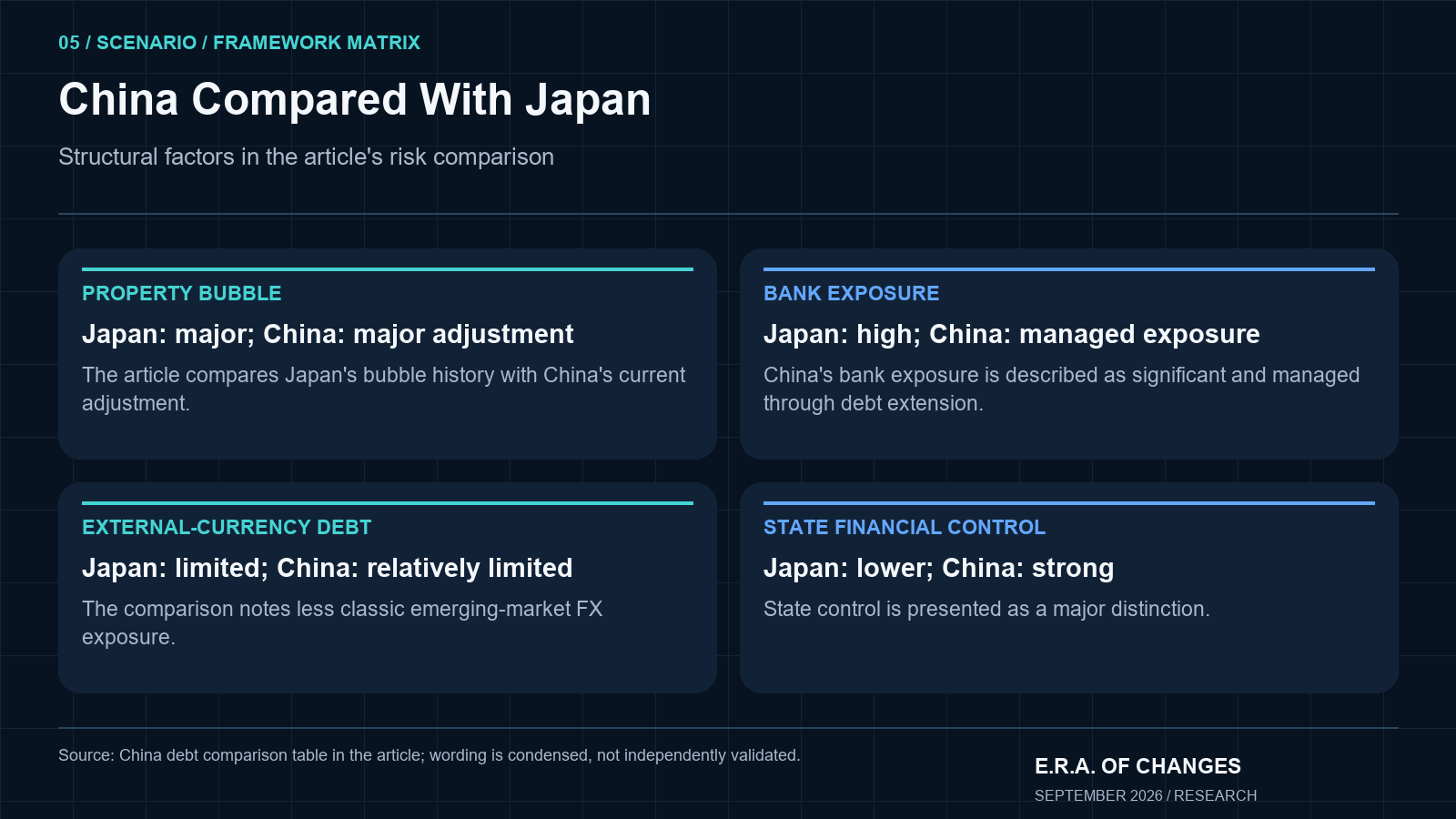
Factor | Japan Post-Bubble | China Current Risk |
|---|---|---|
Property bubble | Major | Major adjustment underway |
Bank balance-sheet exposure | High | Significant, managed via extension |
Domestic savings | High | High |
External-currency debt | Limited | Relatively limited |
State control of finance | Lower | Strong CPC influence |
Demographic pressure | Increasing | Increasing |
Capital controls | Limited | More significant |
Export capacity | Strong | Very strong |
Deflation risk | Significant | Material concern |
China’s Property Crisis and the Debt System
Property is not a separate story from the LGFV and local government financing problem. It is the same story told from a different angle.
Local governments relied heavily on land-sale revenue to fund both budget expenditures and LGFV obligations, revenue that was dependent on developers purchasing land at rising prices. When property prices fell and developers stopped bidding for land, local fiscal revenues came under direct and immediate pressure. In the first seven months of 2026, property investment fell 19.2 percent year-on-year and new construction starts dropped 24 percent. In Q1 2026, residential sales value fell 18.5 percent to RMB 1.49 trillion. The cumulative effect of that revenue shortfall on provincial finances, and on the LGFVs they created to manage them, is substantial and ongoing.
The household channel runs in parallel and is equally important. For most Chinese middle-class households, residential property constitutes 60 to 70 percent of net worth. A prolonged correction in property values does not only affect developers and local governments; it affects household balance sheets, consumer confidence, and discretionary spending. A market in which 50.4 percent of all residential transactions now involve second-hand homes, for the first time in three decades, is not a market approaching stabilization. It is a market in which buyers have stopped absorbing development-stage risk. That behavioral shift takes years to reverse even after prices find a floor.
China’s Banking System: Where Do the Losses Go?
This is the analytical core of why I describe the adjustment as a slow process rather than an acute event. Within China’s financial architecture, losses that cannot be immediately recognized have several institutional channels for absorption, and the system is using all of them.
The most common current mechanism is loan extension and evergreening: banks roll over matured LGFV and property-sector loans rather than classifying them as non-performing, converting a credit event into a balance-sheet management problem. This keeps the recognized non-performing loan ratio artificially low while capital remains locked to unproductive borrowers. When extension reaches its practical limits, the debt-swap mechanism shifts implicit obligations to the sovereign balance sheet. Central government can recapitalize state-owned banks when their balance sheets deteriorate to a point that limits their credit function. In the extreme, fiscal transfers from the center address gaps in local financing capacity directly.
The BIS noted in 2026 that loans to real estate and LGFVs still constitute a relatively large share of total outstanding lending in China, while that category is now declining rather than expanding. That contraction is the mechanism through which growth slows: capital is no longer being allocated to the sectors that drove the investment cycle, but it is also not yet being redirected efficiently toward the private-sector productivity growth that would replace it. A financial system that is managing legacy losses cannot simultaneously allocate capital aggressively to new opportunities. That is the growth cost of the socialization model, and it compounds every year the process continues. For more on how interest rate dynamics interact with this mechanism, see Era’s analysis of how interest rates affect financial markets.
The Biggest Global Impact: China Exporting Deflation
This is the dimension of China’s debt adjustment that I think global investors most consistently underweight, because it operates through a mechanism that is counterintuitive compared to how conventional financial crises transmit.
A typical emerging-market debt crisis is inflationary in its global transmission: currency collapse raises import prices, capital outflows pressure local rates, and the affected economy is effectively quarantined from the global financial system for a cycle. China’s adjustment, if my base case of controlled balance-sheet deleveraging is correct, transmits differently. Domestic demand weakens. Chinese households and corporations reduce spending and investment. Industrial capacity, built during the investment cycle, remains in place. Chinese producers, facing weak domestic absorption, compete aggressively in export markets. Global goods prices face sustained downward pressure.
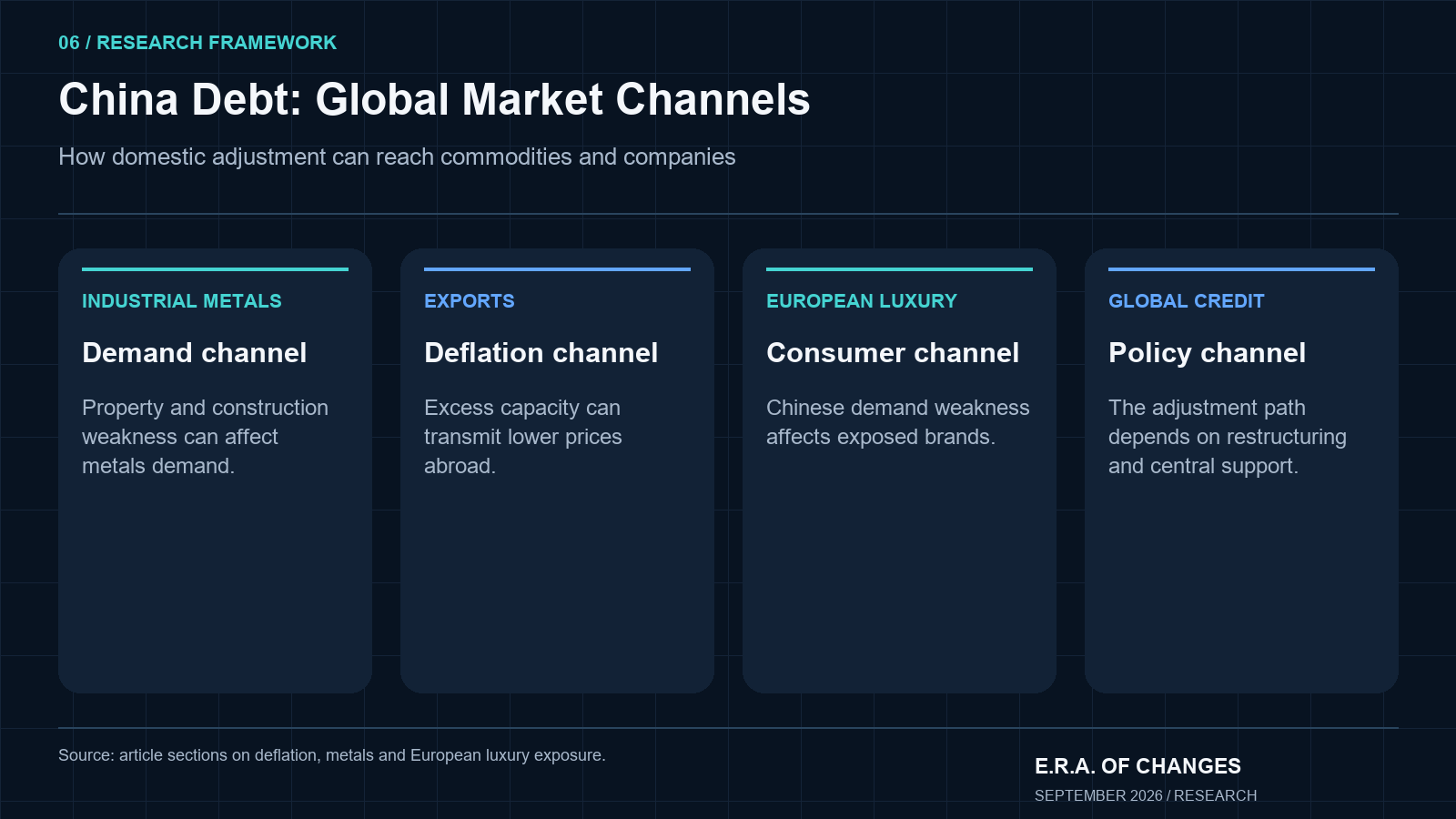
This is what I mean when I say China will export deflation. Not a financial contagion. A demand deflation that flows outward through commodity markets, manufacturing supply chains, and the consumption patterns of Chinese tourists and luxury buyers. The global economy feels this not as a crisis arriving from outside, but as a persistent, structural disinflationary force that makes it harder for central banks to meet their inflation targets from below and compresses the pricing power of companies across the sectors most exposed to Chinese demand.
Industrial Metals: The First Channel
Industrial metals are the most direct transmission channel because Chinese demand accounts for approximately 60 percent of global consumption for several key base metals. When China’s fixed-investment cycle contracts, the marginal demand that sets the global clearing price for iron ore, copper, and steel inputs contracts with it.
LME copper sits at approximately $13,484 per tonne in mid-2026, roughly 32 percent above its 2025 annual average, a level that partly reflects energy-transition demand for electricity infrastructure and EV production, which is providing meaningful structural support independent of property. But the import picture is mixed and should be read across copper product segments and end-use demand, rather than treated as a direct proxy for the property sector. Cumulative iron ore imports are down 1.6 percent year-on-year through August, and the World Bank projects iron ore prices declining below 2019 levels through 2026 and 2027 as Chinese construction investment contracts.
I want to be precise about copper because it is more complex than a simple China-property story. Electrification demand (grid infrastructure, EV manufacturing, solar installations) provides structural support that is partially decoupled from property and construction cycles. The outlook for copper is therefore genuinely two-sided, and making a simplistic “China slows, copper crashes” argument would be wrong. Iron ore and coking coal, which are overwhelmingly tied to steel production for construction and infrastructure, have a more direct and less complicated exposure to China’s balance-sheet adjustment.
European Luxury Goods and the Consumer Channel
The luxury goods sector offers one of the clearest windows into how China’s household balance-sheet adjustment transmits to European corporate earnings, and 2026 data are making the channel visible in real time.
LVMH, the largest luxury goods company by revenue, saw its stock fall 30 percent year-to-date through August 22, 2026, with first-half revenue and profit under pressure from weaker luxury demand across Asia and China specifically. Organic revenue grew only 2 percent in H1 2026 while reported revenue declined 3 percent. The wealth effect is running in reverse: Chinese households that anchored a meaningful portion of their net worth in property, and watched that asset decline for 37 consecutive months, are not purchasing Louis Vuitton and Cartier at the same clip as in 2021 and 2022. That shift is not a quarterly fluctuation. It reflects a structural change in perceived household wealth that takes years of balance-sheet repair to reverse.
European automakers face what I would describe as a double exposure. The first layer is demand: a prolonged household balance-sheet adjustment reduces appetite for premium-brand vehicles among the Chinese middle class. Porsche’s China volume fell to 41,900 units in 2025, down 26 percent from 56,900 in 2024, marking the brand’s fourth consecutive year of volume decline in its most important growth market. BMW and Mercedes-Benz have adjusted volume targets and channel structures in China for the same reasons. The second layer is competitive: Chinese domestic EV manufacturers (BYD, Nio, Li Auto) are gaining market share within China and, increasingly, in European markets. European automakers face weakening Chinese demand and the rise of capable, competitively priced Chinese alternatives simultaneously. Those are not the same risk, but they arrive in the same earnings statement.
Three Scenarios for China’s Debt Adjustment
Scenario 1: Controlled Deleveraging (Era Base Case)
LGFV debt continues to be restructured through the swap program and rolling refinancing. Banks extend maturities on property-sector exposure, recognizing losses gradually rather than immediately. The central government deploys targeted fiscal transfers and bank recapitalization as needed. Growth slows to 3 to 4 percent per year, property remains weak through the late 2020s, and deflationary pressure persists through export competition and weak domestic demand. The global impact arrives primarily through soft commodity demand and weak Chinese consumer spending rather than financial contagion.
Scenario 2: Stronger Central-Government Socialization
Beijing moves more aggressively to absorb local and banking-sector losses: larger fiscal transfers, expanded bank recapitalization, broader household-focused stimulus. Explicit public debt rises substantially toward 80 to 90 percent of GDP, but near-term financial risk is reduced. If household stimulus is effective, Chinese domestic demand recovers faster than in the base case and the global deflationary transmission is partially offset. This scenario requires Beijing to accept a significant increase in visible sovereign leverage that it has historically been reluctant to acknowledge.
Scenario 3: Disorderly Credit Event
The conditions for this scenario are specific: a major LGFV default cascade beyond what the swap program and administrative channels can absorb, widespread bank funding stress in smaller regional institutions that lack the implicit central-government backstop of the large state-owned banks, capital controls failing to prevent a meaningful acceleration in outflows, and RMB depreciation developing its own momentum beyond policy management capacity. I consider this scenario less likely given the institutional architecture described above. But I want to be clear about what would change my view: sustained evidence that the debt-swap program is insufficient to prevent LGFV refinancing failure, or signs that interbank funding conditions are deteriorating rapidly in the regional banking sector. If I see those signals, I will revise upward.
Era China Debt Risk Dashboard
Indicator | Green | Amber | Red |
|---|---|---|---|
LGFV refinancing conditions | Functional | Rising spreads / local restructuring | Broad refinancing failure |
Land-sale revenue | Stable | Persistent multi-month decline | Fiscal disruption across provinces |
Property prices | Stable / recovering | Continued gradual decline | Disorderly, accelerating decline |
Bank credit quality | Normal NPL ratio | Evergreening rising visibly | Funding stress / solvency events |
RMB stability | Managed range | Sustained directional weakness | Disorderly rapid depreciation |
Copper / iron ore demand | Stable Chinese imports | Demand deterioration | Sharp volume repricing |
Household consumption | Positive real growth | Flat / slight contraction | Broad contraction |
Current reading as of September 2026: Amber on property, land revenue, and household demand. Green on LGFV refinancing, with the swap program at 94% deployment and functioning. Copper mixed: energy-transition demand offsetting property-sector weakness. Next dashboard review: December 2026.
What Would Prove Era’s Thesis Wrong?
My Japan 2.0 base case would require significant revision under two distinct sets of conditions, and I want to state both clearly.
The first set is an outcome worse than expected: LGFV defaults becoming disorderly beyond what the swap program and administrative channels can absorb; bank funding stress emerging in smaller regional institutions that lack the large state-owned bank backstop; capital controls failing to prevent meaningful acceleration in outflows; or RMB depreciation developing its own momentum beyond policy management. Any one of those signals would cause me to raise my probability for a more acute event.
The second set is an outcome better than expected: property stabilizing on a durable basis with land-sale revenue recovering, which would relieve the core LGFV financing pressure; household balance-sheet repair happening faster than I anticipate, driven by effective consumer stimulus; or private-sector credit demand recovering sufficiently to redirect banking-system capital toward productive investment. If those conditions emerge clearly in the data, I will revise toward a more optimistic scenario. Era does not maintain a “China is condemned to stagnation” position; we maintain a “the current trajectory does not yet show the structural inflection needed to revise toward optimism” position. Those are different things, and intellectual honesty requires acknowledging it. For more on how Era constructs and updates probabilistic forecasts, see our forecasting methodology.
Frequently Asked Questions
Is China facing a debt crisis?
China is facing a significant structural debt challenge centered on local government financing vehicles and the property sector. Whether that qualifies as a “crisis” depends on the definition you apply. Era’s base case is not an acute collapse; it is a prolonged balance-sheet adjustment similar in mechanism to Japan’s post-1990 experience, where losses are absorbed gradually through restructuring, bank loan extensions, and fiscal transfers. The crisis is happening slowly, in the balance sheet, rather than quickly in the currency or equity market.
How much debt does China have?
The answer depends critically on what you include. Official central and local government debt stands at approximately 55 percent of GDP. The IMF’s augmented government-debt estimate, which includes LGFV activity and government-guided funds, was 111.3% of GDP at end-2023, compared with official general-budgetary debt of 54.7% - a gap of 56.6 percentage points, represents the hidden layer of local government financing that the LGFV system was designed to keep off the formal balance sheet. Source.
What are LGFVs in China?
LGFVs are entities created by local governments to raise capital outside the formal budget. Because Chinese law historically restricted local governments from direct borrowing, provinces and municipalities created financing vehicles that could issue bonds and borrow from banks on their behalf. The resulting liabilities are technically corporate but functionally quasi-sovereign, and the IMF estimates they amount to roughly 46 percent of China’s GDP, a figure that does not appear in China’s official debt statistics.
Why are Chinese local governments so indebted?
China’s fiscal architecture assigned local governments major spending responsibilities (infrastructure, urban development, social services) without giving them corresponding revenue capacity. Land sales and LGFV borrowing filled the gap during the property boom years. Now that property prices have declined for 37 consecutive months and land-sale revenue has contracted sharply, the financing model is under severe stress from both the asset side and the revenue side simultaneously.
Is China’s property crisis causing a banking crisis?
Not yet, in the classic sense. China’s banks are extending and restructuring rather than recognizing immediate impairment, which is why reported non-performing loan ratios remain relatively contained. The risk Era monitors is the slow deterioration: capital tied to low-return legacy LGFV and property loans is capital not available to fund productive private-sector investment, which damages long-run growth even without triggering an acute banking event in the near term.
Could China experience a financial crisis like 2008?
The 2008 U.S. crisis was driven by securitized mortgage losses flowing through wholesale funding markets and triggering sudden bank solvency concerns that spread globally within weeks. China’s structure differs materially: domestic-currency financing, state influence over banks, capital controls, and gradual administrative management of credit allocation make the 2008 transmission mechanism largely inapplicable. The risk is prolonged stagnation rather than rapid liquidation.
Is China becoming like Japan after its property bubble?
The parallel has genuine analytical merit in terms of mechanism: falling property values, impaired bank balance sheets, weak private credit demand, companies prioritizing debt repayment over investment. China differs in ways that could make the adjustment faster in some dimensions: Beijing has more fiscal tools and greater willingness to use them aggressively than Japan deployed in its early adjustment years. The Japan analogy is a useful framework for understanding balance-sheet recession mechanics, not a deterministic forecast.
Can China simply bail out local governments?
The CNY 10 trillion debt-swap program is, in effect, a large-scale central-government support of the LGFV financing structure. The constraint is not willingness; Beijing has demonstrated readiness to deploy large fiscal resources. The constraint is resolution: the swap program changes who holds the debt and at what financing cost, but does not automatically make unproductive investment economically viable. Restructuring the financing structure is achievable. Solving the underlying productivity problem requires different policy instruments.
How does China’s debt problem affect the global economy?
The primary transmission channel is deflationary: weaker Chinese demand for commodities, manufactured goods, and premium consumption reduces global goods-price pressure. Industrial metals (copper, iron ore, steel inputs) are most directly exposed through Chinese fixed-investment demand. European luxury goods and automotive sectors face direct exposure through Chinese household consumption and tourism spending. Commodity-exporting economies with large China trade linkages (Australia, Brazil, Chile, Peru) face revenue and currency pressure through falling commodity prices.
Why would a China debt crisis hurt copper and iron ore?
China accounts for approximately 60 percent of global demand for several major industrial metals. When Chinese property investment and infrastructure spending contract, as they are doing in 2026, with property investment down 19.2 percent year-on-year and construction starts down 24 percent, the marginal demand that sets the global price for iron ore and steel inputs is removed. Copper has partial protection from energy-transition demand, so import trends should be read across product segments and end-use demand rather than treated as a direct proxy for property alone.
Could China’s debt crisis cause global deflation?
It is already contributing to deflationary pressure. China’s industrial overcapacity, combined with weak domestic demand, is generating sustained competitive pressure on global goods prices. Chinese EV producers competing in European markets, Chinese steel producers maintaining export volume despite weak domestic construction, Chinese manufacturers competing aggressively on price across product categories: all of these are the deflationary transmission channel I described above. The question is not whether this pressure exists. It is whether it will be sufficient to offset inflationary pressures in services and energy that dominate in other major economies.
What indicators should investors watch for China debt risk?
The most important signals in Era’s monitoring framework are LGFV bond spreads and refinancing access, land-sale revenue trends in major provinces, property prices across Tier 1 through Tier 3 cities, interbank funding conditions for smaller regional banks, and the RMB both onshore and offshore. For global transmission, Chinese copper and iron ore import volumes are the most reliable early signals of construction demand. LVMH Asia-Pacific revenue and European auto sales in China provide the consumer-channel read each quarter.
About E.R.A. OF CHANGES
E.R.A. OF CHANGES is an independent macroeconomic research and geopolitical intelligence firm providing institutional-quality analysis to investors worldwide. Our research combines macroeconomics, financial markets, blockchain analytics, and geopolitical risk into proprietary forecasting frameworks designed to identify structural market trends before they become consensus. The Era Global Risk Index, updated daily from 24 structural indicators, serves as the foundation of our analytical methodology, providing a forward-looking measure of systemic financial stress grounded in structural economic evidence rather than market sentiment. Our full methodology, live index reading, and forecast archive are available at eraperemen.info/en.
The content published by E.R.A. OF CHANGES is for informational and educational purposes only and does not constitute financial, investment, legal, or tax advice. All views expressed are the personal analytical perspective of the author. Past forecast accuracy does not guarantee future results. Readers should conduct their own research and consult a qualified financial professional before making any investment decisions.
Sources
- IMF Executive Board Concludes 2025 Article IV Consultation with China: IMF, February 2026
- People’s Republic of China: 2025 Article IV Consultation, IMF eLibrary
- China LGFV Debt Resolution: The CNY 12 Trillion Swap, Property Overhang, and the 2026 Counter-Cyclical Test, Deluair Consultancy
- China Gets Chance at Fiscal Rethink After Debt Cleanup Milestone: Bloomberg, July 2026
- China Unveils RMB10 Trillion Local Government Debt Swap Program: Global X ETFs
- China Announces $1.4 Trillion Package to Tackle Local Governments’ Hidden Debt: CNBC, November 2024
- China’s Housing Market Free-Falls as Buyers Wait for Floor Prices: Asia Times, July 2026
- China Property Crisis 2026: Evergrande and Falling Home Prices, International Investment
- China’s Copper Prices: 2026 Market Dynamics and Economic Indicators, Discovery Alert
- Global Critical Minerals Outlook 2026: Market Overview (IEA)
- LVMH Stock Slides 30 Percent in 2026 as China Luxury Demand Cools: Ad-Hoc News
- High-End Car Sales Sink in China as Economy Slows: Yahoo Finance
- How Foreign Luxury Brands Will Play Their Hand in China in 2026: Gasgoo
- German Carmakers Are Placing a Risky Bet on China: Merics
- Global Debt Risks 2026: E.R.A. OF CHANGES
- Emerging Market Investment Risks: E.R.A. OF CHANGES
- Currency Crises Explained: E.R.A. OF CHANGES
- Era CrisisMeter Explained: E.R.A. OF CHANGES
- Era Forecasting Methodology: E.R.A. OF CHANGES
- Era Global Risk Index: E.R.A. OF CHANGES
- How Interest Rates Affect Financial Markets: E.R.A. OF CHANGES