Executive Summary
The dominant question in geopolitical research on Taiwan, “will China invade?”, is the wrong question. Not because the risk is not real, but because framing Taiwan risk as a binary invasion scenario causes investors and analysts to misallocate attention toward a tail outcome while underweighting the more probable pathways that are already producing consequences in shipping, semiconductor supply chains, and risk premiums today.
Era evaluates four distinct 24-month paths for the Taiwan Strait. Continued gray-zone coercion (military exercises, coast-guard enforcement, cyber operations, economic pressure) receives the highest weight at 55 percent. A maritime quarantine or blockade, which I consider the principal escalation scenario, receives 30 percent. Full-scale invasion receives 10 percent. Meaningful de-escalation receives 5 percent.
These are Era’s current scenario estimates, not objective probabilities or official intelligence assessments. They should be revised as observable conditions change.
My early-warning framework prioritizes economic preparation over political rhetoric. The signal I take most seriously is not a provocative speech or a defensive press release: it is an unusual, synchronized acceleration in Chinese strategic reserves (oil, grain, critical inputs) occurring alongside capital repatriation and changes in external financial exposure. That combination, sustained across multiple categories, is the leading indicator worth watching.
For investors, the key insight is this: a blockade and an invasion are not interchangeable scenarios. They produce different consequences for semiconductor production, shipping, and global markets, and they deserve separate analysis.
Key Takeaways
- A Taiwan conflict does not have to begin with an amphibious invasion. Gray-zone coercion is already part of the current cross-Strait environment.
- Era’s 24-month scenario estimates: gray-zone pressure 55%, blockade/quarantine 30%, full invasion 10%, de-escalation 5%.
- CSIS estimates roughly $2.45 trillion of goods passed through the Taiwan Strait in 2022, representing over 20 percent of global maritime trade.
- A maritime blockade can stop semiconductor exports and cut off Taiwan’s energy imports without physically destroying fabrication facilities.
- Taiwan’s domestic energy self-sufficiency stands at approximately 4.2 percent, making sustained maritime disruption highly consequential for industrial production even without a single physical attack on infrastructure.
- TSMC said N2 entered high-volume manufacturing in the fourth quarter of 2025 and expected a fast ramp in 2026. That capacity cannot be replicated elsewhere in months or years. Source. Source 2.
- The most important early-warning cluster is not rhetoric but synchronized commodity stockpiling, capital repatriation, and unusual military preparation occurring simultaneously.
- Era’s thesis is that current valuations in Taiwanese semiconductor equities and U.S. big-tech names may not adequately compensate investors for low-probability, high-impact Taiwan supply-chain disruption.
The Question Investors Are Actually Asking, and Why It Needs to Change
Every six months or so, the headlines rediscover Taiwan. An exercise. A media statement. An aircraft crossing the median line of the Taiwan Strait. And the financial press asks: will China invade Taiwan?
I understand why the question is framed that way. An invasion would be an extreme, binary, unmistakable event. It would require no analytical framework to recognize. The problem is that by focusing attention on the most dramatic and least probable scenario, this framing misses the risks that are already in motion and the ones most likely to materialize first.
A Taiwan crisis does not have to begin with amphibious assault vehicles approaching Keelung harbor. It can begin with an inspection announcement, a customs enforcement zone, a shipping company rerouting its vessels quietly to avoid an area of “elevated operational activity.” Gray-zone coercion, maritime quarantine, and limited blockade are not hypothetical predecessors to the “real” crisis; they are the probable next chapters of a strategic competition that has been running continuously for decades and shows no structural tendency toward resolution.
The investor’s question should not be “will there be a Taiwan invasion?” It should be: “what form of coercion is emerging, which observable signals distinguish one scenario from another, and how concentrated is my portfolio’s exposure to the outcomes I am not modeling?”
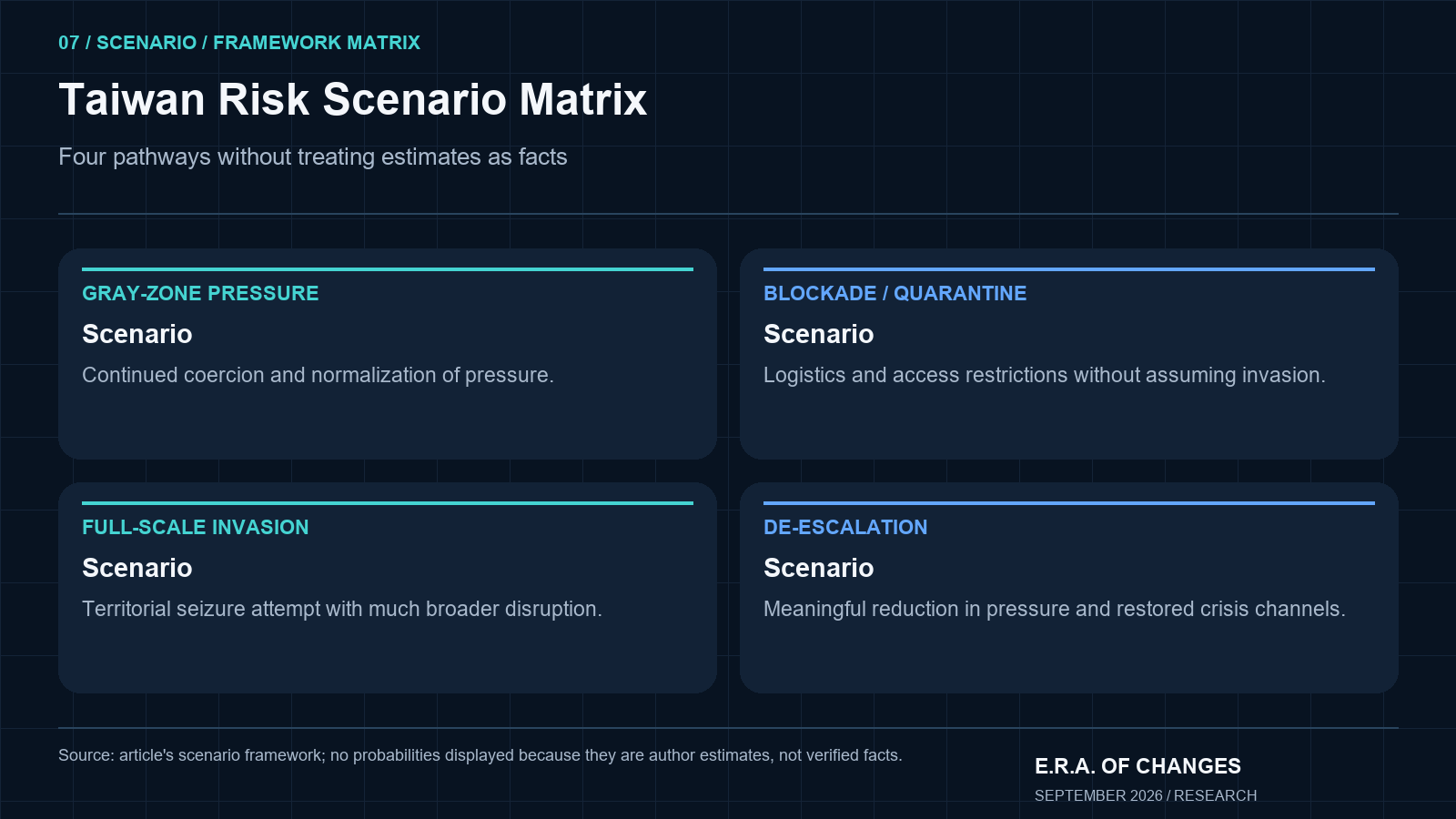
Era’s Four Taiwan Risk Scenarios: 24-Month Estimates
The following scenario weights represent Nikolai Fainizky’s current analytical assessment. They are not official intelligence estimates, are not derived from classified sources, and should be treated as a framework for probabilistic thinking rather than a forecast.
Scenario | Era 24-Month Estimate |
|---|---|
Continued gray-zone coercion | 55% |
Maritime blockade / quarantine | 30% |
Full-scale invasion | 10% |
Meaningful de-escalation | 5% |
These percentages are designed to be revised as observable conditions change. The section below explains what conditions would move them.
Scenario 1: Continued Gray-Zone Pressure (Era Estimate: 55%)
Gray-zone activity means actions that exert pressure below the formal threshold of declared conventional war. The term covers a wide range of instruments: PLA air incursions into Taiwan’s air defense identification zone, naval patrols in contested maritime areas, coast-guard enforcement operations around Taiwan’s outlying islands, cyber operations targeting government and critical infrastructure, economic pressure through trade and investment restrictions, and information operations.
This is not a theoretical scenario. It is the current operational baseline, and in 2025 it reached a documented record. Taiwan’s Ministry of National Defense recorded 3,764 PLA air incursions into Taiwan’s de facto ADIZ in 2025, a 22.4 percent increase from 2024. Coast Guard Administration data shows 15 documented Chinese Coast Guard incursions into Taiwan’s restricted waters in the first quarter of 2026 alone: 12 concentrated around Kinmen, three around Dongsha Island, with dwell times on the Dongsha incursions exceeding 24 hours. In March 2026, despite a 60 percent year-over-year decline in aerial sorties following the December 2025 Justice Mission exercises, Taiwan’s MND still tracked 173 PLA aerial sorties in a single month. On August 16, 2026, Taiwan’s MND detected 11 PLA aircraft and 8 PLAN vessels operating around the island, with seven aircraft crossing the Taiwan Strait median line in a single day.
Gray-zone pressure matters even without escalation to conventional conflict because it is not static. It normalizes a military presence, tests response times, gathers operational intelligence, and creates sustained psychological and financial pressure on Taipei. The economic effects accumulate invisibly: higher defense spending, supply-chain contingency costs, insurance premiums for maritime activity near the strait, and investor uncertainty that depresses valuation multiples in Taiwanese equities over time. A gray-zone scenario can persist for years without producing the sudden global disruption of a blockade, which is precisely why markets have difficulty pricing it and why it tends to be underweighted in portfolio risk models.
Scenario 2: Maritime Blockade or Quarantine (Era Estimate: 30%)
This is the scenario I spend the most time analyzing, because it is the most probable escalation pathway and because its consequences are fundamentally different from invasion in ways that markets routinely conflate.
A maritime quarantine, in the most likely implementation, would involve Chinese Coast Guard and PLAN vessels asserting enforcement authority over shipping entering and leaving Taiwanese ports. It could be framed legally through customs enforcement, vessel inspection requirements, or the declaration of maritime safety exclusion zones rather than a formal act of war. A blockade is a more explicit attempt to prevent shipping or military access to Taiwan. Both share a core consequence: Taiwan is cut off from the logistics that sustain it, without a single bomb being dropped on a single factory.
The ambiguity between quarantine and blockade is not a weakness in the analytical framework. It is an important feature of how this scenario would likely develop in practice. Shipping firms would quietly begin rerouting before any formal announcement. Insurance war-risk premiums would start rising. AIS tracking would show anomalous traffic patterns around southern Taiwan’s ports. The Strait would not be declared closed; it would simply become a place where no commercial operator was willing to send a vessel. That incremental development creates precisely the international-response ambiguity that a gradual enforcement strategy is designed to exploit.
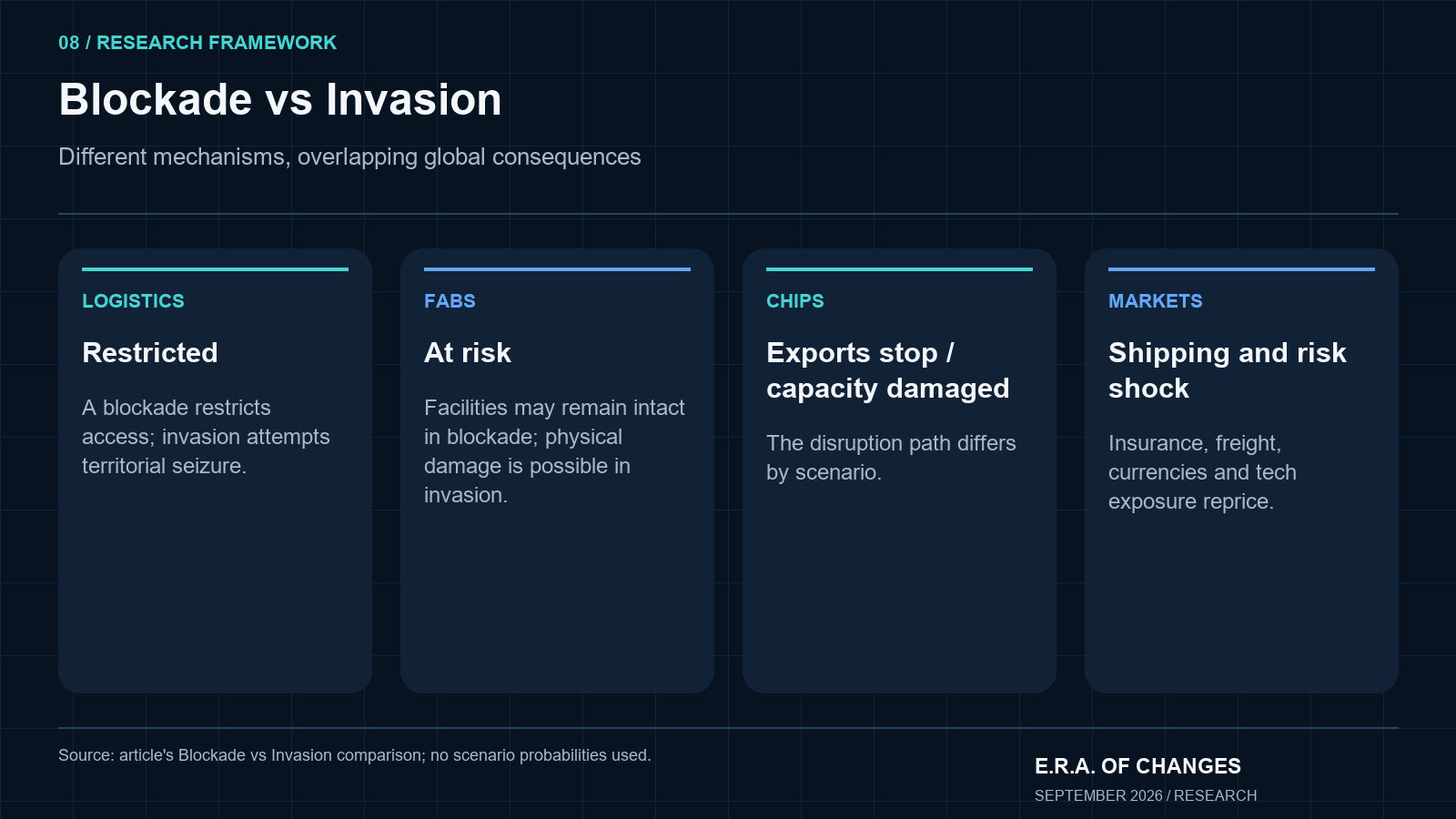
The Critical Distinction: Blockade versus Invasion
This is the analytical differentiation I push hardest on, because conflating the two scenarios leads to systematically wrong conclusions about market impact.
Maritime Blockade / Quarantine | Full-Scale Invasion | |
|---|---|---|
Primary effect | Restricts logistics | Attempts territorial seizure |
Fabrication facilities | May remain physically intact | Infrastructure faces physical damage |
Chip production | May continue; exports stop | Production itself may be damaged |
Energy imports | Critical constraint | Energy + industrial infrastructure at risk |
Shipping impact | Sharp insurance and rate shock | Full regional maritime disruption |
Diplomatic exit | Window remains possible | Escalation much harder to reverse |
Warning time | Days to weeks (gradual development) | Days to months |
The fabrication distinction is the most important one for investors modeling semiconductor supply-chain risk. TSMC said N2 entered high-volume manufacturing in the fourth quarter of 2025 and expected a fast ramp in 2026; its annual report describes CoWoS as an advanced-packaging technology for high-performance computing. In a blockade scenario, those fabs may remain physically intact. What stops is the export of finished chips from Taiwan and the import of the materials and energy needed to keep the fabs running. Source.
Physical damage to Taiwan’s leading semiconductor capacity (the scenario under a full invasion) could create an extreme global electronics and computing supply shock. That framing is more accurate than “zero out the global tech sector,” but the supply consequences of losing an unquantified volume of N2 output, on top of all other Taiwan-based capacity, would reverberate across AI hardware, smartphones, automotive, server infrastructure, and networking for years. Neither scenario is benign. They are different in mechanism and in the degree of irreversibility. Source.
Why the Taiwan Strait Matters to Global Trade
The geographic scale of what is at stake is often stated as a statistic without context. CSIS estimates that roughly $2.45 trillion of goods (representing more than one-fifth of global maritime trade) transited the Taiwan Strait in 2022. Taiwan’s ports handled approximately $517 billion of trade in 2024, nearly all of it flowing through a handful of facilities located as little as 100 miles from the Chinese mainland. The routes that Japan, South Korea, and China itself rely on for energy and manufactured-goods trade pass through or adjacent to the Strait.
The comparison to the Red Sea disruptions of 2023 and 2024 is instructive but limited. When Houthi attacks on commercial vessels forced shipping companies to reroute around the Cape of Good Hope, the primary consequence was higher freight rates and longer transit times: a cost shock, painful but manageable. Taiwan risk is structurally different. Rerouting solves the shipping-distance problem but does not solve the problem of Taiwan still needing to receive energy imports and raw materials through the same contested waters. The origin of the disruption and the destination are the same island. You cannot route around Taiwan if what you are trying to do is supply or export from Taiwan.
Taiwan’s energy self-sufficiency stands at approximately 4.2 percent of its consumption needs, according to CSIS analysis. Everything else arrives by sea. In a sustained blockade, the chain of consequences runs from restricted maritime access to declining fuel imports to power-system pressure to reduced industrial operating hours, and semiconductor output falls not because a single fab is attacked, but because the electricity and chemical inputs needed to run the fab begin to run short. The factories are intact. The production stops anyway. That indirect mechanism is less dramatic and more difficult for markets to price in real time.
Scenario 3: Full-Scale Taiwan Invasion (Era Estimate: 10%)
A full-scale invasion would involve an integrated sequence of PLA operations: missile and air strikes on air-defense infrastructure, naval blockade and mine-laying, amphibious landings, cyberattacks on communications and power systems, and the prospect of external military involvement depending on U.S. and allied response. I keep this at 10 percent over a 24-month horizon not because the strategic ambition is absent (it is not) but because the operational, political, and economic costs of a full-scale amphibious assault against a defended island are enormous, and because Beijing has structurally better options short of invasion that it has not yet exhausted.
The economic consequences of an invasion, as distinct from a blockade, would include not only semiconductor supply disruption and maritime trade chaos but the near-certain imposition of the broadest Western sanctions package since the 2022 Russia-Ukraine response, on the world’s second-largest economy, deeply integrated into global manufacturing supply chains in ways that Russia never was. A scenario that removes China from the global trading system is not simply a semiconductor shock. It is a structural reconfiguration of global trade that has no historical precedent in speed or scale. That self-inflicted economic cost is a genuine constraint on Beijing’s decision calculus, and it deserves analytical weight alongside the political and strategic factors.
The critical caution I apply to this constraint: economic costs are one input into state decision-making. They are not a guarantee of restraint. History offers enough examples of governments pursuing geopolitical objectives at severe economic cost that the “war is too expensive therefore it won’t happen” argument should never be treated as sufficient on its own.
For more on how Era evaluates the intersection of sanctions and geopolitical risk, see our analysis of how economic sanctions affect global trade and how political events affect financial markets.
Scenario 4: Meaningful De-Escalation (Era Estimate: 5%)
I assign de-escalation the lowest weight, and I want to be precise about why, because “low probability” and “impossible” are different analytical positions, and I hold the former, not the latter.
Meaningful de-escalation would require observable changes in behavior, not only in rhetoric. Lower exercise frequency, sustained reduction in coast-guard pressure around Taiwan’s outlying islands, reopened high-level PLA-U.S. military communication channels, reduced economic coercive measures, and stabilized cross-Strait interaction would all qualify. Diplomatic statements and post-election narratives about improved relations do not qualify, because the structural competition driving cross-Strait tension is institutional, not personal to any administration.
My interpretation, stated clearly as Era’s analytical position rather than established fact, is that the U.S.–China strategic competition has moved beyond a phase where individual administrations can produce durable de-escalation. The competitive dynamic runs through semiconductor export controls, naval deployments, alliance structures, and economic decoupling pressures that predate and will outlast any particular election result. Markets periodically price in de-escalation scenarios after elections. That repricing creates opportunities, and it also creates positions that need to be unwound when the structural reality reasserts itself.
The conditions that would push me to raise this estimate are specific: a sustained, multi-quarter reduction in PLA air and naval activity around Taiwan, not just a single-quarter anomaly; new crisis-management mechanisms between Washington and Beijing that are actually operational; and observable normalization in commercial shipping insurance premiums in the Strait. I have not seen that combination materialize.
The Most Important Early-Warning Indicator
This is the part of Nikolai’s framework that I believe is most underused by analysts who focus on military activity and political rhetoric as their primary signals.
My preferred early-warning cluster is economic preparation, not declaratory posture. The signal I take most seriously is an unusual, synchronized acceleration in Chinese strategic reserves (oil, grain, critical industrial inputs) occurring above and beyond what normal seasonal and commercial demand would explain, and occurring at the same time as capital repatriation and changes in China’s external financial positioning. No individual element of that cluster is conclusive on its own. The combination, sustained across multiple categories over several months, is what changes the risk assessment.
China’s strategic petroleum reserve already stands at nearly 1.4 billion barrels as of December 2025, built through a 2025 import campaign that averaged 1.1 million barrels per day in additions to strategic inventory and peaked at 13.18 million barrels per day in December 2025, the highest monthly import volume in Chinese history. State companies Sinopec and CNOOC have active plans to add at least 169 million barrels of additional storage capacity across 11 sites through 2026. In the first two months of 2026, China was adding to strategic storage at an average of 1.24 million barrels per day.
Those numbers are large. But I want to be direct about a caution that is essential to honest analysis: China has legitimate energy-security reasons to build strategic reserves that have nothing to do with Taiwan. An economy that imports 10 to 11 million barrels per day has obvious incentives to hold substantial buffer stocks regardless of any military planning. The signal becomes analytically meaningful not when China buys oil (it does that constantly) but when the accumulation rate accelerates suddenly and unusually across multiple commodity categories simultaneously, and when that acceleration coincides with financial and military preparation indicators that are themselves moving in the same direction.
The financial preparation dimension received attention in the U.S. Treasury TIC data. China’s reported Treasury holdings fell from approximately $695.6 billion in July 2025 to $618.0 billion in July 2026. That is a meaningful decline. It is also consistent with several explanations (reserve diversification, currency management, reduced export earnings) that have nothing to do with Taiwan. Era interprets Treasury divestment as a material Taiwan signal only when it occurs alongside capital repatriation, strategic stockpiling, and unusual military preparation as part of a coordinated pattern. In isolation, it tells you about portfolio management, not operational intent. For context on the broader de-dollarization discussion, see Era’s De-Dollarization Report.
Era Analyst’s Perspective
The market’s biggest mistake in Taiwan risk analysis is not underestimating the invasion probability; it is underestimating the probability of the scenario that comes before invasion. Thirty percent on a maritime blockade or quarantine over 24 months is not a low probability for a geopolitical scenario that would immediately halt chip exports from the world’s leading advanced semiconductor manufacturer.
TSMC said N2 entered high-volume manufacturing in the fourth quarter of 2025 and expected a fast ramp in 2026. Apple says iPhone 18 Pro uses the A20 Pro chip built with a 2-nanometer process, and describes M6 as its first 2-nanometer chip. NVIDIA says its Blackwell platform uses TSMC’s custom 4NP process. These are not abstractions; they are products with delivery schedules, inventory positions, and market capitalizations attached to them. Source. Source. Source. Source 2.
The geopolitical risk premium embedded in those valuations, in my reading of market pricing, does not adequately reflect a 30 percent probability that exports from Hsinchu and Tainan could face maritime interdiction within two years. That may not produce an immediate correction: markets can ignore tail risks for extended periods, especially when the earnings growth narrative is strong. But it is the kind of asymmetry that experienced investors build structural hedges around, not the kind they dismiss because last quarter’s numbers were good.
Taiwan Semiconductor Exposure: What the Supply Chain Actually Looks Like
The concentration of advanced semiconductor capacity in Taiwan is not a hypothetical vulnerability. It is a structural reality that has deepened, not diminished, as AI demand has accelerated.
TSMC said N2 entered high-volume manufacturing in the fourth quarter of 2025 and expected a fast ramp in 2026. It scheduled A16 volume production for the second half of 2026. TSMC describes CoWoS as an advanced-packaging technology for high-performance computing. The company has received 25 finalized 2nm chip designs and has more than 70 additional customer projects in development. Geographic diversification is progressing: TSMC has fabs under construction in Arizona, Kumamoto, and Dresden. But the engineering talent, specialized supply networks, and equipment density that make advanced semiconductor manufacturing possible at scale took decades to build in Taiwan. They cannot be duplicated in Arizona in 18 months. Source. Source 2.
The investor framework I apply is not “will there be a Taiwan conflict?” but rather “what percentage of this company’s advanced-chip supply comes from Taiwan, and does the current valuation adequately compensate for the probability-weighted impact of a supply interruption?” Companies differ meaningfully in inventory depth, their ability to use alternative nodes or foundries, their exposure to leading-edge versus mature process technology, and their geographic diversification of design and back-end operations. Those differences matter more to supply-chain risk analysis than the company’s headquarters address.
How a Blockade Would Transmit to Global Markets
The transmission mechanism from Taiwan Strait disruption to global financial markets runs through several channels that are distinct in timing, severity, and reversibility.
The first channel is shipping and insurance. War-risk insurance premiums would spike immediately upon any credible escalation signal, before a single commercial vessel was physically stopped. Freight rates for Asia-Pacific routes would follow. AIS tracking data would show rapid vessel rerouting away from Strait transits. Container shipping firms that route through southern Taiwan’s ports (Kaohsiung handled approximately 8.89 million TEUs in 2025, according to Taiwan International Ports Corporation) would face immediate operational decisions. This channel moves within days. Source.
The second channel is semiconductor inventory and production continuity. The global tech industry carries varying levels of inventory buffers, measured in weeks to months depending on the component and the company. In the early weeks of a blockade, production would continue drawing on stored inputs while the supply chain assessed the disruption timeline. The visible impact on electronics production and earnings would lag the physical event by one to two inventory cycles. This channel moves within weeks to months.
The third channel is financial market repricing. Taiwan equity markets, TSMC’s ADR, and U.S. technology companies with concentrated Taiwan foundry exposure would price the shock immediately. Credit spreads in Asia would widen. Asian currencies (particularly the Taiwan dollar, Korean won, and Japanese yen) would face significant risk-off pressure. Safe-haven flows into U.S. Treasuries, the Swiss franc, and gold would emerge. This channel also moves within days but can continue moving for months as the scenario evolves.
The broader global growth impact (the fourth and longest-duration channel) would depend on the severity and duration of the disruption. A prolonged blockade affecting semiconductor production and regional trade would exert contractionary pressure on global growth that central banks in the U.S. and Europe would struggle to offset with standard tools. For more on how these dynamics interact with recession probability, see Era’s Global Recession Probability Report.
Era’s CrisisMeter framework monitors these systemic stress channels in real time.
China Would Also Face Enormous Economic Costs
Balanced analysis requires stating this clearly, and I think it is often omitted from Western commentary on Taiwan risk.
CSIS estimates that approximately $1.4 trillion of Chinese imports and exports passed through the Taiwan Strait in 2022, roughly 57 percent of China’s total Taiwan Strait-transiting trade. China relies heavily on the Strait for energy imports, industrial inputs, and the coastal shipping routes that connect its northern and southern economic centers. An enforcement action that closes or severely restricts the Strait would impose direct costs on Chinese logistics, manufacturing, and energy supply. A full invasion, triggering a broad Western sanctions package, would represent economic costs several orders of magnitude larger: potential restrictions on the technology transfers, financial transactions, and export markets that sustain Chinese manufacturing competitiveness.
This economic self-exposure is a genuine constraint in scenario analysis, and it deserves analytical weight. It does not eliminate the risk. Governments pursue geopolitical objectives at economic cost with sufficient frequency that the “too expensive to do” argument should never be the last word. But the economic interdependence means that any Beijing decision-maker modeling a Taiwan contingency is working with a cost-benefit calculus that includes very large numbers on the cost side: not only Western sanctions but the disruption of China’s own trade flows, its own energy security, and its own industrial supply chains.
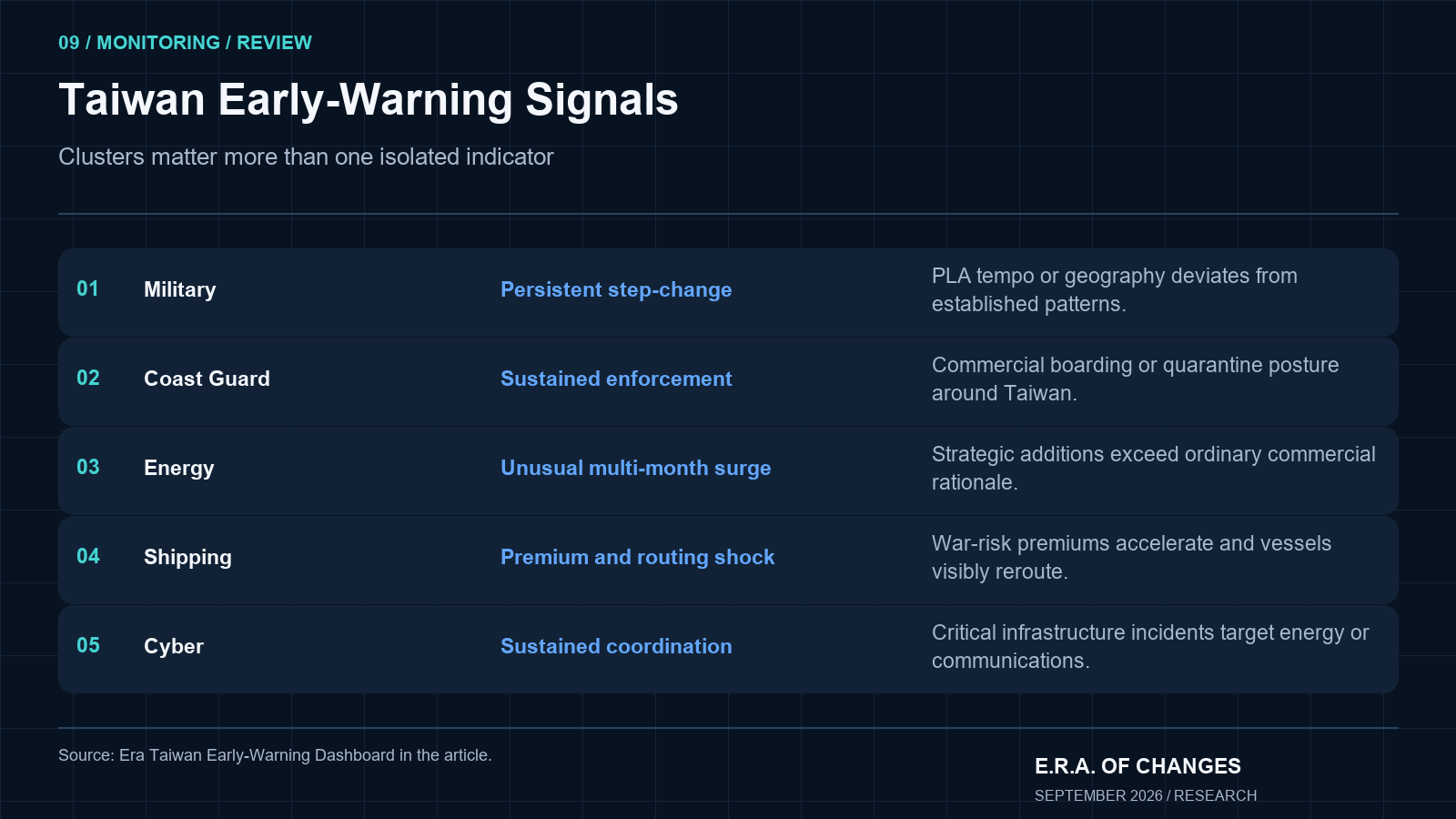
Era Taiwan Early-Warning Dashboard
Category | Indicator | Escalation Signal |
|---|---|---|
Military | PLA air/naval sorties, exercise geography | Persistent step-change in tempo or new operational patterns |
Coast Guard | CCG enforcement operations around Taiwan islands | Commercial boarding operations, sustained quarantine-enforcement posture |
Energy | China strategic crude additions above 1M bpd | Multi-month surge above normal commercial/strategic rationale |
Food/Grain | Grain reserve build rate | Non-economic surge in strategic grain imports |
Finance | Treasury holdings, capital repatriation | Coordinated, multi-asset repatriation alongside other indicators |
Shipping | War-risk premiums, freight rates, AIS routing | Rapid regional premium acceleration; visible commercial rerouting |
Cyber | Critical infrastructure incidents in Taiwan | Sustained, coordinated attacks on energy/communications infrastructure |
Diplomacy | Military-to-military communications | Breakdown of crisis channels or abrupt restoration after preparation |
No single indicator should be interpreted in isolation. The meaningful escalation signal is multiple categories moving in the same direction over the same period.
What Would Cause Era to Change the 24-Month Scenario Estimates?
The signals that would push me to increase the blockade/invasion probability are: unusual synchronized commodity stockpiling across oil, grain, and critical industrial inputs occurring simultaneously over multiple months; broader military mobilization patterns deviating from the established exercise calendar; commercial vessel inspections or maritime exclusion zones being announced around Taiwanese ports; large-scale financial repatriation occurring alongside reduced external financial exposure; and emergency economic measures such as export controls, rationing preparation, or capital movement restrictions. The combination matters more than any single indicator.
The signals that would push me toward a higher de-escalation probability are: a sustained, multi-quarter decline in PLA air and naval activity (not a single-month anomaly following an exercise) accompanied by CCG normalization around Kinmen and Dongsha; new, operational crisis-management mechanisms between Washington and Beijing that are actually being used; stable and declining war-risk insurance premiums in the Taiwan Strait; and durable commercial-shipping normalization with consistent AIS data showing no unusual vessel routing. I have not seen that combination materialize as of September 2026. If I do, the estimate moves.
Common Mistakes in Taiwan Risk Analysis
The first mistake is treating invasion as the only scenario worth analyzing. A gray-zone quarantine can produce substantial semiconductor supply disruption and shipping-rate shocks without a single act of formal warfare. Thirty percent on a blockade deserves as much analytical attention as ten percent on a full invasion.
The second mistake is reading every PLA exercise as operational war preparation. Routine exercises serve coercion, training, intelligence, and normalization purposes. The distinction between coercive gray-zone activity and genuine pre-invasion preparation lies in the cluster of concurrent signals (military, economic, financial), not in the exercises themselves.
The third mistake is assuming semiconductor diversification has already solved the supply-chain concentration problem. It has not. TSMC’s Arizona fabs will not produce leading-edge nodes at commercial scale for several years after their announced opening dates. TSMC’s Kumamoto fab produces mature nodes. Geographic diversification is happening, and it is important, but the supply chain cannot be instantly relocated, and the most advanced capacity remains concentrated where it has been built over thirty years.
The fourth mistake is treating China’s Treasury selling or stockpiling as a Taiwan signal in isolation. Both activities have multiple plausible explanations. They become material Taiwan indicators only when they occur alongside the broader preparation cluster. Absent that cluster, they tell you about reserve management and energy policy, not operational timelines.
The fifth mistake is assuming economic costs make conflict impossible. They make it more expensive. They do not make it impossible.
Frequently Asked Questions
Will China invade Taiwan?
Era’s current 24-month estimate assigns a 10 percent probability to a full-scale invasion. That is a low probability but not negligible for an event with extreme global consequences. The more probable scenario over this horizon is continued gray-zone coercion at 55 percent, with a maritime blockade or quarantine at 30 percent representing the principal escalation pathway. These are Era’s analytical estimates, not official intelligence assessments, and they are revised as observable conditions change.
What is the risk of a Taiwan invasion?
Within Era’s 24-month scenario framework, a full-scale invasion receives 10 percent. The higher-probability risk (30 percent) is a maritime blockade or quarantine that restricts Taiwan’s access to energy imports and chip export routes without necessarily destroying fabrication capacity. Both scenarios would have severe global market consequences, but through different mechanisms and with different probabilities.
What would a China–Taiwan war look like?
A full-scale conflict would likely involve integrated missile and air strikes on air-defense infrastructure, naval blockade and mine-laying around Taiwan’s ports, amphibious operations, cyberattacks on communications and power systems, and the near-certain involvement of U.S. and allied forces under treaty and strategic commitments. The economic consequences would include the broadest Western sanctions package since 2022 (imposed on the world’s second-largest economy) alongside catastrophic disruption to semiconductor supply chains and East Asian trade.
Could China blockade Taiwan instead of invading?
Yes, and Era assigns this scenario a higher probability than full invasion: 30 percent versus 10 percent over 24 months. A maritime quarantine or blockade would restrict shipping into and out of Taiwan’s ports without requiring an amphibious assault. The consequence for semiconductor exports and Taiwan’s energy imports would be severe even if every fab remained physically intact, because Taiwan’s domestic energy self-sufficiency stands at approximately 4.2 percent.
What is the difference between a blockade and a quarantine?
A quarantine typically involves maritime inspection and enforcement operations framed through customs or law-enforcement authority, without a formal declaration of war. A blockade is a more explicit military action to prevent shipping access. Both restrict Taiwan’s logistics. The distinction matters for international legal response and diplomatic off-ramps, not for the practical consequence of halting chip exports and energy imports.
Why is Taiwan important for semiconductors?
Taiwan produces over 90 percent of advanced semiconductors at leading-edge process nodes. TSMC said N2 entered high-volume manufacturing in the fourth quarter of 2025 and expected a fast ramp in 2026; its annual report identifies CoWoS as an advanced-packaging technology for high-performance computing. Apple, Nvidia, AMD, and virtually every major technology company that relies on leading-edge chip design uses TSMC’s Taiwan fabs as a primary or sole source for their most critical products. Source.
What would happen to TSMC during a Taiwan conflict?
In a blockade scenario, TSMC’s physical facilities may remain intact, but semiconductor exports would stop and the energy and materials imports needed to operate the fabs would be restricted or cut off. In an invasion scenario, physical damage to fabrication and advanced-packaging infrastructure would add a production-capacity shock on top of the logistics disruption. TSMC is expanding geographically (Arizona, Kumamoto, Dresden), but those facilities are producing mature or mid-range nodes, not the leading-edge capacity currently in Taiwan.
How would a Taiwan blockade affect global trade?
CSIS estimates that $2.45 trillion of goods transited the Taiwan Strait in 2022. A blockade would trigger immediate war-risk insurance premium increases and vessel rerouting across Asia-Pacific shipping. Unlike the Red Sea disruption, Taiwan Strait risk cannot be fully mitigated by a longer route: Taiwan still needs to receive inputs by sea, and semiconductor exports originate on the island regardless of which route carriers take.
What are the warning signs of a Taiwan invasion?
Era’s early-warning framework focuses on the cluster of observable preparation: an unusual, synchronized acceleration in Chinese strategic reserves (oil, grain, critical inputs) above normal commercial and seasonal demand; large-scale capital repatriation and changes in China’s external financial exposure; PLA military mobilization patterns deviating from the established exercise calendar; and Chinese Coast Guard enforcement actions against commercial vessels around Taiwan’s ports. No single indicator is conclusive. The convergence of multiple categories moving simultaneously is the meaningful signal.
Is China stockpiling oil and food for a Taiwan conflict?
China’s strategic petroleum reserve reached nearly 1.4 billion barrels by December 2025, built through an import campaign averaging 1.1 million barrels per day in strategic additions in 2025. In early 2026, the daily addition rate was averaging 1.24 million barrels. These are very large numbers, but China has independent energy-security reasons to hold large strategic reserves, and stockpiling is not a Taiwan signal in isolation. Era treats it as a material Taiwan indicator only when it accelerates unusually alongside grain imports, capital repatriation, and concurrent military preparation. That specific convergence has not been confirmed as of September 2026.
How would a Taiwan conflict affect Apple and Nvidia?
Apple says iPhone 18 Pro uses A20 Pro, built with a 2-nanometer process, and that M6 is its first 2-nanometer chip. NVIDIA says its Blackwell platform uses TSMC’s custom 4NP process. Both companies have meaningful inventory buffers, but a sustained blockade that halted TSMC exports would reduce available supply within one to two inventory cycles. Era’s thesis is that current market valuations for companies with concentrated Taiwan foundry exposure may not fully compensate investors for a 30 percent probability of blockade-level supply disruption over 24 months. Source. Source 2. Source.
Would a Taiwan war also hurt China’s economy?
Substantially. Approximately $1.4 trillion of Chinese trade transited the Taiwan Strait in 2022 (including energy imports and manufactured exports that China’s industrial economy depends on). A full invasion triggering Western sanctions would expose the world’s most trade-dependent major economy to restrictions on the technology, finance, and market access that sustain its manufacturing base. Economic costs are a real constraint on Beijing’s decision-making. They are not, by themselves, a guarantee of restraint.
About E.R.A. OF CHANGES
E.R.A. OF CHANGES is an independent macroeconomic research and geopolitical intelligence firm providing institutional-quality analysis to investors worldwide. Our research combines macroeconomics, financial markets, blockchain analytics, and geopolitical risk into proprietary forecasting frameworks designed to identify structural market trends before they become consensus. The Era Global Risk Index (updated daily from 24 structural indicators) serves as the foundation of our analytical methodology, providing a forward-looking measure of systemic financial stress grounded in structural economic evidence rather than market sentiment. Our full methodology, live index reading, and forecast archive are available at eraperemen.info/en.
The content published by E.R.A. OF CHANGES is for informational and educational purposes only and does not constitute financial, investment, legal, or tax advice. All views expressed are the personal analytical perspective of the author. Past forecast accuracy does not guarantee future results. Scenario estimates are Era’s analytical assessments and not official intelligence or government assessments. Readers should conduct their own research and consult a qualified financial professional before making any investment decisions.
Sources
- China’s Taiwan Drills Are Crossing a New Line: The Diplomat, January 2026
- Strait Snapshot March 2026 Update: Taiwan Security Monitor, Schar School / GMU
- PLA Activities in the Waters and Airspace Around Taiwan: Global Security / Taiwan MND, June 2026
- Tracking China’s Increased Military Activities in the Indo-Pacific in 2025: CSIS China Power
- Crossroads of Commerce: How the Taiwan Strait Propels the Global Economy, CSIS China Power
- The State of Maritime Supply-Chain Threats: CSIS
- Taiwan’s Semiconductor Dominance: Implications for Cross-Strait Relations, CSIS Perspectives on Innovation
- TSMC Touts Advanced Packaging, 2nm Progress at Tech Symposium: Focus Taiwan, May 2026
- TSMC Plans 70% CAGR for 2nm and A16 Capacity Through 2028: AtlasPCB
- China’s Strategic Petroleum Reserve in 2026: Levels, Capacity and Days of Supply, Project Fifty-4
- China and Its Strategic Petroleum Reserve: AGBI, August 2026
- China’s Early 2026 Oil Stockpiling Amid Supply Challenges: IndexBox
- U.S. Treasury International Capital Data: U.S. Department of the Treasury
- Top 10 Geopolitical Hotspots in 2026: E.R.A. OF CHANGES
- How Political Events Affect Financial Markets: E.R.A. OF CHANGES
- How Economic Sanctions Affect Global Trade: E.R.A. OF CHANGES
- Emerging Market Investment Risks: E.R.A. OF CHANGES
- Era CrisisMeter Explained: E.R.A. OF CHANGES
- Era Forecasting Methodology: E.R.A. OF CHANGES
- Era Global Risk Index: E.R.A. OF CHANGES
- De-Dollarization Report: E.R.A. OF CHANGES